Revelation 1:4-8 – The One Who Is, Who Was, and Who Is To Come

John,

To the seven churches in the province of Asia:

Grace and peace to you from him who is, and who was, and who is to come, and from the seven spirits before his throne, and from Jesus Christ, who is the faithful witness, the firstborn from the dead, and the ruler of the kings of the earth.

To him who loves us and has freed us from our sins by his blood and has made us to be a kingdom and priests to serve his God and Father—to him be glory and power for ever and ever! Amen.

“Look, he is coming with the clouds,”
    and “every eye will see him,
even those who pierced him”;
    and all peoples on earth “will mourn because of him.”
So shall it be! Amen.

“I am the Alpha and the Omega,” says the Lord God, “who is, and who was, and who is to come, the Almighty.” (New International Version)

In my undergraduate college days, one of the required classes for my major was “Philosophy of History” taught by a crusty old professor who looked like he was one-hundred-and-ten-years-old. One day he came into the classroom and began his lecture by looking directly at me with those beady black eyes of his and said, as only he could say it, “Ehrhardt! Can God change history?”

The Apostle John was exiled to the island of Patmos. Late in the first century, all the other original disciples of Jesus were dead, having been martyred for their faith. Only John was left. The churches that the Apostle Paul established in Asia Minor were undergoing significant persecution. 

The trouble began with the church facing social ostracizing. Eventually, xenophobia took hold with many parts of the Roman Empire, and Christians began getting martyred. Misunderstandings of what the church is all about were rife.

If we were living during that time, we might seriously wonder if Christianity would survive, at all. Into this situation, the last Apostle, John, in exile, experienced a great vision (revelation) of Jesus concerning what is to come. While things looked awfully bleak, God graciously pulled back the veil between heaven and earth long enough for John to glimpse the great lordship of Jesus.

So, can God change history? You might be wondering about my response to the old professor. My answer was this: The question is only relevant if God were never in control and sovereign over history to begin with. There’s no need to change history if God is already actively working out divine purposes through history. Therefore, a more appropriate question is: Since God is Lord over all history, will we submit to the divine lordship? 

In difficult times, it’s only human to wonder if God is really sovereign over all the earth. With so much war, violence, and unrest in the world; with so many natural disasters and diseases all around; and whenever Christianity (and religion itself) is seen as a threat to many, we may sincerely ask ourselves, “Can God change history? Is God even in control of this present world?”

The revelation of Jesus to John, which he then shared with the struggling churches, was meant to encourage them – to give them hope that, even though Christ’s reign is invisible and seems limited and temporary, it will ultimately be visible, and is pervasive and permanent. 

Today’s New Testament lesson is meant to strengthen and bolster the believer’s faith with a vision of who Jesus is; what Jesus has done; and what Jesus will do.

Who Jesus Is

He is the faithful witness. The word “witness” is where we get our English word “martyr.” Faithful believers in the first centuries of the church witnessed to their faith and proclaimed the gospel of new life in Christ. They were effective enough to alter the social order, which brought persecution and, in some cases, death. 

These men and women died proclaiming their devotion to Jesus. They saw themselves as merely emulating and following the way of their sovereign Lord Jesus, who was himself a faithful martyr.

Jesus is the firstborn from the dead, that is, Christ has conquered death. Just as Christ rose from death, so also, we will be raised to life. Because Jesus is alive, Christians will live forever and experience bodily resurrection, as well.

Whatever happens to Jesus, happens to us. Jesus was persecuted, suffered, and died. We, too, shall suffer persecution and death. Jesus was raised from the dead and so shall we. The evil we experience in this life is very much known to God. Our solidarity with Jesus helps us to not grow weary and lose heart.

Jesus is the ruler, the king of kings and lord of lords. God reigns over the past, the present, and the future. Christ is in charge, presently now working out good plans and purposes. God bends events, situations, and hearts toward justice and righteousness. 

What Jesus Has Done

Jesus freed us from the power of sin by his blood. This is more than some nice information to know; it is truth designed for us to live a new life depending on King Jesus. Sometimes, we have horrible, no good, very bad days. We don’t respond to others well,  and then ask God’s forgiveness. Other days are wonderful, with bright sunshine and a spring in your step. We play well with others and express gratitude to God.

Jesus is Lord of both good days and bad days. Faith is not dependent upon our circumstances because it is the blood of Jesus which has freed us to live for God, no matter the situations we face. Christians overcome circumstances by the blood of Christ – and not because everything goes our way.  

We are never far from the cross of Christ. We overcome bad tempers, defeats, disordered love, fears, pettiness, and a host of other things by the blood of the Lamb. The daily goal is to not simply have a wonderful day without any adversity. Rather, the aim is to know Jesus Christ, and him crucified, dead, risen and ascended. 

Jesus has made us to be a kingdom of priests. Christians have continual access and unconditional acceptance of God through the blood of Jesus. We can intercede for others by going directly to God. Just as Jesus has unlimited access to the Father, so, the Christian has the privilege of coming to God at all times. 

Christians are a kingdom of priests where every believer intercedes for other believers, and even for the world which persecutes them. Jesus not only freed us from sin’s grip of evil for our own individual benefit, but also so that we can be agents of rescue for others. 

What Jesus Will Do

Jesus will come to judge the earth, the living and the dead. Moving deeper into Revelation, it truly becomes apocalyptic. It’s as if a group of trapped cave explorers choose one of the individuals to squeeze through a narrow flooded passage to get out to the surface and call for help. The point of the choice is more than personal salvation, it is the saving of the entire group. She is to bring help and equipment to ensure the rest get rescued.

Indeed, God elects, chooses, and calls us not only for our personal benefit but for the sake of many.

Conclusion

Jesus is worthy of our praise. He is the Alpha and Omega, the beginning and the end, the first and the last. His kingdom will never end. Since this is true, we are to faithfully serve God. In life and in death, we belong to God. We are not our own; we were bought at a price. 

“Can God change history?” is not the real question. Since God has changed history forever in the sending of the Son, the proper question is, “What will we do with the lordship of Christ over the world?”

Jesus is coming soon. When he returns, what will he find you doing?

Gracious God, we pray for Christ’s Church everywhere. Fill it with all truth and peace. Where it is corrupt, purify it; where it is in error, direct it; where anything it is amiss, reform it. Where it is right, strengthen it; where it is in want, provide for it; where it is divided, reunite it; for the sake of Jesus Christ, your Son, our Savior. Amen.


Luke 13:18-21 – What is the Kingdom of God Like?

A mustard seed

Jesus asked, “What is God’s kingdom like? What can I compare it to? It’s like a mustard seed that someone planted in a garden. It grew and became a tree, and the birds nested in its branches.”

He asked again, “What can I compare God’s kingdom to? It’s like yeast that a woman mixed into a large amount of flour until the yeast worked its way through all the dough.” (God’s Word Translation)

I grew up on a rural Mid-West America farm. Working with seeds was our livelihood. And making bread was second nature to us. Even though my parents worried incessantly about the weather and the price of groceries, there were two things they were never anxious about: seeds and yeast.

My dad knew that when we planted seeds in the Spring, there would be a harvest in the Fall. That’s because he knew the seed already has within itself everything it needs to germinate, take root, grow, and produce a harvest. His role was simply to tend to it all by keeping the fields free of weeds, worms, and critters.

My mom knew that when she put the bread in the oven, it would bake and rise into a glorious loaf. That’s because she had full confidence that the little bit of yeast she worked into the dough would do it’s job. Her role was simply to ensure the proper amount of ingredients and oversee the time and temperature of baking.

Since I was the youngest, I typically got the grunt work of our massive garden. I was always excited when we planted things because I knew what was coming in a few months: some delicious veggies on my dinner plate which were fresh from the garden I tended. I never wondered whether there would be food on the table, or not.

Seeds are, of course, small. If you think about it, they appear quite unimpressive. Yet, we know better. We understand that when planted, watered, and cultivated, those seeds turn into amazing plants. 

But it takes time. Even as dumb little kid, I clearly knew that my planting seeds would not result in seeing anything above ground the next day. I understood it would take a few weeks before new growth would break the ground.

The kingdom of God, Jesus told us, is like a mustard seed – a very small seed which can grow into a tree big enough for birds to nest. Unlike the mighty Roman Empire, or contemporary powerful national governments, the kingdom of God had humble beginnings. It grows, over a long period of time, to become a force greater than anything the world can produce.

While our world races forcefully on with the speed of the hare, Jesus is carefully and patiently building his church at the pace of a tortoise. In the end, the kingdom of God will rule over all creation, while the kingdoms of this world shall no longer exist. 

Even though many of us now live in a society where the quick, the fast, and the strong dominate everything, still the best things in life come as a result of tedious perseverance over an extended period of time. 

We are in such a hurry to accomplish our goals, make as much money as we can, and keep constant vigilance over our work. And for what purpose?

“What an unspeakable comfort it is to know that in the midst of humanity’s mischief, in the midst of their scheming and bad speculations, their shaping and misshaping, their activism and their failures, there is still another stream of events flowing silently on, that God is letting divine seeds grow and achieving divine ends.” 

Helmut Theilicke

Quiet, humble submission to King Jesus is at the heart of the kingdom. God is working-out good purposes in and through us with all the care of the farmer expecting to eventually reap a harvest. To get ourselves into the groove of God’s unforced rhythms of grace, we must learn to slow down, so as to not miss Christ’s benevolent kingdom. So, how do we do that?

  • Listen to yourself. Our bodies send us signals all the time, telling us what we need. There is a time for work and a time for rest, a time to hurry and a time to slow down. If we continually stressed, it could be that we are trying to force God’s kingdom into our lives or the lives of others.

But if you listen to me,
you will be safe and secure
    without fear of disaster. (Proverbs 1:33, CEV)

  • Practice gratitude. Count your blessings. Keep things in proper perspective. Sit with joy and happiness. Whenever something really good happens, slow down and savor the moment – don’t just quickly move on to the next thing. The kingdom of heaven revolves on thankfulness, not criticism.

O give thanks to the Lord, for he is good,
    for his steadfast love endures forever.
O give thanks to the God of gods,
    for his steadfast love endures forever.
O give thanks to the Lord of lords,
    for his steadfast love endures forever. (Psalm 136:1-3, NRSV)

  • Use breath prayers. Take some deep breaths. While inhaling, pray, “More of you, Lord.” And exhale saying, “Less of me.” Or inhale, praying, “Fill me with your Spirit,” then exhaling, “So that I may be a blessing.” Go ahead and develop your own prayers, as well.

“Speak, Lord, for your servant is listening.” (1 Samuel 3:10, NRSV)

  • Say, “no.” If we are in the habit of helping others, it can be hard to say “no.” But if we are working to understand how to slow down, learning to say “no” is a skill we need to develop. We must set boundaries and manage our time responsibility. That means leaving plenty of time to slow down, rest, observe, and relax.

Just say ‘yes’ and ‘no.’ When you manipulate words to get your own way, you go wrong. (Matthew 5:37, MSG)

  • Walk outdoors. Nature walks are an opportunity to stroll through God’s creation and notice the wonder that is all around us.

The heavens proclaim the glory of God.
    The skies display his craftsmanship.
Day after day they continue to speak;
    night after night they make him known.
They speak without a sound or word;
    their voice is never heard.
Yet their message has gone throughout the earth,
    and their words to all the world. (Psalm 19:1-4, NLT)

  • Ask for help. To ask for what we need and want is neither selfish nor a sign of weakness. Rather, piling on responsibilities only causes us to run ragged and never get around to slowing down. Asking for help requires humility, which is the very thing needed to enter the kingdom of heaven.

Jesus said, “Ask and it will be given to you; seek and you will find; knock and the door will be opened to you. For everyone who asks receives; the one who seeks finds; and to the one who knocks, the door will be opened.” (Matthew 7:7-8, NIV)

Spiritual formation and development are dependent upon slow growth over a long period of time. Don’t short circuit the process through accumulating more and more responsibility and constant busyness. Let God’s grace do its work and sense the kingdom of God near you.

Lord God, everlasting Father, you have brought me to this point in time.  Preserve me according to your unassuming power so that I might not be seduced by worldly might, nor be overcome by the rantings of politicians, but in all things daily direct me to the fulfilling of your purpose, through Jesus Christ, my Lord.  Amen.

John 18:33-37 – Worship Christ the King

14th century painting of Jesus standing before Pilate by Italian artist Duccio di Buoninsegna

Pilate then went back inside the palace, summoned Jesus and asked him, “Are you the king of the Jews?”

“Is that your own idea,” Jesus asked, “or did others talk to you about me?”

Am I a Jew?” Pilate replied. “Your own people and chief priests handed you over to me. What is it you have done?”

Jesus said, “My kingdom is not of this world. If it were, my servants would fight to prevent my arrest by the Jewish leaders. But now my kingdom is from another place.”

“You are a king, then!” said Pilate.

Jesus answered, “You say that I am a king. In fact, the reason I was born and came into the world is to testify to the truth. Everyone on the side of truth listens to me.” (New International Version)

In Christianity, to worship God means we praise the person and work of Christ and are also spiritually formed through that adoration. Christ the King Sunday focuses our worship on Jesus Christ’s reign over the entire world. It is a proclamation that everything and everyone in all creation is subservient to King Jesus. Furthermore, it is an invitation to actively enjoy Christ’s gracious and benevolent rule over us.

Jesus came to this earth to bring connection and intimacy to God and humanity. We all have relationships in which we want to be closer.

  • A parent might be dissatisfied, and sad, that one of their children is estranged from them, because they want intimacy.
  • A spouse may want to have a more relationally intimate marriage, having been distant for too many years.
  • A teenagers or twenty-something might want to get closer to that special someone. 
  • A friend might be keeping their distance. And although you have conversations with them, they only let you in so far.

We want to go deeper, and it isn’t happening because the other party is not willing.

In this we reflect the image of God within us because God feels that same longing and desire to move deeper and closer to us. The Lord desires intimacy, yet we might keep treating him like he is some untouchable monarch like Queen Elizabeth – as if there is no chance of really getting close, and we wonder if there is any real power there to make a difference. 

However, God is not a ruling figurehead, and does not want a casual superficial relationship with us. Christ’s kingship moves closer to people, not further away. Everything Jesus did on this earth was to bring people closer to God because God wants a personal and familiar relationship with us. 

Jesus does not want us estranged from God, and he has gone to the greatest lengths possible to make that close relationship possible and real through the cross, resurrection, ascension, and a kingly reign which is near to us. The kingdom of God, with Jesus as King, is a kingdom of closeness and fellowship with the divine.

Christ the King Sunday appropriately challenges us to consider what it means to say that Jesus Christ is the Lord of our life. Jesus Christ, as our Lord and King, means much more than God calling the shots and issuing commands; it means Christ uses his lordship to satisfy his longing to be with us.

Our Gospel lesson for today plunges us into an event we associate with Holy Week. Christ has been arrested by the conniving of his enemies. Since the religious authorities could not put anyone to death, they bring Jesus to the Roman governor, Pontius Pilate, in the hope he will do their dirty work for them. 

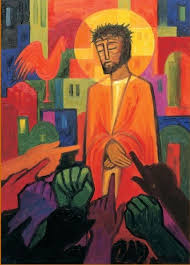
Jesus condemned to death, painting by the Benedictine Sisters of Turvey Abbey

The scene takes place early in the morning at Pilate’s palace. Pilate doesn’t like the Jewish authorities because they put a dent in his career plans through their constant complaints about him to his supervisors in Rome. For purely political reasons, Pilate decides he will satisfy their demand and interview this Jesus who they claim is an enemy of Rome.

The prisoner, Jesus of Nazareth, is brought to Pilate. He is a mess. Christ’s clothes are stained with dirt and blood. His face is bruised and haggard. He has not slept all night. Pilate has heard of Jesus, and so he’s curious to make a personal evaluation of him. Jesus looks nothing like a king to Pilate.

Pilate, in contrast, looks the image of a worldly leader with his power suit on and all the strength of Rome behind him. He hardly has time for this sideshow, this pathetic presentation of leadership in front of him. Jesus looks like nothing more than a kingly wannabe. There is nothing from Christ’s outward appearance that gives any impression he is qualified to be a leader of anybody. We can almost picture Pilate rolling his eyes, saying “so you are the King of the Jews?”

What follows is a strange, convoluted conversation about kingship and truth with a contrast between this world and a world to come. Repeatedly, Jesus makes it clear his kingdom is not of this world. Two thousand years have passed since that dialogue between Jesus and Pilate, yet the same issue remains.

The issue is this: Jesus is calling all of us to follow him – to put his Kingdom first in our lives. In Pilate, we have a symbol of worldly power, which is arbitrary, unprincipled, self-serving, and brutal. Pilate knows the right thing to do but chooses the path of least resistance. He caves to the political pressure, denying the truth which is right under his prominent Roman nose.

Earthly power seeks its own ends. It wants to hold onto control and call the shots. Conversely, Christ’s kingly power is used to serve, to wash feet and meet needs, to move closer to people. Earthly kingdoms use violence to conquer and maintain order and control its subjects. In stark contrast, Christ’s kingdom uses love to transform and unify people around Jesus so that the subjects are with the king and enjoy his rule and reign.

Christ’s kingdom is not of this world. It is counter-cultural and counter-intuitive to how every other leadership structure works on earth. It is an upside-down kingdom that seems like it won’t work or make sense: The way up is down; to be great is not to work for a high position, suck up to the boss, and climb the ladder of wealth and success. Rather, it is to embrace humility and be a servant.

In God’s kingdom, the way to pursue truth is not in forming original ideas and expressing opinions but is found in a person. Truth-seeking disciples will listen to this one voice of Jesus, and filter-out all others. It is a voice calling for submission to his lordship, and to do so because it brings us into an intimate relationship with God.

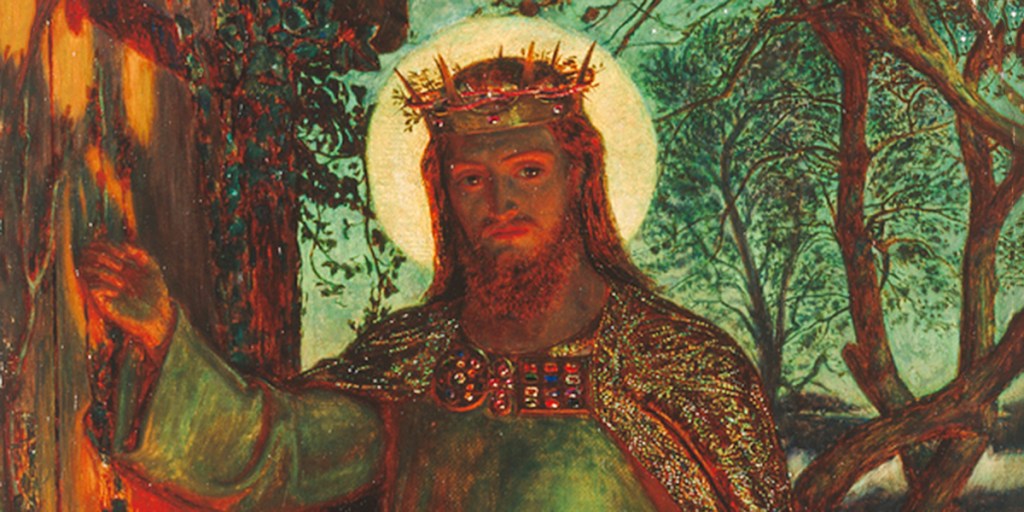
The Light of the World, by English artist William Holman Hunt, 1852

The message of our crucified Savior reigning as King in our lives is not that, having suffered for us, Jesus will somehow keep us from facing difficult times. Instead, Jesus faced a horrible death so that our own tough times can triumph with God’s power to save us and move deeper into our lives. God’s presence and promise is what sustains us, not the avoidance of suffering. Christ as our King means God is with us.

Black Friday and Cyber Monday are almost upon us. This season demonstrates a contrast between two kingdoms. The kingdom of this world calls on us to demonstrate our worth and gain meaningful relationship through grabbing control and obtaining stuff. The pressure in seeking the perfect gift at the perfect price in the hope that if we can bag it, wrap it, and get it under the tree, then we will be perfect, and the perfect family Christmas will happen, and relationships will be great, and everyone will act like I want. Right!?

In contrast, the kingdom Jesus describes assures us we don’t have to prove our worth through endless accomplishments and generous gifts. We don’t need to have the perfect Christmas experience to gain our deepest relational needs. Because, in our baptism, we have been accepted; we are sons and daughters of the living God; and we do not need to achieve greatness through financially and emotionally bleeding ourselves.

In his conversation with Pilate, Jesus said: “My kingdom is not of this world.” When Christians say Jesus Christ is our King, we acknowledge we are his subjects and that we march to the beat of a different drum. The heart of this relationship is our dependence on Jesus who came that we might have life and have it in abundance.

On this Sunday, followers of Jesus Christ boldly state our confidence that, at the end of time, Jesus will come again as King and Ruler of all. 

Blessed are those who see the truth by faith and not by sight. Blessed are those who say “Jesus is the King and the Lord of Life” without rolling their eyes or with a selfish agenda but with a sincere conviction that they belong to Jesus and want to be ever closer to him who is the Way, the Truth, and the Life.

Almighty God, everlasting heavenly Father, you break the power of evil and make all things new in your Son Jesus Christ, the King of the universe. Our confidence is firmly in you, Lord Jesus, knowing you will redeem all things and make all things new. 

We affirm that our security is not in personal abilities, clever plans, or lucrative jobs; our security is in you alone. Your creation still groans with the pain of living in a fallen world. But you have conquered sin through your love, and it is to your love we rely upon. May all things in heaven and on earth recognize the glory of your kingly rule and never cease to praise you. We ask this through our Lord Jesus Christ, your Son, who lives and reigns with you and the Holy Spirit, one God, now and forever. Amen.

1 Samuel 16:14-23 – The Work of God

Now the Lord’s spirit had departed from Saul, and an evil spirit from the Lord tormented him. Saul’s servants said to him, “Look, an evil spirit from God is tormenting you. If our master just says the word, your servants will search for someone who knows how to play the lyre. The musician can play whenever the evil spirit from God is affecting you, and then you’ll feel better.”

Saul said to his servants, “Find me a good musician and bring him to me.”

One of the servants responded, “I know that one of Jesse’s sons from Bethlehem is a good musician. He’s a strong man and heroic, a warrior who speaks well and is good-looking too. The Lord is with him.”

So, Saul sent messengers to Jesse to say, “Send me your son David, the one who keeps the sheep.”

Jesse then took a donkey and loaded it with a homer of bread, a jar of wine, and a young goat, and he sent it along with his son David to Saul. That is how David came to Saul and entered his service. Saul liked David very much, and David became his armor-bearer. Saul sent a message to Jesse: “Please allow David to remain in my service because I am pleased with him.” Whenever the evil spirit from God affected Saul, David would take the lyre and play it. Then Saul would relax and feel better, and the evil spirit would leave him alone. (Common English Bible)

In the realm of God, everything seems upside-down. Those who are first are last, and the last are first. The rich are really poor, and the poor are actually rich. People of low position are the highest in God’s realm, while those at the top are really at the bottom. The religious insiders, appearing close to God, are on the outside; and the outsiders, seemingly far from God, are really the insiders and close to the Lord.

If we judge circumstances according to human standards of fair-play and what seems right to us, God’s ethics might not make much sense. There are two extreme responses to this reality of God’s odd working in the world. 

One response is to try and nail down everything we don’t understand, to create a black and white world where every question has an answer, and all things are certain so that we know exactly how God works, all the time. 

The opposite response is to never try answering anything about the mysterious working of God, saying, “whatever will be, will be.” Somewhere in the middle of the extremes is probably a good place to be – working to know God better and how divinity operates in the world, while being comfortable with mystery and discerning we will never completely understand everything in this life.

There are times we feel confident of what God is doing. Other times, maybe most of the time, we are clueless as to how God is working. We do not have all the answers to God’s activity. Yet, there is still a lot we know about God. The Lord worked in quite different ways with Saul than with David.  

The difference in the two characters, Saul and David, hinges upon the presence and absence of God. God withdrew divine presence from Saul. King Saul’s deliberate and consistent disobedience of God’s direct commands led to the divine absence. Not only did God leave Saul, but an evil or bad spirit from the Lord tormented him. That reality might be something way off your understanding of how God works with people.  God departed from Saul and put him in a situation of inflicting pain.

Bear in mind, in a biblical worldview, there are not two equally opposing forces of God and Satan. Rather, Lucifer is a created being who aspired to be like God and fell from heaven. God stands alone as the one sovereign Being who controls all things in heaven and earth. 

Saul is not an isolated occurrence of experiencing a bad spirit. For example, God hardened the heart of Pharaoh so that he acted harshly against the people of Israel (Exodus 9:12; 10:20, 27; 11:10). From a strictly human perspective, it seemed God was kicking the can down the road, pushing off the people’s deliverance. Yet, the Lord was orchestrating deliverance from bondage, and a redemption far beyond what the Israelites could have ever imagined. 

Sometimes, we are privy to God’s working. For example, in the days of the Judges:

Abimelech ruled over Israel three years. But God sent an evil spirit between Abimelech and the lords of Shechem; and the lords of Shechem dealt treacherously with Abimelech. This happened so that the violence done to the seventy sons of Jerubbaal might be avenged and their blood be laid on their brother Abimelech, who killed them, and on the lords of Shechem, who strengthened his hands to kill his brothers. (Judges 9:22-24, NRSV)

In whatever way we understand an evil spirit from God in the life of Saul, the point to grasp is that God is aware and in control – whereas Saul is a disturbed man due to his own bad choices. Some ancient interpreters of the story view this as an act of mercy on God’s part, by not just eradicating Saul altogether, but, instead, giving Saul an opportunity to turn his life around and again experience the presence of God.

Keep in mind, just because someone experiences mental or emotional pain in the form of depression or anxiety or other disorder, does not necessarily mean there is a bad decision behind it. To go down that route is to take the extreme position of living in the black and white world of trying to be certain of everything. We only need consider the life of Job to know that pain, even extreme pain and horrible circumstances, does not necessarily mean sin is at the root of it all. (Job 2:7-10)

“People with absolute certainty are usually the misguided souls who confidently tell other people in terrible circumstances how God is either punishing them or that this will all work out in some fairy tale ending of the miraculous (which it rarely does).” 

Mit Tdrahrhe

On the other extreme, those embracing only mystery simply say to people in pain to trust God and accept your situation because God has a plan (not helpful, even hurtful). So, what is helpful?

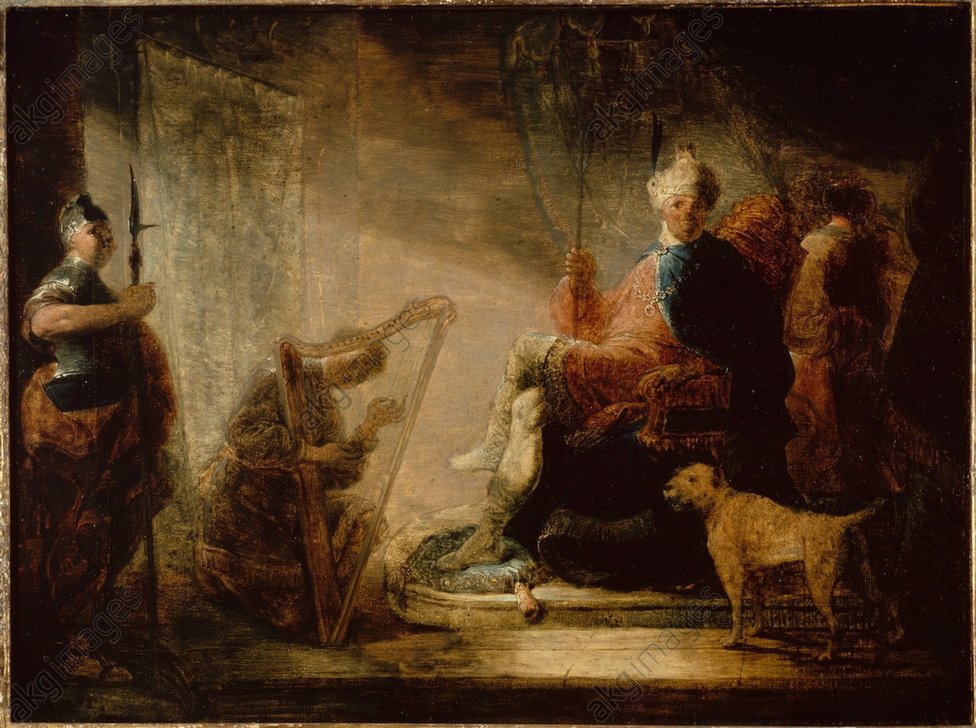
The servants of Saul knew what was helpful. They asked the king to put out an ad for a music therapist. And the best one they could find was David. The problem of Saul’s anguish needed the answer of a good harpist. 

Saul got some relief from pain, got a chance to perhaps come back to God, and David (already the next anointed king) got to learn the job of leading first-hand from the bottom-up by being in Saul’s service.

David needed to learn lowly service before becoming an exalted king. God could have simply knocked Saul off the throne and did away with him (which would make sense to a lot of people). Instead, God graciously gave young David time to observe the duties of a king.

God isn’t off his rocker. God knows what he is doing. God knew both Saul and David, inside and out. And, the Lord intimately knows each person, family, faith community, nation, and people group. If anyone claims to know precisely what God is doing and should do, they are a spiritual huckster speaking from ignorant pride. Conversely, if anyone throws up their arms in exasperation, mumbling how nobody can know God’s working, they are spiritually immature and irresponsible.

How we act or not act, what we say and do not say, is all a function of our theology – our real view of God. So, what might we take away from this story?

  1. The mystery of God and the certainty of people do not mix well. Claiming to always know what God is doing is delusional and just doesn’t help anyone.
  2. The clarity of God through divine commands, and the apathy of people to them, is a bad situation.  Claiming to never know what God is doing is a cop-out (because God has spoken clearly about a lot of things, like the Ten Commandments).
  3. Unlike Saul, do the best you can in the circumstances before you. Many situations we cannot avoid. However, in every situation we can control our response.
  4. Like David, be an agent of comfort, healing, and blessing to others. Most of the psalms were written in times of doubt, distress, and disturbance. We can take those psalms and pray them directly to God in the midst of our own discomfort.

We are in God’s hands, all of time. There is never a time when we are outside of God’s sight or ability to work.  The Lord’s arm is not too short to accomplish good purposes. God is our strong tower and mighty fortress for every life circumstance.

**Above painting: David playing the harp for King Saul, by German painter, Januarius Zick, 1750