Jesus of Nazareth (Matthew 2:13-23)

Nazareth Village, Israel

When they had gone, an angel of the Lord appeared to Joseph in a dream. “Get up,” he said, “take the child and his mother and escape to Egypt. Stay there until I tell you, for Herod is going to search for the child to kill him.”

So he got up, took the child and his mother during the night and left for Egypt, where he stayed until the death of Herod. And so was fulfilled what the Lord had said through the prophet: “Out of Egypt I called my son.”

When Herod realized that he had been outwitted by the Magi, he was furious, and he gave orders to kill all the boys in Bethlehem and its vicinity who were two years old and under, in accordance with the time he had learned from the Magi. Then what was said through the prophet Jeremiah was fulfilled:

“A voice is heard in Ramah,
    weeping and great mourning,
Rachel weeping for her children
    and refusing to be comforted,
    because they are no more.”

After Herod died, an angel of the Lord appeared in a dream to Joseph in Egypt and said, “Get up, take the child and his mother and go to the land of Israel, for those who were trying to take the child’s life are dead.”

So he got up, took the child and his mother and went to the land of Israel. But when he heard that Archelaus was reigning in Judea in place of his father Herod, he was afraid to go there. Having been warned in a dream, he withdrew to the district of Galilee, and he went and lived in a town called Nazareth. So was fulfilled what was said through the prophets, that he would be called a Nazarene. (New International Version)

Jesus is the New Exodus

Joseph was told to take Jesus to Egypt. He obeyed the Lord and assumed the role of protecting the child Jesus, unlike King Herod’s demented attempt to murder Jesus. Whereas Herod sought only his own personal agenda, Jesus identified with the people of God and sought their best interests.

Just as God brought the Israelites out of Egypt through a great deliverance, so God brought up Jesus, the Great Deliverer, out of Egypt as the unique Son of God. Jesus is God’s divine Son, and so is the rightful Ruler in God’s kingdom.

In Christianity, Jesus is the special God Man who secures salvation for us. God preserved Israel from Pharaoh’s wrath; God protected Jesus from Herod’s wrath.

Flight to Egypt by He Qi

God’s kindness and loyalty preserves us from the wrath of the devil who seeks to keep as many people as possible in the realm of darkness. 

Our hope is in the Lord, specifically, in Jesus who has conquered the devil; and he did it by first establishing a beachhead on this earth through his incarnation as the Son of God.

Just as Hosea’s prophecy was an appeal to turn from other gods to the true and living God of mercy and grace, so Matthew calls us to turn from idolatry, from anything that would displace Jesus as the rightful Ruler of our lives.

Jesus brought us out of exile

King Herod massacred innocent toddlers in order to ensure the destruction of Jesus. Behind his atrocity was the devil himself who knew that Jesus was the coming King who would one day bring salvation, and the satanic agenda was set in place.

However, nothing can thwart the fulfillment of God’s promises – including Satan, whose most powerful weapon, death, has now lost its sting because of Jesus.

Just as the prophet Jeremiah spoke hope to the people that exile will not be forever, so Matthew speaks the fulfillment of that hope. The incarnation is here. Jesus has arrived. Salvation has come in the form of a child. He is the Deliverer, the Savior. Christ brings us from captivity into the promises of God.

Jesus came to save the littlest, the lowly, the least, the lost, the lonely, and the last. God demonstrated the commitment to deliver such persons through a humble existence in a backwater town called Nazareth.

Jesus is the new Moses

Joseph is, again, unexpectedly visited by an angel with instructions concerning Jesus. Herod, after all his sinister shenanigans, finally dies. The ancient Jewish historian, Josephus, described Herod’s death: 

He had a terrible craving to scratch himself, his bowels were ulcerated, and his privates were full of gangrene and worms. At Jericho he assembled the men of distinction from all parts of the nation and ordered them shut inside the hippodrome. He told his sister, Salome, that as soon as he died, all these men were to be killed, so that there would be grief throughout the country at his death rather than joy. (Paul Maier, Josephus: The Essential Works, 252)

The contrast between King Herod and King Jesus could not be any more pronounced; Jesus said in a clear demonstration of his humility and grace at his death:

“Father, forgive them, for they do not know what they are doing.” (Luke 23:24, NIV)

With Herod dead, it was safe to return to Israel. Matthew links Jesus to the exodus and deliverance of the Israelites as the new Moses. Just as Moses was by God to go back to Egypt because all the men who wanted to kill him were dead (Exodus 4:19) so Jesus is also told to return from Egypt because he will save the people from their sins.

Everything in Holy Scripture points to Jesus, in one way or another, on purpose, as the center from which all things hinge and revolve. 

Christ the Deliverer, Rio De Janeiro, Brazil

At the beginning of this New Year, in the middle of Christmastide, it is good to remember the incarnation of Jesus to help set the tone for the entire year.

Christ came to us so that he might set apart a holy people, dedicated to doing his will, and living according to the ethics of God’s kingdom. 

God doesn’t determine who is a good follow through the metrics of perfect attendance to church services, but in how we interact with people while we are there, and how we live our lives when we are outside the four walls of a church building. 

God has found us, and the purpose of our existence is to know God and enjoy the Lord forever.

Jesus of Nazareth

Nazareth was an obscure village, not a likely place for a king to settle down and live. Yet, this is in line with what the prophet said would occur:

Nevertheless, there will be no more gloom for those who were in distress. In the past he humbled the land of Zebulun and the land of Naphtali, but in the future he will honor Galilee of the nations, by the Way of the Sea, beyond the Jordan—

The people walking in darkness
    have seen a great light;
on those living in the land of deep darkness
    a light has dawned. (Isaiah 9:1-2, NIV)

The choice of settling in Nazareth underlines that the gospel is not only for particular people, not just for Jews, the wealthy, or the influential; the gospel is for everyone, especially for the lost, the least, and the lowly. 

Describing Christ as “Jesus of Nazareth” means we are expressing an important theological truth that God is with us, that the Lord identifies with us, that the universal Sovereign of all is concerned for the common person, the poor, needy, and powerless among humanity.

The settling in Nazareth also underscores that Jesus is a different kind of king – he rules over God’s kingdom as a servant leader, using his power to dispense grace. Christ shares that power by giving it away, and together with the Father, gives the Holy Spirit. 

Unlike earthly political kings who demanded outward allegiance, Jesus gains followers through touching the heart by means of grace and love. Christ doesn’t coerce and cajole but serves others. He is patient, not wanting any to perish but all to come to eternal life.

Jesus is the culmination and climax of history. Hope is not found in electing the right politicians or having the right boss at a workplace; hope is not in attending church services and doing all the acceptable Christian activities.

Rather, hope resides in the child Jesus who was born to die so that we might live. We aren’t saved by the right people in the right positions, or in doing the right things, or having the right ideas – because Jesus is the Savior; he is our hope.

Almighty Lord God, give us true faith, and make that faith grow in us day by day. Also give us hope and love, so that we may serve our neighbors according to your will; through your Son, Jesus Christ our Lord, who lives and reigns with you and the Holy Spirit, one God, now and forever. Amen.

Hope for the Grieving (Jeremiah 31:15-22)

Orthodox icon of Rachel weeping for the children

This is what the Lord says:

“A voice is heard in Ramah,
    mourning and great weeping,
Rachel weeping for her children
    and refusing to be comforted,
    because they are no more.”

This is what the Lord says:

“Restrain your voice from weeping
    and your eyes from tears,
for your work will be rewarded,”
declares the Lord.
    “They will return from the land of the enemy.
So there is hope for your descendants,”
declares the Lord.
    “Your children will return to their own land.

“I have surely heard Ephraim’s moaning:
    ‘You disciplined me like an unruly calf,
    and I have been disciplined.
Restore me, and I will return,
    because you are the Lord my God.
After I strayed,
    I repented;
after I came to understand,
    I beat my breast.
I was ashamed and humiliated
    because I bore the disgrace of my youth.’
Is not Ephraim my dear son,
    the child in whom I delight?
Though I often speak against him,
    I still remember him.
Therefore my heart yearns for him;
    I have great compassion for him,”
declares the Lord.

“Set up road signs;
    put up guideposts.
Take note of the highway,
    the road that you take.
Return, Virgin Israel,
    return to your towns.
How long will you wander,
    unfaithful Daughter Israel?
The Lord will create a new thing on earth—
    the woman will return to the man.” (New International Version)

The bereavement of losing someone you care about is awful. A parent experiencing the death of a child is next level grief. There is no bereavement like it.

As a hospital chaplain, I occasionally attend to a grieving mother who just lost her baby. I have shown up for premature and stillborn deaths, full term births, then death, sudden infant death, and more. The grief is indescribable.

On some level, there is no comfort – and never will be. I know that, for me, providing grief support to mothers who are enduring the death of a baby or young child has profoundly changed me and forever impacted my soul. So, I can only imagine what it’s like for a mother.

Many Christians will recognize the verse of Rachel weeping for her children as part of the early story surrounding Jesus:

An angel of the Lord appeared to Joseph in a dream. “Get up,” he said, “take the child and his mother and escape to Egypt. Stay there until I tell you, for Herod is going to search for the child to kill him.”

So he got up, took the child and his mother during the night and left for Egypt,where he stayed until the death of Herod. And so was fulfilled what the Lord had said through the prophet: “Out of Egypt I called my son.”

When Herod realized that he had been outwitted by the Magi, he was furious, and he gave orders to kill all the boys in Bethlehem and its vicinity who were two years old and under, in accordance with the time he had learned from the Magi. Then what was said through the prophet Jeremiah was fulfilled:

“A voice is heard in Ramah,
    weeping and great mourning,
Rachel weeping for her children
    and refusing to be comforted,
    because they are no more.”(Matthew 2:13-18, NIV)

It’s really hard to have hope when you’re in the throes of lamenting the death of children. We need hope. It’s necessary to life. We cannot survive, let alone thrive, without it.

It is possible to simultaneously experience hopelessness and hope. At the same time, we hold both despair and desire, anguish and anticipation, in our hearts. While we may never forget who we have lost, we make it through our days believing that another child can change the world for the better. We place our faith in the Christ child, in Jesus.

Wily old King Herod massacred innocent toddlers in order to ensure the destruction of Jesus. Behind his atrocity was the devil himself who knew that Jesus was the coming King who would one day bring salvation. But the old King’s sinister plan didn’t work. 

Reflecting on a vision of Christ’s birth, the Apostle John stated:

The dragon stood in front of the woman who was about to give birth, so that it might devour her child the moment he was born. She gave birth to a son, a male child, who “will rule all the nations with an iron scepter.” And her child was snatched up to God and to his throne. (Revelation 12:4-5, NIV)

Satan wars against God’s Son and God’s people, whose roots go all the way back to the first prophecy of Christ:

And I will put enmity
    between you and the woman,
    and between your offspring and hers;
he will crush your head,
    and you will strike his heel.” (Genesis 3:15, NIV)

There has been bad blood, ever since the Fall of humanity, between the serpent and the seed of the woman. The Old Testament Israelites were continually being threatened with extermination; they were constantly tempted to conform to pagan ways for handling their suffering and grief. 

Herod was just another in a long line of demonically animated men trying to perpetuate the kingdom of darkness. The devil knows that his time is short; and he uses twisted persons like Herod for his insidious schemes.

Many people experience hell on earth because Satan is on a rampage; mothers and their children are often the collateral damage.

The holiday season is a hard time of year for many people, filled with depression instead of joy, grieving over lost loved ones for whom you will not spend another Christmas with. And yet, there is a reunion coming, the hope of a bodily resurrection in which we will be with Jesus and God’s people forever.

Satan’s most powerful weapon, death, has lost its sting because of Jesus. Death does not have the last word; resurrection does. And this hope for the future helps us in the present to keep going and not give up.

The prophet Jeremiah was dealing with children lost in war to the invading Babylonians. His words are a lament in the context of the hope that captivity and exile will not be forever. 

Matthew wants us to see that the exile is over for us; Jesus has arrived, and the tears that were shed will shortly dry up. There may be a time of suffering that we must endure, but there is glory ahead.

Jesus is the Great Deliverer who brings us out of the grip of death, grief, and lament and into the promises of God. Christ is our hope. Amen, and amen.

Luke 13:31-35 – Blessed Is He Who Comes In the Name of the Lord

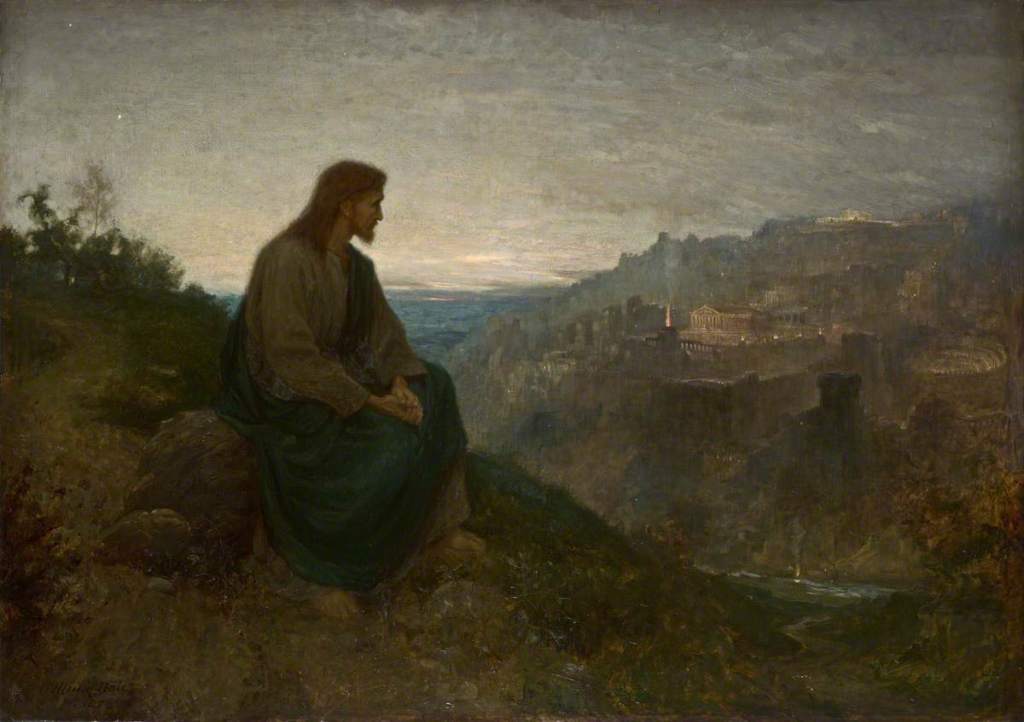
“If Thou Had’st Known” by William Brassey (1846-1917) Royal Scottish Academy of Art & Architecture; http://www.artuk.org/artworks/if-thou-hadst-known-186809

At that time some Pharisees came to Jesus and said to him, “Leave this place and go somewhere else. Herod wants to kill you.”

He replied, “Go tell that fox, ‘I will keep on driving out demons and healing people today and tomorrow, and on the third day I will reach my goal.’ In any case, I must press on today and tomorrow and the next day—for surely no prophet can die outside Jerusalem!

“Jerusalem, Jerusalem, you who kill the prophets and stone those sent to you, how often I have longed to gather your children together, as a hen gathers her chicks under her wings, and you were not willing. Look, your house is left to you desolate. I tell you – you will not see me again until you say, ‘Blessed is he who comes in the name of the Lord.’” (New International Version)

King Herod of Judea, who was in the pocket of the Roman Empire, was issuing threats against Jesus. And those threats had some teeth behind them. Herod had recently beheaded Christ’s friend and cousin, John the Baptist (Luke 9:7-9). Yet, Jesus seemed unconcerned by the warnings. He made it clear that he was going to keep doing what he was doing, unfazed by Herod’s bluster.

Jesus had no intention of halting his travels, even because of a credible threat by the governing powers. Christ emphasized his words by assuring his listeners that the work he is doing will be done today, and the next, and the day after that—building ultimately to his greatest work of securing redemption through his crucifixion and resurrection. 

I hope to be always journeying towards Jerusalem with a heart full of compassion that will not waver in the midst of violent killing and injustice. That isn’t easy, yet I know that my humble pilgrimage with Jesus will be worth it all, in the end.

A pilgrimage is an apt description for the Christian season of Lent. Believers journey with Jesus, making the slow trek with him through his earthly ministry and to Jerusalem, up the Mount of Olives. There Christ is crucified – and we with him:

I have been crucified with Christ and I no longer live, but Christ lives in me. The life I now live in the body, I live by faith in the Son of God, who loved me and gave himself for me. (Galatians 2:20, NIV)

So far, we have made a stop in Bethlehem, following the star to the place where the newborn king was laid in a simple stinky feeding trough. The juxtaposition of that reality could not be more pronounced. The rightful Lord of all, far more powerful than old King Herod or the Roman Emperor, comes to earth not to be served, but to serve, and give his life as a ransom for many. (Mark 10:42-45)

In our walk with Jesus, we observe him deliberately posturing himself as a lowly servant throughout his earthly ministry. Whereas Herod acted the predictable part of a power hungry worldly ruler, squelching all rivals to the throne, Jesus shared his authority with others, along with a promise of continual presence. (Matthew 2:16-18, 28:16-20)

There is nothing romantic about this journey, this walk with Christ. It is often a hard road, and many count the cost of discipleship and choose to walk away.

Yet, Jesus is down for the struggle. He knows that injustice and systemic evil must be carefully rooted out. He understands that hearts and minds aren’t changed overnight. It will take time. So, we walk slowly with our Lord because Christ is in it for the long haul. We see Jesus is patiently, and sometimes imperceptibly, using divine power and authority to preserve the good and weed out the bad.

Dealing with human sin and the awful fallenness of this world will take a while. It will be an extended process because there are so many hard hearts. Jesus was ready, willing, and able to gather people together, as a mother hen gathers her chicks – yet there was an unwillingness to it.

And Christ, the heavenly ruler, isn’t in the business of twisting arms and manipulating others, like Herod, the earthly ruler.

Instead, Jesus invites. He doesn’t squeeze people like an orange to get their juice. Christ carefully prepares a meal. He sets the table himself. He gives of himself. Like some wildly potent superfood, a bit of wine and morsel of bread is more than enough to fill the hungry soul and the thirsty spirit.

With Jesus, there is always room at the Table.

There is room for you and for me. There is room for every kind of person – from every nation, race, gender, ethnicity, class – no matter the distinctions and no matter the past. It is the love of God in Christ, not the judgment, which brings people peace and salvation. It comes through a baby who grew and learn and suffered, just like us, and not through some wily old fox of a ruler.

Eventually, the phrase will be uttered, “Blessed is he who comes in the name of the Lord.” Jesus pulled this phrase from the Old Testament psalms. He did this, knowing quite well the context surrounding the verse:

The stone the builders rejected
    has become the cornerstone;
the Lord has done this,
    and it is marvelous in our eyes.
The Lord has done it this very day;
    let us rejoice today and be glad.

Lord, save us!
    Lord, grant us success!

Blessed is he who comes in the name of the Lord. (Psalm 118:22-26, NIV)

The chicks may scatter and refuse to be gathered. The builders might reject the crucial cornerstone and still try to build. Yet, it will not always be this way. As we journey with Jesus, eventually along the Via Dolorosa, the way of suffering, the road to Calvary, with an eye to where this will all culminate at an empty tomb and a great celebration of new life.

We will not be looking down at our feet forever in sorrow but will lift our faces toward the clouds. Just as we see Jesus ascending, we shall see Christ coming again. The time is near….

Look! He comes with the clouds of heaven.
    And everyone will see him—
    even those who pierced him.
And all the nations of the world
    will mourn for him.
Yes! Amen! (Revelation 1:7, NLT)

The triumphal entry of Jesus on Palm Sunday is followed by a triumphal entry into my heart, and the hearts of many. And there is coming yet another triumphal entry, back to this earth. All things will made new….

“There will be no more death, no more grief or crying or pain. The old things have disappeared.” Then the one who sits on the throne said, “And now I make all things new!” (Revelation 21:4-5, GNT)

May it be so, to the glory of God.

Almighty God, you know that we have no power in ourselves to help ourselves: Keep us both outwardly in our bodies and inwardly in our souls so that we may be defended from all adversities that may happen to the body, and from all evil thoughts that may assault and hurt the soul, through Jesus Christ our Lord, who lives and reigns with you and the Holy Spirit, one God, for ever and ever. Amen.

Luke 13:31-35 – Blessed is He Who Comes in the Name of the Lord

Blessed is He Who Comes in the Name of the Lord, by José Luis Castrillo

At that time some Pharisees came to Jesus and said to him, “Leave this place and go somewhere else. Herod wants to kill you.”

He replied, “Go tell that fox, ‘I will keep on driving out demons and healing people today and tomorrow, and on the third day I will reach my goal.’ In any case, I must press on today and tomorrow and the next day—for surely no prophet can die outside Jerusalem!

“Jerusalem, Jerusalem, you who kill the prophets and stone those sent to you, how often I have longed to gather your children together, as a hen gathers her chicks under her wings, and you were not willing. Look, your house is left to you desolate. I tell you – you will not see me again until you say, ‘Blessed is he who comes in the name of the Lord.’” (New International Version)

King Herod of Judea, who was in the pocket of the Roman Empire, was issuing threats against Jesus. And those threats had some teeth behind them. Herod had recently beheaded Christ’s friend and cousin, John the Baptist (Luke 9:7-9). Yet, Jesus seemed unconcerned by the warnings. He made it clear that he was going to keep doing what he was doing, unfazed by Herod’s bluster.

Jesus had no intention of halting his travels, even because of a credible threat by the governing powers. Christ emphasizes his words by assuring his listeners that the work he is doing will be done today, and the next, and the day after that—building ultimately to his greatest work of securing redemption through his crucifixion and resurrection. 

I hope to be always journeying towards Jerusalem with a heart full of compassion that will not waver in the midst of violent killing and injustice. That isn’t easy, yet I know that my humble pilgrimage with Jesus will be worth it all, in the end.

Yet, for now, I need to make a stop in Bethlehem. I must follow the star to the place where Christ the newborn king is lying in a simple stinky feeding trough. The juxtaposition of that reality could not be more pronounced. The rightful Lord of all, far more powerful than old King Herod or the Roman Emperor, comes to earth not to be served, but to serve, and give his life as a ransom for many. (Mark 10:42-45)

What’s more, Jesus deliberately donned the clothing and postured himself as a lowly servant throughout his earthly ministry. Whereas Herod acted the predictable part of a power hungry worldly ruler, squelching all rivals to the throne, Jesus shared his authority with others, along with a promise of continual presence. (Matthew 2:16-18, 28:16-20)

“Almighty God, give us grace to cast away the works of darkness and put on the armor of light, now in the time of this life, in which your Son Jesus Christ came to visit us in great humility; So that, at the last day, when he shall come again in his glorious majesty to judge the living and the dead, we may rise to the life immortal.” 

Book of Common Prayer

Jesus is down for the struggle. He knows that injustice and systemic evil must be carefully rooted out. He understands that hearts and minds aren’t changed overnight. It will take time. Yet, Christ is in it for the long haul. The Lord is patiently, and sometimes imperceptibly, using divine power and authority to preserve the good and weed out the bad.

It will take a long time, and will be an extended process, because there are so many hard hearts. Jesus was ready, willing, and able to gather people together, as a mother hen gathers her chicks – yet there was an unwillingness to it. And Christ isn’t in the business of twisting arms and manipulating others, like Herod.

Jesus invites. He doesn’t squeeze people like an orange to get their juice. Christ carefully prepares a meal. He sets the table himself. He gives of himself. Like some wildly potent superfood, a bit of wine and morsel of bread is more than enough to fill the hungry soul and thirsty spirit.

There is always room at the Table.

There is room for you and for me. There is room for every kind of person – from every nation, race, gender, ethnicity, class – no matter the distinctions and no matter the past. It is the love of God in Christ, not the judgment, which brings people peace and salvation. It comes through a baby, not some wily old fox of a ruler.

Eventually, the phrase will be uttered, “Blessed is he who comes in the name of the Lord.” Jesus pulled this phrase from the Old Testament psalms. He did this, knowing quite well the context surrounding the verse:

The stone the builders rejected
    has become the cornerstone;
the Lord has done this,
    and it is marvelous in our eyes.
The Lord has done it this very day;
    let us rejoice today and be glad.

Lord, save us!
    Lord, grant us success!

Blessed is he who comes in the name of the Lord. (Psalm 118:22-26, NIV)

The chicks might scatter and refuse to be gathered. The builders may reject the crucial cornerstone and still try to build. Yet, it will not always be this way. As we celebrate the first advent of Christ in his incarnation, the second advent is continually in view. Christ is coming… again. The time is near….

Look! He comes with the clouds of heaven.
    And everyone will see him—
    even those who pierced him.
And all the nations of the world
    will mourn for him.
Yes! Amen! (Revelation 1:7, NLT)

The triumphal entry of Jesus on Palm Sunday is followed by a triumphal entry into my heart, and the hearts of many. And there is coming yet another triumphal entry, back to this earth. All things will made new….

“There will be no more death, no more grief or crying or pain. The old things have disappeared.” Then the one who sits on the throne said, “And now I make all things new!” (Revelation 21:4-5, GNT)

May it be so, to the glory of God.