We Are All In the Same Boat (Romans 3:9-20)

What shall we conclude then? Do we have any advantage? Not at all! For we have already made the charge that Jews and Gentiles alike are all under the power of sin. As it is written:

“There is no one righteous, not even one;
    there is no one who understands;
    there is no one who seeks God.
All have turned away,
    they have together become worthless;
there is no one who does good,
    not even one.”
“Their throats are open graves;
    their tongues practice deceit.”
“The poison of vipers is on their lips.”
    “Their mouths are full of cursing and bitterness.”
“Their feet are swift to shed blood;
    ruin and misery mark their ways,
and the way of peace they do not know.”
    “There is no fear of God before their eyes.”

Now we know that whatever the law says, it says to those who are under the law, so that every mouth may be silenced and the whole world held accountable to God. Therefore no one will be declared righteous in God’s sight by the works of the law; rather, through the law we become conscious of our sin. (New International Version)

Whenever there is division, separation, and polarization between two groups of people, it’s important that someone has the ability to come back to what is true and common to all of us.

And that is what the Apostle Paul did in addressing the two differing groups of people in the ancient Roman Church of both Jewish and Gentile believers in Jesus.

The Jewish Christians, Paul argued, did not have a leg up on the Gentiles, just because of their long history with God. They tended to see themselves as better than their Gentile brothers and sisters in Christ. After all, the Jewish believers reasoned, we don’t have such a background of sinful pagan practices and estrangement from God.

Well, actually they do, however the Apostle did not rehearse his own people’s long history of stubborn rebellion and waywardness from God. Instead, he went back to the scriptures, and reminded the Jewish Christians of something they seemed to have lost sight of:

To be a human being is to be intimately familiar with sin and godlessness, guilt and shame, no matter the group nor the individual. We are all in the same boat.

In saying this, the Apostle Paul was not implying there is not anything good in anyone. Quite the contrary. For what is also true of humanity is that every individual person is a good creature, created from a good Creator, with the divine stamp of God’s image and likeness. There are no exceptions to this.

With all the mudslinging within the church, Paul simply pointed out that there is more than enough blame to go around. All the things that one group accuses another of is also true about they themselves.

And when it comes to sin – all those actions, words, and attitudes we have done and failed to do in loving our fellow humanity, and God – every one of us is in the same boat of guilt before God. There are no exceptions to this.

The power and ubiquity of sin is everywhere. Sin is like a nasty weight which continually burdens the world, and like an acrid fog that is always hanging in the air. We all feel the heaviness; we all breathe the same air.

All of our puny attempts at dividing one another into star-bellied Sneetches, and Sneetches without stars upon thars, is only proof positive of our sinful predilections to acquiesce to sin’s power on this earth.

This means that none of us can claim to take the moral and spiritual high ground. Nobody has an advantage on another. Therefore, it is ridiculous to ever try and implement policies of favoritism, cronyism, or prejudice. Such thinking itself is sinful, and ought to be jettisoned at the first awareness of it.

Whether we know what is right, or not; and whether we have the law and a covenant code, or not, isn’t really the issue. Obeying the law and doing what is right and just, with a good heart, is the real issue for all of us.

But it’s rather difficult to truly embrace justice and righteousness if the heart is no good. In truth, all of us have some rather dark places in our hearts. And until these are addressed, we will keep having all of our humanly contrived divisions and separations based upon a supposed superiority of the other.

The very fact that it is so easy to point out the sin in another, and label them as sinner, ought to tell us that “It takes one to know one.”

All Jews and Gentiles are under the accusation of God’s law, without exception. Everyone is accountable to God and the law. Proper observance of the law is to love God and neighbor – and thus, condemnation under the law is to ignore and disobey God, and to ignore and hate one’s fellow humanity.

What’s more, neither Jew nor Gentile can be justified by the law. Not a one of us can undo our guilt by ourselves.

No amount of work can satisfy the breadth and depth of that guilt. Pledges of perfectionism cannot help us, namely because we don’t even have the ability to follow through on them. Sheer hard work will not do the trick, because it would be like trying to empty the ocean with a kid’s sand toy bucket.

Only grace can reverse things. We need a pardon, and a new heart, which can sync and beat with the holy rhythms of divine love and justice. We need Jesus.

The Apostle Paul eventually got to that point later in his letter. Yet, here, he needed to establish everyone’s commonality of sin, so that they would embrace Jesus together as the one people of God who are in desperate need of his saving work, and the Spirit’s sanctifying work.

Therefore, the proper place to begin in being at peace with God and the world is to confess our own complicity in sin. Let us, then, offer this prayer of confession:

Lord Jesus, we have sinned times without number, and been guilty of pride and unbelief, and of neglect to seek you in our daily lives. Our sins and shortcomings present us with a list of accusations, but we thank you that they will not stand against us, for all have been laid on Christ. Deliver us from every evil habit, every interest of former sins, everything that dims the brightness of your grace in us, everything that prevents us taking delight in you. Amen.


A Parable On Being Right with God (Luke 18:9-14)

The Tax Collector and the Pharisee by Peter Gallen

To some who were confident of their own righteousness and looked down on everyone else, Jesus told this parable: “Two men went up to the temple to pray, one a Pharisee and the other a tax collector. The Pharisee stood by himself and prayed: ‘God, I thank you that I am not like other people—robbers, evildoers, adulterers—or even like this tax collector. I fast twice a week and give a tenth of all I get.’

“But the tax collector stood at a distance. He would not even look up to heaven, but beat his breast and said, ‘God, have mercy on me, a sinner.’

“I tell you that this man, rather than the other, went home justified before God. For all those who exalt themselves will be humbled, and those who humble themselves will be exalted.” (New International Version)

There’s a lot to observe in Christ’s parable for today. Notice six observations of the story….

1. We Cannot Make Ourselves Right with God

I’m convinced that most Gentile Christians, standing two millennia apart from Christ’s telling of this parable, are much too hard on the Jewish Pharisees: “Well, I’m certainly glad that I am not like the Pharisee in this story!” so many tell themselves. It seems to me the Pharisees get a bad rap because of our own predilection to justify ourselves.

After all, we can only really criticize something we are already familiar with.

A temptation which every individual and community faces is the seduction toward self-justification, instead of being justified by God.

Way back in the day, when I made treadmill belts for a living, I was in charge of quality control. It was my job to make sure that the quality department provided the shipping department with a finished product, free of defects, and could stand the test of continual use. I justified the belt as being a treadmill belt of integrity; the belt did not, nor could not, justify itself, hide or fix its flaws, or make itself right.

To think that a treadmill belt could justify itself is in the same sort of crazy that believes we can make ourselves right. No, it is God alone who justifies the sinner.

The paradox of Christ’s parable is that the real sinners are those who claim to be righteous, while the truly righteous are those who recognize they cannot justify themselves and need God to make them right.

2. We Need to Be Honest about the Right Thing

In order to hear the good news about God’s ability to justify and make right, we must also hear the bad news about why we need justification to begin with. An honest look into the mirror reveals that we have been hiding behind a cosmetic façade of self-justification.

Our illusions and delusions need to be confronted and shattered. Because only then can we receive grace and realize the peace and harmony of God’s justification.

Since God justifies, I don’t have to!

I don’t need to defend myself, make myself look better than I am, nor fool myself into believing that the false façade is the true self.

The parable of Jesus is a contrast between the Pharisee who justifies himself, and the tax collector who looks to God alone for his justification.

3. The Put-Together Guy Wants to Make Himself Right

Jesus uses a Pharisee as a character in the parable because the guy represented someone who everyone else looks up to as the model of a spiritual and religious person. Christ is inviting his hearers to look beyond the façade of what we see with our physical eyes.           

We need to use our spiritual eyes to notice below the surface. Look at the attitude. The smug self-justifying disposition is flat-out sin. What’s more, self-justification is a root of all sorts of sins.

Judging ourselves to be right means that others are wrong. That attitude creates division, separates people into bad and good, fosters disharmony, and is an affront to God. 

To try and obtain what is already provided by grace is plain old-fashioned sin.

4. We’re Obsessed with the Right Lines

Adam and Eve were told by God that they could eat from any tree in the garden but were given strict instructions not to eat of the tree of the knowledge of good and evil. (Genesis 2:15-17) So, why avoid that particular tree?

Because it was a tree which spiritually and socially blinds people. Adam and Eve ate from it and their eyes were “opened” to a different reality – which was actually a “closed” view of reality that changed the way humanity deals with one another. From that point forward, people began drawing lines down the middle and placing themselves on the “good” side while vilifying those on the other side, the “bad” side.

“Apple Picking,” the fall of Adam and Eve, by Vittorio Canta

Adam and Eve immediately began justifying their actions, their attitudes, and their behavior. (Genesis 3:8-13) Adam drew a line: “That woman, Eve, gave me the fruit; she’s on the other side; it’s her fault!” Eve drew a line: “The serpent made me do it; that wasn’t really me, I’m basically good….” And ever since, the quest of making ourselves right has never stopped….

Today, we draw all sorts of lines. A popular religious line is this: “We’re good; they’re bad. Our theology is right, everybody else’s is wrong. The Bible says….” (insert a kooky interpretation of Scripture, based in self-justification and separation of people into good and bad groups)

People draw class lines, race lines, gender lines, ethnic lines, economic lines. We want clean lines, vertical lines, horizontal lines, perpendicular lines, thick lines, thin lines, any kind of line; just give me a line! Let’s go line dancing. Maybe take an airline. There are offensive lines and defensive lines. By the way, what’s the line on the Packers? We even judge the lines themselves: Long lines, short lines, front lines, back lines, and DMV lines are clearly evil, right!?

Why are we so obsessed with drawing lines? So that we can take self-justifying sides. Violence, war, and most every other sin of the world comes from the original sin project of trying to make ourselves right: “I’m okay; you’re not.”

The Pharisee (really a representative of us all) drew a very clear line between himself and the despised sinful tax collector. Notice that self-justification always compares itself with others. Those who obsessively draw lines are compulsively concerned about other people; they believe they have a right to know what’s going on with them. They remain vigilant to keep the lines drawn and distinguish themselves from those on the other side.

5. God Is On the Other Side of the Right Line

The Pharisee found that every time he drew a line, God was on the other side with the “sinners.” That makes perfect biblical sense. If God alone justifies sinners and makes them right; and if Jesus identifies with them in his life, death, and resurrection; then God is to be found on the other side of our line-drawing.  

A self-justified person sees no need for God’s justification. Therefore, God is not on their side; God is on the other side, justifying sinners by making them right.

6. The Unraveled Guy Wants To Be Made Right

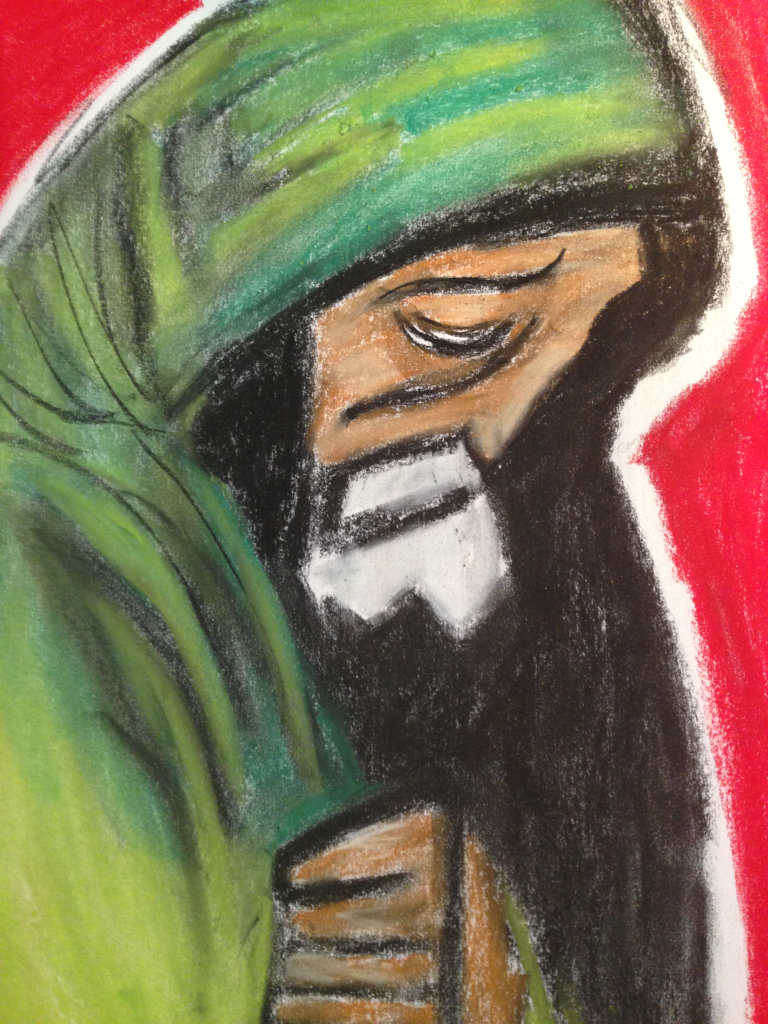
“O God, Be Merciful To Me, A Sinner,” by Ronald Raab

The tax collector’s only concern was for God to show him mercy because he is a sinner. In contrast to the proud attitude of the Pharisee, the tax collector, a sinner by anyone’s definition, humbled himself and sought justification from God alone.

  • Justification by God makes us right and:
  • Lifts the curse upon humanity and reverts everything back to its original design. (Revelation 22:1-5)
  • Erases the lines. (Romans 4:7-8)
  • Restores our souls are and strengthens our faith. (Acts 16:5; Romans 4:20)
  • Enables us to rest in Christ’s finished work. (John 19:28-30)
  • Does not condemn us. (Romans 8:1-2)
  • Eliminates comparisons because Christ is sufficient for us. (Colossians 2:13-14)
  • Replaces the anxiety and fear about how we look to others with the contentment and satisfaction of God’s love in Christ. (1 John 4:16-18)

Conclusion

Self-justification separates us from people and creates distance and division. But God’s justification connects people in love and crosses the arbitrary lines created by others.

The bad news: Many religious folk, when confronted with their self-justifying attitudes, do not change. Instead, they label the person as bad and place the offending person on the other side of their line so that they can maintain their façade of righteousness.

The good news: Jesus can be found on the other side of the line because justification is a gift. Yet, until we go to him, outside our little camp, we will continue in vain to make ourselves look good and be on the right side of everything while making others look bad.

The good and the right is to humbly – and with much flavor – cry out to God for mercy because only the Lord can save us from our plight.

Lord Jesus Christ, Son of God, have mercy on me, a sinner. 

Lord Jesus Christ, Son of God, have mercy on me, a sinner. 

Lord Jesus Christ, Son of God, have mercy on me, a sinner, and grant me your peace.

Just and right God, by your mercy we were created, and by your mercy you redeemed us through your Son, the Lord Jesus. Your mercy is the light by which all people – both sinner and saint – return to you. Your divine justice and your divine mercy exist together so that you refuse to punish us as we deserve.

Lord Jesus, it was not enough for you to take on our humanity; you died for us as well. So, we humbly and gratefully receive your gracious deliverance from sin, death, and hell. Amen.

Romans 5:1-5 – Maybe There Can Be Peace…

Therefore, since we have been justified through faith, we have peace with God through our Lord Jesus Christ, through whom we have gained access by faith into this grace in which we now stand. And we boast in the hope of the glory of God. Not only so, but we also glory in our sufferings, because we know that suffering produces perseverance; perseverance, character; and character, hope. And hope does not put us to shame, because God’s love has been poured out into our hearts through the Holy Spirit, who has been given to us. (New International Version)

Today, there are millions, perhaps billions, of people without peace in this world.

Maybe…

Maybe there isn’t much peace in your life. Because of that unsettled icky sense of agitation, your mind is somewhere else. It could be that you are upset about something that has happened or are worried about something that is going to happen. 

Maybe the lack of peace has to do with another person. They did or said something, and it’s been grinding on you. So, you are having conversations with that person in your head for which you will probably never say aloud. 

Maybe you have to deal with someone else who doesn’t have peace, and it’s creating stress for you. And you are wondering when things will settle down.

Maybe the lack of peace runs much deeper than your immediate circumstances and plans. 

Maybe every day, day-in-and-day-out, you are not quite sure about where you stand with a person or a group of people.

Maybe you aren’t sure about how you stand with God. You wonder whether God is really pleased with you, or not. 

Maybe you aren’t even in touch with your lack of peace because you are an expert at pushing whatever feelings you have so far down that you think you’re fine. But you really aren’t.

Maybe you are a perfectionist…

Perfectionists are never at peace. The specter of perfectionism always hangs in the air. There’s a steady stream of “should have’s,” and “could have’s” making noise in your head. Your work, no matter how good, is never good enough. “I should have done better.”  “I ought to do better.”  “I must be better.” 

Instead of viewing life’s opportunities as challenges to be welcomed, the perfectionist sees life as one unending mountain to climb, never quite reaching the top. 

The constant companions of perfectionistic people are disappointment, condemnation, frustration, and perceived failure. There is, for them, an internal world of self-loathing based on the lie that I am not enough – I have to be perfect. Peace, for the perfectionist, is a pipe dream.

Maybe we could focus a bit on God…

The Christian God is a triune God, existing in three persons – Father, Son, and Spirit – the great Three-in-One. The Trinity is the basis for all we are and all we do.

All of life is grounded in the triune God. God exists in perfect unity and harmony. God is God’s own community of glorious love. God’s glory is primarily seen on this earth through creation, through us, God’s creatures.

Glory is revealed as we reflect the image of God stamped on us in creation. Since God is love, God’s people are to be characterized by love – loving God, loving one another, and loving neighbor. God’s people are meant to exist together in unity and harmony, reflecting the very nature of the Holy Trinity. 

Yet, after the creation of the world and humanity, man and woman fell into guilt and shame through bucking God’s design for people. Ever since, God has been on a mission to reclaim the lost glory.

Maybe we need to focus on the Son… 

The ultimate expression of God’s mission was the sending of the Son to this earth. It is through Christ’s life, death, resurrection, and ascension that the way has been opened to a renewed relationship with our triune God.

The way is now clear for us to experience real practical peace. It has been achieved through the cross of Jesus Christ.

Therefore, since God has initiated a rescue mission for us by sending the Son, since we have been justified through faith, we have peace with God. 

To be justified means God made us righteous – has made things right between us. God has also provided access for us to be right with each other and the rest of creation. To put this in a contemporary vernacular, we ask God, “Are we good?” and God responds, “We’re good.”

Since then, we’re good with God, we have peace with God. 

Since then, that is true, we cannot try and get peace by another way.

Peace does not come through doing the right things, and by being a good person. 

Peace does not come through trying to obtain feelings of peace.

Peace is not merely the absence of conflict – of just keeping people from strangling each other and harming one another. 

Peace cannot be achieved by trying to relieve anxiety through better effort. 

Maybe grace is the answer…

The antidote to perfectionism, the resolution to feeling a lack of peace is unconditional approval from God. 

Grace is the elixir of life. 

Grace is the thing a perfectionist cannot work to obtain, and the thing that truly helps. 

Grace is freely given; it is a gift.   

Grace (God’s loving unconditional acceptance of us) is the true way of peace.

Some folks have so tied themselves to impossible performances and conditional love that the gift of grace is hard to accept. 

Change won’t happen overnight, and that’s okay – because God deals with us according to grace, not by earning spiritual merit badges. 

The renewal that brings transformation is a process, not an event. In Scripture it’s called “sanctification.” So, it’s important to enjoy the process. 

When you’ve caught yourself going back to the pigsty of perfectionism, instead of beating yourself up, go ahead and laugh at yourself and your own fallibility. Perfectionists take themselves way too serious. Anytime they can lighten up, it lights up the face of God (in a non-performance sort of way!).

Maybe peace is possible…

Peace delivers us from our brokenness.  Again, let’s return to the triune God. There is perfect peace within Father, Son, and Spirit. God is perfect unity, harmony, and love.

Peace means living, working, and playing together. 

Peace means experiencing wholeness, integrity, and contentment, even in the midst of hard circumstances. 

Peace means being a peacemaker.

The late Fred Rogers, from Mister Rogers’ Neighborhood, got into television because he didn’t like TV. During spring break of his senior year in seminary he encountered television for the first time. What he saw repulsed him because he saw people demeaning each other and not having peace.  

Fred Rogers worried that TV programming would create a generation of emotionally-bankrupt children. Faced with the decision to either sour on television itself or work to restore the medium, he chose the latter. He dropped out of seminary and began pursuing a career in broadcasting. Fourteen years later, he created a television show that shaped entire generations of children, running on PBS from 1968-2001.

Mr. Rogers was a devout Christian who rarely talked about his faith on the air. Yet, his show infused our society with beauty and grace. “You’ve made this day a special day by just your being you,” he’d famously sign off. “There is no person in the whole world like you, and I like you just the way you are.” 

In many ways, the lasting legacy of Mr. Rogers will not only be the greater emotional stability of generations of children, but also his wonderful example of peace and how to restore the world through basic human kindness.

Maybe the path of peace is different than I believed…

Having all our circumstances like we want them is not the basis of experiencing peace. That’s being delusional. Peace doesn’t happen whenever everything goes our way.

Instead, we are to rejoice in all our circumstances, even the ones which cause suffering – because they the Holy Spirit’s means of teaching us to experience the peace we long for.

Suffering is our triune God’s way of weaning us off all that divides and antagonizes so that we can attach ourselves to God’s peace. 

One of the most read Christian books of all time was written in the 1500’s by a French woman known as Madame Guyon. She saw the disunity of the world and the lack of peace in our individual lives as stemming from our lack of practicing God’s ways. 

Much of the world doesn’t know what to do with suffering, and does not accept it, because people want their own way with everything.

War and Peace by U.S. Air Force Staff Sgt. Jamal D. Sutter

To know God’s peace, we must practice just the opposite – by refusing all personal desires we have, whether good or bad. Why? Because the practice of refusing our own will breaks it free so it can attach to God’s will.  

We need our brains to be rewired in saying “no” to ourselves.

The other part of Madame Guyon’s practice is to accept every circumstance, even difficulty and suffering, with joy and thanksgiving. 

We can learn to say “yes, thank you” for each hard circumstance, whether good or bad. As in the case of Mr. Rogers, the evil we observe can spur us toward making peace in this world. We detach from personal desires so we can attach to what God wants to do.

Peace, on the practical level, comes from persevering under suffering and rejoicing in it. Why rejoice? Because suffering produces character and character hope. There cannot be hope without suffering. 

God the Father called God the Son to suffer; and God the Spirit leads us into suffering so that we might know peace and hope on a daily basis.

Conclusion

Abandon everything to God. Let it go – every dream, every personal desire, everything you have so that you are free to know God’s will for your life. 

Accept each circumstance you face with joy and thanksgiving. The Trinitarian love of God is poured into our hearts through every circumstance of life, even if it is difficult and hard. 

When we practice abandonment of our wills and acceptance of our circumstances, the result gives us hope, the confident expectation that nothing in our lives happens in vain. 

Every situation can lead us to know God and experience peace. This is very different from simply believing in the Trinity; it is to daily experience the Trinity. 

Glorious God, make your presence known through our worship, our prayer, and our reading of your Word. Father, Son, and Holy Spirit, within you lies unity, love, justice, peace, and power.

Fill our outstretched hearts with your Spirit and encircle us with your love. Make yourself known to us in new and challenging ways. Empower us to forsake every will but your own.  Inspire us toward your peace. Do with us what you will, through Christ our Lord in the power of the Holy Spirit. Amen.

Romans 5:6-11 – Christ Died For Us

“Golgotha” by Edvard Munch, 1900

You see, at just the right time, when we were still powerless, Christ died for the ungodly. Very rarely will anyone die for a righteous person, though for a good person someone might possibly dare to die. But God demonstrates his own love for us in this: While we were still sinners, Christ died for us.

Since we have now been justified by his blood, how much more shall we be saved from God’s wrath through him! For if, while we were God’s enemies, we were reconciled to him through the death of his Son, how much more, having been reconciled, shall we be saved through his life! Not only is this so, but we also boast in God through our Lord Jesus Christ, through whom we have now received reconciliation. (New International Version)

In Christianity, there is only one way of approaching God: Through the death of Jesus Christ. That means we cannot approach God by our good works, doing things right, or by our spiritual pedigree. We are justified and declared righteous by grace alone through faith in the cross of Christ.

Back when my youngest daughter was still living at home, sometimes I needed to go into her room to get something. More often than not, it ended up becoming an archaeological dig. I had to wade through layers of stuff. I didn’t always find what I was looking for, and other times I discovered things I didn’t know I had even lost. 

When the magisterial Reformer, Martin Luther (1483-1546) went digging into the Bible, he found he was wading through layers of church tradition and came upon something that was lost. Luther rediscovered that God justifies sinners by grace through faith apart from any good works done by us. Luther found in the Scriptures that we are completely and totally at the mercy of God in Christ.

The cross of Jesus Christ is the means of salvation from what ails us because the cross is an attack on human sin. Luther discovered we all have layers of stuff that has grown around our hearts to the degree that we no longer see the sheer grace of God in Christ alone to meet the most pressing needs of our lives. 

The Reformation has taught believers that apart from Christ, we are addicted to ourselves. The cross is the intervention we need to help us confront our constant me-ism.

We might justify ourselves with the fact we do good works. However, one of the legacies of the Reformation, coming from the book of Romans, is that good works do not earn us deliverance from sin. In fact, Luther said that our good deeds are the greatest hindrance to our salvation because we have the tendency to trust in those good deeds instead of the death of Christ. 

So, Luther actually called our good works a mortal sin that sets off God’s wrath and leads straight to hell. In other words, good deeds can be deadly, if they are done as a means of approaching and appeasing God. 

It is through the suffering of Jesus on the cross, his death for us while we were still sinners, not when we were lovely and looking fine with all our pious actions, that we are saved. 

“He who does not know Christ does not know God hidden in suffering. Therefore, he prefers works to suffering, glory to the cross, strength to weakness, wisdom to folly, and, in general, good to evil. These are the people who are under God’s wrath! God can only be found in suffering and the cross. It is impossible for a person not to be puffed by his good works unless he has first been deflated and destroyed by suffering and evil until he knows that he is worthless and that his works are not his but God’s.”

Martin Luther’s Heidelberg Disputation

God does not come to us in our beauty and goodness but in our ugliness and sin.

While we were still sinners, ungodly, enemies of God, powerless to save ourselves, Christ died on the cross for us. We spend too much time and effort concerned about looking good and doing good things in order to present ourselves acceptable to each other and even to God. 

But that is the very sin that sends people to a hellish existence. The hottest places of damnation are actually reserved for outwardly pious persons who trusted all their lives in themselves and how they looked to others without a thought, at all, about justification, reconciliation, and being restored to God through Christ.

Like a gold ring in a pig’s snout, is a person who has good deeds but knows nothing of God’s grace.

It is a totally human tendency to decide which sinful actions are trivial and which are the biggie sins. The Apostle Paul was really hard on his fellow Jews in the book of Romans because they tended to place their trust in who they were and what they did – being the covenant people and practicing all the good things a good person does. And Paul says the wrath of God is reserved for them. 

The way of approaching God is by seeing our true ugliness, our rebellious hearts, and that the hope of salvation is through the cross of Christ. We are justified by and reconciled to God because of Jesus, and not for any other reason. A new relationship is established based solely in God’s grace.

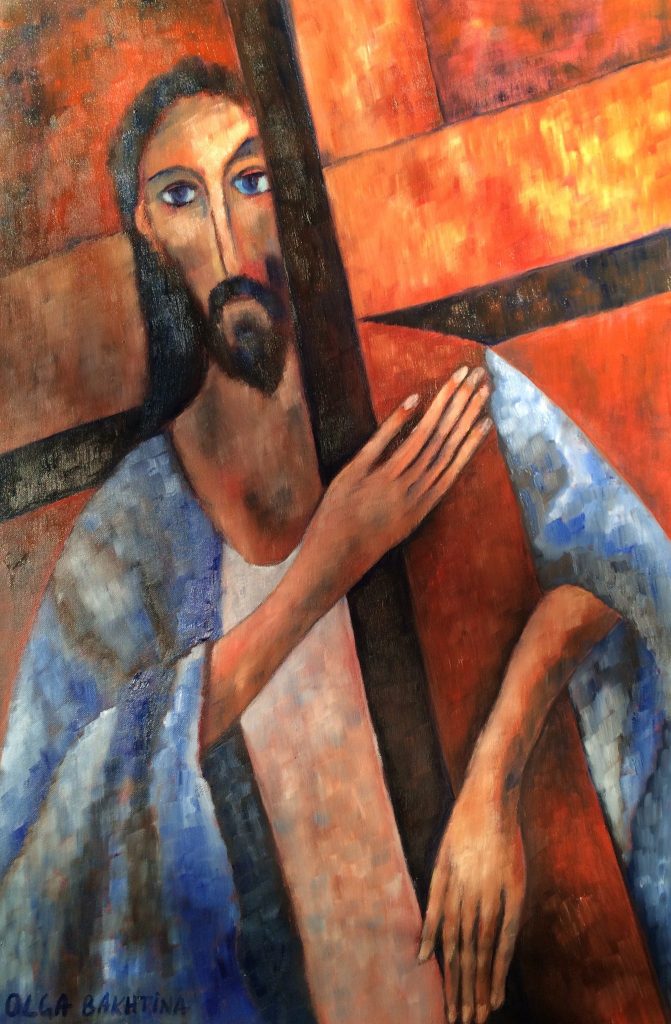
“Jesus Carrying The Cross” by Olga Bakhtina, 2017

When Christians grasp this truth, even a little bit, it should cause us to repent of our sinful good works (yes, sinful good works). Wherever there is humility that leads to a complete turning to Jesus, there is revival to new life in God, and a personal reformation around the doctrine of grace instead of the doctrine of my glorious works that I perform.

We, then, as Christians, saved and justified through the blood of Jesus, ought to be the most joyful and grateful people on the planet. We have deliverance from the deception of our hearts to life in Christ. Apathy and lethargy to the things of God are the twin evils that reign in the place of awe and appreciation for what God has done for us in Christ.

There is nothing more God can do to show us that he loves us than by actually dying for us, and by doing so, satisfying God’s own wrath against the sin which seeks to destroy us. The late Brennan Manning once told the story about how he got the name “Brennan.”

While growing up, his best friend was Ray. The two of them did everything together: bought a car together as teenagers, double-dated together, and went to school together. They even enlisted in the Army together, went to boot camp together and fought on the frontlines together.

One night while sitting in a foxhole, Brennan was reminiscing about the old days in Brooklyn while Ray listened and ate a chocolate bar. Suddenly, a live grenade came into the foxhole. Ray looked at Brennan, smiled, dropped his chocolate bar and threw himself on the live grenade. It exploded, killing Ray, but Brennan’s life was spared.

Later in life, when Brennan became a priest, he was instructed to take on the name of a saint. He thought of his friend, Ray Brennan. So, he took on the name “Brennan.”

Years later he went to visit Ray’s mother in Brooklyn. They sat up late one night having tea when Brennan asked her, “Do you think Ray loved me?” Mrs. Brennan got up off the couch, shook her finger in front of Brennan’s face and shouted, “What more could he have done for you?” Brennan said that at that moment he experienced an epiphany. He imagined himself standing before the cross of Jesus wondering, Does God really love me? And Jesus’ mother Mary pointing to her son, saying, “What more could he have done for you?”

The cross of Jesus is God’s way of doing all he could do for us. And yet we often wonder: Does God really love me? Am I important to God? Does God care about me? We tend to ask those questions when we are trusting in ourselves, because we never really know where we stand with God.

No matter how bad or how good you are, the path of suffering of our Lord Jesus has taken care of the sin issue once for all.

Week after week for the past two-thousand years, God’s people have gathered together to worship this same Lord Jesus who died on the cross. The only thing left for us to do, since Jesus has done it all for us, is to offer our lives to him.

While we were still sinners, enemies, estranged, hopeless, lost, despondent, proud, and stained by sin, Jesus died a cruel death on a cross to wash away your sins with his blood. It is my hope and prayer that today you are rediscovering the great Reformation truth that we are justified by grace alone through faith in Jesus alone, and the life of unbounded joy in knowing that we have now received reconciliation with God in Christ.

Lord God Almighty, the ground is level at the foot of the cross. We need you, Lord Jesus, and come to you on the basis of nothing else but your shed blood. I pray for all those who are wrestling with you right now. Oh, that you would revive those that need new life, that you would renew those who have become cold, and that you would reform all of our hearts so that our lives would completely be devoted around the person and work of Jesus Christ! 

Thank you, Lord Jesus, for dying for us while we were still powerless, sinful, and ungodly. Thank you for saving us from God’s wrath. Thank you, God Almighty, for reconciling us back to yourself through the cross. There are those needing you to break through their stubborn hearts; and those who need peace to their troubled hearts. O God, save us from ourselves, whether it is from our trust in our own perceived goodness, or our sense of shame and guilt. Thanks be to God, who gives us the victory through our Lord Jesus Christ. Amen.