Romans 5:6-11 – Christ Died For Us

“Golgotha” by Edvard Munch, 1900

You see, at just the right time, when we were still powerless, Christ died for the ungodly. Very rarely will anyone die for a righteous person, though for a good person someone might possibly dare to die. But God demonstrates his own love for us in this: While we were still sinners, Christ died for us.

Since we have now been justified by his blood, how much more shall we be saved from God’s wrath through him! For if, while we were God’s enemies, we were reconciled to him through the death of his Son, how much more, having been reconciled, shall we be saved through his life! Not only is this so, but we also boast in God through our Lord Jesus Christ, through whom we have now received reconciliation. (New International Version)

In Christianity, there is only one way of approaching God: Through the death of Jesus Christ. That means we cannot approach God by our good works, doing things right, or by our spiritual pedigree. We are justified and declared righteous by grace alone through faith in the cross of Christ.

Back when my youngest daughter was still living at home, sometimes I needed to go into her room to get something. More often than not, it ended up becoming an archaeological dig. I had to wade through layers of stuff. I didn’t always find what I was looking for, and other times I discovered things I didn’t know I had even lost. 

When the magisterial Reformer, Martin Luther (1483-1546) went digging into the Bible, he found he was wading through layers of church tradition and came upon something that was lost. Luther rediscovered that God justifies sinners by grace through faith apart from any good works done by us. Luther found in the Scriptures that we are completely and totally at the mercy of God in Christ.

The cross of Jesus Christ is the means of salvation from what ails us because the cross is an attack on human sin. Luther discovered we all have layers of stuff that has grown around our hearts to the degree that we no longer see the sheer grace of God in Christ alone to meet the most pressing needs of our lives. 

The Reformation has taught believers that apart from Christ, we are addicted to ourselves. The cross is the intervention we need to help us confront our constant me-ism.

We might justify ourselves with the fact we do good works. However, one of the legacies of the Reformation, coming from the book of Romans, is that good works do not earn us deliverance from sin. In fact, Luther said that our good deeds are the greatest hindrance to our salvation because we have the tendency to trust in those good deeds instead of the death of Christ. 

So, Luther actually called our good works a mortal sin that sets off God’s wrath and leads straight to hell. In other words, good deeds can be deadly, if they are done as a means of approaching and appeasing God. 

It is through the suffering of Jesus on the cross, his death for us while we were still sinners, not when we were lovely and looking fine with all our pious actions, that we are saved. 

“He who does not know Christ does not know God hidden in suffering. Therefore, he prefers works to suffering, glory to the cross, strength to weakness, wisdom to folly, and, in general, good to evil. These are the people who are under God’s wrath! God can only be found in suffering and the cross. It is impossible for a person not to be puffed by his good works unless he has first been deflated and destroyed by suffering and evil until he knows that he is worthless and that his works are not his but God’s.”

Martin Luther’s Heidelberg Disputation

God does not come to us in our beauty and goodness but in our ugliness and sin.

While we were still sinners, ungodly, enemies of God, powerless to save ourselves, Christ died on the cross for us. We spend too much time and effort concerned about looking good and doing good things in order to present ourselves acceptable to each other and even to God. 

But that is the very sin that sends people to a hellish existence. The hottest places of damnation are actually reserved for outwardly pious persons who trusted all their lives in themselves and how they looked to others without a thought, at all, about justification, reconciliation, and being restored to God through Christ.

Like a gold ring in a pig’s snout, is a person who has good deeds but knows nothing of God’s grace.

It is a totally human tendency to decide which sinful actions are trivial and which are the biggie sins. The Apostle Paul was really hard on his fellow Jews in the book of Romans because they tended to place their trust in who they were and what they did – being the covenant people and practicing all the good things a good person does. And Paul says the wrath of God is reserved for them. 

The way of approaching God is by seeing our true ugliness, our rebellious hearts, and that the hope of salvation is through the cross of Christ. We are justified by and reconciled to God because of Jesus, and not for any other reason. A new relationship is established based solely in God’s grace.
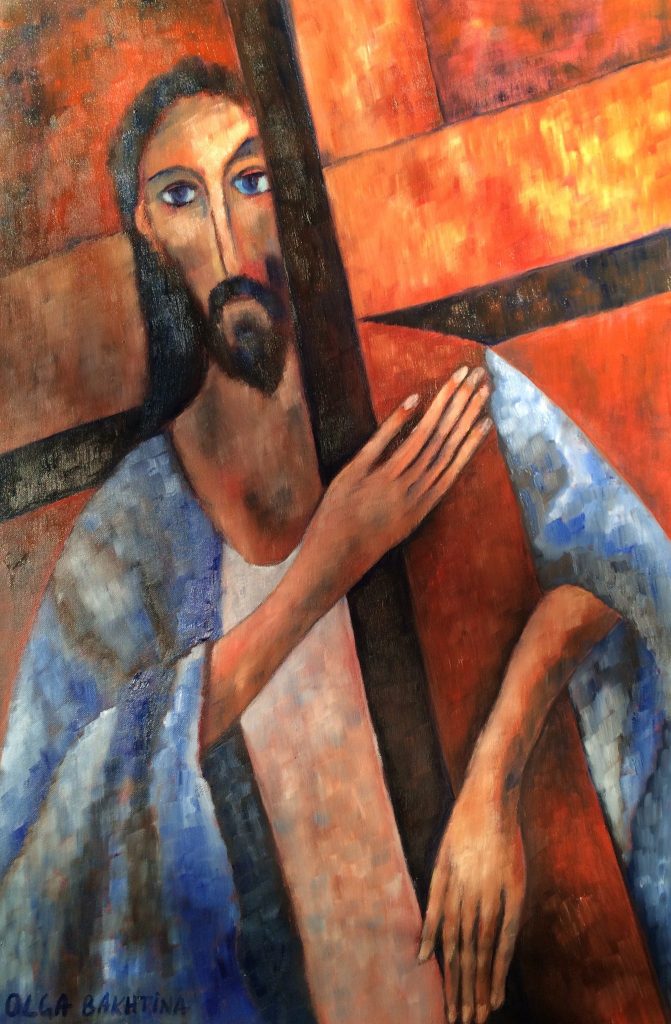
“Jesus Carrying The Cross” by Olga Bakhtina, 2017

When Christians grasp this truth, even a little bit, it should cause us to repent of our sinful good works (yes, sinful good works). Wherever there is humility that leads to a complete turning to Jesus, there is revival to new life in God, and a personal reformation around the doctrine of grace instead of the doctrine of my glorious works that I perform.

We, then, as Christians, saved and justified through the blood of Jesus, ought to be the most joyful and grateful people on the planet. We have deliverance from the deception of our hearts to life in Christ. Apathy and lethargy to the things of God are the twin evils that reign in the place of awe and appreciation for what God has done for us in Christ.

There is nothing more God can do to show us that he loves us than by actually dying for us, and by doing so, satisfying God’s own wrath against the sin which seeks to destroy us. The late Brennan Manning once told the story about how he got the name “Brennan.”

While growing up, his best friend was Ray. The two of them did everything together: bought a car together as teenagers, double-dated together, and went to school together. They even enlisted in the Army together, went to boot camp together and fought on the frontlines together.

One night while sitting in a foxhole, Brennan was reminiscing about the old days in Brooklyn while Ray listened and ate a chocolate bar. Suddenly, a live grenade came into the foxhole. Ray looked at Brennan, smiled, dropped his chocolate bar and threw himself on the live grenade. It exploded, killing Ray, but Brennan’s life was spared.

Later in life, when Brennan became a priest, he was instructed to take on the name of a saint. He thought of his friend, Ray Brennan. So, he took on the name “Brennan.”

Years later he went to visit Ray’s mother in Brooklyn. They sat up late one night having tea when Brennan asked her, “Do you think Ray loved me?” Mrs. Brennan got up off the couch, shook her finger in front of Brennan’s face and shouted, “What more could he have done for you?” Brennan said that at that moment he experienced an epiphany. He imagined himself standing before the cross of Jesus wondering, Does God really love me? And Jesus’ mother Mary pointing to her son, saying, “What more could he have done for you?”

The cross of Jesus is God’s way of doing all he could do for us. And yet we often wonder: Does God really love me? Am I important to God? Does God care about me? We tend to ask those questions when we are trusting in ourselves, because we never really know where we stand with God.

No matter how bad or how good you are, the path of suffering of our Lord Jesus has taken care of the sin issue once for all.

Week after week for the past two-thousand years, God’s people have gathered together to worship this same Lord Jesus who died on the cross. The only thing left for us to do, since Jesus has done it all for us, is to offer our lives to him.

While we were still sinners, enemies, estranged, hopeless, lost, despondent, proud, and stained by sin, Jesus died a cruel death on a cross to wash away your sins with his blood. It is my hope and prayer that today you are rediscovering the great Reformation truth that we are justified by grace alone through faith in Jesus alone, and the life of unbounded joy in knowing that we have now received reconciliation with God in Christ.

Lord God Almighty, the ground is level at the foot of the cross. We need you, Lord Jesus, and come to you on the basis of nothing else but your shed blood. I pray for all those who are wrestling with you right now. Oh, that you would revive those that need new life, that you would renew those who have become cold, and that you would reform all of our hearts so that our lives would completely be devoted around the person and work of Jesus Christ! 

Thank you, Lord Jesus, for dying for us while we were still powerless, sinful, and ungodly. Thank you for saving us from God’s wrath. Thank you, God Almighty, for reconciling us back to yourself through the cross. There are those needing you to break through their stubborn hearts; and those who need peace to their troubled hearts. O God, save us from ourselves, whether it is from our trust in our own perceived goodness, or our sense of shame and guilt. Thanks be to God, who gives us the victory through our Lord Jesus Christ. Amen.

Luke 10:25-37 – The Parable of the Good Samaritan

Good Samaritan by He Qi

A legal expert stood up to test Jesus. “Teacher,” he said, “what must I do to gain eternal life?”

Jesus replied, “What is written in the Law? How do you interpret it?”

He responded, “You must love the Lord your God with all your heart, with all your being, with all your strength, and with all your mind, and love your neighbor as yourself.”

Jesus said to him, “You have answered correctly. Do this and you will live.”

But the legal expert wanted to prove that he was right, so he said to Jesus, “And who is my neighbor?”

Jesus replied, “A man went down from Jerusalem to Jericho. He encountered thieves, who stripped him naked, beat him up, and left him near death. Now it just so happened that a priest was also going down the same road. When he saw the injured man, he crossed over to the other side of the road and went on his way. Likewise, a Levite came by that spot, saw the injured man, and crossed over to the other side of the road and went on his way. A Samaritan, who was on a journey, came to where the man was. But when he saw him, he was moved with compassion. The Samaritan went to him and bandaged his wounds, tending them with oil and wine. Then he placed the wounded man on his own donkey, took him to an inn, and took care of him. The next day, he took two full days’ worth of wages and gave them to the innkeeper. He said, ‘Take care of him, and when I return, I will pay you back for any additional costs.’ What do you think? Which one of these three was a neighbor to the man who encountered thieves?”

Then the legal expert said, “The one who demonstrated mercy toward him.”

Jesus told him, “Go and do likewise.” (Common English Bible)

In Christianity, no one justifies themselves. The kingdom of God turns on grace, and not with us working more or harder. As we anticipate Reformation Day, Christians remember the famous posting of the 95 Theses by Martin Luther on the Castle Church door in Wittenberg, Germany in 1517. 

Justification by grace through faith, apart from human effort, is the great theological emphasis and legacy of the Reformers. I suppose one would expect to look at the New Testament books of Romans and Galatians when it comes to dealing with justification. However, there might just be a better place to go….

Christ’s parable of the Good Samaritan is a famous and familiar story to many people, even for those outside of the Christian faith tradition. The parable is likely not the place one thinks to go when considering the Reformation. Yet, this parable is just the right place for considering the grand Reformation doctrine of justification.

“Every week I preach justification by faith to my people, because every week they forget it.”

Martin Luther (1483-1546)

The Gospel writer, Luke, gives us insight into the thought process of the person for whom Jesus told the parable to. That man sought to justify himself. 

When we view the parable from the angle of justification, we see the perspective of the wounded and hapless man, the victim of robbers. He was left for dead, and, indeed, in the story we know that he would die apart from help – the kind of help the man could not do for himself. He was completely dependent on someone to rescue him from his plight.

The Samaritan, the Christ figure in the story, comes and shows the man mercy. This grace was free, lacked any sort of favoritism, and was full of sheer kindness. Without the Samaritan’s actions of binding up the man’s wounds and getting him to a safe place, the victim would have died.  

Reformation Day, and every day, is a good day to celebrate the wonderful and glorious reality that Jesus Christ saves people from their terrible plight. 

Christ’s mercy is not dependent on what kind of people we are but is simply based on need. God graciously gives us the gift of faith and the mercy of deliverance. By Christ’s wounds we are healed. 

Take some time today to reflect on this most gracious of biblical truths: We do not need to justify ourselves. As Christians, we already possess justification by grace alone apart from human effort. 

Read the parable of the Good Samaritan carefully and slowly, absorbing it from this angle of the inability to justify ourselves and the incredible mercy of Christ. Let this wonderful truth sink deep in your soul to bring increased awareness, emotional wholeness, and spiritual healing.

Lord God, heavenly Father, you did not spare your only Son, but gave him up for us all to be our Savior, and along with him you have graciously given us all things. We thank you for your precious, saving gospel, and we pray that you would help us to believe in the name of our Savior faithfully and steadfastly, for he alone is our righteousness and wisdom, our comfort and peace, so that we may stand on the day of his appearing, through Jesus Christ, your dear Son, our Lord. Amen. – A Lutheran Collect of Thanksgiving

God Alone Justifies


God alone makes people right (Romans 8:33; Luke 18:9-14).  Because it is God who justifies, we do not have to!  We do not need to defend ourselves, make ourselves look good, or fool ourselves into believing that we are what we want others to think of us.  Insisting that we are always okay and right only creates division, separates people into bad and good, fosters disharmony, and is an affront to God.  To pursue what is already provided by God’s grace is sin.
 
            I realize I am using strong language here about self-justification.  But consider its origins.  It goes all the way back to the original sin of Adam and Eve.  They were told by God that they could eat from any tree in the garden; but they were given strict instructions not to eat of the tree of the knowledge of good and evil.  Have you ever wondered why God deemed it so important not to eat of that specific tree?  The knowledge of good and evil actually seems like it might be useful, even necessary.  So, why completely avoid that tree?  When Adam and Eve ate from it their eyes were opened to a different perspective, a new reality that changed the way humanity deals with one another.  From that point forward people began drawing lines down the middle and placing themselves on the good side while vilifying those on the other side, the bad side.
 
            Adam and Even started justifying their actions, their attitudes, and their behavior on the day they fell by drawing lines between good and evil.  Adam drew a line between him and Eve.  Eve gave him the fruit; she is on the other side.  Eve drew a line between her and the serpent.  Adam drew a line between himself and God!  Ever since our original ancestors started drawing lines and taking sides, it has never stopped.  We draw political lines and place ourselves on the good side while demonizing the other side.  We draw religious lines and place ourselves on the good side while distancing ourselves from our fellow humanity and calling them evil.  We draw lines between classes, races, gender, and ethnicities.  We are constantly drawing lines and taking sides.  Violence, war, and every other sin in the world come from the original sin of self-justification:  I am okay, you are not.
 
            In the movie, What About Bob? Bill Murray was asked by his therapist why he was divorced.  His answer:  “There are two kinds of people in the world; those who like Neil Diamond, and those who don’t; my wife loved him.”  Bob drew a line, placing himself on the good side of it while implying that his ex-wife was on the other side, the bad side.  Ever since the fall of humanity we keep drawing lines and justifying our attitudes and our actions.
 
            Self-justification always compares itself with others.  People who think that it is their job to always be right are constantly concerned about other people; they need to know what is going on with them.  They keep their ear to the ground because they must be vigilant to keep the lines drawn and distinguish themselves from those on the other side, the bad side.
 
            But when we are justified by God and he makes us right by his own grace, the curse upon humanity is reversed.  Everything changes and reverts to its original design.  Our souls are rebuilt and become robust and vigorous not through effort and work, but through relaxation and rest in Christ’s finished work.  There is now no fear because there is no condemnation for those who are in Christ Jesus.  There is no comparisons needed anymore because God is enough, Christ is sufficient.  There is no more worry about how we look to others; instead, there is contentment and satisfaction in the love of God in Christ.


Only God can justify!  Righteousness is a gift.  Until we know this, receive the gift, and live in it, we will continue in vain to make ourselves look good and be on the right side of everything while making others look bad.  It is not the job of church ministries to group people into who is in and who is out, who is bad and who is good; rather, church ministry is to proclaim the righteousness of Christ as the only means of making people right.  If there are no sides to take, then we are all in life together.  Until we get to that point, there is no progress.  But when we do, there is peace, love, and abundant joy that God would save such as sinner as I.

Jesus Is Enough


Jesus is our great high priest.  His priesthood, his intercessory ministry, is permanent.  He is the once-for-all sacrifice for sins.  Jesus lives forever.  He saves completely.  Jesus meets our need.  He has been made perfect forever (Hebrews 7:23-28).  Say any of those statements in the typical church and hardly an eyebrow would get raised – they almost seem ho-hum.  Our blank affect testifies that we have lost a great deal of the original force and extreme impact of Christianity.
 
In the first century, it was a radical idea to have one sacrifice to end all sacrifices.  Every ancient person understood that sacrifices were only temporary; you had to keep offering them over and over again.  Christianity, however, asked the world to have a new understanding of sacrifice.  No longer would there be any sacrifice – no grain sacrifice; no offerings of first-fruits; no animal sacrifices; no sacrifices, period.  There was no longer any need for them because Jesus is the once-for-all sacrifice to end all sacrifices.  This was such a crazy and ridiculous notion for so many people that they mocked Christians for it.  Both Jews and pagans could barely wrap their minds around such a liberal progressive idea.  It would be like saying to us today that there is no longer any need for money because somebody just became the underwriter for everything everybody does.
 
            Yet, we in the modern church sometimes go back to the old kind of sacrificial system, not by physically offering animal sacrifices, but treating Christ’s once-for-all finished work as if it were just too good to be true.  We reason that we need to do something to help save ourselves.  However, Jesus has not just saved us partially, but fully.  Our church attendance can subtly be looked upon as a sacrifice to appease God, as if he needed to be soothed into not becoming angry at us.  Our giving can become some non-bloody sacrifice that is meant to satisfy God’s furrowed brow against us.  Our service can degenerate into a sacrifice to assuage our guilty conscience.  In all these kinds of instances, it is going back to an old sacrificial system that is obsolete.
 
            The biblical and theological truth is that Jesus has thoroughly saved us from our sin, and, so, has cleansed us from all guilt, including a guilty conscience.  Jesus meets our need and has completely satisfied God’s wrath against sin.  Jesus is our mediator and intercedes for us as we come to God’s throne of grace.  That means we do not need to try and get God’s attention with performing spiritual cartwheels or some incredible sacrifice that will somehow obligate him to take notice.  The truth is that there is never a time in which we lack attention from God.
 
            Since we have been justified by faith in Jesus, we need not worry anymore about being good enough.  Since Jesus is perfect, his work is made complete in us.  This constant anxiety of feeling like we don’t measure-up does not come from God.  Jesus is sufficient and has taken our place so that we can live in the freedom and joy of a complete deliverance from sin, death, and hell.  There is no longer any necessary sacrifice to make!
 
            “Well,” you might say, “if everybody in the church believed that then nobody would ever do anything.”  No, it is just the opposite.  When we feel like we don’t measure up, we do less, not more.  A low level discouragement sets in and we do nothing because we intuitively know it will never be enough.  We do just enough to squeak by, never quite knowing if it is doing anything.  We consider giving up because Christianity doesn’t work for us.  But when we grasp the New Covenant of Christ’s sacrifice to end all sacrifices, and are overwhelmed by grace, then everything we do in the Christian life is a simple desire to say “thank you” with our life and our lips.  It is a joyous offering ourselves, body, soul, and spirit.  It is the grace, and not the wrath, of God that teaches us to say “no” to ungodliness and worldly passions and to live upright and godly lives (Titus 2:11-12).


            On this upcoming Reformation Sunday we celebrate the glorious reality that we are justified by faith in Jesus Christ alone and not by our own accomplishments, pedigree, or effort.   Trusting in our heritage, relying on our family’s faith, or believing our hard work gives us a leg-up toward heaven will only end in despair.  But if we trust in Christ’s perfect sacrifice then a whole new world of mercy and grace opens before us.  Soli Deo Gloria!