We Are All In the Same Boat (Romans 3:9-20)

What shall we conclude then? Do we have any advantage? Not at all! For we have already made the charge that Jews and Gentiles alike are all under the power of sin. As it is written:

“There is no one righteous, not even one;
    there is no one who understands;
    there is no one who seeks God.
All have turned away,
    they have together become worthless;
there is no one who does good,
    not even one.”
“Their throats are open graves;
    their tongues practice deceit.”
“The poison of vipers is on their lips.”
    “Their mouths are full of cursing and bitterness.”
“Their feet are swift to shed blood;
    ruin and misery mark their ways,
and the way of peace they do not know.”
    “There is no fear of God before their eyes.”

Now we know that whatever the law says, it says to those who are under the law, so that every mouth may be silenced and the whole world held accountable to God. Therefore no one will be declared righteous in God’s sight by the works of the law; rather, through the law we become conscious of our sin. (New International Version)

Whenever there is division, separation, and polarization between two groups of people, it’s important that someone has the ability to come back to what is true and common to all of us.

And that is what the Apostle Paul did in addressing the two differing groups of people in the ancient Roman Church of both Jewish and Gentile believers in Jesus.

The Jewish Christians, Paul argued, did not have a leg up on the Gentiles, just because of their long history with God. They tended to see themselves as better than their Gentile brothers and sisters in Christ. After all, the Jewish believers reasoned, we don’t have such a background of sinful pagan practices and estrangement from God.

Well, actually they do, however the Apostle did not rehearse his own people’s long history of stubborn rebellion and waywardness from God. Instead, he went back to the scriptures, and reminded the Jewish Christians of something they seemed to have lost sight of:

To be a human being is to be intimately familiar with sin and godlessness, guilt and shame, no matter the group nor the individual. We are all in the same boat.

In saying this, the Apostle Paul was not implying there is not anything good in anyone. Quite the contrary. For what is also true of humanity is that every individual person is a good creature, created from a good Creator, with the divine stamp of God’s image and likeness. There are no exceptions to this.

With all the mudslinging within the church, Paul simply pointed out that there is more than enough blame to go around. All the things that one group accuses another of is also true about they themselves.

And when it comes to sin – all those actions, words, and attitudes we have done and failed to do in loving our fellow humanity, and God – every one of us is in the same boat of guilt before God. There are no exceptions to this.

The power and ubiquity of sin is everywhere. Sin is like a nasty weight which continually burdens the world, and like an acrid fog that is always hanging in the air. We all feel the heaviness; we all breathe the same air.

All of our puny attempts at dividing one another into star-bellied Sneetches, and Sneetches without stars upon thars, is only proof positive of our sinful predilections to acquiesce to sin’s power on this earth.

This means that none of us can claim to take the moral and spiritual high ground. Nobody has an advantage on another. Therefore, it is ridiculous to ever try and implement policies of favoritism, cronyism, or prejudice. Such thinking itself is sinful, and ought to be jettisoned at the first awareness of it.

Whether we know what is right, or not; and whether we have the law and a covenant code, or not, isn’t really the issue. Obeying the law and doing what is right and just, with a good heart, is the real issue for all of us.

But it’s rather difficult to truly embrace justice and righteousness if the heart is no good. In truth, all of us have some rather dark places in our hearts. And until these are addressed, we will keep having all of our humanly contrived divisions and separations based upon a supposed superiority of the other.

The very fact that it is so easy to point out the sin in another, and label them as sinner, ought to tell us that “It takes one to know one.”

All Jews and Gentiles are under the accusation of God’s law, without exception. Everyone is accountable to God and the law. Proper observance of the law is to love God and neighbor – and thus, condemnation under the law is to ignore and disobey God, and to ignore and hate one’s fellow humanity.

What’s more, neither Jew nor Gentile can be justified by the law. Not a one of us can undo our guilt by ourselves.

No amount of work can satisfy the breadth and depth of that guilt. Pledges of perfectionism cannot help us, namely because we don’t even have the ability to follow through on them. Sheer hard work will not do the trick, because it would be like trying to empty the ocean with a kid’s sand toy bucket.

Only grace can reverse things. We need a pardon, and a new heart, which can sync and beat with the holy rhythms of divine love and justice. We need Jesus.

The Apostle Paul eventually got to that point later in his letter. Yet, here, he needed to establish everyone’s commonality of sin, so that they would embrace Jesus together as the one people of God who are in desperate need of his saving work, and the Spirit’s sanctifying work.

Therefore, the proper place to begin in being at peace with God and the world is to confess our own complicity in sin. Let us, then, offer this prayer of confession:

Lord Jesus, we have sinned times without number, and been guilty of pride and unbelief, and of neglect to seek you in our daily lives. Our sins and shortcomings present us with a list of accusations, but we thank you that they will not stand against us, for all have been laid on Christ. Deliver us from every evil habit, every interest of former sins, everything that dims the brightness of your grace in us, everything that prevents us taking delight in you. Amen.

Divine Affirmation (Isaiah 44:1-5)

The Lord says,

“Listen now, Israel, my servant,
    my chosen people, the descendants of Jacob.
I am the Lord who created you;
    from the time you were born, I have helped you.
Do not be afraid; you are my servant,
    my chosen people whom I love.

“I will give water to the thirsty land
    and make streams flow on the dry ground.
I will pour out my spirit on your children
    and my blessing on your descendants.
They will thrive like well-watered grass,
    like willows by streams of running water.

“One by one, people will say, ‘I am the Lord’s.’
    They will come to join the people of Israel.
They each will mark the name of the Lord on their arms
    and call themselves one of God’s people.” (Good News Translation)

Who do you believe you are, at the very core of your being?

Your very essence, the person you are deep down inside, is worthy of divine blessing and belonging. You are loved by God.

In a world of abject hate and injustice, there remains within the soul the majesty of people created in the image and likeness of God. There is still hope for us, that is, if we will receive water in our thirst and be bathed in the reality of who we are. And I take a decidedly Christian perspective on that identity.

I am a firm believer in making daily affirmations of truth based upon what God has done for us in Christ. The Christian doctrine of justification means that God has justified us and made us right, along with all creation through the cross of Jesus. This is more than a doctrine to believe, but it is also a reality to be lived into each and every day.

I know it doesn’t always feel like we belong or that we are blessed. Many of our adverse situations may cause us to wonder about whether God accepts us, or not.

As we go through life, there are those who don’t like the way we do things, or are upset about our views on particular subjects, or think that we ought to be doing something we aren’t doing. In such times, my initial reaction might be to justify myself – to defend my words or my silence, my actions or inactions, and my work. 

I am not yet what I will be someday, but I am not what I used to be either.

These sorts of encounters can easily leave us feeling insecure, like a vulnerable teenager trying to look cool in the middle of his awkwardness. I even once had a person complain to me that on a particular Sunday my shoes were not shined well enough. For a person like me who is borderline obsessive-compulsive, that was not an easy mental slough-off; I really wanted to beat myself up over the lack of shiny shoes!

The truth of the Christian life is that I have no need to justify myself. Why? Because God has already justified me in Christ. 

The following are some regular affirmations we can tell ourselves for truth and righteousness to awaken within our souls:

  1. I thankfully acknowledge and accept who I am in my unchangeable physical appearance which God has uniquely designed for me, so that the Lord can bring a special view to others through my life. (Psalm 139:13-18; 2 Corinthians 10:12, 12:9-10)
  2. I thankfully acknowledge and accept that I am unconditionally loved and treasured by God, who wanted a relationship with me, and to whom I belong. (Romans 8:31-32, 38-39; John 6:44, 17:23)
  3. I thankfully acknowledge that I am unconditionally accepted as a worthy person to God, because of Jesus Christ, in whom I trust for all things. (Ephesians 1:16; Romans 4:6-8; Isaiah 61:10)
  4. I thankfully acknowledge that I am a secure person because God cares about me and asks me to trust divine leadership and goodness. (Romans 8:28; Matthew 6:25-33; Proverbs 3:5-6; Psalm 37:3-7, 23)
  5. I thankfully acknowledge that I am in a process of growth. My sinful nature is part of my personality, but it is not who I am. I consider myself dead to the sinful nature and alive and responsive to God. I am not yet what I will be someday, but I am not what I used to be either. I accept my struggles with guilt and shame as opportunities to depend more on God and Christ’s justification for me. (1 Peter 2:1-3; Romans 6:11; 2 Corinthians 10:13; Galatians 5:16)
  6. I thankfully acknowledge and accept that I am a competent person who is adequate to fulfill God’s will successfully each day. My strength is supplied by God’s Holy Spirit, who works through me to make an important and eternal impact on others with the love of God and the message of Christ. (Philippians 2:13, 4:13; 1 Corinthians 10:13; 1 Peter 4:10-11; 2 Corinthians 5:20)

We are loved, accepted, and cared for by God. And we have important lives to live. Therefore, we need not threatened or devastated by the way some people treat us. 

Others do not determine our self-worth. We might be pained when others let us down, but it is not the end of the world. We can continue to act responsibly toward them without demanding that they understand us, accept us, or respect us.

Many if not most people try to find acceptance and significance through family, peers, faith communities, achievements, appearance, work, etc. Yet, none of those sources can satisfy or fulfill our basic personal needs. This is why there are so many people who feel resentment, anxiety, guilt, or a vague sense of emptiness and even despair.

Yet when a person trusts God and exhibits faith in Christ, as the true source of justification in order to satisfy basic needs, that person can learn to regard themself in their new identity with Christ: 

  • Their faith can be trained to believe in and focus on a new self-concept, even in circumstances when they feel the pain of rejection. 
  • They can rebound from disappointment and develop resilience. 
  • They can forgive others and continue to serve others without dependence upon positive feedback from another.

To be justified by Christ means that we can live in the security of being a child of God without depending on others to do for us what God has already done through Jesus. Learning to live in this way takes daily affirmations of faith and truth.

Glory to the Father and to the Son and to the Holy Spirit; as it was in the beginning is now and shall be forever. Our faith and hope is not in vain, because God’s love has been poured into our hearts. Amen.

A Parable On Being Right with God (Luke 18:9-14)

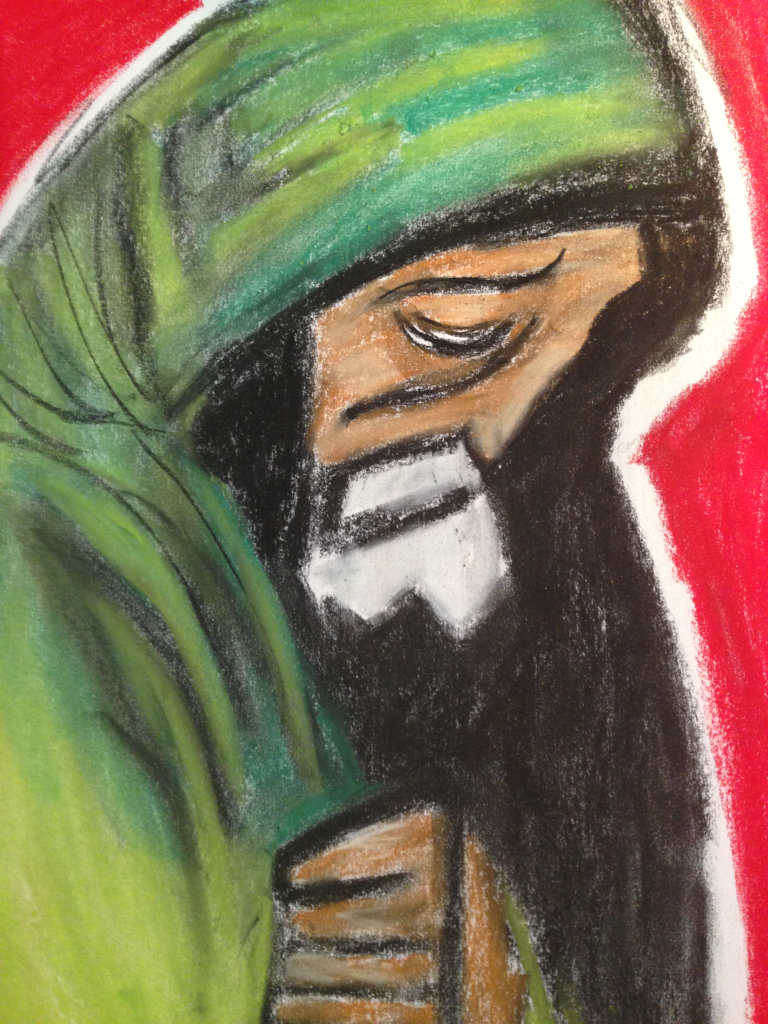
The Tax Collector and the Pharisee by Peter Gallen

To some who were confident of their own righteousness and looked down on everyone else, Jesus told this parable: “Two men went up to the temple to pray, one a Pharisee and the other a tax collector. The Pharisee stood by himself and prayed: ‘God, I thank you that I am not like other people—robbers, evildoers, adulterers—or even like this tax collector. I fast twice a week and give a tenth of all I get.’

“But the tax collector stood at a distance. He would not even look up to heaven, but beat his breast and said, ‘God, have mercy on me, a sinner.’

“I tell you that this man, rather than the other, went home justified before God. For all those who exalt themselves will be humbled, and those who humble themselves will be exalted.” (New International Version)

There’s a lot to observe in Christ’s parable for today. Notice six observations of the story….

1. We Cannot Make Ourselves Right with God

I’m convinced that most Gentile Christians, standing two millennia apart from Christ’s telling of this parable, are much too hard on the Jewish Pharisees: “Well, I’m certainly glad that I am not like the Pharisee in this story!” so many tell themselves. It seems to me the Pharisees get a bad rap because of our own predilection to justify ourselves.

After all, we can only really criticize something we are already familiar with.

A temptation which every individual and community faces is the seduction toward self-justification, instead of being justified by God.

Way back in the day, when I made treadmill belts for a living, I was in charge of quality control. It was my job to make sure that the quality department provided the shipping department with a finished product, free of defects, and could stand the test of continual use. I justified the belt as being a treadmill belt of integrity; the belt did not, nor could not, justify itself, hide or fix its flaws, or make itself right.

To think that a treadmill belt could justify itself is in the same sort of crazy that believes we can make ourselves right. No, it is God alone who justifies the sinner.

The paradox of Christ’s parable is that the real sinners are those who claim to be righteous, while the truly righteous are those who recognize they cannot justify themselves and need God to make them right.

2. We Need to Be Honest about the Right Thing

In order to hear the good news about God’s ability to justify and make right, we must also hear the bad news about why we need justification to begin with. An honest look into the mirror reveals that we have been hiding behind a cosmetic façade of self-justification.

Our illusions and delusions need to be confronted and shattered. Because only then can we receive grace and realize the peace and harmony of God’s justification.

Since God justifies, I don’t have to!

I don’t need to defend myself, make myself look better than I am, nor fool myself into believing that the false façade is the true self.

The parable of Jesus is a contrast between the Pharisee who justifies himself, and the tax collector who looks to God alone for his justification.

3. The Put-Together Guy Wants to Make Himself Right

Jesus uses a Pharisee as a character in the parable because the guy represented someone who everyone else looks up to as the model of a spiritual and religious person. Christ is inviting his hearers to look beyond the façade of what we see with our physical eyes.           

We need to use our spiritual eyes to notice below the surface. Look at the attitude. The smug self-justifying disposition is flat-out sin. What’s more, self-justification is a root of all sorts of sins.

Judging ourselves to be right means that others are wrong. That attitude creates division, separates people into bad and good, fosters disharmony, and is an affront to God. 

To try and obtain what is already provided by grace is plain old-fashioned sin.

4. We’re Obsessed with the Right Lines

Adam and Eve were told by God that they could eat from any tree in the garden but were given strict instructions not to eat of the tree of the knowledge of good and evil. (Genesis 2:15-17) So, why avoid that particular tree?

Because it was a tree which spiritually and socially blinds people. Adam and Eve ate from it and their eyes were “opened” to a different reality – which was actually a “closed” view of reality that changed the way humanity deals with one another. From that point forward, people began drawing lines down the middle and placing themselves on the “good” side while vilifying those on the other side, the “bad” side.

“Apple Picking,” the fall of Adam and Eve, by Vittorio Canta

Adam and Eve immediately began justifying their actions, their attitudes, and their behavior. (Genesis 3:8-13) Adam drew a line: “That woman, Eve, gave me the fruit; she’s on the other side; it’s her fault!” Eve drew a line: “The serpent made me do it; that wasn’t really me, I’m basically good….” And ever since, the quest of making ourselves right has never stopped….

Today, we draw all sorts of lines. A popular religious line is this: “We’re good; they’re bad. Our theology is right, everybody else’s is wrong. The Bible says….” (insert a kooky interpretation of Scripture, based in self-justification and separation of people into good and bad groups)

People draw class lines, race lines, gender lines, ethnic lines, economic lines. We want clean lines, vertical lines, horizontal lines, perpendicular lines, thick lines, thin lines, any kind of line; just give me a line! Let’s go line dancing. Maybe take an airline. There are offensive lines and defensive lines. By the way, what’s the line on the Packers? We even judge the lines themselves: Long lines, short lines, front lines, back lines, and DMV lines are clearly evil, right!?

Why are we so obsessed with drawing lines? So that we can take self-justifying sides. Violence, war, and most every other sin of the world comes from the original sin project of trying to make ourselves right: “I’m okay; you’re not.”

The Pharisee (really a representative of us all) drew a very clear line between himself and the despised sinful tax collector. Notice that self-justification always compares itself with others. Those who obsessively draw lines are compulsively concerned about other people; they believe they have a right to know what’s going on with them. They remain vigilant to keep the lines drawn and distinguish themselves from those on the other side.

5. God Is On the Other Side of the Right Line

The Pharisee found that every time he drew a line, God was on the other side with the “sinners.” That makes perfect biblical sense. If God alone justifies sinners and makes them right; and if Jesus identifies with them in his life, death, and resurrection; then God is to be found on the other side of our line-drawing.  

A self-justified person sees no need for God’s justification. Therefore, God is not on their side; God is on the other side, justifying sinners by making them right.

6. The Unraveled Guy Wants To Be Made Right

“O God, Be Merciful To Me, A Sinner,” by Ronald Raab

The tax collector’s only concern was for God to show him mercy because he is a sinner. In contrast to the proud attitude of the Pharisee, the tax collector, a sinner by anyone’s definition, humbled himself and sought justification from God alone.

  • Justification by God makes us right and:
  • Lifts the curse upon humanity and reverts everything back to its original design. (Revelation 22:1-5)
  • Erases the lines. (Romans 4:7-8)
  • Restores our souls are and strengthens our faith. (Acts 16:5; Romans 4:20)
  • Enables us to rest in Christ’s finished work. (John 19:28-30)
  • Does not condemn us. (Romans 8:1-2)
  • Eliminates comparisons because Christ is sufficient for us. (Colossians 2:13-14)
  • Replaces the anxiety and fear about how we look to others with the contentment and satisfaction of God’s love in Christ. (1 John 4:16-18)

Conclusion

Self-justification separates us from people and creates distance and division. But God’s justification connects people in love and crosses the arbitrary lines created by others.

The bad news: Many religious folk, when confronted with their self-justifying attitudes, do not change. Instead, they label the person as bad and place the offending person on the other side of their line so that they can maintain their façade of righteousness.

The good news: Jesus can be found on the other side of the line because justification is a gift. Yet, until we go to him, outside our little camp, we will continue in vain to make ourselves look good and be on the right side of everything while making others look bad.

The good and the right is to humbly – and with much flavor – cry out to God for mercy because only the Lord can save us from our plight.

Lord Jesus Christ, Son of God, have mercy on me, a sinner. 

Lord Jesus Christ, Son of God, have mercy on me, a sinner. 

Lord Jesus Christ, Son of God, have mercy on me, a sinner, and grant me your peace.

Just and right God, by your mercy we were created, and by your mercy you redeemed us through your Son, the Lord Jesus. Your mercy is the light by which all people – both sinner and saint – return to you. Your divine justice and your divine mercy exist together so that you refuse to punish us as we deserve.

Lord Jesus, it was not enough for you to take on our humanity; you died for us as well. So, we humbly and gratefully receive your gracious deliverance from sin, death, and hell. Amen.

Luke 10:25-37 – The Parable of the Good Samaritan

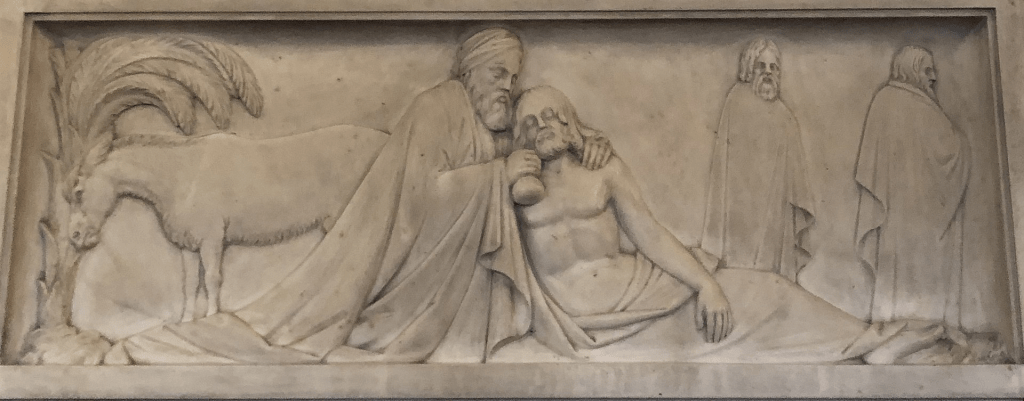
The Good Samaritan by Samuel Nixon. St. Paul’s Church, Halifax, Nova Scotia, Canada

 On one occasion an expert in the law stood up to test Jesus. “Teacher,” he asked, “what must I do to inherit eternal life?”

“What is written in the Law?” he replied. “How do you read it?”

He answered, “‘Love the Lord your God with all your heart and with all your soul and with all your strength and with all your mind’; and ‘Love your neighbor as yourself.”

“You have answered correctly,” Jesus replied. “Do this and you will live.”

But he wanted to justify himself, so he asked Jesus, “And who is my neighbor?”

In reply Jesus said: “A man was going down from Jerusalem to Jericho, when he was attacked by robbers. They stripped him of his clothes, beat him and went away, leaving him half dead. A priest happened to be going down the same road, and when he saw the man, he passed by on the other side. So too, a Levite, when he came to the place and saw him, passed by on the other side. 

But a Samaritan, as he traveled, came where the man was; and when he saw him, he took pity on him. He went to him and bandaged his wounds, pouring on oil and wine. Then he put the man on his own donkey, brought him to an inn and took care of him. The next day he took out two denarii and gave them to the innkeeper. ‘Look after him,’ he said, ‘and when I return, I will reimburse you for any extra expense you may have.’

“Which of these three do you think was a neighbor to the man who fell into the hands of robbers?”

The expert in the law replied, “The one who had mercy on him.”

Jesus told him, “Go and do likewise.” (New International Version)

Who do you relate to in the story? Which character most resonates with you in your life right now?

The Lawyer (an expert in the Old Testament Law)

The Gospel writer, Luke, gives us insight into the thought process of the person for whom Jesus told the parable to. That man sought to justify himself. In Christianity, no one justifies themselves. The kingdom of God turns on grace, and not with us working more or harder. 

Christ’s mercy is not dependent on what kind of people we are but is simply based on need. God graciously gives us the gift of faith and the mercy of deliverance. By Christ’s wounds we are healed. 

As Christians, we already possess justification by grace alone apart from human effort.

Each individual must realize they are in a theological ditch. We are all unable to get out of our predicament. Everyone needs the compassion of Christ.

But now God’s way of putting people right with himself has been revealed. It has nothing to do with law, even though the Law of Moses and the prophets gave their witness to it. God puts people right through their faith in Jesus Christ. God does this to all who believe in Christ, because there is no difference at all: everyone has sinned and is far away from God’s saving presence. But by the free gift of God’s grace all are put right with him through Christ Jesus, who sets them free. (Romans 3:21-24, GNT)

We do not need to justify ourselves.

The Priest and the Levite (experts in the Law)

The shock that hits closes to home, from Christ’s parable, is how frequently we are the ones who pass by and ignore the other. The command to “Go and do likewise,” extends about as far as the end of the story for modern hearers, landing us in the ditch between knowing the Samaritan and his compassionate generosity are set forth as an example and our tendency to ignore the cries of the downtrodden and disenfranchised.

Do not seek revenge or bear a grudge against anyone among your people but love your neighbor as yourself. I am the Lord…. When a foreigner resides among you in your land, do not mistreat them. The foreigner residing among you must be treated as your native-born. Love them as yourself, for you were foreigners in Egypt. I am the Lord your God. (Leviticus 19:18, 33-34, NIV)

The Lord defends the cause of the fatherless and the widow, and loves the foreigner residing among you, giving them food and clothing. And you are to love those who are foreigners, for you yourselves were foreigners in Egypt. (Deuteronomy 10:18-19, NIV)

We are to go and do likewise.

The Samaritan

The Samaritan, the Christ figure in the story, comes and shows the man mercy. This grace was free, lacked any sort of favoritism, and was full of sheer kindness. Without the Samaritan’s actions of binding up the man’s wounds and getting him to a safe place, the victim would have died.  

It is no coincidence that there are many hospitals throughout the country named “Good Samaritan.” Christians were at the forefront of establishing hospitals because of this very parable of Jesus. It was a significant way of living into the values of God’s kingdom.

Mercy is at the heart of all Christian ministry.

Jesus, responding to those who questioned his acts of mercy toward questionable people, said:

“Those who are well have no need of a physician, but those who are sick. Go and learn what this means, ‘I desire mercy, not sacrifice.’ For I have not come to call the righteous but sinners.” (Matthew 9:12-13, NRSV)

I appeal to you therefore, brothers and sisters, on the basis of God’s mercy, to present your bodies as a living sacrifice, holy and acceptable to God, which is your reasonable act of worship. (Romans 12:1, NRSV)

Do justice. Love mercy. Walk humbly. (Micah 6:8)

The Victim

The wounded hapless man was left for dead. In the story, we know he would die apart from help – the kind of help the man could not do for himself. He was completely dependent on someone to rescue him from his plight.

The victim in the ditch reminds us of what it feels like to be forgotten by others — and perhaps even by God. The feeling of loneliness and forsakenness invites compassion and empathy for all who experience it.

Victimization needs a voice and a champion. There are powerless people who either cannot speak or who are not heard by others. There are people, victims of abuse, who cannot get out of their traumatic ditch – overwhelmed by what another did to them.

God stands for the victim and against the robbers.

You will never again
    make victims of others
or send messengers to threaten
    everyone on this earth. (Nahum 2:13, CEV)

God will send help.

When the righteous cry out, the Lord listens;
    he delivers them from all their troubles.
The Lord is close to the brokenhearted;
    he saves those whose spirits are crushed.

The righteous have many problems,
    but the Lord delivers them from every one of them. (Psalm 34:17-19, CEB)

By his wounds we are healed.

Conclusion

The victim in the ditch is worthy of help because he carries the divine image of God.

The one who showed compassion and mercy, the Samaritan, reflected God’s likeness through his actions.

Those who passed by, the priest and the Levite, also bear the indelible mark of their Creator, yet chose to ignore their gut and got lost in their heads.

Maybe God — through Christ — comes to us as the one in the ditch or maybe as the one who shows compassion and mercy; perhaps God even comes to us as a reminder that the call to care for others frequently goes unheeded as we pass by the cries of those in need of help.

Lord God, heavenly Father, you did not spare your only Son, but gave him up for us all to be our Savior, and along with him you have graciously given us all things. We thank you for your precious, saving gospel, and we pray that you would help us to believe in the name of our Savior faithfully and steadfastly, for he alone is our righteousness and wisdom, our comfort and peace, so that we may stand on the day of his appearing, through Jesus Christ, your dear Son, our Lord. Amen.