Be Wise and Beware (1 Kings 10:1-13)

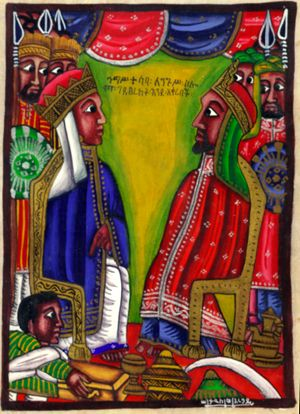
Ethiopian depiction of the Queen of Sheba and King Solomon

The Queen of Sheba heard how famous Solomon was, so she went to Jerusalem to test him with difficult questions. She took along several of her officials, and she loaded her camels with gifts of spices, jewels, and gold. When she arrived, she and Solomon talked about everything she could think of. He answered every question, no matter how difficult it was.

The Queen was amazed at Solomon’s wisdom. She was breathless when she saw his palace, the food on his table, his officials, his servants in their uniforms, the people who served his food, and the sacrifices he offered at the Lord’s temple. She said:

Solomon, in my own country I had heard about your wisdom and all you’ve done. But I didn’t believe it until I saw it with my own eyes! And there’s so much I didn’t hear about. You are wiser and richer than I was told. Your wives and officials are lucky to be here where they can listen to the wise things you say.

I praise the Lord your God. He is pleased with you and has made you king of Israel. The Lord has always loved Israel, so he has given them a king who will rule fairly and honestly.

The Queen of Sheba gave Solomon more than four tons of gold, many jewels, and more spices than anyone had ever brought into Israel.

In return, Solomon gave her the gifts he would have given any other ruler, but he also gave her everything else she wanted. Then she and her officials went back to their own country.

King Hiram’s ships brought gold, juniper wood, and jewels from the country of Ophir. Solomon used the wood to make steps for the temple and palace, and harps and other stringed instruments for the musicians. It was the best juniper wood anyone in Israel had ever seen. (Contemporary English Version)

The ancient Sabeans were a wealthy people. The kingdom of Sheba was geographically located on the southwest corner of the Arabian peninsula (present day Yemen). They were ideally situated to control all the trade in and out of the Red Sea.

Since the Sabeans were a maritime people, the Queen of Sheba made it a habit to engage in trade missions and relations with other kingdoms. King Solomon was making quite a name for himself, and his nation, through his own extensive trade endeavors. It was inevitable that the two would meet.

Solomon had wisdom and wealth because of the divine gift given to him by the Lord. It’s wonderful to have a gracious gift given by God. Most of us can relate to desiring spiritual gifts and blessings from the God we serve.

Yet, what doesn’t usually get talked about is that every divine gift given to us carries with it not only opportunities to bless the world, but also the temptation to avoid proper stewardship and use the gift for personal aggrandizement.

Slowly, over time, it can become rather easy to slip into a mode of getting more and more, of expanding influence, seeking greater honor and accolades, and increasing wealth to exorbitant extremes. For those who know the biblical storyline of Solomon, this is precisely what happened to him. Perhaps in today’s Old Testament lesson, we begin to get a glimpse of the beginnings of that slippery slope into the bottomless abyss of more.

The Queen of Sheba and King Solomon meet

The Queen of Sheba, who herself was one of the wealthiest and most influential monarchs of her day, knew what affluence looked like. So, for her to be breathless over what she observed in Solomon’s kingdom must have been over-the-top abundance and riches.

It’s telling that many contemporary Westerners can read this account and see no problem with it. In fact, some even seem to believe this is something to aspire to – to be just like King Solomon, as if this is what God wants for us.

Yet, it could be that the writer and historian of the biblical kings was leading us to a different conclusion, placing Solomon in the unfavorable light of abusing his divine gift.

After all, it’s clear Solomon used his wisdom and wealth for himself in ways that went well beyond the simple meeting of needs. Solomon was a really smart guy, familiar with God’s Law, so he knew what Moses said about all this stuff:

The king should not have many horses, especially those from Egypt. The Lord has said never to go back there again. And the king must not have a lot of wives—they might tempt him to be unfaithful to the Lord. Finally, the king must not try to get huge amounts of silver and gold.

The official copy of God’s laws will be kept by the priests of the Levi tribe. So, as soon as anyone becomes king, he must go to the priests and write out a copy of these laws while they watch. Each day the king must read and obey these laws, so that he will learn to worship the Lord with fear and trembling and not think that he’s better than everyone else.

If the king completely obeys the Lord’s commands, he and his descendants will rule Israel for many years. (Deuteronomy 17:16-20, CEV)

But Solomon ended up not heeding any of these warnings. And so, it ought to have been no surprise that, after Solomon’s death, the kingdom became divided and was never the same again.

Sheba’s Queen is the one who seemed to have both her head and her heart in the right place. She’s the one who blesses Yahweh and reminds Solomon about the need to rule with integrity and justice. The Queen was able to affirm Solomon’s gift, while at the same time reminding him of what that gift is truly for.

The wise person knows there is always a shadow side to every good gift we have. If we fail to acknowledge this, and not pay attention to it, we will find ourselves doing as much harm as we do benefit.

Generous and loving God, all we are and all that we have is a gift from you. In faith and love, help us to do your will. We offer to you this day all the facets of our lives, whether it be at home, at work, or at school. We seek to be patient, merciful, generous, and holy. Give us the wisdom and insight to understand your will for us and the fervor to carry out our good intentions. We offer to you our gifts of time, abilities, and possessions as a true act of faith, to reflect our love for you and our neighbors. Help us to reach out to others as you have reached out to us. Amen.

Sensing the Divine (Exodus 3:1-5)

The Burning Bush by Yoram Raanan

Now Moses was tending the flock of Jethro his father-in-law, the priest of Midian, and he led the flock to the far side of the wilderness and came to Horeb, the mountain of God. There the angel of the Lord appeared to him in flames of fire from within a bush. Moses saw that though the bush was on fire it did not burn up. So Moses thought, “I will go over and see this strange sight—why the bush does not burn up.”

When the Lord saw that he had gone over to look, God called to him from within the bush, “Moses! Moses!”

And Moses said, “Here I am.”

“Do not come any closer,” God said. “Take off your sandals, for the place where you are standing is holy ground.” (New International Version)

The burning bush is one of those iconic objects and stories in Holy Scripture. Moses had an experience which changed his life, as well as the lives of all the Israelites then and now.

Having spent the first forty years of his life as a darling in the Egyptian court; and then the next forty years far from that life on the backside of the desert with a bunch of sheep; it’s an understatement to say that Moses did not expect or ever envision encountering God in a burning bush. The impossible has no possibility… Or does it?…

The experience of the burning bush fired the five senses of Moses:

  • See. There was the paradoxical sight of seeing fire in a bush that isn’t burning up.
  • Smell. All around there were the smells of sheep, the outdoors, and perhaps, even the lack of smelling burnt wood.
  • Hear. Listening to the voice and call of God from within the bush.
  • Taste. Spiritually and emotionally savoring God’s attentive justice toward the people.
  • Touch. Removing his sandals to feel the grounding of sacred space.

The story also comments on the senses of God, as well. Even though God is Spirit and is worshiped as such, God is alive with divine sensations:

  • See. Observing the approach of Moses, and the misery of the Israelites.
  • Smell. The stench of injustice wafting into God’s nostrils, bringing a strong divine reaction.
  • Hear. Listening to the cries of suffering and oppression amongst the people.
  • Taste. Anticipating the savor of showing mercy, justice, and righteousness.
  • Touch. A profound and holistic touching of Moses so that both he and the Israelites would never be the same again.

Through it all, the close identification between God and the people is expressed. The Lord feels the humiliation and pain of the Israelites – and vows to uproot them from the Egyptian factory farm of slavery and plant them firmly into rich Promised Land soil.

And what God promises to do, God has the authority and power to make good on.

Although experiencing all of this unbelievable sensory encounter, Moses knew it to be an impossible task in freeing so many Israelites from such a powerful Egyptian juggernaut.

After all, the people had their senses aflame, as well; and not in a good way:

  • See. The sight of family being worked to the bone; and cruelly treated.
  • Smell. The constant smell of bricks baking, mixed with the ever-present smell of death.
  • Hear. Listening day after day to the groans of people, just trying to survive under awful conditions.
  • Taste. Every day tasting the desert dust.
  • Touch. Overstimulated with handling tools to the point of hard callouses and dry, cracked, bloody hands.

Hundreds of years of backbreaking bondage to a national force so mighty that nothing can be done about it be broken…. Ah, but God specializes in systems of oppression and miserable people.

It is the Lord’s abilities which conquer the mightiest of foes and can extend mercy to the lowest and the least powerful. The entire Israelite situation was ripe for divine intervention and supernatural wonders to occur.

God will make a way where there seems to be no way. God works in ways which transcend our senses.

  • See. We are blind, but God gives us the gift of sight.
  • Smell. Our nostrils have become accustomed to the smell of death, but God’s aroma of life awakens us to new hope.
  • Hear. We are deaf, but God opens our ears with the sound of justice.
  • Taste. Our taste buds are shot with the gruel of poverty, but God causes our tongues to dance with the zest of mercy.
  • Touch. Our nerve endings are raw from cruel bondage, but God touches us with freedom.

You already intuitively know deep in your spirit that the impossible is possible with God. It’s never a question of God’s ability, but of God’s timing.

God is able and works the impossible in its proper time so that justice and mercy will have their full effect.

God of the impossible: I believe. Help me in my unbelief.

God of mercy: I receive. Help me in my denial.

God of justice: I accept. Help me in my rejection.

God of all time: I endure. Help me in my impatience.

God of All: I submit. Help me in my rebellion.

God of power and of might: I trust. Help me in my distrust.

God of our Lord Jesus Christ: I follow. Help me in my wandering.

God of the nations: Yes, you know that I love you. Yes, Lord, you know I love you. Lord, you know all things, and you know that I love you. So, yes, I will answer your call to go. Help me in my sending. Amen.

Repent! (Luke 3:1-18)

John the Baptist Preaching by Frank Brangwyn (1867-1956)

In the fifteenth year of the reign of Tiberius Caesar—when Pontius Pilate was governor of Judea, Herod tetrarch of Galilee, his brother Philip tetrarch of Iturea and Traconitis, and Lysanias tetrarch of Abilene—during the high-priesthood of Annas and Caiaphas, the word of God came to John son of Zechariah in the wilderness. He went into all the country around the Jordan, preaching a baptism of repentance for the forgiveness of sins. As it is written in the book of the words of Isaiah the prophet:

“A voice of one calling in the wilderness,
‘Prepare the way for the Lord,
    make straight paths for him.
Every valley shall be filled in,
    every mountain and hill made low.
The crooked roads shall become straight,
    the rough ways smooth.
And all people will see God’s salvation.’”

John said to the crowds coming out to be baptized by him, “You brood of vipers! Who warned you to flee from the coming wrath? Produce fruit in keeping with repentance. And do not begin to say to yourselves, ‘We have Abraham as our father.’ For I tell you that out of these stones God can raise up children for Abraham. The ax is already at the root of the trees, and every tree that does not produce good fruit will be cut down and thrown into the fire.”

“What should we do then?” the crowd asked.

John answered, “Anyone who has two shirts should share with the one who has none, and anyone who has food should do the same.”

Even tax collectors came to be baptized. “Teacher,” they asked, “what should we do?”

“Don’t collect any more than you are required to,” he told them.

Then some soldiers asked him, “And what should we do?”

He replied, “Don’t extort money and don’t accuse people falsely—be content with your pay.”

The people were waiting expectantly and were all wondering in their hearts if John might possibly be the Messiah. John answered them all, “I baptize you with water. But one who is more powerful than I will come, the straps of whose sandals I am not worthy to untie. He will baptize you with the Holy Spirit and fire. His winnowing fork is in his hand to clear his threshing floor and to gather the wheat into his barn, but he will burn up the chaff with unquenchable fire.” And with many other words John exhorted the people and proclaimed the good news to them. (New International Version)

John the Baptist was the sort of guy that people either loved or hated. When I think of John, I picture a hippy driving a Volkswagen bus with bumper stickers plastered everywhere with sayings like, “Get Right or Get Left,” “Turn or Burn,” “Repent or Regret,” “Jesus Is Coming to Take Over,” “Here Comes the Judge,” “Armageddon Outta Here!” and “Axe Me What’s Next.”

He tended toward seeing things as black and white. John wasn’t much of a gray area sort of dude.

Yet, no matter what one things of John the Baptist, he was affirmed by Jesus as doing exactly what he was supposed to do: Prepare for the coming of the Lord. (Matthew 3:13-17, 11:1-19)

And the best way to prepare, as John pointed out, is to repent.

Repentance is one of those big biblical words that sometimes gets lost as being archaic and out of touch – sort of like a hippy John the Baptist. Yet, without repentance, nobody becomes a Christian and no one lives a fruitful life following Jesus. 

To “repent” simply means to change our minds – to stop doing one thing, and to start doing another. 

Orthodox icon of John the Baptist

Throughout Holy Scripture, repentance means to stop sinning and start worshiping God. “Sin” and “worship” are also words that don’t get used a lot and tend to get relegated as antiquated language.

To “sin” is to say and do things which harm others, or to fail to say and do things which are helpful. (Deuteronomy 15:9; Proverbs 10:19; Romans 14:23; James 4:17; 1 John 3:4, 5:17)

To “worship” means to bend the knee, to submit and honor a deity. (Psalm 95:6; Matthew 4:8-10; Revelation 4:10, 5:14, 7:11, 11:16, 19:10,

The prophet Isaiah saw a vision of God in the temple, a self-revealing of the One true God that caused him to be completely unraveled with repentance.

The Apostle Peter saw the Lord Jesus in his immensity and power through a miraculous catch of fish. He then fell at the Lord’s feet and said, “Go away from me, Lord; I am a sinful man.” (Luke 5:8) 

John the Apostle had a vision of Jesus Christ in all his glory and heard his voice. John fell at the Lord’s feet as though dead. (Revelation 1:12-17) 

Ezekiel the prophet had a vision of God and saw the appearance of God’s glory. Then, he fell facedown. (Ezekiel 1:25-28) 

Even Daniel, perhaps the most righteous person of all time, saw a vision of God in all his glory and fell prostrate with his face to the ground, totally overwhelmed with God’s holiness and human sinfulness. (Daniel 8:15-18)

Methinks there is so much sin in the world and so much indifference in the church because people are not seeing a vision of a glorious and holy God. Because if they did, they would be completely beside themselves and see sin’s terrible foulness and degradation; they would repent from all the ways in which they have been apathetic and complacent in living their lives.

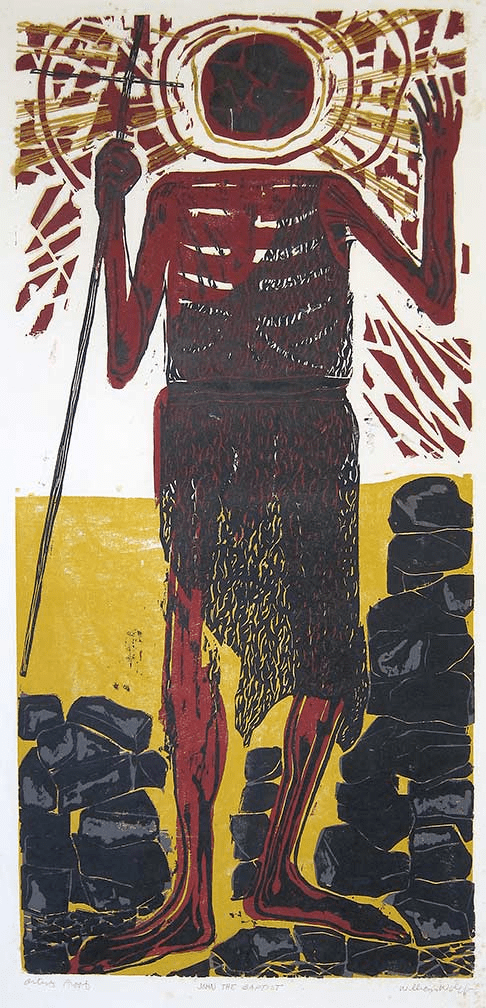
John the Baptist by William Wolff, 1968

We must, therefore, put ourselves in a position to see and hear God so that we can turn from all the obstacles that prevent us from experiencing Father, Son, and Spirit. 

And those hindrances to experiencing God are legion, including: 

  • Passiveness toward God’s Word and God’s creation, thus causing a lack of mindfulness and attention to the Holy Spirit.
  • Preoccupations and daydreams that prevents availability to the words and ways of Jesus.
  • Poverty of sleep, healthy habits, and an overall poor well-being that dulls the spiritual senses and prevents awareness of God.
  • Paucity of spiritual practices and disciplines that would put us in a position to experience a vision of God.

We must repent of all the ways we do not pay attention to God. The Lord is coming but we don’t perceive it.

  1. What, then, must we do to put ourselves in a position to see and hear God?
  2. In what ways might we corporately foster a sense of the holy God? 
  3. How will repentance fit into both our personal and corporate worship? 
  4. Have we identified and named the things that grieve the heart of God so that we can repent of them? 
  5. What is one action step you will take in response to this blog post?

None of us need to be like John the Baptist in order to be godly. We don’t have to eat locusts and be black-and-white thinkers. But we do all have to repent of the ways we make the road difficult by placing obstacles in the way of experiencing Jesus.

Most merciful God, we confess that we have sinned against you in thought, word, and deed, by what we have done, and by what we have left undone. We have not loved you with our whole heart; we have not loved our neighbors as ourselves. We are truly sorry and we humbly repent. For the sake of your Son Jesus Christ, have mercy on us and forgive us; that we may delight in your will, and walk in your ways, to the glory of your Name. Amen.

Think of the Needs of the Group (1 Corinthians 10:23-11:1)

Looking at it one way, you could say, “Anything goes. Because of God’s immense generosity and grace, we don’t have to dissect and scrutinize every action to see if it will pass muster.” But the point is not to just get by. We want to live well, but our foremost efforts should be to help others live well.

With that as a base to work from, common sense can take you the rest of the way. Eat anything sold at the butcher shop, for instance; you don’t have to run an “idolatry test” on every item. “The earth,” after all, “is God’s, and everything in it.” That “everything” certainly includes the leg of lamb in the butcher shop. If a nonbeliever invites you to dinner and you feel like going, go ahead and enjoy yourself; eat everything placed before you. It would be both bad manners and bad spirituality to cross-examine your host on the ethical purity of each course as it is served. On the other hand, if he goes out of his way to tell you that this or that was sacrificed to god or goddess so-and-so, you should pass. Even though you may be indifferent as to where it came from, he isn’t, and you don’t want to send mixed messages to him about who you are worshiping.

But, except for these special cases, I’m not going to walk around on eggshells worrying about what small-minded people might say; I’m going to stride free and easy, knowing what our large-minded Master has already said. If I eat what is served to me, grateful to God for what is on the table, how can I worry about what someone will say? I thanked God for it, and he blessed it!

So eat your meals heartily, not worrying about what others say about you—you’re eating to God’s glory, after all, not to please them. As a matter of fact, do everything that way, heartily and freely to God’s glory. At the same time, don’t be callous in your exercise of freedom, thoughtlessly stepping on the toes of those who aren’t as free as you are. I try my best to be considerate of everyone’s feelings in all these matters; I hope you will be, too.

It pleases me that you continue to remember and honor me by keeping up the traditions of the faith I taught you. (The Message)

“To know how to free oneself is nothing; the arduous thing is to know what to do with one’s freedom.”

Andre Gide

Extreme individualism wants what it wants and doesn’t give a thought about anyone else – which is why we always have such a peck of trouble in the world all the time.

We need to get a phrase into our language which will become a continual mantra we say and observe:

Think of the needs of the group.

Christianity is a religion of community, of being attentive to and meeting one another’s needs, and of caring about the common good of all persons throughout the world. Christians dishonor their Lord and buck their spiritual tradition whenever they go rogue and base everything they say and do on what sort of advantage it is for them without considering others.

Yes, believers in Jesus have freedom in Christ. The cross has released the shackles that kept us in sin’s bondage. But, no, that doesn’t mean we get to do whatever we want, whenever we want. That’s the way individualism looks at it. That’s not how a communal people, the church, are to look at it.

Freedom hinges on two very important and seemingly small grammar prepositions: from and to.

Freedom always involves two elements:

  1. Freedom from what hinders or oppresses us.
  2. Freedom to become who we are meant to be.

In Christianity, believers are saved from sin, death, and hell – released from guilt and shame. There is redemption from the pit of despair. The bonds that hindered are now broken through the cross of Christ. The power of the world, the sinful nature, and the devil are taken away.

Yet, in no way does that now mean that we now get to do whatever we want, as if we’ve finally outgrown childhood and parental authority.

The extreme individualist Christian looks at freedom solely from this vantage. As a result, such a person considers the church as nonobligatory, involvement in issues of justice as optional, the use of personal funds and resources as discretionary, and accountability to others as arbitrary.

Such individualism sees Christianity as a fire insurance policy from hell, and a ticket punched for heaven. Until Christ returns, the reasoning goes, I can do whatever the heck I want. It’s my life, not yours.

Christians, however, are still servants. Whereas we were once enslaved to the dark forces of this world, now we are slaves to Christ. We exchanged masters. Satan is no longer the deceitful and lying task master over us. We are now under new management and have a new Master, the Lord Jesus. We’ve changed allegiances.

And now, submitted to Christ, we embrace our mandate of freedom to become whom we were always meant to be: At peace with our Creator and in harmony with all creation. We are now free to enjoy right relationships with God and others, to walk in faith, hope, and love, and to bless both the church and the world.

The Christian’s freedom came at a price: the very blood of Christ Jesus. Therefore, we are not to abuse that freedom by focusing solely on our freedoms from all that once bound us. We are also responsible and accountable for using that freedom in going to the world and proclaiming the gospel in word and sacrament, as well as loving God and neighbor.

Freedom is only freedom when it has the well-being of everyone in mind.

Think of the needs of the group.

Lord God, almighty and everlasting Father: Help us to live into the freedom you have brought to us. May we exercise our freedom, with the heart of a faithful disciple of Jesus Christ, to serve your purposes. Unite us, protect our sacred liberties and rights, and defend us from every evil. Strengthen your people as a foundation of moral clarity, justice, love, and gospel proclamation. Grant all this by the power of your Holy Spirit and in the Name of Jesus Christ, your Son, our Lord. Amen.