
Broken and Poured Out (Matthew 26:6-13)

Jesus was in Bethany at the house of Simon the leper. While he was there, a woman came to him. She had an alabaster jar filled with expensive perfume. She poured the perfume on Jesus’ head while he was eating.

The followers saw the woman do this and were upset at her. They said, “Why waste that perfume? It could be sold for a lot of money, and the money could be given to those who are poor.”

But Jesus knew what happened. He said, “Why are you bothering this woman? She did a very good thing for me. You will always have the poor with you. But you will not always have me. This woman poured perfume on my body. She did this to prepare me for burial after I die. The Good News will be told to people all over the world. And I can assure you that everywhere the Good News is told, the story of what this woman did will also be told, and people will remember her.” (Easy-to-Read Version)

It seems that much of the world’s default response to events right in front of their eyes is to be judgmental, binary, and negative – as if everything is a simple sum of right and wrong, good and bad – and all adjudicated by our perceptions and perspectives on it.

The disciples reflexively moralized the actions of the woman and her jar of expensive perfume. What a waste, they believed. They thought they knew better and could do better.

But there was more going on in today’s Gospel lesson than what meets the eye. In the Apostle John’s account, the woman in the story is identified as Mary, a woman with a sordid background who had her life transformed through meeting Jesus. (John 12:1-11)

Near the end of Christ’s life, as he was about to enter Jerusalem and be arrested, tried, tortured, and killed, this woman, Mary, is aware of what is happening when others are not, even the disciples of Jesus. Her own brokenness cracked open to her the true reality of life.

The surface event itself is a touching and tender moment in history. This woman, whom everyone knew was a damaged person, took a high-end perfume and broke the entire thing open. She then proceeded to anoint Christ’s feet with it. You can imagine the aroma which filled the entire house with expensive perfume for all to smell. 
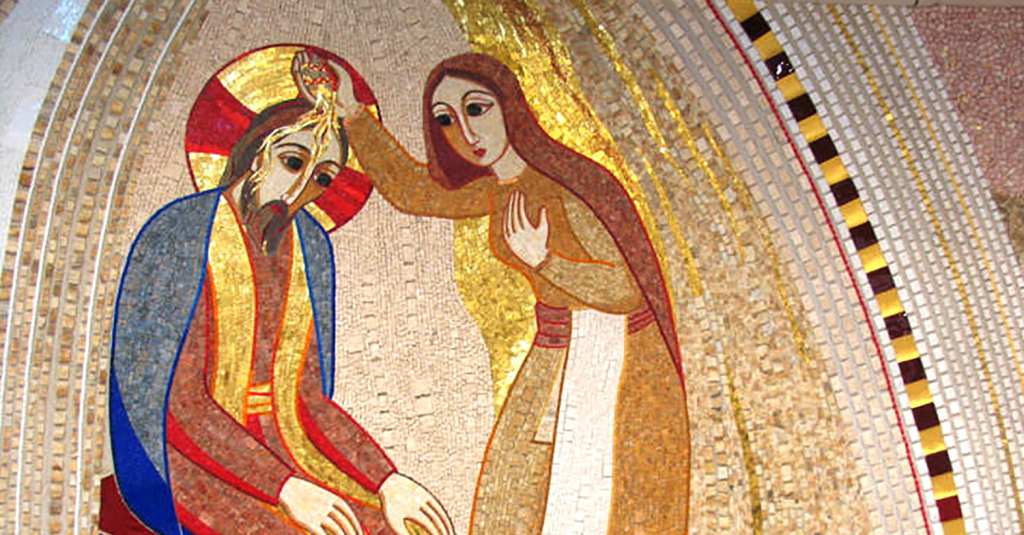
The woman, Mary, was affirmed by Jesus for seeing the situation as a possibility and opportunity of loving her Lord. Mary alone had the vision amongst all the disciples, and the accompanying action, to enter through the door of risk in order to connect intimately and lovingly with Jesus.

Mary’s love, radiating outward for all to see, reflected the genuine love of God for the world – a love so great that Jesus would soon experience death and burial because of that love for humanity.

The disciples were grumping and cursing about the right way to do things; whereas Jesus blessed the woman with no reference whatsoever to morality or ethics. Mary had no concern for playing the numbers game and counting money, but instead focused on the ultimate value before her.

Giving what she had to Jesus, Mary demonstrated the path of true discipleship. She helps open our eyes to the realities which are right in front of us:

  • The broken jar of perfume shows us her brokenness and our need to be broken. (Matthew 5:3-4)
  • An extraordinary and extravagant amount of perfume was used, picturing her overflowing love for Jesus. (John 20:1-18)
  • The perfume was poured on the head of Jesus, and she herself used her hair as the application (according to John); hair is a rich cultural symbol for submission and respect. (1 Corinthians 11:14)
  • The perfume directs us to the death of Jesus. (John 19:38-42)
  • The perfume highlights for us the aroma of Christ to the world. (2 Corinthians 2:15-17)
  • There is more to the disciples’ response than mere words about perfume; the Apostle John specifically names Judas as questioning this action – the one who is not actually concerned for the poor. (Matthew 26:15)
  • The woman and the disciples (specifically, Judas and Mary) serve as spiritual contrasts: Mary opens herself to the sweet aroma of Christ; Judas just plain stinks.
  • The perfume presents a powerful picture of the upcoming death of Christ, for those with eyes to see; he was broken and poured out for our salvation. (Luke 23:26-27:12)

Christianity was never meant to be a surface religion which only runs skin deep. The follower of Christ is meant to be transformed, inside and out, so that there is genuine healing, spiritual wellness, and authentic concern for the poor and needy. 

Keeping up appearances is what the Judas’s of this world do. However, the Mary’s among us dramatically point to Jesus with their tears, their humility, their openness, and their love.

In this contemporary environment of fragmented human ecology, our first step toward wholeness and integrity begins with a posture of giving everything we have – body, soul, and spirit – to the Lord Jesus. In receiving the love of God, we can then freely give that love to a world locked in the shackles of tunnel vision, judgmentalism, and incessant moralizing.

To take the risk of breaking ourselves open and becoming vulnerable, we find love. In finding love, there we see intimacy. And where there is intimacy, there is the relational connection which transforms the dark and the negative to possibility and light.

Loving Lord Jesus, my Savior, and my friend, you have gone before us and pioneered deliverance from an empty way of life and into a life of grace and gratitude. May I, and all of your followers, emulate the path of Mary and realize the true freedom which comes from emptying oneself out for you. Amen.

The Church that Makes a Difference (Matthew 16:13-20)

Photo by Felix Mittermeier on Pexels.com

When Jesus came to the region of Caesarea Philippi, he asked his disciples, “Who do people say the Son of Man is?”

They replied, “Some say John the Baptist; others say Elijah; and still others, Jeremiah or one of the prophets.”

“But what about you?” he asked. “Who do you say I am?”

Simon Peter answered, “You are the Messiah, the Son of the living God.”

Jesus replied, “Blessed are you, Simon son of Jonah, for this was not revealed to you by flesh and blood, but by my Father in heaven. And I tell you that you are Peter, and on this rock I will build my church, and the gates of Hades will not overcome it. I will give you the keys of the kingdom of heaven; whatever you bind on earth will be bound in heaven, and whatever you loose on earth will be loosed in heaven.” Then he ordered his disciples not to tell anyone that he was the Messiah. (New International Version)

A lot of research studies have come out in the past 20 years demonstrating that legions of adults, especially between the ages of 18-29, are leaving the Church in droves. This confirms my own anecdotal evidence over the years that about 80% of twenty-somethings drop out of church altogether. So, why are people leaving? Can anything be done about it?

Most of the studies can be boiled down to three major reasons: 

  1. The Church is irrelevant to my life and doesn’t talk about things important to me
  2. The Church is judgmental toward others not like themselves
  3. The Church is hypocritical by saying one thing and yet living another way

A good, right, and real confession of Jesus will speak a relevant word into the culture and into various generations, will proclaim the gospel of grace (not judgment), and will live what it believes.

In today’s Gospel lesson, Jesus and his disciples are in the Gentile (non-Jewish) territory of Caesarea Philippi, a city 25 miles north of the Sea of Galilee. Up to this point, the disciples encountered a lot of people and heard a lot of things said. So, Jesus asked them two questions: 

Who do people say the Son of Man is?

The disciples gave a variety of answers, which is to be expected, with some of them being a bit esoteric. John the Baptist raised from the dead is a stretch. Elijah was a man who never died, but was just taken to heaven; maybe he’s back. Maybe Jeremiah or one of the other prophets got sent back. 

When asking this question to folks today, you will also get a variety of answers as to whom Jesus is – a good teacher, a model humanitarian, a myth or a legend who didn’t really exist. A few times I have been told that Jesus was an alien from another planet. My personal favorite when I asked who Jesus, a guy answered that he was a nudist, and that if we all just took off our clothes, there would be peace in the world.

Who do you say I am?

Peter acted as the spokesperson for the group. Given the disciples’ track record of scratching their heads over nearly everything Jesus said or did, one might expect to hear another crazy answer. But Peter got it right by confessing, “You are the Christ, the Son of the Living God.” 

“Christ” is another way of saying “Messiah,” or “Savior.” It literally means, in the Greek language, “Answer.”  Peter confessed Jesus as being The Answer, the person for whom everything comes down to. Peter may not have fully understood what he was saying, but he said it.

The reason that craziness didn’t come out of Peter’s mouth is that “The Answer” was divinely revealed to him.  Faith in Jesus Christ is a gift given to us by God. 

“All things have been committed to me by my Father. No one knows the Son except the Father, and no one knows the Father except the Son and those to whom the Son chooses to reveal him.” Jesus (Matthew 11:27, NIV)

Peter was blessed – not necessarily because of sincerity, openness, or deserving it – but because of God’s grace which revealed to him that Jesus is the “Answer.”

The Apostle Peter put himself in a position to know by obeying the voice of Jesus to follow him. It took him and the other disciples a while to “get it,” but eventually they did. And if it took years of being with Jesus for the disciples to make a right and good confession of faith, then it’s important that we have a great deal of patience for our friends and relatives.

Jesus proclaimed Peter (which means “rock”) the immovable object from which the Church would be built.  The Apostle Paul framed it this way:

You are no longer foreigners and strangers, but fellow citizens with God’s people and also members of his household, built on the foundation of the apostles and prophets, with Christ Jesus himself as the chief cornerstone. In him the whole building is joined together and rises to become a holy temple in the Lord. (Ephesians 2:19-21, NIV)

Christ is the one who builds the Church – and not me,  nor you. This reality is encouraging and comforting to me. If it was up to me to build the Church, I would screw it up so badly that it would actually be overcome by hell. But I can’t screw it up, because it’s Christ’s Church, not mine. 

So, we can move forward and storm the gates of hell, we can move and work and act and call others to confess, all with the confidence and security of knowing that Jesus is building his Church. There’s no need to worry whether we’re getting it right, or not, because we aren’t the ones in control of the project.

However, I admit what Jesus says next isn’t very comforting to me. Christ told Peter that he will give him the “keys of the kingdom of heaven,” and that whatever he binds on earth will be bound in heaven, and whatever he lets loose on earth will be loosed in heaven.

Giving Peter the keys of the kingdom seems akin to giving an 8 year old the keys to the car and saying, “Go ahead, take it for a spin, you can drive it!” 

What are the keys of the kingdom? 

The preaching of the holy gospel and Christian discipline toward repentance. Both preaching and discipline open the kingdom of heaven to believers and close it to unbelievers. 

How does the preaching of the gospel open and close the kingdom of heaven? 

The kingdom of heaven is opened by proclaiming and publicly declaring to all believers, each and every one, that, as often as they accept the gospel promise in true faith, God, because of what Christ has done, truly forgives all their sins. The kingdom of heaven is closed, however, by proclaiming and publicly declaring to unbelievers and hypocrites that, as long as they do not repent, the anger of God and eternal condemnation rest on them. (The Heidelberg Catechism, Q&A 83, 84 )

The Church is true to its mission when it proclaims the good news of God’s grace in Christ. We possess the keys of the kingdom. Jesus knew exactly what he was doing, that is, the risks and the problems of letting people do the task of proclaiming the gospel. Yet, Christ still tossed us the keys to his Mercedes.

Conclusion

A Church that makes a difference is made up of people who confess Jesus, are called by God, and call others to confess Jesus, too. The de-churched and the disaffected want to see a Church that seeks to understand the world, to provide relevant ministry to others, and to tackle the injustice that exists everywhere.

We must use the power given us with the keys of the kingdom to bestow mercy to the weak, the oppressed, and the lost. We need to live what we believe with a passionate heart and an unashamed faith.

Together, as God’s people, we can extend the hospitality and the kindness to make a difference in the church and the world. 

May our confession of Christ shape our words and our actions. And may it give us the confidence and boldness to live as Jesus did, and to enjoy him forever. Amen.

Luke 6:6-11 – Every Day is Meant for Doing Good

On another Sabbath, Jesus went into the synagogue and was teaching, and a man was there whose right hand was shriveled. The Pharisees and the teachers of the law were looking for a reason to accuse Jesus, so they watched him closely to see if he would heal on the Sabbath. But Jesus knew what they were thinking and said to the man with the shriveled hand, “Get up and stand in front of everyone.” So, he got up and stood there.

Then Jesus said to them, “I ask you, which is lawful on the Sabbath: to do good or to do evil, to save life or to destroy it?”

He looked around at them all, and then said to the man, “Stretch out your hand.” He did so, and his hand was completely restored. But the Pharisees and the teachers of the law were furious and began to discuss with one another what they might do to Jesus. (New International Version)

Lectio Divina is an ancient Latin term which means “spiritual reading.”  It means to read Holy Scripture not just to know its contents, but to experience its power to restore, heal, transform, and draw close to God.

Lectio Divina is a simple way to prayerfully read Scripture, meditate on its message, and listen for what God may be saying for us to do. It can be done privately, or with a small group of people. The goal is to become more Christ-like.

Lectio Divina is based upon reading a selected text of Scripture three times. Each reading is followed by a period of silence after which each person is given the opportunity to briefly share what they are hearing as they listen to God (if done in a group).

For today’s Gospel lesson, I invite you to give it three different readings, as is common to a Lectio Divina approach:

  1. In the first reading, read the text aloud slowly and carefully. Listen for a word, phrase or idea that captures you attention. As you recognize a word, phrase or idea, focus your attention on it, repeating it several times.
  2. In the second reading, focus your attention on how the selected word, phrase or idea speaks to your life right now. What does it mean for you today? How is Christ speaking to you about your life through this word, phrase or idea?
  3. In the third reading, focus on what God is calling you to do or to become. Experiencing God’s presence changes us. It calls us to something. What is that something?

So, here are my reflections from reading today’s Gospel lesson three times:

  1. In my first reading, the phrase “watched him closely” stood out to me. As I sat and pondered this phrase, I thought about how there are always people watching us. How I live my life, and what I say, are continually on display. Mostly, this is a good thing, because I believe that modeling an authentic and devout life to Christ is important. Yet, whenever someone is watching us closely, in the sense of continually looking over our shoulder, or scrutinizing every word and action so as to find fault, this is a very bad thing.
  2. In my second reading, I hear God speaking to me about how Jesus experienced this bad sort of watching, and yet, he did not let it deter him from doing good and following through on what is right by healing a man on the Sabbath. In fact, Christ confidently had the man with the shriveled hand stand up in front of everyone. He wanted the entire congregation, including those who were watching him with judgmental eyes, to see exactly what he was doing. Jesus neither healed him quietly nor waited till after the synagogue service was over; he was very open about what was happening.
  3. In my third reading, I felt Jesus beside me – not looking for something to correct or chastise me about – but rather putting his arm around my shoulder, knowing exactly what it feels like to be the object of criticism, scorn, and malevolent plotting against. I sense my solidarity with Christ, my union with him, believing that nothing can separate me from the love of God in Christ, my Savior and Lord, who always has my back. I hear Jesus graciously calling me to stand firm and openly do what is good and right, every day, no matter who is watching or why they are watching.

Today’s Gospel lesson shows us Christ’s disapproval of those who focus so narrowly on the traditions and laws of religion that they end up losing sight of God’s message.

For the Christian, the message is a gospel of grace, not condemnation. Jesus challenges the legalistic way of keeping the Sabbath holy by asking a penetrating question: “Is it lawful to do good on the Sabbath rather than to do evil, to save life rather than to destroy it?”

By showing compassion to the man with the withered hand, Jesus points us to a way of holiness that’s a whole lot more than keeping the law and performing rituals.

By healing the man, Jesus teaches us to respond to God’s call to do good and save lives. Traditions should never interfere with our compassion for those in need.

“If anyone, then, knows the good they ought to do and doesn’t do it, it is sin for them.”

James 4:17

If you haven’t already done so, give the Lectio Divina a healthy try – because God is always speaking to us; we just need to be still and silent in order to hear.

Lord Jesus Christ, Son of God, have mercy on me, and grant me your peace. Amen.

Colossians 2:16-3:1 – Get Rid of the List

Do not let anyone judge you by what you eat or drink, or with regard to a religious festival, a New Moon celebration or a Sabbath day. These are a shadow of the things that were to come; the reality, however, is found in Christ. Do not let anyone who delights in false humility and the worship of angels disqualify you. Such a person also goes into great detail about what they have seen; they are puffed up with idle notions by their unspiritual mind. They have lost connection with the head, from whom the whole body, supported and held together by its ligaments and sinews, grows as God causes it to grow.

Since you died with Christ to the elemental spiritual forces of this world, why, as though you still belonged to the world, do you submit to its rules: “Do not handle! Do not taste! Do not touch!”? These rules, which have to do with things that are all destined to perish with use, are based on merely human commands and teachings. Such regulations indeed have an appearance of wisdom, with their self-imposed worship, their false humility and their harsh treatment of the body, but they lack any value in restraining sensual indulgence.

Since then, you have been raised with Christ, set your hearts on things above, where Christ is, seated at the right hand of God. (New International Version)

“Moral stupidity comes in two different forms: relativism and legalism. Relativism sees no principles, only people; legalism sees no people, only principles.” – Peter Kreeft

There was once a pastor who found the roads blocked one Sunday morning and was forced to skate on the river to get to church, which he did. When he arrived the elders of the church were horrified that their preacher had skated on the Lord’s day.

After the service they held a meeting where the pastor explained that it was either skate to church or not go at all. Finally, one elder asked, “Did you enjoy it?” When the preacher answered, “No,” the board decided all was good.

Nothing can choke the heart and soul out of true spirituality like legalism – a precise extra-biblical list of do’s and don’ts. For many folks, it seems easier to live by the list than to pursue the harder road of developing character qualities.

Christian discipleship involves growing into spiritual maturity and allowing a seasoned character to shape how we make decisions. We must patiently and consistently follow in the way of Jesus, which is the way of grace and of life.

The Apostle Paul spent a lot of his time and energy trying to keep the churches he established from slipping into a soul-less legalism.

Legalism is a compulsion to spell out every detail of how everyone is to live a godly life, going beyond the stated commands of Holy Scripture.

The problem with this approach to the Christian life is that godliness is merely an outward expression of our ability to hold to the list. This legalistic way feeds human pride and boasting, going against the inner heart values of genuine humility and thoughtful service to others.

Biblical teaching thus gets lost in trying to do everything right or perfect.

There are only two alternatives: Choose the way of life and set your heart on things above – or choose the way of destruction through the legalistic list.

The legalist is like a wolf in sheep’s clothing. We need to be wary of people who seem pious and sincere, yet who do not quite pass the smell test. After all, Satan himself, the Apostle Paul once said, masquerades as an angel of light, appearing righteous, yet is intent on deceiving many (2 Corinthians 11:13-15).

So, how do we recognize a legalistic wolf who spiritually and emotionally devours people by judging them according to a contrived list, instead of altruistically helping them with grace? 

Look at the fruit of the tree. Anyone who fails to uplift others will be seen by the rotten fruit of boasting and pride. A telltale sign of such a person is their lack of connection with any spiritual body of people or faith community.

Bellicose boasters and nit-picking legalists believe they are above others because of their expertise at keeping the list of do’s and don’ts. 

A bogus disciple will always be shown by their profound lack of grace, gentleness, and genuine humility. They inevitably advocate for holding to their brand of religion and keeping the unscriptural list. Steer clear of such persons.

A sobering reality is that many people can be deceived with a devil’s bargain: take the nice handy list and you will become godly; here are twelve principles to change your life; follow these rules, pray this prayer, give your money to this, and all will be well.

It is, however, a highway to the grave. The so called “fruit inspector” comes along and goes on to judge everyone according to the legalistic list.

So, get rid of the extra-biblical and even unbiblical list. Stop judging others on whatever someone has deemed the nasty nine sins to avoid or the terrible ten things that will send you to hell. Don’t waste your time or energy on such persons.

The legalist holding to a contrived list of don’ts is not honest about their struggles. Because the bald fact of list-living is that it cannot be fulfilled; it’s unreasonable. So, when we know we are not measuring up to the list, the temptation is to keep up appearances as if we are. 

List-living eschews showing any weakness or imperfection. The legalist’s self-talk says:

  • Always avoid admitting my sin to anyone because the list pronounces me a failure if I do. 
  • Don’t ever enter a deep and prolonged grief over my loss because the list says I need to stay strong. 
  • I cannot profess my doubts about God because the list says if I doubt, I am not a real Christian.
  • Just tell me what is on the list, and I will do it – even though I cannot.

Here is my response to legalistic list-living: To hell with the list! 

You were raised from death with Christ. So, live for what is in heaven, where Christ is sitting at the right hand of God.

Grace transforms hearts, turns lives around, and provides genuine joy and satisfaction – not list-keeping.

If grace is not the answer, we are not asking the right question.

The greatest anti-legalistic prayer we can pray is the tried and true ancient prayer of the Church:

“Lord Jesus Christ, Son of God, have mercy on me a sinner.”