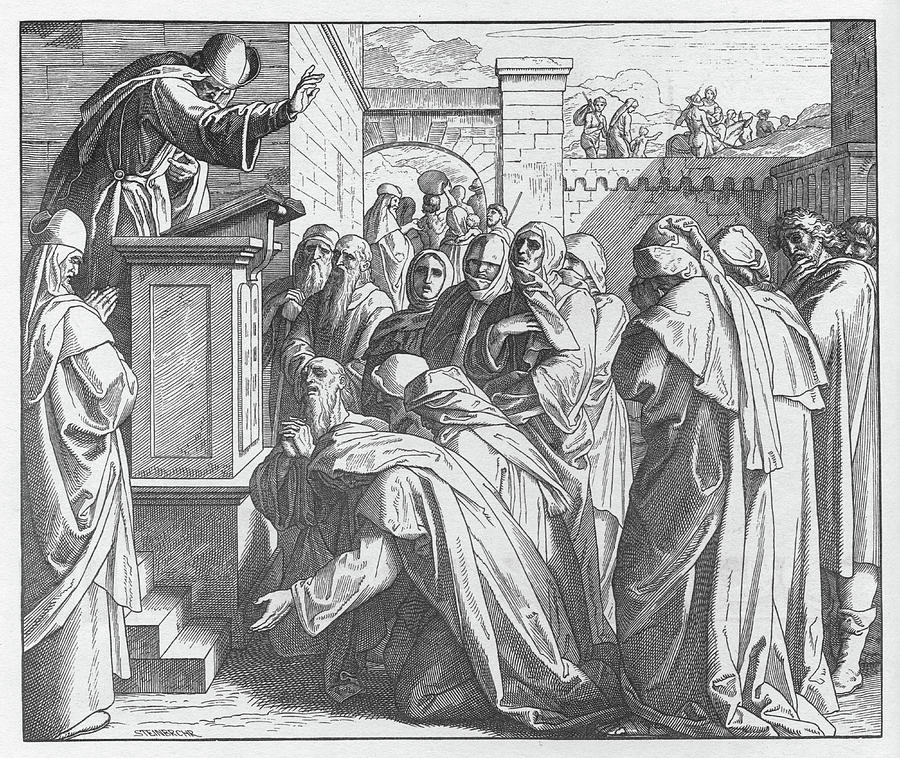
Amos 9:8-15 – Grace Has the Last Word

The eyes of the Lord God are upon the sinful kingdom,
    and I will destroy it from the face of the earth
    —except that I will not utterly destroy the house of Jacob,
says the Lord.

For lo, I will command,
    and shake the house of Israel among all the nations
as one shakes with a sieve,
    but no pebble shall fall to the ground.
All the sinners of my people shall die by the sword,
    who say, “Evil shall not overtake or meet us.”

On that day I will raise up
    the booth of David that is fallen,
and repair its breaches,
    and raise up its ruins,
    and rebuild it as in the days of old;
in order that they may possess the remnant of Edom
    and all the nations who are called by my name,
    says the Lord who does this.

The time is surely coming, says the Lord,
    when the one who plows shall overtake the one who reaps,
    and the treader of grapes the one who sows the seed;
the mountains shall drip sweet wine,
    and all the hills shall flow with it.
I will restore the fortunes of my people Israel,
    and they shall rebuild the ruined cities and inhabit them;
they shall plant vineyards and drink their wine,
    and they shall make gardens and eat their fruit.
I will plant them upon their land,
    and they shall never again be plucked up
    out of the land that I have given them,
says the Lord your God. (New Revised Standard Version)

Doom and hope. Judgment and grace. Suffering and glory. These are the movements and rhythms of the Old Testament prophets. 

There was injustice aplenty in ancient Israel way back in the eighth-century B.C.E. Not only were the poor and needy in the land trampled upon, but the people in power saw nothing wrong with building their wealth and status by taking advantage of the less fortunate. 

Yet, God was not okay with this state of affairs. Thus, the time was imminent when God would deal with the situation by destroying an inequitable and exclusive way of life in which the privileged enjoyed a lifestyle on the backs of the unprivileged.

The Lord clearly communicated that the people will be sent away to a place with no chance to oppress others. Death would come to many. The oppressors shall die by the sword, even though, in their arrogant inebriation of power, they actually believed disaster wouldn’t ever happen to them.

However, it did. And history shows that the prophecy of Amos came to pass. The Assyrians, a powerful people who had their own egregious sins to deal with before the Almighty, were the instruments of divine judgment upon God’s people. Israel was conquered, the people deported, and the proud oppressors became the lowly oppressed.

Even in such a terrible time for Israel as that, judgment doesn’t have the last word – grace does. God would not completely destroy forever. Restoration, renewal, and fruitful times will come as a result of God’s mercy toward a wayward people. 

The Lord spoke a promise that it will not forever be this way. Rebuilding and restoration will eventually happen. God chooses to act with mercy and demonstrate grace because that is what God does. 

We may often get the wrongheaded notion in our creaturely pea-brained heads that God executes judgment to teach people a lesson or make a point, like some capricious schoolmaster who wraps kids on the knuckles with a ruler when they act up in class. But God acts out of holiness, justice, and grace. The Lord maintains righteous decrees while showing mercy to the undeserving.  

Israel deserved only judgment, not grace. God would have been completely justified to destroy rich and powerful oppressors and never restore or renew them. Yet, be that as it may, this is not how the Lord of the universe operates. God’s grace overwhelms human sin. Grace always has the last word.
Try and understand grace and you will be befuddled. Some things just defy comprehension. Sometimes it’s just best to observe and appreciate. Grace is wildly illogical, nonsensical, and unconditionally free. Grace shows radical acceptance where there ought to be only hell.  

God’s grace is downright scandalous. Whereas we might have a stick-it-to-the-man mentality, God is much bigger than petty petulant posturing. The Lord doesn’t sit in heaven and scheme clever ways to irritate sinners and put them in their place, like some belligerent divine bully.

Rather the Lord of all continually conspires within perfect Love how to guide folks mercifully and gently to Truth – utilizing incredibly diverse tools of divine kindness to woo people to the source of amazing grace.

The height of grace, the pinnacle of restoring the fortunes of Israel, came through a baby, by a humble birth in the small village of Bethlehem. 

Jesus came to save the people from their sins. God acted by entering humanity with free divine love so that there could be new life and fresh hope. Therefore, let grace wash you clean. Allow mercy to renew your life. Let worship of the newborn king shape your season and the New Year.

Gracious God, although you are careful to uphold your great holiness, your mercy extends from everlasting to everlasting. May the gospel of grace form all of my words and actions so that true righteousness reigns in my life through Jesus, your Son, my Lord, who with you and the Holy Spirit are one God, now and forever. Amen.

Amos 8:4-12 – A Spiritual Famine

Listen to this, you who walk all over the weak,
    you who treat poor people as less than nothing,
Who say, “When’s my next paycheck coming
    so I can go out and live it up?
How long till the weekend
    when I can go out and have a good time?”
Who give little and take much,
    and never do an honest day’s work.
You exploit the poor, using them—
    and then, when they’re used up, you discard them.

God swears against the arrogance of Jacob:
    “I’m keeping track of their every last sin.”
God’s oath will shake earth’s foundations,
    dissolve the whole world into tears.
God’s oath will sweep in like a river that rises,
    flooding houses and lands,
And then recedes,
    leaving behind a sea of mud.

“On Judgment Day, watch out!”
    These are the words of God, my Master.
“I’ll turn off the sun at noon.
    In the middle of the day the earth will go black.
I’ll turn your parties into funerals
    and make every song you sing a dirge.
Everyone will walk around in rags,
    with sunken eyes and bald heads.
Think of the worst that could happen
    —your only son, say, murdered.
That’s a hint of Judgment Day
    —that and much more.

“Oh yes, Judgment Day is coming!”
    These are the words of my Master God.
“I’ll send a famine through the whole country.
    It won’t be food or water that’s lacking, but my Word.
People will drift from one end of the country to the other,
    roam to the north, wander to the east.
They’ll go anywhere, listen to anyone,
    hoping to hear God’s Word—but they won’t hear it. (The Message)

Four hundred years of silence….  That’s how long it was between the Old and New Testaments of the Bible. In that period, there was no word from God. No prophets sent by God. No divine message, at all, of either judgment or grace. There was complete silence from the Lord… until the fullness of time, when the incarnation of Jesus changed everything. Why so long to hear from God?

The prophet Amos delivered a scathing message to God’s people about their total disregard for the poor and needy in the land. Those in positions of authority and power in Israel merely looked on the less fortunate as commodities – as pawns to be taken advantage of for the rich merchants. 

Because the wealthy never took the time to listen to the poor, God would not listen to them. A famine was coming – neither about hungering for food in short supply, nor about thirsting for clean water. Instead, there will be a scarcity of hearing words from God. Folks can search far and wide just to get a wordy tidbit or even a crumb of a message from the Lord, but they won’t find it.

Whenever people refuse listening to the poor, the entire human community is at risk of experiencing a famine of God’s speech. That’s for all people, not just some. Justice is the responsibility of everyone, and not just a few.

“If you can’t feed a hundred people, then feed just one.”

Mother Teresa

Scripture says people don’t live on food alone but by every word that comes from the mouth of God (Deuteronomy 8:3; Matthew 4:4). God’s Word is necessary sustenance, just as much as the need for three square meals a day. Withholding both physical and spiritual resources from others, either through sheer inattention or blatant disregard, damns a society to experiencing famine in the total sense of the word – for all, not just some.

We live in a day when the poor are often disregarded. Either they are ignored altogether or are given hand-outs and services without ever having any significant human contact.  In other words, very few people take the time to listen and get to know the real face of poverty. After all, we are busy making money and checking our stocks, and…. 

Oh, my, perhaps we have the answer as to why there is such a lack of revival in the land. The Lord shows such solidarity with the poor that to ignore them is to ignore God. No matter our financial picture and outlook, every one of us can grace the poor with the gift of time and listening to them. For in doing so we might just be listening to the voice of God.

God identifies closely with the poor, distressed, and needy. The Lord listens to the lowly. So, we as God’s people, are to share this same concern.

God will rescue the needy person who cries for help
and the oppressed person who has no one’s help.
He will have pity on the poor and needy
and will save the lives of the needy. (Psalm 73:12-13, GW)

Those who mock the poor insult their Maker; those who rejoice at the misfortune of others will be punished. (Proverbs 17:5, NLT)

Those who are gracious to the poor lend to the Lord, and the Lord will fully repay them. (Proverbs 19:17, CEB)

If you close your ear to the cry of the poor, you will cry out and not be heard. (Proverbs 21:13, NRSV)

Those who give to the poor will lack nothing, but those who turn a blind eye will be greatly cursed. (Proverbs 28:27, CEB)

Give your food to the hungry
    and care for the homeless.
Then your light will shine
    in the dark;
your darkest hour will be
    like the noonday sun. (Isaiah 58:10, CEV)

The Spirit of the Sovereign Lord is on me,
    because the Lord has anointed me
    to proclaim good news to the poor. (Isaiah 61:1, NIV)

 Jesus said, “If you want to be complete, go, sell what you own, and give the money to the poor. Then you will have treasure in heaven.” (Matthew 19:21, CEB)

 If we are rich and see others in need, yet close our hearts against them, how can we claim that we love God? My children, our love should not be just words and talk; it must be true love, which shows itself in action. (1 John 3:17-18, GNT)

We already have words from God. What will we do with them?…

Gracious God, you are found everywhere – both the halls of power, and the back alleys of slums.  As I seek you more and more, may I see the face of Jesus in everyone I encounter, whether rich or poor so that I can share the gift of life with them all in this season of anticipation.  Amen.

Jeremiah 33:14-16 – Longing for Justice and Righteousness

Jeremiah by Marc Chagall, 1956

The Lord said:

I made a wonderful promise to Israel and Judah, and the days are coming when I will keep it.

I promise that the time will come
when I will appoint a king
    from the family of David,
a king who will be honest
    and rule with justice.
In those days,
    Judah will be safe;
Jerusalem will have peace
and will be named,
   “The Lord Gives Justice.” (Contemporary English Version)

Jeremiah is known as “the weeping prophet.” From the very beginning of his prophetic ministry, Jeremiah was given a message that Jerusalem and Judah would experience God’s wrath and be exiled to a foreign country. 

The prophet Jeremiah was faithful to his calling. Yet, he loved his homeland, and it grieved his heart to know that everything familiar around him would be either altered or destroyed. All would change because God’s judgment was coming.

The Lord gave Jeremiah an unpopular message, especially since Judah was enjoying a time of abundance, economic stability, and relative freedom from war. No one took Jeremiah seriously. Initially, when Jeremiah began to spread his message of gloom and doom, he was perceived as a kook, and no one took him seriously. 

But Jeremiah did not let up. The eye-rolling turned into annoyance, and then, over time, contempt. Judah’s king and the governing officials tried to silence Jeremiah as being subversive and unpatriotic. As a result, Jeremiah was imprisoned several times.

Jeremiah, in today’s Old Testament lesson, is under house arrest. The city of Jerusalem is under siege by the Babylonian army. Jeremiah’s prophecy is knocking at the door….

But the people are not listening, believing they’ll be delivered by God for two reasons:

1) They see the Babylonians are evil pagans who do not recognize the One true God, so, obviously, God would never use such an ungodly army to overthrow the people of God, right!?

2) They have the temple and the true worship of God, and God would never let the temple be desecrated, right!? 

So, the people of Jerusalem felt immune from any kind of terrible judgment, as if being God’s people with God’s temple would ward-off any disaster.

The siege against Jerusalem lasted over two years. During that time, the people of Jerusalem went from cocky and confident to having a very rude awakening. Horrible disaster was upon them. At their lowest point, with barely any food, and atrocities occurring throughout the city, Jeremiah’s word from God was a message of grace. 

The people would not be delivered from their inevitable fate. Yet, God would not wipe them off the map and destroy them forever. There is coming a day when there will be a Deliverer, a just and right Savior from the line of the greatest Israelite king ever, David.

The hardest reality for Jerusalem’s people to accept was that their way of life would never be the same again. It would forever change. Although they continued to practice all the rituals of the temple system and worship, over the generations it had simply become a rabbit’s foot for them – as long as they did their duty, they could walk away and do whatever they wanted. And they did.

That approach got God’s attention. Divine wrath came through the most unlikely of instruments: the pagan Babylonians led by the arrogant King Nebuchadnezzar.

The transition from one way of life to another was excruciating. 

Oftentimes change happens and it’s out of our control. However, what is within our influence is how we make the transition from the previous reality to the new reality. 

A biblical way to deal with difficult changes and transitions is by focusing on God’s promises. There are two pairs of the promise we have within the prophecy of Jeremiah: judgment and grace; justice and righteousness. 

“Justice and righteousness was never meant to be the work of only one person, or one part of society. It should be the foundation of how everyone stewards their lives, as well as an integral, normal part of all of society. Every aspect of this world needs God’s justice and righteousness.”

Jessica Nicholas

By looking ahead with hope to the new future of what God is doing and will accomplish, we then come to grips with present troubles.

Judgment and Grace

All of the Old Testament prophetic books have a rhythm of judgment and grace. The promise God gave to the people through Jeremiah was that judgment was coming; and, that grace would follow on its heels.

Proclaiming only a message of judgment without grace brings despair, death, and hell; there is hopelessness. Conversely, only speaking of grace apart from judgment is oxymoronic – it doesn’t exist because there is no need for grace if there is no judgment; grace is an undeserved mercy given freely by God in the face of our sinful selves.

The siege of Jerusalem was terribly horrific. The details are too graphic to mention. Even the most pious of believers who believed Jeremiah’s message were completely aghast at the level of cruelty and violence done to God’s people.

At the people’s darkest hour, the message of grace came to them….

Justice and Righteousness

A safe, secure, just, and peaceful future will be provided by God. The Lord will not forget the people. Better days are coming. A king will arise. His rule will be just and right, providing protection, peace, and prosperity. God’s people were to keep their heads up looking toward that future in order to help them now in the present.

This requires patience. They must wait.

While waiting, the people need to live in the way God intended before all this terror happened. They are to uphold justice and live righteously because that’s what the coming king is all about.

Justice and righteousness are often paired together in the Old Testament. They’re really two sides of the same coin. We may often think of justice in the punitive sense of giving lawbreakers what they deserve. Yet, biblical justice has more to do with giving someone what they need and deserve to live and thrive as human beings. 

To act justly means to provide essentials like clean drinking water, a safe environment, food to eat, a place to sleep, etc. Righteousness is the relational element to justice. To be righteous means to have right relationships, to connect with people, to move toward them and provide them with all the relational things that people need like respect, dignity, friendship, hospitality, fellowship, etc.

Justice and righteousness go together. Justice without righteousness is at best, impersonal, and, at worst, condescending. Righteousness without justice is a dead faith that wishes well but never delivers. Together, however, justice and righteousness brings love, peace, harmony, well-being, and human flourishing because all the basic necessities of life, physical and relational, are met in abundance.

This is what is meant in the Old Testament when Israel is referred to as “a land of milk and honey.”

Conclusion

For Christians, the time of abundance is here, in Christ. Yet, it’s not here in its fullness. We anticipate, wait, and hope for the Second Coming of our Savior and King. While we exercise patience, we long for better days. A true Advent spirit is a deep longing for justice and righteousness because King Jesus is just and right.

So, what do you long for today? 

I long for justice.

I long for broken spirits to be made right, for people’s healing of both body and soul. I long for the day when children with epilepsy will have no more seizures. I long for the day when individuals and families will not have to contend with cancer anymore. I long for the day when there will be no more depression, anxiety, mental illness, or dementia. I long for the day when people will be free of addictions. I long for the day when there will be no more sex trafficking, death from malnutrition, grinding poverty, corrupt governments, whole families and communities torn by the ravages of diseases, refugees with no place to call home, and devastating natural disasters. 

I long for righteousness.

I long for the day when women and girls across the globe will not be abused and become the victims of disordered power. I long for the day when nations, ethnicities, races, and everyone everywhere will no longer hate each other. I long for every individual to know forgiveness. I long for people to experience the exhilaration of new life in Christ. I long for my community to hear and believe the gospel. I long for peace, harmony, unity, equity, and an egalitarian spirit.

I long for God’s benevolent rule to come in all its fullness, freedom, joy, prosperity, peace, and happiness. I long for Christ’s coming! And I long to be doing justice and righteousness when Jesus arrives!

Maranatha, come Lord Jesus!

Nehemiah 9:26-31 – Judgment and Grace

“Repentance of the People” by German painter Julius Schnoor von Carolsfeld (1794-1872)

But despite all this [God’s blessings] they were disobedient and rebelled against you. They turned their backs on your Law, they killed your prophets who warned them to return to you, and they committed terrible blasphemies. So, you handed them over to their enemies, who made them suffer. But in their time of trouble, they cried to you, and you heard them from heaven. In your great mercy, you sent them liberators who rescued them from their enemies.

But as soon as they were at peace, your people again committed evil in your sight, and once more you let their enemies conquer them. Yet whenever your people turned and cried to you again for help, you listened once more from heaven. In your wonderful mercy, you rescued them many times!

You warned them to return to your Law, but they became proud and obstinate and disobeyed your commands. They did not follow your regulations, by which people will find life if only they obey. They stubbornly turned their backs on you and refused to listen. In your love, you were patient with them for many years. You sent your Spirit, who warned them through the prophets. But still, they wouldn’t listen! So once again you allowed the peoples of the land to conquer them. But in your great mercy, you did not destroy them completely or abandon them forever. What a gracious and merciful God you are! (New Living Translation)

Much of the Old Testament is a rhythmic pattern of God’s judgment and grace. The storyline often goes something like this: 

God makes promises and gives commands. 

People get stubborn, refuse to listen, and disobey. 

God responds with judgment. 

People cry out in their distress.

God gives grace and fulfills divine promises. 

People enjoy, then get stubborn again…. 

The promise of God always involves judgment and grace. Proclaiming only a message of judgment without grace brings despair, death, and hell; there is no hope. Speaking only of grace apart from judgment is oxymoronic – it doesn’t exist because there is no need for grace if there is no judgment; grace is an undeserved mercy given freely by God in the face of our stubborn obstinate selves.

Nehemiah chapter nine is a beautiful prayer of confession. Having heard the Word of God proclaimed, the people released their obstinacy; they realized exile occurred because of their own stubborn refusal to listen to God. So, they repented. 

“Fallen man is not simply an imperfect creature who needs improvement: he is a rebel who must lay down his arms.”

C.S. Lewis

The ancient Jewish people acknowledged their checkered past of ignoring God’s prophets, and they bellied-up and took ownership of their past choices. And God was faithful. Even though the city of Jerusalem had been overtaken and the people sent into exile, God brought them back and the broken wall was rebuilt.

It’s never too late to turn from a past filled with poor decisions, broken relationships, and spiritual disobedience. The time of confession is available, and the time is now. God’s grace always overwhelms our dubious past. 

The appropriate response to today’s Old Testament lesson is to spend some time in confession to God. This chapter, along with Nehemiah chapter one, are good places to begin with understanding just what to say to God. 

For the Christian, confession ought always to conclude with accepting the grace available to us in Christ. 

Today is a new day and a new Christian Year. Let it be a life with the love of Jesus implanted in your heart. As we enter the Advent season, allow that love of Christ to gestate within your soul. Anticipate the birth. Look forward to the Nativity. Long for Christmas and the inbreaking of God to this earth.

Holy Lord, in this time of Advent, we confess we often are distracted by the season’s busyness, by the stress of commitment, and even by putting our own traditions ahead of the true meaning of Christmas. We confess we also often prefer being sentimental to being sacrificial.

Forgive us for all the times we have missed seeing You in our midst, for all the times we have doubted Your presence, and for all the times we have failed to hold the holidays as holy days. Pour peace into our lives and let us be bearers of Your peace to others. Remind us that this is a season of waiting and preparation for the greatest Gift of all. In the holy Name of our Savior, Jesus, we pray. Amen.