Nehemiah 9:26-31 – Judgment and Grace

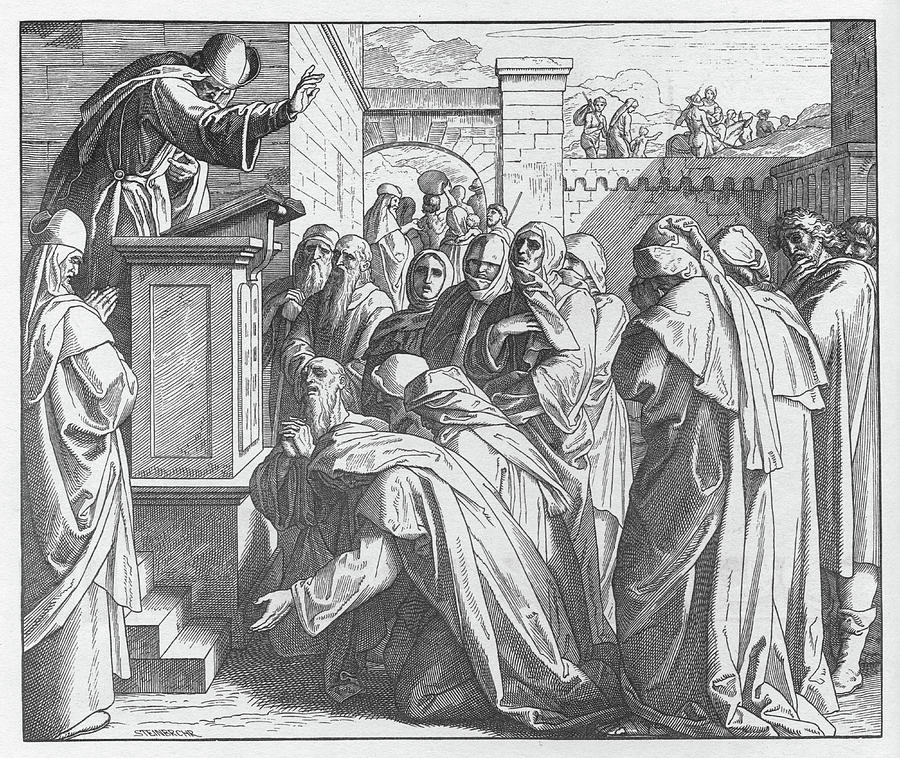
“Repentance of the People” by German painter Julius Schnoor von Carolsfeld (1794-1872)

But despite all this [God’s blessings] they were disobedient and rebelled against you. They turned their backs on your Law, they killed your prophets who warned them to return to you, and they committed terrible blasphemies. So, you handed them over to their enemies, who made them suffer. But in their time of trouble, they cried to you, and you heard them from heaven. In your great mercy, you sent them liberators who rescued them from their enemies.

But as soon as they were at peace, your people again committed evil in your sight, and once more you let their enemies conquer them. Yet whenever your people turned and cried to you again for help, you listened once more from heaven. In your wonderful mercy, you rescued them many times!

You warned them to return to your Law, but they became proud and obstinate and disobeyed your commands. They did not follow your regulations, by which people will find life if only they obey. They stubbornly turned their backs on you and refused to listen. In your love, you were patient with them for many years. You sent your Spirit, who warned them through the prophets. But still, they wouldn’t listen! So once again you allowed the peoples of the land to conquer them. But in your great mercy, you did not destroy them completely or abandon them forever. What a gracious and merciful God you are! (New Living Translation)

Much of the Old Testament is a rhythmic pattern of God’s judgment and grace. The storyline often goes something like this: 

God makes promises and gives commands. 

People get stubborn, refuse to listen, and disobey. 

God responds with judgment. 

People cry out in their distress.

God gives grace and fulfills divine promises. 

People enjoy, then get stubborn again…. 

The promise of God always involves judgment and grace. Proclaiming only a message of judgment without grace brings despair, death, and hell; there is no hope. Speaking only of grace apart from judgment is oxymoronic – it doesn’t exist because there is no need for grace if there is no judgment; grace is an undeserved mercy given freely by God in the face of our stubborn obstinate selves.

Nehemiah chapter nine is a beautiful prayer of confession. Having heard the Word of God proclaimed, the people released their obstinacy; they realized exile occurred because of their own stubborn refusal to listen to God. So, they repented. 

“Fallen man is not simply an imperfect creature who needs improvement: he is a rebel who must lay down his arms.”

C.S. Lewis

The ancient Jewish people acknowledged their checkered past of ignoring God’s prophets, and they bellied-up and took ownership of their past choices. And God was faithful. Even though the city of Jerusalem had been overtaken and the people sent into exile, God brought them back and the broken wall was rebuilt.

It’s never too late to turn from a past filled with poor decisions, broken relationships, and spiritual disobedience. The time of confession is available, and the time is now. God’s grace always overwhelms our dubious past. 

The appropriate response to today’s Old Testament lesson is to spend some time in confession to God. This chapter, along with Nehemiah chapter one, are good places to begin with understanding just what to say to God. 

For the Christian, confession ought always to conclude with accepting the grace available to us in Christ. 

Today is a new day and a new Christian Year. Let it be a life with the love of Jesus implanted in your heart. As we enter the Advent season, allow that love of Christ to gestate within your soul. Anticipate the birth. Look forward to the Nativity. Long for Christmas and the inbreaking of God to this earth.

Holy Lord, in this time of Advent, we confess we often are distracted by the season’s busyness, by the stress of commitment, and even by putting our own traditions ahead of the true meaning of Christmas. We confess we also often prefer being sentimental to being sacrificial.

Forgive us for all the times we have missed seeing You in our midst, for all the times we have doubted Your presence, and for all the times we have failed to hold the holidays as holy days. Pour peace into our lives and let us be bearers of Your peace to others. Remind us that this is a season of waiting and preparation for the greatest Gift of all. In the holy Name of our Savior, Jesus, we pray. Amen.

Hebrews 10:26-31 – On Rejecting Divine Love

 If we deliberately keep on sinning after we have received the knowledge of the truth, no sacrifice for sins is left, but only a fearful expectation of judgment and of raging fire that will consume the enemies of God.Anyone who rejected the law of Moses died without mercy on the testimony of two or three witnesses. How much more severely do you think someone deserves to be punished who has trampled the Son of God underfoot, who has treated as an unholy thing the blood of the covenant that sanctified them, and who has insulted the Spirit of grace? For we know him who said, “It is mine to avenge; I will repay,” and again, “The Lord will judge his people.”It is a dreadful thing to fall into the hands of the living God. (New International Version)

Love isn’t all rainbows and unicorns. Sometimes it’s downright tough, unabashedly truthful, and concerned for appropriate justice.

Love is compassionate, kind, and full of good deeds. Love is also subversive. Love takes a breach in relations seriously. Love announces that the hurt which has happened is not to be accepted as normal. Love is a refusal to settle for what is.

So, whenever God’s people drift away and slide into unhealthy or damaging ways of living, God’s love is not okay with it.

There’s a reason why we feel emotional pain. That’s because God feels pain. We don’t have to go very far into that thick book, the Bible, to find the hurt:

The Lord saw that the human beings on the earth were very wicked and that everything they thought about was evil. He was sorry he had made human beings on the earth, and his heart was filled with pain. (Genesis 6:5-6, NCV)

There is perhaps no more awful pain than being brokenhearted. A thousand kidney stones are not as painful as becoming heartsick over a relationship gone awry. Love can be an affliction – a deep ache which longs for wholeness, integrity, connection, and unity.

Perhaps we have neglected how much God hurts and longs for prodigal people to return in love to a divine relationship of grace. Just because God is always content, happy, and celebrating within perfect Trinitarian Love does not mean that God isn’t also profoundly sad, full of grief, and gazing from heaven, watching and waiting for sinful humanity to come to their senses.

God’s wrath exists because of God’s love.

God doesn’t paper over humanity’s guilt and shame and pretend it isn’t there. Instead, God has gone to the ultimate length to realize a restored relationship with fallen people. God got down in the trenches with us, in the person of Jesus, and dwelt among us – willing to suffer and die for us. Grace is most certainly free; however, it is anything but cheap.

Therefore, to know this great Love, then spurn it, is much more than agonizingly painful – it isn’t right. The preacher in the New Testament book of Hebrews captures the pathos of God against all that separates people from such perfect Love.

To renege on a commitment to Jesus is tantamount to crucifying him all over again.

This is an emotional and spiritual pain which transcends any human disappointment or failed friendship. Because God’s heart is so large, so God’s agony over defiant persons who turn from Love is immense beyond what we can even imagine.

Yes, it is a dreadful thing to fall into the hands of the Living God. Those who hate ought to beware. The ones trampling God’s moral law and ethical will into the ground, like some animal dung, ought not to think they are outside the reach of Divine Love, complete with Divine Wrath purging the resentment and rancor from Earth.

The warning of the preacher is of rejecting the spirit of Love and replacing it with the ancient evil spirt of hubris, animosity, and fear. Perfect Love drives out fear, restores comity, and embraces humility.

We are responsible for our own transgressions against others; our own failures to love as we ought; and our own neglect of God. Therefore, we must forsake willful and deliberate treatment of God and others by denigrating the work of the Spirit and attributing evil intentions to them.

If we focus on loving God and neighbor, then there is no room for apostasy, for lashing out and being an evangelist of wickedness. By clarifying and focusing on what matters most; being non-retaliatory; and reminding oneself of divine Love, we can cultivate a spirit of grace and forsake the hateful spirit.

Whenever we are wounded by another, or even by God, holding onto the hurt only causes gangrene of the soul. Yet, through forsaking all forms of violent and destructive language and behavior, and embracing the wounds of Christ, we can experience healing – even if our present adverse circumstance does not change.

So, be kind to yourself and others. Allow God’s kindness to penetrate the deep portions of your heart. Live a life of grace. Why be punished for acting like a foolish person? If you must suffer, suffer for doing good, not evil.

O Lord God, I confess and acknowledge your infinite mercy and goodness to me, and my ingratitude for such grace shown. You have saved me and made me your own child, and an heir of heaven. And I end up ignoring your gracious blessings, giving into temptation, and treating faith like a paper plate to be trashed when I’m done with it. I am truly sorry for my offenses toward you and admit my failure to observe your goodness. Accept my imperfect repentance, forgive my wickedness, purify my uncleanness, strengthen my weakness, heal my unstable spirit, and let your divine Love rule in my heart, through the love of Jesus Christ. Amen.

Romans 12:17-21, 13:8-10 – Let Love Be Your Only Debt

Don’t mistreat someone who has mistreated you. But try to earn the respect of others and do your best to live at peace with everyone.

Dear friends, don’t try to get even. Let God take revenge. In the Scriptures the Lord says,

“I am the one to take revenge
    and pay them back.”

The Scriptures also say,

“If your enemies are hungry,
    give them something to eat.
And if they are thirsty,
give them something
    to drink.
This will be the same
as piling burning coals
    on their heads.”

Don’t let evil defeat you but defeat evil with good….

Let love be your only debt! If you love others, you have done all that the Law demands. In the Law there are many commands, such as, “Be faithful in marriage. Do not murder. Do not steal. Do not want what belongs to others.” But all of these are summed up in the command that says, “Love others as much as you love yourself.” No one who loves others will harm them. So, love is all that the Law demands. (Contemporary English Version)

Not everybody is likable. We all have others that drive us crazy on the inside with their annoying habits or ungodly ways of life. 

Sometimes we might experience much more than being irritated. Raging vitriol that results in verbal persecution; becoming the targets of evil intent; and, in some cases, finding ourselves victims of violence done to us or a loved one can stretch our Christian sensibilities to their maximum. It is understandable that in such cases we would be upset, angry, in grief, and desire justice.

As we reflect back on Reformation Day and the great truth that we are justified apart from any work of our own but by grace alone through faith, this helps to give understanding as to why we do not take vengeance into our own hands. 

We are clearly exhorted in today’s New Testament lesson to repay no one evil for evil because vengeance belongs to God alone, not us. 

If justification is a work of God to rescue and redeem sinners from their plight, then wrath is also a work of God. Just as justification is initiated and made possible through Christ by faith, so vengeance belongs to God, as well. Our part in the whole affair is to trust God to take care of judging the world. Judgment is way above our pay grade.

Our responsibility is showing love, even to those whom we consider enemies. If we are to love our neighbors as ourselves, then we will leave plenty of room for God to do what God does best: either show mercy to sinners or execute judgment upon them. It’s all God’s business what happens with humanity. Our business is coming under the lordship of Christ and allowing God’s new creation to work itself out through us. 

We are to work for the kind of justice that provides others with what they need, not what they deserve. The world cannot become a better place if we keep insisting on playing judge, jury, and executioner. Sometimes the best way to show love is to sincerely pray for the person for whom we have such difficulty loving. 

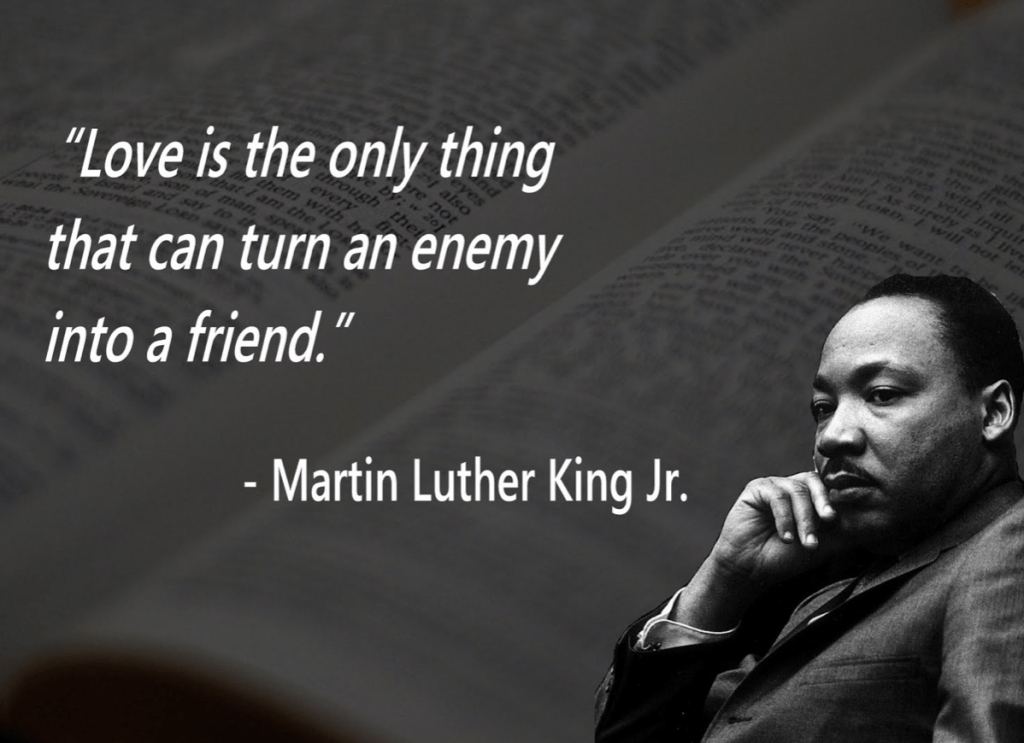
Who do you need to love today? Here is an excerpt from a sermon by Dr. Martin Luther King Jr., delivered at the Dexter Avenue Baptist Church, Montgomery, Alabama, on November 17, 1957:

“Love has within it a redemptive power. And there is a power there that eventually transforms individuals. That’s why Jesus says, ‘Love your enemies.’ Because if you hate your enemies, you have no way to redeem and to transform your enemies. But if you love your enemies, you will discover that at the very root of love is the power of redemption. You just keep loving people and keep loving them, even though they’re mistreating you.

Here’s the person who is a neighbor, and this person is doing something wrong to you and all of that. Just keep being friendly to that person. Keep loving them. Don’t do anything to embarrass them. Just keep loving them, and they can’t stand it too long. Oh, they react in many ways in the beginning. They react with bitterness because they’re mad because you love them like that. They react with guilt feelings, and sometimes they’ll hate you a little more at that transition period, but just keep loving them.

And by the power of your love, they will break down under the load. That’s love, you see. It is redemptive, and this is why Jesus says love. There’s something about love that builds up and is creative. There is something about hate that tears down and is destructive. So, love your enemies.”

Just and merciful God, you are the rightful Judge of all the earth. Help me to trust in you so that I can give room for you to do whatever you want to do in others’ lives. I pray you will grace many people with the repentance that leads to new life in Jesus. Amen.

Acts 12:20-25 – Don’t Be Worm Food

Herod had been furious with the people of Tyre and Sidon for some time. They made a pact to approach him together, since their region depended on the king’s realm for its food supply. They persuaded Blastus, the king’s personal attendant, to join their cause, then appealed for an end to hostilities. On the scheduled day Herod dressed himself in royal attire, seated himself on the throne, and gave a speech to the people. Those assembled kept shouting, over and over, “This is a god’s voice, not the voice of a mere human!” Immediately an angel from the Lord struck Herod down, because he didn’t give the honor to God. He was eaten by worms and died.

God’s word continued to grow and increase. Barnabas and Saul returned to Antioch from Jerusalem after completing their mission, bringing with them John, who was also known as Mark. (Common English Bible)

Accountability is important. People need to be held to a clear, right, and just standard of attitude and behavior – especially when they mess with the food supply.

Herod Agrippa Is Worm Food

The King Herod in our New Testament story today, known as Herod Agrippa, was a grandson to Herod the Great. Simply put, King Herod Agrippa was a self-absorbed jerk. Although he only reigned four years, he was something like a modern day evangelical huckster. Herod knew how to turn a phrase and play on the emotions of people to get what he wanted while keeping up appearances with both the Empire and the Jewish people.

Yet, despite or because of his eloquence and power, Herod was vain and ruled for self – and neither for God nor country. So, he was stricken by God and died an unpleasant death. The connection is clear: Herod used the food people depended upon as a means of controlling the politics of the region, so God hit him directly in his intestines with a complete lack of control over his own body.

Just as Herod was an unwanted agent manipulating the food supply for his own ends, so the king received some unwanted guests in the form of worms. In the ancient world, when any ruler used food to control the people, there were individuals and families who ended up starving to death. For Herod, the worm turned, it was he who died.

Jesus Is Gospel Food

The swift judgment from God was both a rebuke to Herod’s personal kingdom building, as well as a means of protecting the fledgling church from severe persecution. With Herod Agrippa off the scene, the Apostles could freely move with regularity (pun intended) and proclaim the good news of Jesus Christ.

Paul, Barnabas, and Mark were able to go on a missionary journey. Nothing can thwart God’s good news and sovereign intentions for humanity – especially not an upstart demigod king who, as a Jew, knew better than to go rogue and mess with people’s food.

The church is to give literal and spiritual food – following the footsteps of their Lord Jesus who said:

“The bread of God is the one who comes down from heaven and gives life to the world…. I am the bread of life. Whoever comes to me will never go hungry, and whoever believes in me will never be thirsty…. I am the bread of life. Your ancestors ate manna in the wilderness, and they died. This is the bread that comes down from heaven so that whoever eats from it will never die. I am the living bread that came down from heaven. Whoever eats this bread will live forever, and the bread that I will give for the life of the world is my flesh…. I assure you, unless you eat the flesh of the Human One and drink his blood, you have no life in you. Whoever eats my flesh and drinks my blood has eternal life, and I will raise them up at the last day. My flesh is true food, and my blood is true drink. Whoever eats my flesh and drinks my blood remains in me and I in them. As the living Father sent me, and I live because of the Father, so whoever eats me lives because of me. This is the bread that came down from heaven. It isn’t like the bread your ancestors ate, and then they died. Whoever eats this bread will live forever.” (John 6:33-58, CEB)

God’s purpose and intent is to provide sustenance. Divine retribution is likely to happen when puny humans try and play their power games, putting entire people groups at risk for starvation. Jesus came to this earth for the provision of food that will nourish to eternal life.

The Lord will provide. God shall ultimately topple all systems of repression which deny people basic life needs. Almighty God seeks to eat away, like an intestinal worm, at contemporary political regimes and oppressive governments which put people in impossible situations of trying to fend for themselves.

Jesus is both Bread and Judge. Christ came in his first advent bringing food for the hungry. There is a time coming when he shall return in his second advent to bring the worm – good news to the suffering, and bad news for the ones who create the suffering.

Be encouraged with the spiritual reality that Christ brings spiritual sustenance and eternal life. And be assured that he knows the condition of all people and will extend grace or judgment with sage wisdom.

Grant, O God, that your holy and life-giving Spirit may so move every human heart, especially the hearts of political authorities, that barriers which divide us may crumble, suspicions disappear, and hatreds cease; that our divisions being healed, we may live in justice and peace so that everyone’s need for food is met, through Jesus Christ our Lord. Amen.