The Trumpets of Judgment (Revelation 8:6-9:12)

The seven angels with seven trumpets, and the angel with a censer, c. 1020 C. E.

Then the seven angels who had the seven trumpets prepared to sound them.

The first angel sounded his trumpet, and there came hail and fire mixed with blood, and it was hurled down on the earth. A third of the earth was burned up, a third of the trees were burned up, and all the green grass was burned up.

The second angel sounded his trumpet, and something like a huge mountain, all ablaze, was thrown into the sea. A third of the sea turned into blood, a third of the living creatures in the sea died, and a third of the ships were destroyed.

The third angel sounded his trumpet, and a great star, blazing like a torch, fell from the sky on a third of the rivers and on the springs of water—the name of the star is Wormwood. A third of the waters turned bitter, and many people died from the waters that had become bitter.

The fourth angel sounded his trumpet, and a third of the sun was struck, a third of the moon, and a third of the stars, so that a third of them turned dark. A third of the day was without light, and also a third of the night.

As I watched, I heard an eagle that was flying in midair call out in a loud voice: “Woe! Woe! Woe to the inhabitants of the earth, because of the trumpet blasts about to be sounded by the other three angels!”

The fifth angel sounded his trumpet, and I saw a star that had fallen from the sky to the earth. The star was given the key to the shaft of the Abyss. When he opened the Abyss, smoke rose from it like the smoke from a gigantic furnace. The sun and sky were darkened by the smoke from the Abyss. And out of the smoke locusts came down on the earth and were given power like that of scorpions of the earth. 

They were told not to harm the grass of the earth or any plant or tree, but only those people who did not have the seal of God on their foreheads. They were not allowed to kill them but only to torture them for five months. And the agony they suffered was like that of the sting of a scorpion when it strikes. During those days people will seek death but will not find it; they will long to die, but death will elude them.

The locusts looked like horses prepared for battle. On their heads they wore something like crowns of gold, and their faces resembled human faces. Their hair was like women’s hair, and their teeth were like lions’ teeth. They had breastplates like breastplates of iron, and the sound of their wings was like the thundering of many horses and chariots rushing into battle. They had tails with stingers, like scorpions, and in their tails they had power to torment people for five months. They had as king over them the angel of the Abyss, whose name in Hebrew is Abaddon and in Greek is Apollyon (that is, Destroyer).

The first woe is past; two other woes are yet to come. (New International Version)
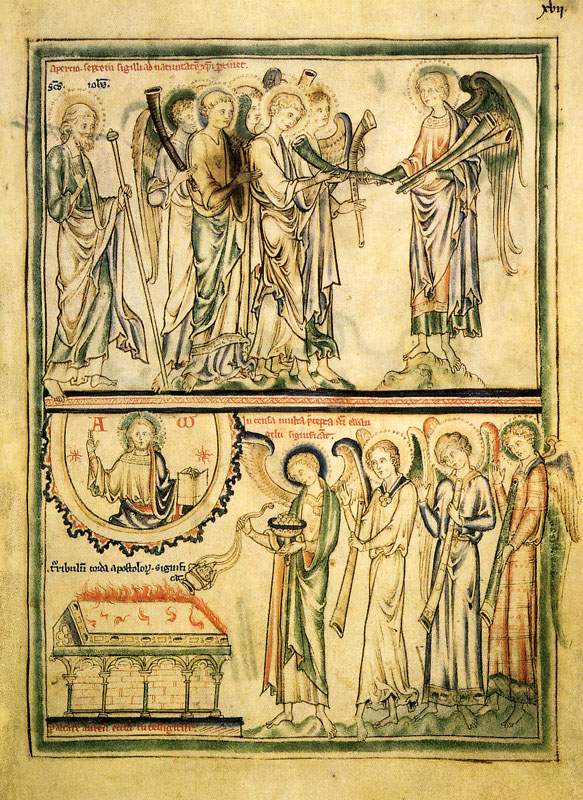
Angels receiving seven trumpets, c. 1255 C.E.

Woah; this isn’t exactly some light bedtime reading. It has to do with the end of all things, with God’s judgment upon the earth. Seven angels with seven trumpets are about to sound them with disastrous results. The last three trumpets are also referred to as the three woes upon the earth.

The first four trumpets are bad, yet not nearly as terrible as the last three. The first four affect the natural world and one-third of the earth; whereas the last three directly impact the earth’s inhabitants and affect the entire world.

As hard as it may be to accept biblical readings like today’s, God is not only the author of abundant flourishing, but also of devastating destruction. And it’s in direct answer to the prayers of the saints. (Revelation 8:3)

Although hail and blood remind the biblical student of the plagues of judgment in ancient Egypt before the great exodus of Israelites, it’s the fire that does damage to the trees and grass of the earth. A third of the earth’s land resources are completely burned up.

The second angel blowing the second trumpet results in a great mountain being hurled into the sea. This is reminiscent, for those familiar with the Gospels, of Jesus stating that one with a small amount of faith can command a mountain to be thrown into the sea, and it will be done. (Mark 11:23)

Going back into the Old Testament, in the giving of the Law on the mountain, and with the disobedience of the people at the foot of the mountain, Mount Sinai was ablaze with fire and the glory of God. The New Testament scene in Revelation appears to be something of a Mount Sinai taken up and thrown into the sea – signifying that the grace of Christ has supplanted the curse of the law.

As a result of the second trumpet, a third of all the great oceans are destroyed.

Although C.S. Lewis gave the name “Wormwood” to a fictional agent of Satan, the Wormwood here is a messenger of God, a star that falls from the sky as a result of the third trumpet blown. A third of all the earth’s drinkable water becomes bitter because of the star – which seems to be a link to previous times of judgment from God:

“I will make them eat bitter food
    and drink poisoned water,
because from the prophets of Jerusalem
    ungodliness has spread throughout the land.” (Jeremiah 23:15, NIV)

“They have followed the stubbornness of their hearts; they have followed the Baals, as their ancestors taught them.” Therefore this is what the Lord Almighty, the God of Israel, says: “See, I will make this people eat bitter food and drink poisoned water. (Jeremiah 9:14-15, NIV)

There’s nothing that falls from the sky with the blast of the fourth trumpet. Yet a third of the sun, moon, and stars are dimmed. This is a portent that something worse is about to happen – which is what the “eagle” [vulture] announces against the earth’s inhabitants.

Another star falls to the earth, but with even more disaster than the previous star – opening a pit in the heart of the earth. Smoke comes billowing out, darkening the sun. Then, locusts with the stinging power of scorpions, come upon the land.

Rather than humans having authority to trample on snakes and scorpions, these demonic insects carry the ability and the authority to harm humanity – much like the great locust horde of judgment during the time of the prophet Joel (Joel 2:1-11). The difference with John’s Apocalypse is that these are a demonic host with Apollyon the Destroyer leading them.

The previous judgments were from above; this first woe is from below – connecting the powers of death, destruction, and the grave together with the force of evil. It’s a time of sheer torture; a traumatic five months of horrendous agony.

Conclusion

None of these terrible scenes of judgment are meant to scare the hell out of anybody and put the fear of heaven into them. Instead, the New Testament book of Revelation (also known as the Apocalypse of John) is meant for devoted believers in Jesus to be encouraged that an end is coming. They can persevere in following Jesus because it will be worth it.

The hardships, difficulties, and persecutions experienced – for following the words and ways of Jesus – will not last; a time is coming soon when God will judge the living and the dead. Evil will be dealt its final blow. And we will enter a realm of unending peace with the God for whom we have given our all.

Therefore, since we are receiving a kingdom that cannot be shaken, let us be thankful, and so worship God acceptably with reverence and awe, for our “God is a consuming fire.” (Hebrews 12:28-29; Deuteronomy 4:24)

May the Lord answer you in the day of trouble!
    The name of the God of Jacob protect you!
May he send you help from the sanctuary
    and give you support from Zion.
May he remember all your offerings
    and regard with favor your burnt sacrifices. Selah

May he grant you your heart’s desire
    and fulfill all your plans. Amen. (Psalm 20:1-4)

Good vs. Evil (2 Thessalonians 2:7-12)

For the mystery of lawlessness is already at work, but only until the one who now restrains it is removed. And then the lawless one will be revealed, whom the Lord Jesus will destroy with the breath of his mouth, annihilating him by the manifestation of his coming. The coming of the lawless one is apparent in the working of Satan, who uses all power, signs, lying wonders, and every kind of wicked deception for those who are perishing because they refused to love the truth and so be saved. For this reason God sends them a powerful delusion, leading them to believe what is false, so that all who have not believed the truth but took pleasure in unrighteousness will be condemned. (New Revised Standard Version)

There are two opposing forces which are operating in this world. One is the power of evil, manifested through lawlessness, selfishness, and wickedness. The other power is good, and it is seen wherever there is a concern for the common good of all people. Labors of love for all humanity and right relations with everyone are a demonstration of the peaceable fruit of righteousness existing in the world.

To put it succinctly, a spirit of merciful grace and a spirit of careless judgment both exist throughout the world.

Hate what is evil; cling to what is good.

The Apostle Paul (Romans 12:9, NIV)

The Apostle Paul wrote his letter to the church in Thessalonica because the believers there were confused. Somebody had told them that the end of the age already happened. Paul sought to set the record straight, that we are still anticipating the return of the Lord and the final judgment of all things.

The great Day of the Lord will not come until the faithless one, the person of lawlessness, the son of destruction, is revealed. Such a person opposes God and has the force of evil behind them. So, who is this person?

The person is not a single individual. Paul was helping the Thessalonian believers understand the actual situation by wrapping the abstract concept of evil into human form, so that they could visualize its reality and sinister nature. In truth, there will be lots of individual humans who manifest themselves through evil intent and actions, until the Lord’s return.

Grace is the operative power which restrains all the evil. A lot of people have questions about God and evil. Why is there so much evil? How come God doesn’t snuff it all out? Is the Lord not able to do anything? What’s going on?

Those are honest questions. And they come from a place of limited human perspective. Let’s turn this on it’s head. It’s not that God is impotent or isn’t doing anything about evil. Think of it this way: When you scoop up a bunch of sand in your hands, there are a lot of sand grains which fall to the ground. If the sand is evil, and the hands are God’s, the reality of the situation is that the Lord has most of the evil kept at bay.

In other words, if God were not involved in this world, at all, we would be living in a real dystopian society – people staying up at night to guard their homes with guns, and anxious folks attacking each other with impunity. As bad as some things are, it could be infinitely worse than it is.

The grace of God is active in restraining evil and providing believers with what they need to not only survive, but also to thrive in this world.

His divine power has given us everything needed for life and godliness, through the knowledge of him who called us by his own glory and excellence. Thus he has given us, through these things, his precious and very great promises, so that through them you may escape from the corruption that is in the world because of lust and may become participants of the divine nature. (2 Peter 1:3-4, NRSV)

A reversal occurs because of God’s grace. The wickedness which exists, especially within the human heart, is dealt with and transformed into a force for good in the world.

Once we, too, were foolish and disobedient. We were misled and became slaves to many lusts and pleasures. Our lives were full of evil and envy, and we hated each other. But—when God our Savior revealed his kindness and love, he saved us, not because of the righteous things we had done, but because of his mercy. (Titus 3:3-5, NLT)

Grace is wonderful for those who believe. However, for those who are faithless, grace is inoperative – simply because the wicked consider virtues like mercy and grace as weak and useless; they have no intention of either giving or receiving such drivel.

From a certain angle, it may seem that God is harsh. The Lord hardens hearts, sends powerful delusions, and entertains mysteries which some people will never discover. Yet, from another point of view, these are all necessary divine tools in dealing with unjust humanity and their systems of oppression.

Justice and righteousness are championed by God, and therefore, injustice and unrighteousness will not be put up with by the Lord. And that is a good thing. Love not only gives, but it also protects and withholds. Evil will be dealt with according to God’s good grace and in God’s good time – and not according to a limited human perspective or any person’s impatience.

The time is short, and the time is near; everything shall not continue, as it presently is, forever. This is why the author of Hebrews exhorted people to pay attention to “Today” with a capital “T.” Today won’t be here tomorrow. Tomorrow is the Day of the Lord. So, while it’s Today, we must be responsive.

My friends, watch out! Don’t let evil thoughts or doubts make any of you turn from the living God. You must encourage one another each day. And you must keep on while there is still a time that can be called “Today.” If you don’t, then sin may fool some of you and make you stubborn. (Hebrews 3:12-13, CEV)

We must encourage each other with continued faith and patience until the end of the age. We can do this. We are all in this life together, so let us keep on holding up one another and carrying each other’s burdens. In so doing, we will not be lawless, but fulfill the Law of Christ. (Galatians 6:2)

Keep on being brave! It will bring you great rewards. Learn to be patient, so you will please God and be given what he has promised. As the Scriptures say,

“God is coming soon!
    It won’t be very long.
The people God accepts
will live because
    of their faith.
But he isn’t pleased
with anyone
    who turns back.”

We are not like those people who turn back and get destroyed. We will keep on having faith until we are saved. (Hebrews 10:35-39, CEV)

May it be so, to the glory of God. Amen.

Luke 13:1-9 – Jesus Will Have None of It

Now there were some present at that time who told Jesus about the Galileans whose blood Pilate had mixed with their sacrifices. Jesus answered, “Do you think that these Galileans were worse sinners than all the other Galileans because they suffered this way? I tell you, no! But unless you repent, you too will all perish. Or those eighteen who died when the tower in Siloam fell on them—do you think they were more guilty than all the others living in Jerusalem? I tell you, no! But unless you repent, you too will all perish.”

Then he told this parable: “A man had a fig tree growing in his vineyard, and he went to look for fruit on it but did not find any. So, he said to the man who took care of the vineyard, ‘For three years now I’ve been coming to look for fruit on this fig tree and haven’t found any. Cut it down! Why should it use up the soil?’

“‘Sir,’ the man replied, ‘leave it alone for one more year, and I’ll dig around it and fertilize it. If it bears fruit next year, fine! If not, then cut it down.’” (New International Version)

Jesus stood in a crowd of thousands of people. They peppered him with questions about all kinds of issues and situations. Christ responded with a combination of direct exhortations and pointed parables, designed to leave the people reflecting and thinking about what he said.

Christ’s direct exhortation is this: Repent. Change your mind. Christ’s pointed parable message is this: Bear fruit. Change your behavior.

The two go together. A fruitless life points to the need for repentance; and repentance results in bearing the fruit of love, joy, peace, patience, kindness, goodness, gentleness, and self-control.

Jesus, throughout his earthly ministry, relentlessly went after the fruitless dead religion of his day. Jesus believed that such religion needed to be cut out and thrown away. 

Therefore, the Lord exposed the assumptions that people have about sin, faith, and judgment. Jesus challenged four false assumptions or presuppositions that people often hold. In dealing with them, Jesus wanted to foster a change of heart which would lead to a change in behavior.

First Wrong Assumption: Other people’s sin is more serious than mine.

It’s a common human tendency to focus on the bad things in the world what other people do, rather than focus on our own heart and life. We can always identify people who are worse sinners than us! 

The crowd believed Pontius Pilate was a terrible sinner who needed to be dealt with, and they wanted Jesus to get on board to their way of thinking. The people wanted to talk trash about the Romans.

“Repentance is nothing else but a reformation of the whole life according to the Law of God.”

John Calvin

We must beware of people who constantly bemoan the state of the world and the sins of others, while ignoring their own issues or how they might be contributing to the problem. It’s so much easier to scapegoat a person or group of people, believing that if “those people” change, then everything will be okay.

But Jesus will have none of it.

Christ steered the discussion to personal repentance. Although you and I cannot control, change, or fix anyone, we can practice self-control, change our personal habits, and be the solution to our own problems.

Everywhere we go, the world is rife with criticisms and accusations of others. It’s always somebody else’s fault for the ills of the world and even the church.

Republicans blame Democrats. Democrats blame Republicans. Anti-vaxers blame the government. The vaccinated blame the previous government. Everyone thinks that if the other changes, all will be well. 

In the church, when things aren’t right, Christians might ask things like, “Who sinned, the pastor or the congregation, the church or the denomination?” With the decline of religion in the land, we look for a scapegoat. 

But Jesus will have none of it.

Christ cut through all the scapegoating and blame-shifting by saying that every single person needs to repent, without exception. Then, Jesus upped the ante with a parable by challenging us with a very probing thought: 

Are we bearing fruit, or just taking up space? 

Whenever we howl for judgment on others, but insist on grace for ourselves, we are the ones in need of repentance.

Second Assumption: My sin isn’t that serious.

When King Frederick II, an eighteenth-century King of Prussia, was visiting a prison in Berlin, the inmates insisted they had been unjustly imprisoned – all except one. That one sat quietly in a corner, while all the rest protested their innocence. Seeing him sitting there oblivious to the commotion, the king asked him what he was there for:

“Armed robbery, your Honor.”

The king asked, “Were you guilty?”

“Yes, Sir,” he answered. “I entirely deserve my punishment.”

The king then gave an order to the guard: “Release this guilty man. I don’t want him corrupting all these innocent people.”

We may concede that we are all sinners, but then struggle with believing that our personal sin really deserves imprisonment. So, we see no need for repentance. It isn’t that bad.

But Jesus will have none of it. 

Here are some questions raised by today’s Gospel lesson: 

Do I continually locate sin outside of my life, or do I discern the sinfulness of my own heart? 

Do I believe people in hardship are more sinful than me? 

Can I envision that I must change for the church and the world to change? 

Is my life fruitful, or fruitless? 

How can I become fruitful? 

What must I repent of? 

What will happen if I don’t repent?

Third Assumption: God will not judge me.

Some might concede we are all sinners, and my own sin is bad. “But is it really so bad that God would judge me?”  Again, the two big ideas Jesus is working with here is that everyone needs repentance, and everyone needs to bear spiritual fruit in keeping with such repentance. 

Jesus alerts us that the future involves a Judgment Day. All shall be held accountable for fruit-bearing, or the lack thereof. No fruit on the branch means it will be cut down and thrown into the fire.

Jesus was talking to a crowd of people who were quite religious. They were faithful temple worshipers, and had weekly practices of giving, fasting, and prayer. But they needed to repent of trusting in self and stuff. 

They believed God would judge the evil Romans and everyone else who did not live or think like them. They were God’s people; the Lord would not judge them!

But Jesus will have none of it.

The Lord almighty looked for justice, but saw bloodshed;
    for righteousness, but heard cries of distress. (Isaiah 5:7, NIV)

Learn to do right; seek justice.
    Defend the oppressed.
Take up the cause of the fatherless;
    plead the case of the widow.

Isaiah 1:17, NIV

Jesus wants spiritual fruit in keeping with repentance. Believing the right things and doing the right service never justifies indulging in hate, rage, anger, discord, selfish ambition, envy, impatience, unkindness, and ungraciousness. Doing a particular set of religious duties never gives one a license to use their attitude, their tongue, or their life in whatever way they want.

Fourth Assumption: I have plenty of time.

Okay, other people’s sin is not worse than mine. My sin is serious. God will deal with my sin if I do not repent. But I have time to deal with it, right? I will get around to it when I get a chance. 

But Jesus will have none of it.

Jesus was establishing a sense of urgency into the crowd. Repentance is not something to put off until tomorrow. Today is the day to deal with sin. If a lack of fruitfulness persists, judgment is imminent. Jesus was not trying to scare people into repentance; he was just letting them know that procrastination puts us in a precarious position. We don’t have unlimited time. We are on the clock.   

Just because God is gracious, merciful, kind, and patient does not mean that he won’t cut the dead religion tree down.

Today is the day of repentance, the day to quit looking for everyone else to repent and change, the day to take our own sin seriously, the day to discern that God does not show favoritism and will judge all persons equally and fairly. 

Today is the day because the hour is almost here when Jesus will return to judge the living and the dead.

Conclusion

So, we must repent of a lack of fruitfulness. The spiritual fruit God is looking for is love, joy, peace, patience, kindness, goodness, faithfulness, gentleness and self-control. 

When an apple trees bear fruit, some of those apples do not just bear the apple’s skin, some the apple’s core, some the apple’s meat. No! When an apple tree bears fruit, it bears apples – whole ones with all the things that make an apple an apple. 

There is no leg to stand on with the notion that I have love, but no patience; or display a lack of peace, but practice self-control. We either have the fruit of the Spirit, or we do not! If we have some of these, but not others, we have genetically modified fruit which has not been raised in the soil of the gospel.

Each one of us needs to look in our heart in this season of Lent and accurately assess the current state of our lives before God. Then, we need to repent, to change those things which the Spirit of God identifies. And, like a farmer, we are to cultivate, fertilize, and tend to our hearts in ways that will produce a crop.

Gracious God, our sins are too heavy to carry, too real to hide, and too deep to undo. Forgive what our lips tremble to name, what our hearts can no longer bear, and what has become for us a consuming fire of judgment. Set us free from a past that we cannot change; open to us a future in which we can be changed; and grant us grace to grow more and more in your likeness and image, through Jesus Christ, the light of the world. Amen.

Matthew 24:45-51 – The Master is Coming

Expert explains about plagues, Armageddon and Jesus' return

Jesus said, “Who then is the faithful and wise servant, whom the master has put in charge of the servants in his household to give them their food at the proper time? It will be good for that servant whose master finds him doing so when he returns. Truly I tell you, he will put him in charge of all his possessions. But suppose that servant is wicked and says to himself, ‘My master is staying away a long time,’ and he then begins to beat his fellow servants and to eat and drink with drunkards. The master of that servant will come on a day when he does not expect him and at an hour he is not aware of. He will cut him to pieces and assign him a place with the hypocrites, where there will be weeping and gnashing of teeth.” (NIV)

Satan once called on some demons of hell and wanted to send one of them to earth to ruin some souls. One demon came forward and said, “I will go.” The devil said, “If I send you, what will you tell the humans?” He said, “I will tell those humans that there is no heaven.” Satan said, “They will not believe you, for there is a bit of heaven in every human heart. In the end everyone knows that right and good must have the victory. You may not go.” 

Then another demon came forward, darker and fouler than the first. The Accuser said, “If I send you, what will you tell humanity?” He said, “I will tell them there is no hell.” Satan looked at him and said, “Oh, no; they will not believe you, for in every human heart there’s a thing called a conscience, an inner voice which testifies to the truth that good will be triumphant and evil defeated. You may not go.” 

Then one last demon came forward, this one from the darkest place of all. The devil said to him, “And if I send you, what will you say to women and men to aid in the destruction of their souls?” The demon said, “I will tell them there is no hurry.” Satan said, “Go!”

Most people’s crime in not gross sin but in plain indifference, without much thought to a future judgment day. Jesus said that such persons will not know what hit them because the Day of the Lord is coming, and it may be soon. Therefore, the question for Christians is not “When will Christ return?” because no one knows the answer.  Rather, the question for us is:

Are you ready for Christ’s return?

Today’s Gospel lesson is part of what is known as the Olivet Discourse, Christ’s final sermon before he faced the cross. Jesus was looking for his disciples to keep watch, to stay alert, to be ready, like a watchman on a tower scanning the landscape for an invading army.  We are to remain vigilant and remember Jesus is coming again.  We are to live each moment considering the promise of Christ’s coming, not knowing the day when it will happen.

Keeping watch, being ready, and staying alert means being witnesses to a world going about their merry way unaware that there is a doomsday.  We are to be active, like Noah building the ark, anticipating the great flood of coming judgment. We are not to waste time creating prophecy charts and trying to connect current events to the Lord’s return. Instead, we are to prepare for the coming judgment through living godly, upright lives. (2 Peter 2:4-9)

We keep watch by being faithful stewards in God’s household. 

We are to avoid being like the unfaithful teenager who, when given the responsibility of watching over the house while his parents are gone for the weekend, has a big party and trashes the house.  The parents will come home at a time the teenager does not expect, and then there will certainly be weeping and gnashing of teeth! 

The faithful and wise steward is busy doing the master’s business – the mundane work of taking care of the master’s house. Preparing for Christ’s return leads to down-to-earth acts of love and care, without passively or nervously sitting around and waiting.  The unfaithful servant in Christ’s story is careless, cruel, and carouses because he pays no attention to the fact that the master could return at any moment.

When Christ returns, none of us knows who will be taken and who will be left – because people might look like the same on the outside, doing the same work side by side, but can be very different persons on the inside.

As believers wait for their Lord’s return, they may become impatient and get caught up in petty day to day problems, losing sight of what is tremendously important.  One day, a man named Denis Waitley, was trying to catch a flight but was running late. So, he ran through the airport terminal.  He got to the gate the split second the gate agent closed the door.  Denis explained his situation, that he had a speaking engagement to get to, but the agent did not budge. 

Denis’s frustration turned into fuming.  He stormed out of the boarding area and back to the ticket counter to register a complaint and reschedule his flight.  The anger intensified as he waited for more than twenty minutes in a line that barely moved.  Just before he got to the counter an announcement over the intercom changed his life.  The flight he missed, flight 191 from Chicago to Los Angeles, crashed on takeoff and killed every person on board the plane. 

Denis Waitley never registered his complaint.  In fact, he never returned his invalidated ticket.  He took it home and pinned it on a bulletin board in his office to remind him whenever he got frustrated or upset that life is more than day to day impatience, worry, and complaints.  It is about serving a lost world destined to slide away from God apart from the grace that can turn judgment into blessing.

We are to keep watch for the Lord’s return because it could be today. 

In the meantime, we are to be faithful by serving a world in tremendous need of getting on the ark and being saved from the coming judgment. Perhaps the best way to overcome our own chronic unhappiness and struggles is to serve the world and be the servant God wants us to be.

God Almighty, you are our hope in this life and the life to come, as we wait for Christ’s return, help us to work for the good, as if each day is our last; and let our hope for a new day shape how we live now. We look forward to the time when all will be made right. Even so, come Lord Jesus. Amen.