Remembering Dr. King

So the angel swung his sickle into the earth, and cut the vineyard of the earth, and he put what he reaped into the great winepress of God’s passionate anger. (Revelation 14:19, Common English Bible)

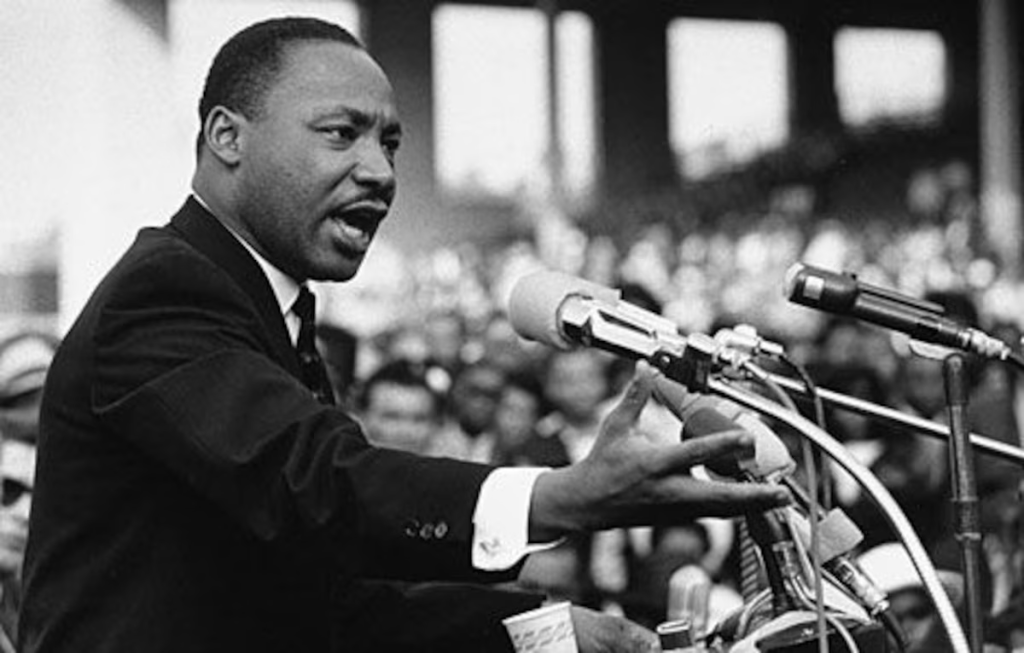
One of the things to keep in mind about Dr. Martin Luther, King Jr., especially on this day remembering his life and work, is that he was a committed Christian clergyman who had deep theological roots in everything he said and did.

King’s public speeches were filled with biblical allusions to the Old Testament prophets, and the New Testament writers. In his address to the Selma marchers, he said:

“How long will justice be crucified, and truth bear it?… It will not be long, because truth crushed to earth will rise again. How long? Not long, because you shall reap what you sow… How long? Not long, because the arc of the moral universe is long, but it bends toward justice.

How long? Not long, because: Mine eyes have seen the glory of the coming of the Lord; He is trampling out the vintage where the grapes of wrath are stored; He has loosed the fateful lightning of His terrible swift sword; His truth is marching on. He has sounded forth the trumpet that shall never call retreat; He is sifting out the hearts of men before His judgment seat. O, be swift, my soul, to answer Him! Be jubilant my feet! Our God is marching on.”

It seems to me that Dr. King would clearly understand our present moment in the United States of America. Two months before his assassination, King preached to his Atlanta congregation, stating:

“God didn’t call America to do what she’s doing in the world now.”

Dr. King could say that because he knew the keen distinction between patriotism and nationalism. Patriotism is a critical affirmation of one’s own country with the desire and attempt to help correct it, peacefully and non-violently, when she is in error. Nationalism, however, is an uncritical support of one’s own nation, regardless of any immoral speech or unethical actions in the world.

King was able to hold a fierce patriotic spirit, while at the same time understanding a nationalistic fervor which contradicted true and real patriotism. In his “I Have a Dream” speech of 1963, Dr. King reminded his listeners:

“My dream is deeply rooted in the American dream that one day this nation will rise up and live out the true mean of its creed: ‘We hold these truths to be self-evident, that all men are created equal.’”

Along with King’s hopeful patriotism, he expressed the sad reality of what he saw. Speaking a commencement address to Lincoln University students he said:

“Since the founding fathers of our nation dreamed this noble dream, America has been something of a schizophrenic personality, tragically divided against herself.”

Dr. King warned against a selfish and arrogant nationalism that champions one’s country at the expense of the world’s common welfare. He discerned that such narrow self-interest puts morality and ethical principles on the back burner of policy and practice. And once down that road, a nation will not stop “because of our pride and arrogance as a nation.”

A year before his death, King spoke at New York’s Riverside Church and called for “a worldwide fellowship that lifts neighborly concern beyond one’s tribe, race, class and nation,” insisting that this is “in reality a call for an all-embracing and unconditional love for all men.”

On this Martin Luther King, Jr. Day, I choose to remember that King’s words came from a place of scriptural wisdom which was hewn in the crucible of dedicated study, along with decided Christian conviction and practice that placed him in a long tradition of suffering saints who upheld what is most important in this life.

God’s justice for the weak and powerless, and God’s judgment against oppressive abuse, go hand-in-hand. It behooves us all to know which side of God we are really on.

Justice Remembered (Exodus 12:1-13, 21-28)

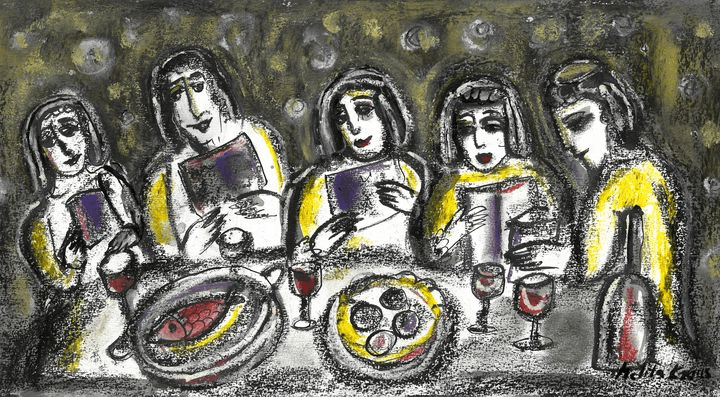
Passover Seder, by Melita Kraus

The Lord said to Moses and Aaron in the land of Egypt, “This month shall mark for you the beginning of months; it shall be the first month of the year for you. Tell the whole congregation of Israel that on the tenth of this month they are to take a lamb for each family, a lamb for each household. If a household is too small for a whole lamb, it shall join its closest neighbor in obtaining one; the lamb shall be divided in proportion to the number of people who eat of it. 

Your lamb shall be without blemish, a year-old male; you may take it from the sheep or from the goats. You shall keep it until the fourteenth day of this month; then the whole assembled congregation of Israel shall slaughter it at twilight. They shall take some of the blood and put it on the two doorposts and the lintel of the houses in which they eat it. 

They shall eat the lamb that same night; they shall eat it roasted over the fire with unleavened bread and bitter herbs. Do not eat any of it raw or boiled in water but roasted over the fire, with its head, legs, and inner organs. You shall let none of it remain until the morning; anything that remains until the morning you shall burn with fire. 

This is how you shall eat it: your loins girded, your sandals on your feet, and your staff in your hand, and you shall eat it hurriedly. It is the Passover of the Lord. I will pass through the land of Egypt that night, and I will strike down every firstborn in the land of Egypt, from human to animal, and on all the gods of Egypt I will execute judgments: I am the Lord. The blood shall be a sign for you on the houses where you live: when I see the blood, I will pass over you, and no plague shall destroy you when I strike the land of Egypt….

Then Moses called all the elders of Israel and said to them, “Go, select lambs for your families, and slaughter the Passover lamb. Take a bunch of hyssop, dip it in the blood that is in the basin, and touch the lintel and the two doorposts with the blood in the basin.

None of you shall go outside the door of your house until morning. For the Lord will pass through to strike down the Egyptians; when he sees the blood on the lintel and on the two doorposts, the Lord will pass over that door and will not allow the destroyer to enter your houses to strike you down. 

You shall observe this as a perpetual ordinance for you and your children. When you come to the land that the Lord will give you, as he has promised, you shall keep this observance. And when your children ask you, ‘What does this observance mean to you?’ you shall say, ‘It is the Passover sacrifice to the Lord, for he passed over the houses of the Israelites in Egypt when he struck down the Egyptians but spared our houses.’ ” And the people bowed down and worshiped.

The Israelites went and did just as the Lord had commanded Moses and Aaron; so they did. (New Revised Standard Version)

The Exodus, by Yoram Raanan

Today’s story of Passover is the highlight of Jewish history concerning both God’s judgment and God’s justice. It is a continual reminder that God is concerned with the divine Name; with his people; and with providing them what they need.

The Lord’s tenth and final plague against the Egyptians was the ultimate judgment of taking their firstborn children. At the same time, the Lord extended great justice to the Israelites by removing the oppressive obstacles which hindered them from having their basic human needs met.

Both God’s judgment and God’s justice were to be annually remembered through rituals established by God. These remembrance rituals of Passover are meant to be brought perpetually to Jewish minds, so that they will maintain a high view of Gods’ Name, and also never be a nation who acts like the Egyptians.

Passover and Exodus constituted a new beginning and new life for Israel. Slaughtering the Passover lamb was the start of liberation for the people; along with the eating of unleavened bread. Both the blood of the lamb, and the absence of leaven, together communicated freedom to the Israelites from God.

Even today, nearly four millennia later, Passover is still celebrated amongst the Jewish community as a great festival of freedom. The primary ritual in this celebration is the seder, an evening meal which involves eating several symbolic foods.

The purpose of coming together to eat special foods is to relive the experience of the Exodus from Egypt. It is a time of passing down the people’s communal memory, as well as reflecting upon God’s divine redemption for them.

The Passover rituals are the root of Christianity’s celebration of communion at the Table. For Christians, the final seder meal of Jesus and his disciples at the Last Supper in the Upper Room is remembered and relived, so that believers may contemplate the Cross of Christ as the ultimate divine redemption.

Table fellowship for both religions – Judaism and Christianity – has a central place in ritual remembrance. God is acknowledged and praised as the great Liberator from oppression. Justice is memorialized. Past events are remembered in order to live justly and rightly in the present.

Deliverance of people from both physical and spiritual slavery is a grand theme throughout all of Holy Scripture. People of freedom are never to let themselves again be placed in bondage. The New Testament puts the matter this way:

For freedom Christ has set us free. Stand firm, therefore, and do not submit again to a yoke of slavery. (Galatians 5:1, NRSV)

The yearning for freedom from oppression and injustice lies within the breast of every human on this earth. It’s why people will go out of their way to use whatever means they have of standing against abusive powers.

It is more than ironic that there are people today who espouse themselves as Christian, yet are hell-bent on using whatever means they have to oppress and abuse others into submission. Such persons are not demonstrating care for the Name of God, especially not the Name of Jesus Christ. Instead, they have another agenda – one that has nothing to do with liberation and freedom.

This is one big reason why we need rituals. Rituals keep us remembering the things we need to remember, and help us forget the things we need to forget.

Earthly power is not the summum bonum of life. Rather, real power is Love. Again, quoting the Apostle Paul from the Book of Galatians:

For you were called to freedom, brothers and sisters, only do not use your freedom as an opportunity for self-indulgence, but through love become enslaved to one another. For the whole law is summed up in a single commandment, “You shall love your neighbor as yourself.” If, however, you bite and devour one another, take care that you are not consumed by one another. (Galatians 5:13-15, NRSV)

Indeed, all that really counts for us in this life is “faith expressing itself through love.” (Galatians 5:6)

Remembering true freedom, and it’s real cost, through established rituals, is perhaps the best way of ensuring that the oppression and injustice of empires like Egypt and Rome do not happen in our present day.

Therefore, if we lose connection with important and seminal events of the past without ritual remembrance, we are setting ourselves up for terrible injustice to occur.

We are better than that. Redemption and remembrance can help show us the way.

Great God of all justice, righteousness, and redemption: Continue to break the yoke of Pharaoh in our time, and forever shatter the bonds of human oppression.. Hasten the Day when we shall all be free, at the coming of your Son, our Lord, Jesus Christ, who with you and the Holy Spirit are one God, now and forever. Amen.

Learn To Do Good (Isaiah 1:1, 10-20)

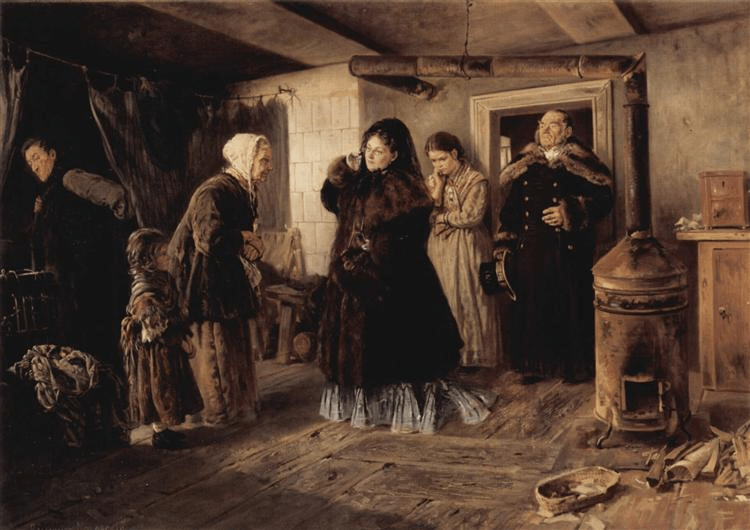
Visiting a Poor People, by Vladimir Makovsky, 1874

The vision of Isaiah son of Amoz, which he saw concerning Judah and Jerusalem in the days of Uzziah, Jotham, Ahaz, and Hezekiah, kings of Judah…

Hear the word of the Lord,
    you rulers of Sodom!
Listen to the teaching of our God,
    you people of Gomorrah!
What to me is the multitude of your sacrifices?
    says the Lord;
I have had enough of burnt offerings of rams
    and the fat of fed beasts;
I do not delight in the blood of bulls
    or of lambs or of goats.

When you come to appear before me,
    who asked this from your hand?
    Trample my courts no more!
Bringing offerings is futile;
    incense is an abomination to me.
New moon and Sabbath and calling of convocation—
    I cannot endure solemn assemblies with iniquity.
Your new moons and your appointed festivals
    my soul hates;
they have become a burden to me;
    I am weary of bearing them.
When you stretch out your hands,
    I will hide my eyes from you;
even though you make many prayers,
    I will not listen;
    your hands are full of blood.
Wash yourselves; make yourselves clean;
    remove your evil deeds
    from before my eyes;
cease to do evil;
    learn to do good;
seek justice;
    rescue the oppressed;
defend the orphan;
    plead for the widow.

Come now, let us argue it out,
    says the Lord:
If your sins are like scarlet,
    will they become like snow?
If they are red like crimson,
    will they become like wool?
If you are willing and obedient,
    you shall eat the good of the land,
but if you refuse and rebel,
    you shall be devoured by the sword,
    for the mouth of the Lord has spoken. (New Revised Standard Version)

Today’s Old Testament lesson is a stout and ancient warning against an age-old problem: Worshiping properly on a high holy day, yet living an evil and unjust life the rest of the days. It’s the mentality of “I give to God what’s required on the Sabbaths and festivals, so I can therefore do what I want the rest of the time, because that’s my stuff and my time.”

Just to be clear: That sort of evil thinking and behavior will raise the ire of the Lord every time. It’s dichotomous messed-up thinking. It’s the wrongheaded notion of believing that my financial and professional success is obviously a validation of God’s blessing upon me.

However, motives of gaining more wealth, rather than being motivated by humility, meekness, righteousness, purity, mercy, and peacemaking, will end badly, no matter who we are.

One of the problems here is an arrogant assumption that we’re right in what we are doing. We feel justified in living a duplicitous life. I have power, authority, and wealth; you do not. Thus, I’m right; you’re wrong; and I can do whatever the heck I want because God is on my side, not yours.

In terms of contemporary Christianity, this is the megachurch mentality: Since there are so many church attenders and money being placed in the offering plates, this is an unquestioned sanction from God of our rightness.

Then, when Sunday passes and Monday comes, both parishioner and pastor feel justified in using their wealth in ways that are inconsistent with the ways and words of Jesus.

Indeed, many times the name of Jesus is rarely (if ever) used in justifications of living the rich life. A blind eye is turned away from the poor and needy. When pressed, far too many parishioners admit to the belief that the poor are underprivileged because of their own personal sin.

Such “Christians” get away with their injustice before God, largely because there is a mass of churchgoers who honor the wealthy and give them places of authority and power.

They think God has shown favor by “blessing” particular people and communities with wealth (because God would never bless someone with poverty!). This can even go so far as to elect a leader of a nation because he is exorbitantly rich. Never mind his daily immorality, meanness, and lying; God has blessed him, right?

Wrong! So says the prophet Isaiah. Judah and Jerusalem, in their hubris, claimed special status. They are God’s people; others are not. They believed they had divine immunity from judgment. After all, only the Judeans worshiped the Lord; all other nations were pagan worshipers.

But their worship and sacrifices, in Isaiah’s day, were offered with no concern for justice and righteousness. So, God called them to repent; and gave them a chance to learn how to please the Lord.

And what pleases God is removing evil and learning to do good.

“Good” is defined by God as seeking to meet the needs of the common people; rescuing those who are oppressed; defending the cause of the orphan, and pleading the case of the widow. There’s no mention of wealth as a sign of divine blessing.

In reality, Judah’s situation before God was pitiful. They failed, even refused, to do justice, love mercy, and walk humbly. Therefore, the Lord called them to repentance and reformation.

Just because Jerusalem had the temple, this sacred space didn’t inoculate the people from judgment. The bald fact of the matter is that the people were living with self-destructive habits of stupidity. And God had enough of it.

In essence, the Lord said to Judah, “Let’s get serious about this.” Despite all the disobedience, God was willing to entertain the people’s change of heart and life – that is, if they themselves were willing to do so.

It’s important for all of us to “have it out with God,” to engage the Lord forthrightly, passionately, intelligently, and realistically.

There are really only two choices: Choose life or choose death. Choose to connect in meaningful, right, good, and just ways with God and neighbor; or choose to disconnect from others and do whatever the heck you want.

Each of our choices impacts what will happen tomorrow and into the future.

Decisions consistent with justice, righteousness, and goodness will ultimately go well for us. Decision-making borne of selfishness, a lack of mercy, and callousness toward others will create all sorts of problems.

Judah’s practical and existential decision came down to whether they wanted a just and productive society, or an invading Assyrian army. Which would you rather have?

To have a public daily life of disrespect and disregard for the needs of others (and of God!) is to invite being up a stinking creek without a paddle, and no one around to hear the yells for help.

Nothing can ever replace good old-fashioned turning away from hate, unforgiveness, bitterness, and pride; and turning toward what is good, right, just, and godly – and then ordering our collective public life around caring for the least and the lost among us.

May it be so, to the glory of God.

God of judgment and grace, you ask not for sacrifices but lives of trusting faith that acknowledge Your power and mercy. Give us a deep belief in Your sovereign goodness, so that we may follow You all the days of our lives, as did Jesus Christ our Savior and Lord. Amen.

Return To the Lord (Amos 4:6-13)

I gave you cleanness of teeth in all your cities
    and lack of bread in all your places;
yet you did not return to me,
            says the Lord.

And I also withheld the rain from you
    when there were still three months to the harvest;
I would send rain on one city
    and send no rain on another city;
one field would be rained upon,
    and the field on which it did not rain withered;
so two or three towns wandered to one town
    to drink water and were not satisfied;
yet you did not return to me,
            says the Lord.

I struck you with blight and mildew;
    I laid waste your gardens and your vineyards;
    the locust devoured your fig trees and your olive trees;
yet you did not return to me,
            says the Lord.

I sent among you a pestilence after the manner of Egypt;
    I killed your young men with the sword;
I carried away your horses;
    and I made the stench of your camp go up into your nostrils;
yet you did not return to me,
            says the Lord.

I overthrew some of you
    as when God overthrew Sodom and Gomorrah,
    and you were like a brand snatched from the fire;
yet you did not return to me,
            says the Lord.

Therefore thus I will do to you, O Israel;
    because I will do this to you,
    prepare to meet your God, O Israel!

For the one who forms the mountains, creates the wind,
    reveals his thoughts to mortals,
makes the morning darkness,
    and treads on the heights of the earth—
    the Lord, the God of hosts, is his name! (New Revised Standard Version)

“Luxury often leads to forgetfulness. As for you, my beloved, if you sit at table, remember that from the table you must go to prayer. Fill your belly so moderately that you may not become too heavy to bend your knees and call upon your God.” St. John Chrysostom, On Wealth and Poverty 

Let us test and examine our ways and return to the Lord.

Lamentations 3:40, NRSV

Again and again, century after century, Israel’s God, Yahweh, sent prophets and calamities in order to shake God’s people from their wayward path.

It was expected that observance and faithfulness to God’s covenant would bring times of goodness and prosperity. Conversely, times of disobedience would elicit misfortune. It seems the people forgot that infidelity to the covenant leads to calamitous circumstances.

Through it all, Israel and Judah were unfaithful. All Yahweh ever wanted was for the people to return to their God, and enjoy all the blessings and benefits of being in a divine/human harmony. But the people weren’t having it.

Amos, throughout his prophecy, made it clear that personal transgressions, social injustice, religious infidelity, and national sins were at the heart of the trouble.

There was a tremendous wealth inequality which existed in ancient Israel. The people lost sight of the reality that everything belongs to God. Therefore, any resources they were blessed with should have been used to help the common good of all, especially the poor and needy.

It was from the prophets like Amos that the great early church preacher, St. John Chrysostom, developed his understanding of personal responsibility, church ministry, and national concern.

In sermon after sermon, Chrysostom argued and established that excessive wealth is dangerous to the soul. He continually warned his parishioners that those who accumulate exorbitant wealth are actually storing up a great retribution for themselves in the next life.

He insisted that the proper response to the extravagance of one’s possessions and money is to return to God and give liberally to others. One must understand, St. John argued, that all things belong to God. Thus, to acquire more and more is, in reality, a form of stealing from the poor.

Kindness and charity to the poor is imperative. Otherwise, a society cannot expect to realize ongoing blessing from God. Chrysostom constantly advocated for people to be generous in giving, not only to help the poor, but also to spur one’s spiritual growth and spiritual wealth. Building treasure in heaven, rather than on earth, was St. John’s basic orientation in life.

In today’s Old Testament lesson, after rehearsing seven different calamities which were meant as warnings, the eighth calamity would be to meet God face to face. We get the gist of the argument as a meeting that wouldn’t go so well for the filthy rich… that is, unless they willingly return to God and submit themselves and their stuff to the Lord of all.

Every one of us must ultimately come to grips with the fact that mercy and wrath are very real concepts that look one another in the eye. There is both hope and warning.

Will we return to the Lord, or will God effect a great visitation upon us?

Will God save us at the eleventh hour, or will the Lord bring devastation?

Either way, there is a meeting coming. Prepare to meet your God. It’s up to us how that meeting is going to shake out.

There is yet hope for those who are penitent, even and especially for those who finagled to obtain power and wealth for themselves. But if they are stubborn, they will find out what is the face opposite of mercy. This is the era of return, because it is still possible to change.

Yet even now, says the Lord,
    return to me with all your heart,
with fasting, with weeping, and with mourning;
    rend your hearts and not your clothing.
Return to the Lord your God,
    for he is gracious and merciful,
slow to anger, abounding in steadfast love,
    and relenting from punishment. (Joel 2:12-13, NRSV)

Most merciful God, we confess that we have sinned against you in thought, word, and deed, by what we have done, and by what we have left undone.

We have not loved you with our whole heart; we have not loved our neighbors as ourselves. We are truly sorry and we humbly repent.

For the sake of your Son Jesus Christ, have mercy on us and forgive us; that we may delight in your will, and walk in your ways, to the glory of your Name. Amen. (Book of Common Prayer)