Malachi 3:16-4:6 – Turning Hearts

Then those revering the Lord,
    each and every one, spoke among themselves.
        The Lord paid attention and listened to them.
Then a scroll of remembrance was written before the Lord
        about those revering the Lord,
            the ones meditating on his name.
On the day that I am preparing,
says the Lord of heavenly forces,
        they will be my special possession.
        I will spare them just as parents spare a child who serves them.
You will again distinguish between the righteous and the wicked,
        between those serving God and those not serving him.

Look, the day is coming,
        burning like an oven.
All the arrogant ones and all those doing evil will become straw.
    The coming day will burn them,
says the Lord of heavenly forces,
        leaving them neither root nor branch.
But the sun of righteousness will rise on those revering my name;
        healing will be in its wings
            so that you will go forth and jump about like calves in the stall.
You will crush the wicked;
        they will be like dust beneath the soles of your feet
            on the day that I am preparing,
says the Lord of heavenly forces.
Remember the Instruction from Moses, my servant,
        to whom I gave Instruction and rules for all Israel at Horeb.
Look, I am sending Elijah the prophet to you,
        before the great and terrifying day of the Lord arrives.
Turn the hearts of the parents to the children
    and the hearts of the children to their parents.
            Otherwise, I will come and strike the land with a curse. (CEB)

According to the U.S. Census Bureau, twenty-five million children in America — one out of every three — live in biological father-absent homes. The National Fatherhood Initiative reports that nine in ten American parents agree this is a “crisis.”  Consequently, there is a “father factor” in many social issues today. Children with involved fathers do better across every measure of child well-being than their peers in father-absent homes.

From a biblical perspective, the relationship between fathers and children is hugely important not only for the well-being of family and society, but for God’s people.  Fathers in ancient Israel were the primary instructors of God’s covenant to their children.  This responsibility was critical to ensuring success in Israel and obeying their God. 

The fact of the matter in the prophet Malachi’s day was this: The fathers blew it.  The last verse of the Old Testament ends on a note of coming judgment. However, that is not the end of the story because the prophet Elijah will come to turn the hearts of the fathers to their children and vice versa.

John the Baptist, Jesus said, was the Elijah to come:

From the days of John the Baptist until now, the kingdom of heaven has been subjected to violence, and violent people have been raiding it. For all the Prophets and the Law prophesied until John. And if you are willing to accept it, he is the Elijah who was to come. Whoever has ears, let them hear. (Matthew 11:12-15, NIV)

In the Christian tradition, Jesus is the fulfillment of God’s covenant promises to the people. Therefore, fathers who follow Jesus have a sacred responsibility to gently guide their kids to Christ. It is important for Christian dads to take up the mantle of teaching children the ways of God especially as expressed by Jesus.  

God is on a mission of restoration, and a good place to begin is with restoring relationships between fathers and children. In fact, it behooves all fathers to step back and slow down enough to consider what the nature of their family relationships are really like – taking action to instruct kids in both word and deed.
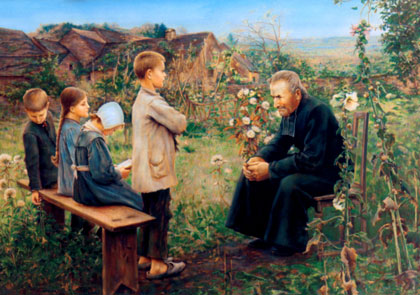
The word catechism derives from the Greek language and means “instruction.” Ever since the start of the Protestant Reformation, learning about God has often taken the form of catechetical teaching. Catechisms vary in length with a pedagogical question and answer format. Typically included are explanations on the Apostle’s Creed, the Ten Commandments, and the Lord’s Prayer.

Question and answer 104 of the Reformed Confession, the Heidelberg Catechism, says this:

Q. What is God’s will for you in the fifth commandment?

A. That I honor, love, and be loyal to my father and mother and all those in authority over me; that I submit myself with proper obedience to all their good teaching and discipline; and also that I be patient with their failings – for through them God chooses to rule us.

Here is a simple observation: Children cannot obey what they have not been taught. Underpinning all submission and obedience of both divine and human authority is the basic assumption that parents will instruct their children in the way of sound theology, biblical ethics, and religious piety.

What is more, we are all spiritual fathers and mothers to a host of children in our sphere of influence. This is a foundational way of relating to one another, and so, deliberate intention and effort needs to be placed here. Otherwise, there is religious decline with neither social nor familial cohesion.

So, let us love one another through careful training, effective teaching, and gracious tutoring so that righteousness will shine like a cloudless dawn and rise to warm the world with the love of God.

Gracious God, thank you for the gift of children.  Teach me your ways of grace so that I might pass them on to children in the merciful name of Jesus Christ through the power of the Holy Spirit.  Amen.

Matthew 14:1-12 – Speaking Truth to Power

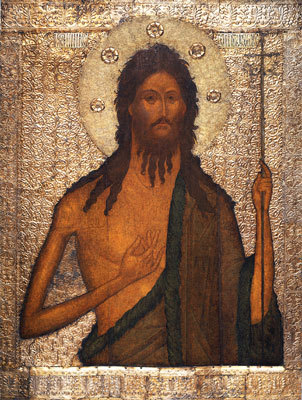
16th century Russian Orthodox icon of John the Baptist

At that time Herod the tetrarch heard the reports about Jesus, and he said to his attendants, “This is John the Baptist; he has risen from the dead! That is why miraculous powers are at work in him.”

Now Herod had arrested John and bound him and put him in prison because of Herodias, his brother Philip’s wife, for John had been saying to him: “It is not lawful for you to have her.” Herod wanted to kill John, but he was afraid of the people, because they considered John a prophet.

On Herod’s birthday the daughter of Herodias danced for the guests and pleased Herod so much that he promised with an oath to give her whatever she asked. Prompted by her mother, she said, “Give me here on a platter the head of John the Baptist.” The king was distressed, but because of his oaths and his dinner guests, he ordered that her request be granted and had John beheaded in the prison. His head was brought in on a platter and given to the girl, who carried it to her mother. John’s disciples came and took his body and buried it. Then they went and told Jesus. (NIV)

John’s murder is a story about our world – a world of power, sex, and intrigue. Times may change, but people across the ages do not change. Humanity is fundamentally the same in every century. And the world is still the world, no matter the historical time. 

The contrast between Herod and John supply us with two types of people who exist throughout every age of humankind, offering us the choice of which way we will go with our lives. The story illustrates for us the reality of living in a fallen world as a devout person.

The Herod in today’s Gospel lesson was a son of Herod the Great, the one who killed all the male babies when Jesus was born in order to try and get rid of any rival king (Matthew 2:1-18). King Herod is displayed in the narrative as a tragic and pathetic figure who is ruled by his own lusts. He seems too proud and wimpy to admit he made a rash promise and killed a man just to save face with his guests at a party.

Talk about a Jerry Springer worthy family drama, here it is: The Herod family was rich, proud, and downright violent. They tended to marry within their own clan to hold their power and possessions for themselves. Herodias married her uncle Herod Philip; Salome was their daughter. Later, Salome married Philip the tetrarch, half-brother to Herod Philip. Through marriage, Salome became both aunt and sister-in-law to her mother. Then the Herod in our story married Herodias, who had been married to Herod’s half-brother, Herod Philip. Having fallen in love with Herod Antipas, Herodias divorced Herod Philip to marry Herod Antipas. Sheesh, nothing like complicated family drama.

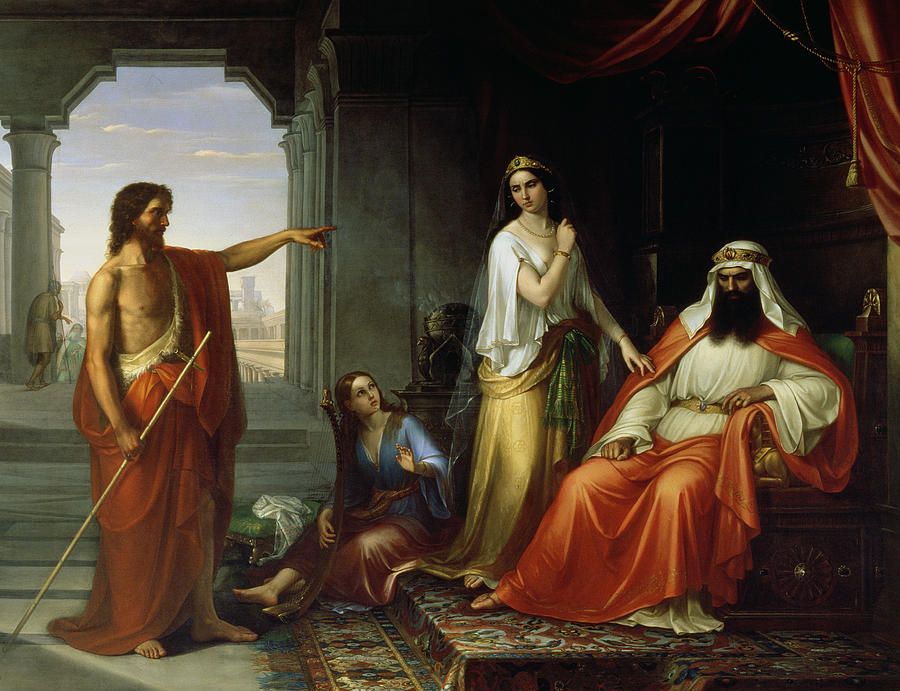
St. John the Baptist Rebuking Herod by Italian artist Giovanni Fattori (1825-1908)

Into this violation of Old Testament marriage laws (the Herod’s were Jewish) came John who made no bones about the fact this was not right (Leviticus 18:16, 20:21). Herodias nursed a grudge against John for speaking out against her and Herod’s choices. Hell, hath no fury like a woman’s scorn, and when Herodias found an opportunity to get rid of John, she coached her daughter into asking for John the Baptist’s head on a platter. Herod, too insecure to take back his ridiculous promise and look like a fool, consented to the execution of John.

In contrast to all this tragic theater is John the Baptist. John was a messenger of God and a preacher of repentance. As one who was preparing the way for Jesus, his message was simple and to the point: Repent, for the kingdom of God is near. John got into trouble and lost his life because he spoke truth to power by meddling in the life of King Herod and his family. The Herod’s were the political establishment of the day, and John did not temper his words when dealing with them.

There is a refreshing integrity about John. He was always the same no matter where he was, and no matter who the people were around him. In contrast to Herod, John was bold, courageous, confident, unafraid, and secure enough in his relationship with God to engage in ministry without thought to the consequences.  He was unconcerned for what others might think of him if he proclaimed truth in the public square, and it did end up costing him his life.

The story of John the Baptist’s death speaks about the hostility of this world. And it prefigured and foreshadowed the death of Jesus. Like John, Jesus was executed by the civil authorities. Herod, like Pilate after him, hesitated to execute and was swayed by the crowd. Herodias, like the chief priests toward Jesus, finally got her way through scheming and manipulation. John’s disciples came and took his body and buried it, just like Joseph of Arimathea and Nicodemus did for Jesus.

These stories, on the surface of things, appear to be only gloom and doom. Yet, there is a message of hope and joy. The absurd is working out itself in deliverance from sin, death, and hell. Through death, Jesus conquered death. We now have no fear of death; its sting has been taken away. Without fear of death, we have no reason to fear life with its troubles and tribulations.

The fork in the road is between the way of John or Herod. It is a values-based decision. If worth is derived from what we do, what we have, and/or other’s opinion of us, we will likely identify more with Herod and his choices. If there is a preoccupation with hoarding power and control, this is the path of Herod. 

Conversely, if the ultimate value is in knowing Christ crucified and the power of his resurrection, then we identify with John as our spiritual ancestor. If security and worth is derived from being in Christ, then there is boldness to speak truth to power and give grace to the powerless.

Herod saw no further than his immediate needs and safety; he failed to discern his own heart. Because of his spiritual blindness, Herod did not look away from himself and look to God. Faith in Jesus comes when persons look away from themselves and look to Christ who holds the power to free all from spiritual bondage.

Let us look to the example of John the Baptist who consistently sought to do the will of God as best as he understood it. Together with all God’s people past and present, we declare that God is with us, the kingdom of God is near, and the love of Christ brings faith and hope.

Almighty God, through your providence John the Baptist was wonderfully born and was sent to prepare the way of your Son, our Savior by the preaching of repentance. Lead us to repent according to his preaching and, after his example, constantly to speak the truth, boldly to rebuke vice, and patiently to suffer for truth’s sake; through Jesus Christ your Son, our Lord, who is alive and reigns with you, in the unity of the Holy Spirit, one God, now and forever. Amen.

Luke 3:1-18

            John the Baptist wasn’t exactly a social conformist.  He lived, acted, and said things that were anything but mainstream thinking.  But John wasn’t out to win friends and please people.  His message was sharp and straightforward:  “You bunch of snakes!  Who warned you to run from the coming judgment?  Do something to show that you really have given up your sins….  An ax is ready to cut the trees down at their roots.  Any tree that doesn’t produce good fruit will be cut down and thrown into a fire.”  John was the first-century version of the guy with a placard on the street corner yelling for everyone to repent.  He probably would have been relegated to the category of loony tunes had he not had an actual and substantial following of people who believed his message of repentance.
 
            The reason the masses did not dismiss John as some creepy clown is that he offered them something better than just being stuck in old destructive patterns of dumb decisions, unhealthy relationships, and bad habits.  John points us away from himself and squarely on Jesus.  Christ is the one who can and will unstick us from our downward spirals of complacency, mediocrity, and sinful behavior.
 
            To repent and believe the gospel of Jesus Christ allows us to bear good fruit.  Being with the Lord, rooted and established in him, allows us to spring from the ground like a fresh new shoot growing into something beautiful.  Dwelling in the presence of Jesus brings healthy patterns of life. 
 
            Jesus came once, and will come again.  We need to get ready for that day.  There are roads that need straightening; fires that need to be lit in order to burn away brush; dead trees need to be cut down; and, there are people who need to repent because the kingdom of God is near. 


            Lord Jesus, you are the rightful King of all creation.  I confess those sinful things I have done, and the good things I have left undone.  Your mercy is from everlasting to everlasting.  Help me to so hear your Word that new life and hope springs within me and produces love, joy, peace, patience, kindness, goodness, and self-control.  Amen.

Luke 7:18-30

            For a short time in my life I had a side business doing some painting.  I once painted an interior apartment in a large beautiful Victorian house.  When I was done, it looked great.  However, there was a bit of a problem.  The owner came to check on my progress only to find that I had painted with the wrong color!  I was certain I had it right, but, alas, the job ended up taking twice as long as anticipated.
 
            Sometimes we can be so sure about our plans, only to discover our expectations were off.  John the Baptist was sitting in jail, not for any crime other than offending the king.  As he sat there, John began to doubt.  He started wondering about Jesus.  Maybe he had been wrong about him.  Perhaps he was not the Messiah after all.  John had been doing ministry with the expectation that Jesus would beat up the Romans, usher in a renewed political Israel, and put down all threats to his Lordship.  But that was not happening.  John was now uncertain.  So, he sent some of his disciples to Jesus to ask, “Are you the one who is to come, or shall we look for another?”
 
            John reasoned that if Jesus were really a sovereign king, he would not be imprisoned facing imminent death.  Jesus responded to John’s uncertainty by quoting the prophet Isaiah and letting him know that the kingdom takeover was going exactly as planned.  The problem was that John had been using the wrong paint.  John’s plans did not fully sync with Jesus.
 
            It is easy to doubt when adversity strikes.  When things don’t go according to our expected plans, then what?  This is why it is so vitally important to continually seek the Scriptures and seek the Lord Jesus so that we might not only paint the right building, but use the paint Jesus expects us to use.  The thing that John got right was pursuing Jesus.  When in doubt, he sought the Lord – and that is something we all can emulate.


            Lord God, you are sovereign over your world, even though at times it does not seem like it.  I look to you, Holy Spirit, to keep me on track with Christ’s kingdom purposes so that your will is accomplished in and through me.  Amen.