What Will You Do with Jesus? (John 5:1-18)

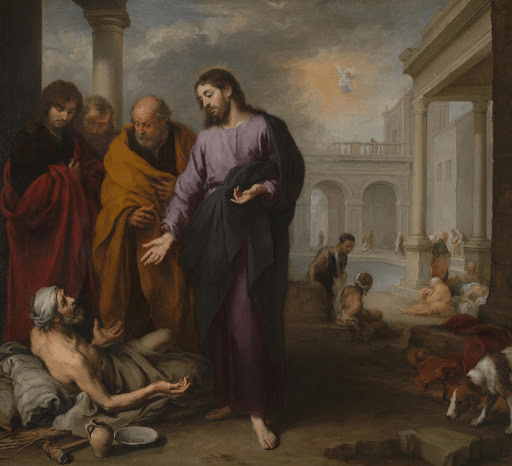
Healing the Paralytic, by Bartolomé Esteban Murillo, 1670

Sometime later, Jesus went up to Jerusalem for one of the Jewish festivals. Now there is in Jerusalem near the Sheep Gate a pool, which in Aramaic is called Bethesda and which is surrounded by five covered colonnades. Here a great number of disabled people used to lie—the blind, the lame, the paralyzed. One who was there had been an invalid for thirty-eight years. When Jesus saw him lying there and learned that he had been in this condition for a long time, he asked him, “Do you want to get well?”

“Sir,” the invalid replied, “I have no one to help me into the pool when the water is stirred. While I am trying to get in, someone else goes down ahead of me.”

Then Jesus said to him, “Get up! Pick up your mat and walk.” At once the man was cured; he picked up his mat and walked.

The day on which this took place was a Sabbath, and so the Jewish leaders said to the man who had been healed, “It is the Sabbath; the law forbids you to carry your mat.”

But he replied, “The man who made me well said to me, ‘Pick up your mat and walk.’ ”

So they asked him, “Who is this fellow who told you to pick it up and walk?”

The man who was healed had no idea who it was, for Jesus had slipped away into the crowd that was there.

Later Jesus found him at the temple and said to him, “See, you are well again. Stop sinning or something worse may happen to you.” The man went away and told the Jewish leaders that it was Jesus who had made him well.

So, because Jesus was doing these things on the Sabbath, the Jewish leaders began to persecute him. In his defense Jesus said to them, “My Father is always at his work to this very day, and I too am working.” For this reason they tried all the more to kill him; not only was he breaking the Sabbath, but he was even calling God his own Father, making himself equal with God. (New International Version)
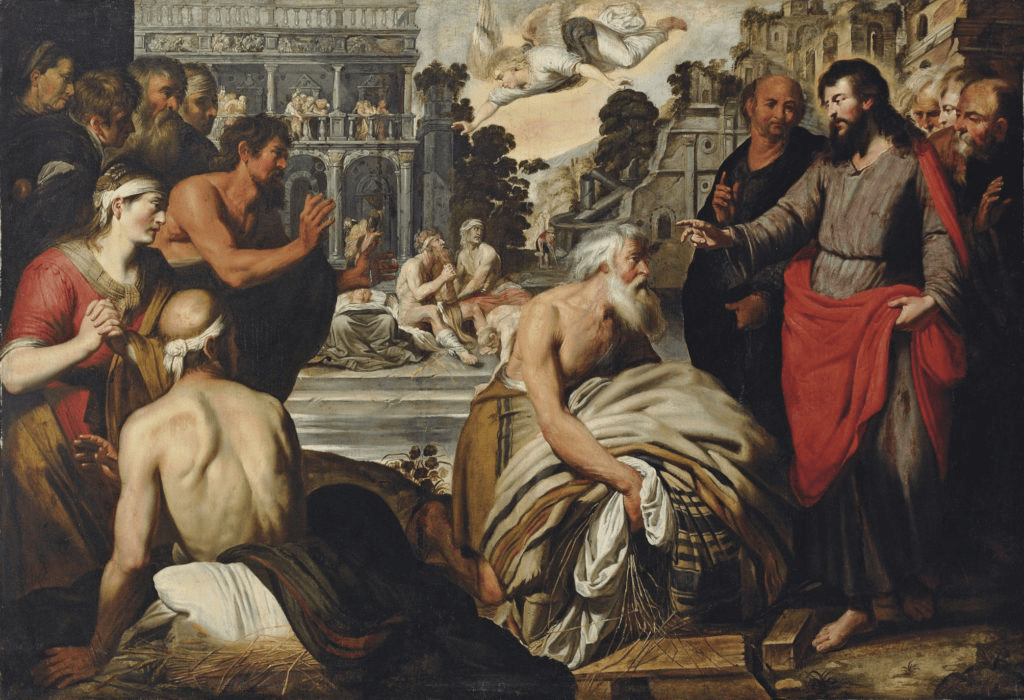
Christ at the Pool of Bethesda, by Artus Wolffort, c. 1625

During one of the yearly Jewish festivals, on a Sabbath day, a miracle happened. Miracles of healing are typically accompanied by celebration and joy. But not so much with this one.

It’s one of those things about living in a messed up world of broken systems, that an invalid can start walking and there are people who have frowns and furrowed brows about it.

Granted, the man who was healed by Jesus may seem a bit hard to like in some ways. We don’t really know what he was into, but when Christ bestows healing on you, then says to stop sinning, it’s probably a significant sin to warrant the Lord’s exhortation.

Regardless of any sort of sin, the man appears to be paraplegic. Especially in the ancient world, this meant all sorts of problems had to be navigated – such as needing others to literally carry you around (no wheelchair or handicapped accessible anything), long periods of social isolation, lack of bodily control over your bowels and bladder, and the continual needs for cleanliness.

This made the man hard to like by many people just because he likely had strong body odors and had to crawl to get around if no one would help. He would not have been pleasant to look at. But he would have to make sure you did because, in the absence of any charity, the guy’s only option was to beg.

I’m glad there are greater forces in the world than indifference and dislike. There is grace – which is an act of bestowing honor and/or forgiveness to another person. It is not dependent upon whether one deserves it. Grace chooses not to hold something over or against another. It is a deep concern for others that comes from within and not from without.

“I do not understand at all the mystery of grace – only that it meets us where we are but does not leave us where it found us.”

Anne Lamott

Another gracious act that Jesus did was to honor the man’s dignity by respecting him with a question. By asking a question, we don’t assume we know what’s best for another. Sincere questions acknowledge another’s basic humanity. “Do you want to get well?” Jesus asked.

In the life of being an invalid and having little control over much of anything, including one’s own body, being asked a question is to receive the gift of autonomy.

There are many times in my work as a hospital chaplain that I speak with patients who don’t have a lot of control in their lives. I go out of my way to ask questions such as, “May I come in?” “Is it alright with you if I pull up a chair and sit down?” “Would you be okay telling me about what is going on?” “May I pray with you?”

This is important, because there are too many other people in this world who would just barge into a room, act like they own the place, and talk at them, and not with them – hence reinforcing to the person that they’re nothing compared to others, that they don’t have any real say.

The man’s response to Jesus was to essentially say that he is alone. He has no one to help him. Even though the man is in a city, surrounded by hundreds and thousands of others, he is lonely.

Not anymore. Jesus saw him, even inquired about him and learned about the man. Jesus Christ, the Lord of all, cared about a non-descript invalid and was sincerely curious about him. In a world of everyone for himself, Jesus championed the lonely and the lost.

A simple command to obey was all. Christ told the man to pick up his mat and walk. That’s it. Just as words created the world, so a few words created a whole new life for the man. So, he got up, and he walked.

It’s interesting that the religious leaders never seemed to notice the man when he was lame, but now that he’s up and walking around, they pay attention to his apparent work on a Sabbath.

The invalid was validated by Jesus, but Jesus, the one validated by the Father, was invalidated by the religious leaders, who are the spiritual invalids.

It was against the (their) rules to carry something around. Apparently, it was okay for people to be lonely, not contribute to society in meaningful and dignifying ways, and to suffer; but it’s not okay to walk and carry a mat.

Even worse, is anyone who would heal on the Sabbath and tell the healed person to walk and carry a mat. It was so bad, apparently, that it warranted persecuting such a person. But that’s what happens when people are forced to serve rules, instead of the rules serving people.

On top of it all, Jesus was working; and he justified it by stating that his Father keeps working. This was dangerously close to blasphemy by likening himself to God. For the religious leaders, not only was Jesus unethical in breaking the law, but he was also theologically immoral; he claimed a special relation with God.

The more that laypeople get to know Jesus, the more compelling he becomes; they want to follow him. But the more that clergy discover Jesus, the more angry they become and want to do away with him.

Ultimately, it is Jesus we must contend with, and not the law and our interpretations of scripture. We need to decide what we are going to do with Jesus… what will you do?…

Against Vainglory (John 5:39-47)

Christ and Pharisee by Russian artist Ivan Filichev, 1993

You study the Scriptures diligently because you think that in them you have eternal life. These are the very Scriptures that testify about me, yet you refuse to come to me to have life.

“I do not accept glory from human beings, but I know you. I know that you do not have the love of God in your hearts. I have come in my Father’s name, and you do not accept me; but if someone else comes in his own name, you will accept him. How can you believe since you accept glory from one another but do not seek the glory that comes from the only God?

“But do not think I will accuse you before the Father. Your accuser is Moses, on whom your hopes are set. If you believed Moses, you would believe me, for he wrote about me. But since you do not believe what he wrote, how are you going to believe what I say?” (New International Version)

I like kids, even and especially Junior High kids. They have not yet learned how to mask their honesty (like Senior High kids). Have a conversation with any early adolescent (other than your own kid) and you will likely get an unfiltered and unvarnished take on whatever topic you are discussing together. If the subject of celebrities comes up, they can quickly rattle off their favorites. There is a reason for that; they are very much in touch with wanting to be impressive, to stand out, even to be famous someday.

I have long contended that if you want to gauge a society’s true values, talk to a young adolescent. Such unique and special people happen to have an emerging awareness of the world; but they do not yet the sophistication to hide their true thoughts from others. Junior High age kids tend to reflect what most adults are thinking but would never dare say out loud. After all, why lose prestige in the eyes of others who think I am wonderful? It’s probably best not to rock the boat, we reason.

“Vainglory” is an old out-of-style word which few people use anymore, yet perfectly captures exactly what Jesus was talking about when it came to people being unable to discern the import of his ministry, and especially his divinity. Wherever and whenever you find an inordinate focus on wanting attention, seeking to impress others, and desiring celebrity status, there you will see vainglory digging its talons into a society.

“They say that hens do cackle loudest when there is nothing vital in the eggs they have laid.”

Ambrose Bierce

Vainglory is precisely what it sounds like: an almost narcissistic self-absorption into one’s need for importance and attention so that the personal vanity blocks being able to see the people right in front of them. In placing so much energy into becoming a celebrity among peers, the vainglorious person’s vanity fogs them from reality and the truth of another.

Conversely, we are to seek the glory which comes from God. Since so many are programmed to seek honor from others, it can be quite the undertaking to turn the hunt into finding our identity and fame as persons in the image of God. Our Gospel lesson today says our reorientation program begins with faith in Jesus Christ. It is the first step toward the unmasking of egomania and soliciting God’s favor.

The sixteenth-century Reformer, John Calvin, said that “a person is only prepared to obey the heavenly teaching when he is convinced that the chief thing to be sought in all of life is God’s approval.”

So then, the appropriate response to vainglory is to fly like a bat of hell to the heavenly mercy of God. There is no shame in wanting honor; it’s just a matter of where we go looking for it. Faith is crippled when we keep trying to discern which way the wind is blowing. Both our identity and our sanity will eventually blow away. However, if we cease prioritizing worldly recognition and cancel our membership in the mutual admiration club, then our conscience clears enough to let divine grace fill our souls with the love of God in Christ.

Give me Jesus and that will be enough, thank you very much. As for recognition and attention, to be adored by the Savior is all I really need. Because at the end of the day, after the hurt of being ignored, overlooked, and forgotten, Jesus is standing at the door knocking, eager to come into the house and grace me with the gift of acceptance, approval, and admiration.

O Lord, in the name of Jesus Christ your Son our God, give me the love which never ceases, that will light my soul with divine grace so that I might be satisfied in you and lessen the darkness of the world. Lord Jesus, I seek your presence and glory. May I see you, desire you, look on you in love, and long after you, for your sake. Amen.

Like Father Like Son (John 5:19-29)

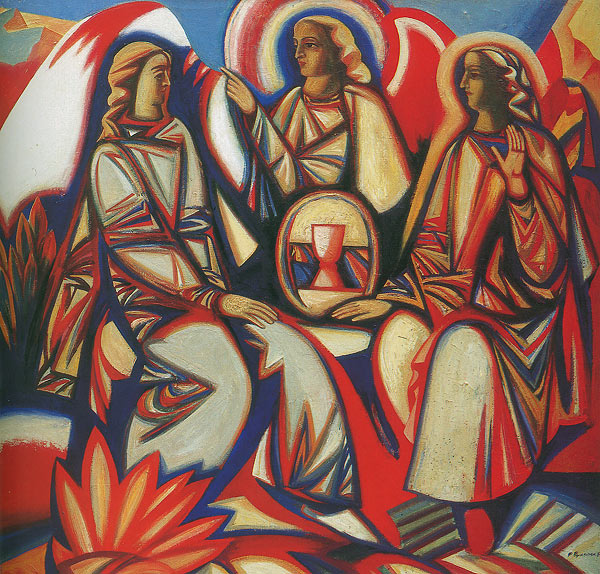
The Trinity, by Ukrainian painter Feodosiy Humeniuk, 1981

Jesus responded to the Jewish leaders: 

“I assure you that the Son can’t do anything by himself except what he sees the Father doing. Whatever the Father does, the Son does likewise. The Father loves the Son and shows him everything that he does. He will show him greater works than these so that you will marvel. 

As the Father raises the dead and gives life, so too does the Son give life to whomever he wishes. The Father doesn’t judge anyone, but he has given all judgment to the Son so that everyone will honor the Son just as they honor the Father. Whoever doesn’t honor the Son doesn’t honor the Father who sent him.

I assure you that whoever hears my word and believes in the one who sent me has eternal life and won’t come under judgment but has passed from death into life.

I assure you that the time is coming—and is here!—when the dead will hear the voice of God’s Son, and those who hear it will live. Just as the Father has life in himself, so he has granted the Son to have life in himself. He gives the Son authority to judge because he is the Human One.

Don’t be surprised by this, because the time is coming when all who are in their graves will hear his voice. Those who did good things will come out into the resurrection of life, and those who did wicked things into the resurrection of judgment.”

(Common English Bible)

So goes the parent, so goes the child. Sons look and act a great deal like their fathers. And there is no mistaking the resemblance between Father of the heavens and Son of the incarnation.

In Christianity, to see Jesus is to see God. To know Christ is to know the Lord. They are distinct, yet inextricably linked as one; each is differentiated from the other in personhood, yet united with the same divine substance.

The deity of the Father and the deity of the Son is one, equal in glory, co-eternal in majesty.

What the Father is, the Son is.

Uncreated, eternal, almighty, and sovereign is the Father; uncreated, eternal, almighty, and sovereign is the Son.

The Father and the Son are not two gods but one God.

There is only one Father; there is only one Son. Each is neither greater nor lesser than the other.

Whoever wants to be saved from guilt, shame, sin, death, and hell – and to be delivered from the injustice of the world, the failings of oneself, and the machinations of evil, should think about the Father and the Son and the Spirit, the Holy Trinity, one God.

– Athanasian Creed

So, why is all this creedal Christian doctrine of any importance? Why pay attention to such things?

Because there are many issues and problems in this world of great importance which must be addressed and dealt with. We need to have some idea of how to go about: 

  • Governing ourselves as a free people
  • Eradicating poverty and disease
  • Educating our children
  • Paying taxes
  • Providing excellent and cost effective healthcare for everyone
  • Dismantling racism
  • Seeking peaceful international relations
  • Building responsible and accountable local community relationships
  • Supporting small businesses
  • Helping workers make a decent contributive living
  • Loving our families and faith communities 

It is my unshakable conviction that all these issues, and many others, need more than our collective mental attention and physical resources; these problems also need spiritual resolutions and solutions.

Seasons, years, centuries, and millennia come and go. People are born, live, and die. Generations exist and then are no more. Civilizations rise and fall. Through it all and above it all is the person of Jesus.

Christ is alive. He brings breath from dust, beauty from ashes, order from chaos, stability from insecurity, dignity from disrespect, and meaning from uncertainty. Jesus gives life, abundant and to the full.

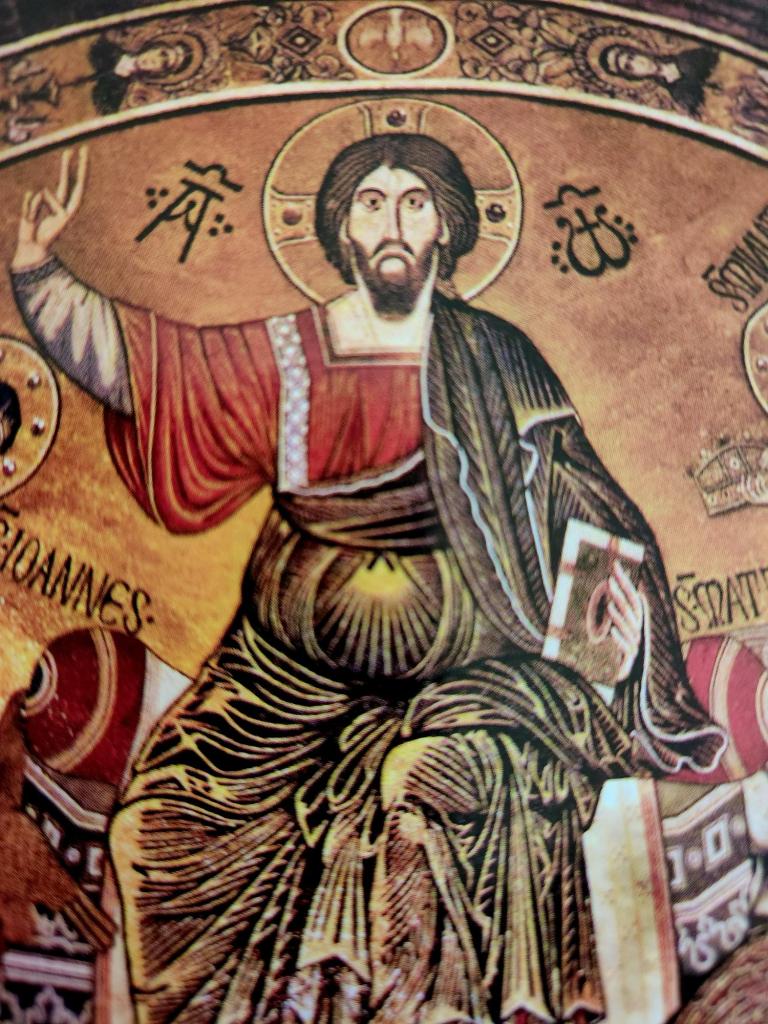
Christ the King, San Miniato al Monte Church, Florence, Italy

Today, this very moment, Christ is still on the throne of all creation. 

Human elections and institutions only have authority as given by Jesus, the Ruler of all.

Presently, Jesus is attentive and vigilant to people, actively interceding for us at the right hand of his Father in heaven. At this very moment, the Holy Spirit is the continuing presence of Christ on this earth, applying Christ’s redemption of humanity to the lives of millions. 

Sometimes we need to remember how important our spiritual resources are to living in this world – and to clarify what’s really of ultimate significance in this old broken world. 

My unwavering spiritual persuasion is this: People need the Lord. Therefore, it only makes good spiritual sense to live in ways that foster a connection with Jesus. 

This morning, I did what I do every morning – whether I’m sick or well, sad or happy, facing a busy day or a relaxed day – I began my day with Scripture reading, prayer, reflection, and gratitude. And I do it with the realization that Christ is King, that as the divine/human Lord of all, his:

  • authority is real
  • rule is benevolent
  • sovereignty is ubiquitous
  • reign is supreme
  • judgments are right and good
  • power is mighty enough to raise the dead

The Christian tradition holds that Jesus Christ is the exalted and glorified Son of God, the Sovereign authority over every dominion. The works of Jesus bear testimony to the cosmic reality that he is Lord of all. And, if that were not enough, Jesus shares his divine power with us, his people.

In the face of Christ’s majesty, the valid and appropriate response is sheer submission to Christ’s authority. 

Just as Jesus listened to the Father and obeyed the Father’s will, so we need to listen to Jesus and carry out his will. 

Just as Jesus enjoyed his relationship with the Father, so we are to bask in our wonderful relationship with Jesus. 

Since Jesus submitted to death on a cross and rose from the dead through God’s power, we now have access to that power by God’s grace through faith in Christ. And we are to use that divine power to take up our own cross and bear the great issues and problems of our day with all the spiritual resources granted to us in Christ Jesus.

Like Father, like Son. Like Christ, like Christians. May all followers of Jesus resemble their Lord in each word and in every way.

Almighty God, to you all hearts are open, all desires known, and from you no secrets are hid: Cleanse the thoughts of our hearts by the inspiration of your Holy Spirit, that we may perfectly love you, and worthily magnify your holy Name; through Christ our Lord. Amen.