
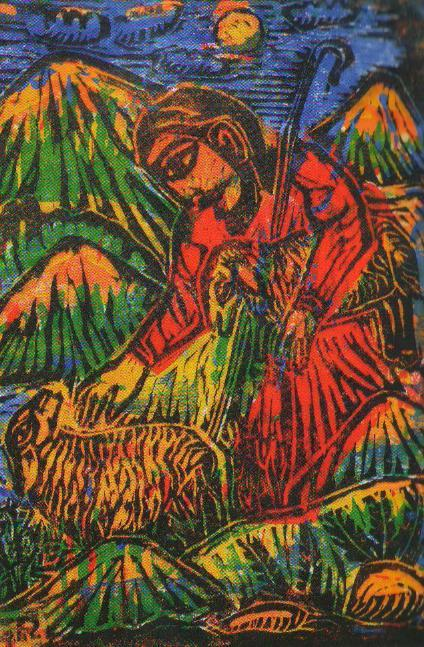
The Good Shepherd (John 10:11-18)

Jesus the Good Shepherd, by Solomon Raj (1921-2019)

“I am the good shepherd. The good shepherd lays down his life for the sheep. When the hired hand sees the wolf coming, he leaves the sheep and runs away. That’s because he isn’t the shepherd; the sheep aren’t really his. So the wolf attacks the sheep and scatters them. He’s only a hired hand and the sheep don’t matter to him.

“I am the good shepherd. I know my own sheep and they know me, just as the Father knows me and I know the Father. I give up my life for the sheep. I have other sheep that don’t belong to this sheep pen. I must lead them too. They will listen to my voice and there will be one flock, with one shepherd.

“This is why the Father loves me: I give up my life so that I can take it up again. No one takes it from me, but I give it up because I want to. I have the right to give it up, and I have the right to take it up again. I received this commandment from my Father.” (Common English Bible)

This is a beautiful passage of Scripture, as we look at it now, two-thousand years removed from its original context. Yet, at the time, Jesus spoke these words after a smack down conflict with the religious authorities, complete with plans to stone him.

In healing a man born blind, Jesus not only restored his physical sight, but he also gave him clear spiritual vision. In contrast, Christ’s opponents remained in their spiritual darkness, unable to see the light of life. And in their spiritual blindness, they couldn’t lead anybody anywhere without falling into a pit and making things worse.

Jesus is the good shepherd, the caring leader who is aware, and has the sheep’s best interests in mind, and at heart. The religious authorities proved to be bad shepherds who only wanted to fleece the sheep of their wool; such persons steal, harm, and kill. Jesus, however, offers abundant life.

The good shepherd provides altruistic care at a great cost. Whereas the hired hand runs away when the wolves come and threaten the flock, Jesus as the Good Shepherd puts his life on the line to protect the sheep. Three times we are told that Christ lays his life down for the benefit of others.

Bad shepherds have no such concern. And, unfortunately, such leaders have been around ever since the fall of humanity into sin. They cut and run when things get risky and dangerous.

This is what the Sovereign Lord says: “Woe to you shepherds of Israel who only take care of yourselves! Should not shepherds take care of the flock? You eat the curds, clothe yourselves with the wool and slaughter the choice animals, but you do not take care of the flock. You have not strengthened the weak or healed the sick or bound up the injured. You have not brought back the strays or searched for the lost. You have ruled them harshly and brutally. 

So they were scattered because there was no shepherd, and when they were scattered they became food for all the wild animals. My sheep wandered over all the mountains and on every high hill. They were scattered over the whole earth, and no one searched or looked for them.” (Ezekiel 34:2-6, NIV)

Jesus, in his incarnation, embodies the love and concern of God for the people of this world. Christ takes the initiative to do what needs to be done for the benefit of the at-risk sheep.
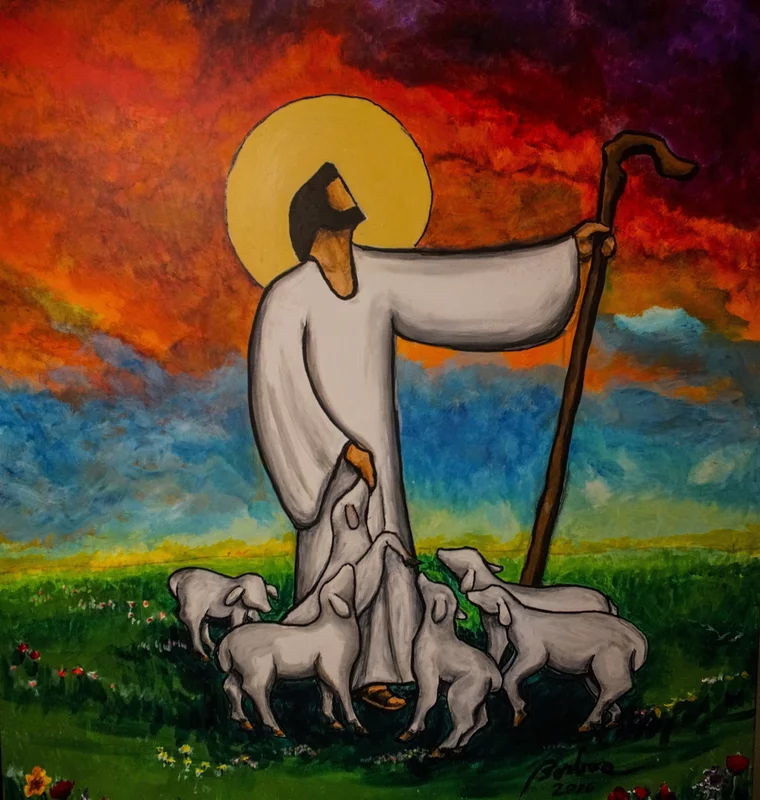
Jesus the Good Shepherd, by Francisco Borboa

For this is what the Sovereign Lord says: “I myself will search for my sheep and look after them. As a shepherd looks after his scattered flock when he is with them, so will I look after my sheep. I will rescue them from all the places where they were scattered on a day of clouds and darkness. I will bring them out from the nations and gather them from the countries, and I will bring them into their own land. I will pasture them on the mountains of Israel, in the ravines and in all the settlements in the land. I will tend them in a good pasture, and the mountain heights of Israel will be their grazing land.

There they will lie down in good grazing land, and there they will feed in a rich pasture on the mountains of Israel. I myself will tend my sheep and have them lie down, declares the Sovereign Lord. I will search for the lost and bring back the strays. I will bind up the injured and strengthen the weak, but the sleek and the strong I will destroy. I will shepherd the flock with justice.” (Ezekiel 34:11-16, NIV)

Since Jesus is the Good Shepherd, he has the unique ability and authority to decide who is in the sheep fold, and who is out. Nobody else gets to make those sorts of decisions. This way, ultimate issues of eternal life and abundant life are handled with perfect justice and righteousness.

It’s okay that this is all a mystery to us. We sheep need only to keep the Shepherd in our line of sight, and let him do his job of caring for us – without whining or complaining. After all, we could easily have a bad shepherd herding us around like a bunch of stupid cows, and treating us with indifference, even meanness.

The Holy Trinity of God – Father, Son, and Spirit – work as One. The Father loves the Son and the Spirit, and also loves those whom the Son and Spirit have touched. The Son loves the Father and the Spirit, and obeys all things from the Father, while listening to the Spirit. And the Spirit loves the Father and the Son, knowing them intimately and always operating in love for the benefit of the sheep’s deliverance from wolves.

In particular, the Son, Jesus, lays down his own life, but takes it up again. He does so because of love. The perfect unity and love of the blessed Holy Trinity spills out in Christ’s care for us.

The laying down and taking up of life on the part of the Good Shepherd is not only an expression of great love and faithfulness toward us sheep, but it is also a deep abiding love and commitment toward the Father from whom all blessings flow.

To put it another way, this motley flock of sheep are purposely drawn into the unity, harmony, and love between the Father and the Son. And when we glimpse and experience such overwhelming love, we choose to remain connected to this incredible loving dance.

Our world is much too characterized by selfish concerns and shortsighted actions. In the loving embrace of the Good Shepherd, we have an opportunity to experience peace and rest, grace and abundance, light and life. To know such love is to never turn back to old self-centered ways of living.

Shepherd of all, by laying down your life for the flock, you reveal your love for all. Lead us from the place of death to the place of abundant life, so that guided by your care for us, we may rightly offer our lives in love for you and our neighbors. Amen.


I Am the Gate (John 10:1-10)

“Very truly I tell you Pharisees, anyone who does not enter the sheep pen by the gate, but climbs in by some other way, is a thief and a robber. The one who enters by the gate is the shepherd of the sheep. The gatekeeper opens the gate for him, and the sheep listen to his voice. He calls his own sheep by name and leads them out. When he has brought out all his own, he goes on ahead of them, and his sheep follow him because they know his voice. But they will never follow a stranger; in fact, they will run away from him because they do not recognize a stranger’s voice.” Jesus used this figure of speech, but the Pharisees did not understand what he was telling them.

Therefore Jesus said again, “Very truly I tell you, I am the gate for the sheep. All who have come before me are thieves and robbers, but the sheep have not listened to them.I am the gate; whoever enters through me will be saved. They will come in and go out, and find pasture. The thief comes only to steal and kill and destroy; I have come that they may have life, and have it to the full. (New International Version)

In an idyllic world, we would never have to contend with thieves and interlopers within the flock of God. But, as you well know, we live in a less than perfect world. The spiritual robber-baron is the one who poses as a religious figure, yet is really around to fleece the sheep.

Obviously, anyone who has to jump the fence, instead of entering through the gate, has something nefarious up their dastardly sleeve. In fact, these interlopers feel they have a right to get in, by any means, because of their inflated sense of self-importance.

Jesus, of course, is using metaphor and figure of speech to communicate something important: The thieves are robbing God’s honor for themselves and bringing harm to God’s people. By trying to take away the way, the truth, and the life, the religious leaders were spiritual burglars attempting to be both gate and gatekeeper.

In short, the religious leaders believed they were more important than Jesus; and they tried to keep Christ and the people from connecting with each other.

And that is the insidious form of all religious quackery – to keep people separated from what can help them the most so that the charlatan can soak up all the attention, authority, and accolades.

But a faithful and true shepherd enters through the gate with confidence and care. Such a person has no other agenda and no other concern than Jesus and what Christ has said, has done, and will do.

The pastoral ministers amongst us help lead the flock through the gate so that they might enjoy safety, security, and succulence. The shepherd calls people by name, and doesn’t generically yell at nameless folk, to bring them alongside the Good Shepherd.

Thus, we are to have a faithful concentration and commitment to Christ; a voice which is discernibly oriented toward pointing people’s attention to Christ; and a teaching and leadership which moves into the world in order to bring Christian speech and action that blesses the world.

One of the problems many persons experience is that they listen to strange voices, instead of the familiar voice of their trusted pastor and the voice of Scripture, reason, and history. They follow a pet preacher’s or person’s interpretation of everything without reservation, rather than seeking to hear the voice of God in everything which is said.

Big churches, large ministries, and eloquent people are not necessarily the vocal chords of God. We must be discerning and wise. Not everyone who says, “Lord, Lord,” will enter the kingdom of heaven. It’s only the person and the faith community which does the will of God that’s able to get in.

Wolves in sheep’s clothing exist. So, we must beware.

Idioms, figures of speech, and metaphors get lost on some folk. That’s what happened for Christ’s original hearers. A lot of head-scratching was happening because they couldn’t figure out what in the world Jesus was talking about. “They” are the people who interpret all of life through personal agendas and selfish means. Their self-absorption prevented them from seeing the person right in front of them, who he really was, and what he was actually saying to them.

I Am the Gate of the Sheepfold, by Kathrin Burleson

So, Jesus plainly told them that he himself is the gate of the sheep. “I am” the gate. Deliverance, reconciliation, freedom, and protection all come together in Christ to provide a good life, a life of abundance that is worth living. We have peace with God through the Lord Jesus.

In today’s Gospel lesson, we learn from Jesus the following:

  • The key to being a good shepherd is being faithful to Jesus Christ
  • The concerns of a good shepherd are to attract, bring in, protect, free, feed, and lead God’s people into a good life through Jesus Christ
  • The way for a good shepherd is to love the sheep, care for them, and be with them through thick and thin, as Christ does
  • The preoccupations of those who ignore entering through the gate, which is Jesus, are to gain for themselves what rightly belongs to God: glory, honor, praise, power, authority, accolades, and devotion.

Everything hinges on Jesus as the gate of life. In centering ourselves completely around Christ, and by giving up the false self of keeping up appearances to others, we find our true self, connected to God in which all our needs are fully met and satisfied.

Merciful Father, you gave your Son Jesus Christ to be the Good Shepherd. In his love for us, he laid down his life and rose again. Keep us always under his protection, and give us grace to follow in his steps, in the strength and enablement of the Holy Spirit. Amen.

John 10:31-42 – “The Real McCoy”

Again, his Jewish opponents picked up stones to stone him,but Jesus said to them, “I have shown you many good works from the Father. For which of these do you stone me?”

“We are not stoning you for any good work,” they replied, “but for blasphemy, because you, a mere man, claim to be God.”

Jesus answered them, “Is it not written in your Law, ‘I have said you are “gods”’?If he called them ‘gods,’ to whom the word of God came—and Scripture cannot be set aside—what about the one whom the Father set apart as his very own and sent into the world? Why then do you accuse me of blasphemy because I said, ‘I am God’s Son’? Do not believe me unless I do the works of my Father. But if I do them, even though you do not believe me, believe the works, that you may know and understand that the Father is in me, and I in the Father.” Again, they tried to seize him, but he escaped their grasp.

Then Jesus went back across the Jordan to the place where John had been baptizing in the early days. There he stayed, and many people came to him. They said, “Though John never performed a sign, all that John said about this man was true.” And in that place many believed in Jesus. (New International Version)

There are all kinds of idioms (a phrase whose meaning cannot be discerned by the words themselves) about something that is truly genuine, not fake:

“The proof is in the pudding.” (that is, the pudding might look good and delicious, but the real test is in the eating of it)

“Put your money where your mouth is.” (do something rather than just talk about it; use your own resources and abilities if it’s so important to you)

“I’ll believe it when I see it.” (your story sounds incredible; I need to experience it myself)

Jesus had the actions to back up his words. He is “the real McCoy.” (authentic)

But his opponents apparently “dug their heels in.” (they’ve already got their minds made up about him)

Seems like many of the religious leaders, back in Christ’s day, saw Jesus as nothing more than a “cock and bull story.” (ridiculous and implausible)

But, as it turns out, those leaders “don’t have a clue.” (they’re ignorant)

Sheesh. “Don’t get me started.” (if I talk about this silliness, I might not stop)

And Jesus wasn’t about to “idiot proof” (be understandable to people who don’t really want to understand to begin with) his life and teaching because the evidence was right there “under their noses.” (they failed to notice even though they should have) 

Jesus wasn’t about to kick back and “shoot the breeze” (to chat idly, casually, and without purpose about unimportant and ordinary things) with these guys. It’s not why he came.

The Lord knew their hearts, and so, he knew when to “get out of Dodge.” (leaving quickly to avoid a dangerous situation)

His opponents were “as mad as a wet hen.” (enraged)

Christ understood that neither their acceptance nor their rejection of his ministry was “worth a plug nickel.” (no value, at all; completely worthless)

But he didn’t skedaddle before “putting them in their place.” (exposing their duplicity and lack of faith)

If it were me, I’d probably “open a can of whoop-ass.” (verbally beat them up)

Yet, Jesus, ever the gracious one, is “gentle as a lamb.” (gets his point across without violence)

The amazing love of Christ chose to “pay the piper.” (bear the consequences for the sins of the people)

“Your mission, should you choose to accept it,” (a catchphrase from the show, “Mission Impossible”) is to take an honest look at Jesus.

I think you will find it’s a “no-brainer.” (it’s easier than you might think)

That’s because Jesus is “straight as an arrow.” (you can trust him)

It does no good to keep Jesus “at arm’s length.” (maintain emotional distance to avoid familiarity or intimacy)

It’s best to accept Jesus as he is. Otherwise, you’ll find you “have a tiger by the tail.” (there’s no way to manage or control him)

“Honest to God.” (emphasizing that something is really true)

Well, there you have it, “from the horse’s mouth.” (this information is coming directly from the person with the experience and knowledge of the situation)

I’m a true believer. “Happy as a lark.” (Very excited and delighted)

Lord Jesus, I just want you to know that “I’m your Huckleberry.” (I’m your person for whatever job you want done)

“Amen to that.” (I agree)