Christmas Day (John 1:1-14)

Art by Lourry Legarde

The Word was first,
    the Word present to God,
    God present to the Word.
The Word was God,
    in readiness for God from day one.

Everything was created through him;
    nothing—not one thing!—
    came into being without him.
What came into existence was Life,
    and the Life was Light to live by.
The Life-Light blazed out of the darkness;
    the darkness couldn’t put it out.

There once was a man, his name John, sent by God to point out the way to the Life-Light. He came to show everyone where to look, who to believe in. John was not himself the Light; he was there to show the way to the Light.

The Life-Light was the real thing:
    Every person entering Life
    he brings into Light.
He was in the world,
    the world was there through him,
    and yet the world didn’t even notice.
He came to his own people,
    but they didn’t want him.
But whoever did want him,
    who believed he was who he claimed
    and would do what he said,
He made to be their true selves,
    their child-of-God selves.
These are the God-begotten,
    not blood-begotten,
    not flesh-begotten,
    not sex-begotten.

The Word became flesh and blood,
    and moved into the neighborhood.
We saw the glory with our own eyes,
    the one-of-a-kind glory,
    like Father, like Son,
Generous inside and out,
    true from start to finish. (The Message)
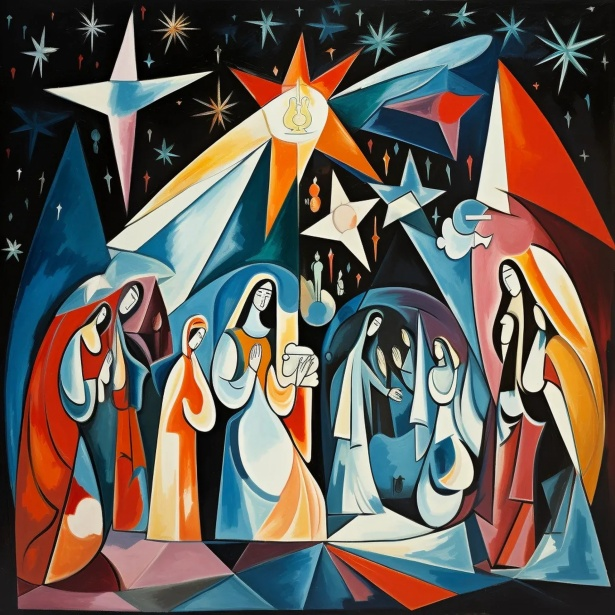
Art by Linnaea Mallette

Joy to the world! Merry Christmas to you, my friend. On this day, and for the next twelve days, we remember and celebrate the nativity of Christ, and the mystery of his incarnation.

We acknowledge with Christians, both past and present, all around the world, in proclaiming together:

“Glory to God in heaven, and on earth peace among those whom he favors.” (Luke 2:14, CEB)

We relate to the shepherds, out in their fields, caring for the flocks of sheep at night, who were terrified, yet went and offered their worship to the newborn king, listening to the angelic message:

Then the angel said to them, “Do not be afraid, for behold, I bring you good tidings of great joy which will be to all people. For there is born to you this day in the city of David a Savior, who is Christ the Lord.” (Luke 2:10-11, NKJV)

We identify with Mary, the mother of Jesus, who pondered the meaning of the nativity in her heart. (Luke 2:19)

This Christmas season extends from December 25 through January 5. Celebrating throughout these days helps us enter into the profound meaning and mystery of Christ’s incarnation – rather than just observing one day.

Today’s Gospel lesson moves us to do just that, to acknowledge and affirm the identity of Jesus Christ as fully human, and at the same time, all the time, fully divine.

Christ was both born into this world, and pre-existed from the very beginning. Indeed, Jesus has always existed, without any sort of preconditions to his eternal being. He is a person, a persona of God. In other words, Jesus is God.

The Lord Jesus is the pre-existent light-bearer who is designated to come as the light-giver, whose light is unquenchable and never goes out. He is the Light of the world.

John is a witness to that light. And although this light should have been expected, there were (and are) many who reject the Light, who is the Word for the world.

Yet, any sort of rejection cannot possibly hinder the light’s ability to illumine the hearts of many people.

This Word, this Light, this pre-existing Christ, has actually enfleshed himself, becoming present with us in this world. And this is precisely what the faithful are celebrating this day, and in this season. God has come among us!

The giving of the Son, this person of God, this incredible light and life, is a grace well beyond the divine giving of the Law – because the Law has been incarnated in the person of Jesus the Christ.

There is much to ponder, and much to celebrate, on this day, and for the upcoming days of this season.

We were all physically born of the flesh. We may all also become spiritually born of God through the Word of God, Jesus, the Savior whom we acknowledge and adore today and every day.

“The Word of God, our Lord Jesus Christ, through his transcendent love, became what we are, so that he might bring us to what he is himself.”

St. Irenaeus

By means of the incarnation, in Christ, and through the Spirit, we have the chance, the ability, made possible by God’s grace, to participate in the divine nature; and in the divine dance of unhindered and unending unity, harmony, peace, and love which continually exists within the Holy Trinity – Father, Son, and Spirit.

This is a spiritual reality worth a robust celebration today – and all the days which God gives us on this earth. To God be the glory.

God, you spoke, and your Word became flesh, breathing a new song of joy and praise into the world. Grant that we may bear the good news of your salvation, proclaiming your promise of peace to the ends of the earth. Amen.


“Follow Me” (John 1:43-51)

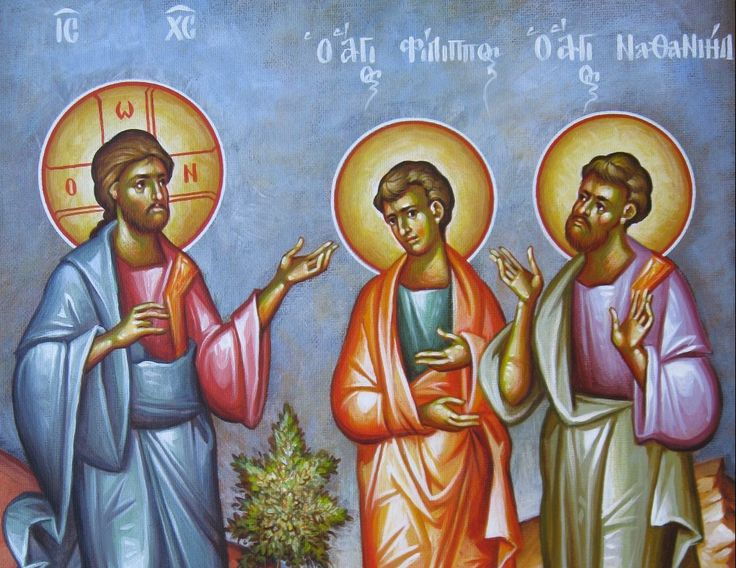
The next day Jesus decided to go to Galilee. He found Philip and said to him, “Come, follow me.” Philip was from Bethsaida, Andrew and Peter’s hometown.

Philip went to look for Nathanael and told him, “We have found the very person Moses and the prophets wrote about! His name is Jesus, the son of Joseph from Nazareth.”

“Nazareth!” exclaimed Nathanael. “Can anything good come from Nazareth?”

“Come and see for yourself,” Philip replied.

As they approached, Jesus said, “Now here is a genuine son of Israel—a man of complete integrity.”

“How do you know about me?” Nathanael asked.

Jesus replied, “I could see you under the fig tree before Philip found you.”

Then Nathanael exclaimed, “Rabbi, you are the Son of God—the King of Israel!”

Jesus asked him, “Do you believe this just because I told you I had seen you under the fig tree? You will see greater things than this.” Then he said, “I tell you the truth, you will all see heaven open and the angels of God going up and down on the Son of Man, the one who is the stairway between heaven and earth.” (New Living Translation)

I describe myself as a follower of Jesus. I have been for decades. I found, and continue to find, in Jesus Christ a compelling person full of grace, truth, and love.

But my early life was not characterized with knowing Christ. I certainly learned about Jesus, that this ancient guy lived an altruistic life, got tortured and killed on a cross, and that Christians believe in his resurrection from death. However, back then it was more like some strange history lesson. The information made no difference to me.

That is, until I heard a voice – not an audible one that others could hear. Yet, it was just a real as any daily conversation with another person. I heard the call of Jesus. The Ancient of Days showed up.

I know with every epistemic fiber in my being that it wasn’t an undigested bit of beef, a blot of mustard, a crumb of cheese, a fragment of an underdone potato. I am sure beyond certainty that there was more of an empty grave than gravy about my experience of the risen Christ.

I experienced the call of Jesus to “follow me.” And that is really, at its simplest, the call which continually goes out to all humanity. It is a gracious and merciful call. It isn’t a summons to experience a cataclysmic event of total belief in one fell swoop. Rather, it’s a call to believe that is much more an unfolding awareness of the deep spirituality and connection with the divine within.

Important to that faith process is another call to “come and see.” Whereas there are some Christian traditions which focus solely on a singular one-time experience of saving faith in Christ, the Gospel of John displays a drama of faith with multiple layers which people move through.

There is no egalitarian zap in which God grants total and immediate understanding. Instead, faith is an ever-increasing process. It is appropriate and biblical to say that our salvation has happened, is happening, and will happen. We follow, we come and see, and we keep following, keep coming, keep seeing more and more.

Like a muscle, our faith grows, develops, stretches, and strengthens over time. To use another metaphor, we ascend a stairway to heaven, one step at a time, day after day, following Jesus and ascending to spiritual maturity.

Orthodox icon of Christ calling Philip and Nathanael

Methinks this is likely part of what Jesus was getting at with Nathaniel in today’s Gospel lesson. Nathaniel would have quickly picked up on the reference Jesus was making, way back to the first book of Genesis. The Jewish patriarch, Jacob, had an experience of seeing the angels of God on some celestial stairway, ascending and descending. It was an encounter of God’s presence with Jacob, assuring him of divine intervention into the muck of humanity. (Genesis 28:10-17)

Jesus connected that ancient portrait to himself so that Nathaniel would understand, would believe, that God has again broken into this world with a special divine presence. To look at Jesus and follow him, is to see and follow God.

Christ Jesus is the ultimate example and embodiment of God with us. Throughout John’s Gospel, Jesus presents himself as:

  • Living water – connecting to Jacob’s well (John 4:5-14)
  • The Temple of God – the place where the Lord dwells in all divine fullness (John 2:18-22)
  • Bread from heaven – linking the giving of manna to the Israelites in the desert (Exodus 16:4-7; John 6:1-59)
  • The good shepherd – fulfilling divine Old Testament imperatives of caring for people (Ezekiel 34:11-16; John 10:1-30)

In all these ways, and more, Jesus intentionally connects himself as fulfilling God’s ancient promises to people.

In whichever way we need to hear the call to follow, Jesus accommodates to us. For some, Christ comes knocking on the front door. For others, he enters the side door, or slips into the backdoor of our lives.

And, if we will come and see, Jesus will also accommodate us by being the authority over us, the teacher to us, or the friend beside us. The Lord Jesus shall shepherd us and woo us to the flock for guidance and protection.

However it may be that Jesus comes to you, it most likely will be in ways you aren’t expecting. Surely, nothing good can come from Nazareth! Yet, it did. Can anything good come from Calcutta, India, or Juarez, Mexico, or Hoboken, New Jersey, or Milwaukee, Wisconsin, or even from a small rural area that doesn’t show up on a map? Yes, it can. Because with Jesus, God has entered this world, and, as it turns out, the Lord’s presence is everywhere.

Follow me. Come and see. Two of the simplest exhortations ever uttered. Yet, two of the most gracious phrases ever said, with profound implications for us beyond what we can fathom or imagine.

Guide us waking O Lord, and guard us sleeping; that awake we may watch with Christ and asleep we may rest in peace. May the shape of each day be formed by the pedantic following of my Lord; and may I come and see the wonders you have done, are doing, and will do. Almighty and merciful God – Father, Son and Holy Spirit – bless us and keep us. Amen.

The Lamb of God (John 1:29-34)

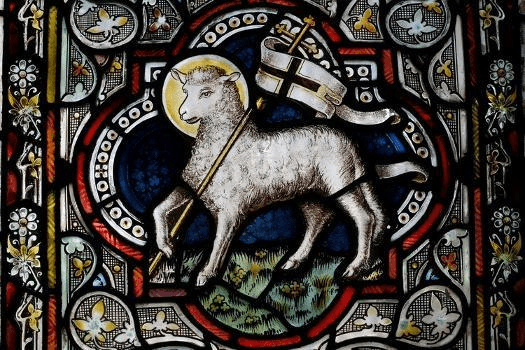
Stained glass of the Agnus Dei (Lamb of God), Chamonix, France

The next day John saw Jesus coming toward him and said, “Look, the Lamb of God, who takes away the sin of the world! This is the one I meant when I said, ‘A man who comes after me has surpassed me because he was before me.’ I myself did not know him, but the reason I came baptizing with water was that he might be revealed to Israel.”

Then John gave this testimony: “I saw the Spirit come down from heaven as a dove and remain on him. And I myself did not know him, but the one who sent me to baptize with water told me, ‘The man on whom you see the Spirit come down and remain is the one who will baptize with the Holy Spirit.’ I have seen and I testify that this is God’s Chosen One.” (New International Version)

The Gospel of John is all about finding and seeing Jesus – and then believing. Jesus is seen from various angles, namely because, as the embodiment of God, he requires a multi-perspectival look. In today’s lesson, we see John the Baptist exhorting everyone to take a look at Jesus as the Lamb of God.

Throughout the Apostle John’s Gospel, we see the gradual unfolding of belief amongst people, including the faith of John the Baptist. The Baptist’s initial understanding was that he was in the presence of someone of much greater worth than himself. Only by means of God’s Spirit is John able to gain increased insight concerning Jesus.

It’s important to point out that faith is never a static sort of thing. Rather, faith is always moving in a direction; it’s dynamic. Faith is more than a gift that’s put in a box and given and received. There is continual discovery to faith. It’s as if we’ve been given the gift of a Russian doll, and there are ever-increasing gifts within the gift. There are multiple levels of belief to explore and discover.

Spiritual insight is an initial gift of faith. There is, however, more. With insight there follows the ability to distinguish between material and immaterial realities. This is one reason why the Gospel of John can be difficult to understand – because within one verse, statement, or story, there are double, even triple, meanings to it.

John often invites us to see the spiritual reality that is there underneath the physical. It will take eyes of faith to see, because sheer physical sight will not see the entire reality. And at the end of faith is Jesus, to confess and believe that he is indeed the very Son of God.

The Holy Spirit in today’s lesson actually serves as the divine witness to John the Baptist’s burgeoning development of faith in Christ; John sees Jesus not only as coming from God, but as God.

The confirming voice of the Spirit at the baptism of Jesus lets everyone know that this Lamb of God, Jesus, the Son of God, will take away the sin of the world in his eventual Passover death.

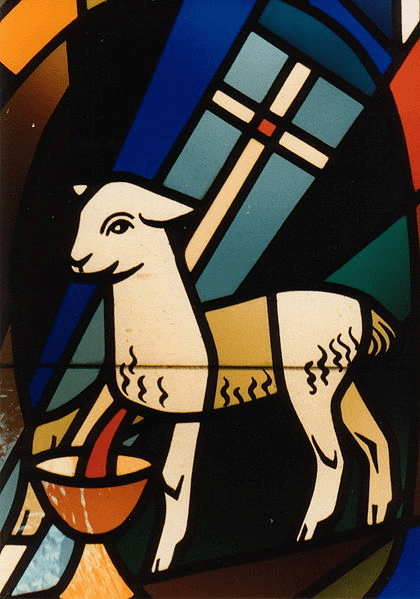
Stained glass of the Agnus Dei, El Cajon, California

To take away sin means to remove it and purify the person from it. John’s increased understanding discerns that his words and his baptism with water don’t bring this removal and purification; but they do point to Jesus. Christ as the one who is able to immerse people in the cleansing bath of grace.

Jesus Christ is qualified and able to call, gather, and cleanse not only Israel, but also the world and all the scattered children of God. Thus, John the Baptist’s ministry is to reveal Jesus to Israel; it’s directed to the entire world and to the taking away of the world’s great sin, once and for all.

The reference to Jesus as the “Lamb of God” is a familiar one to Christians. Lambs are common throughout the Bible. A lamb, however, that takes away sin is somewhat novel (although a scapegoat symbolically takes aways Israel’s sin into the desert, Leviticus 16:8-10). Passover lambs, lambs offered twice daily and in several offerings and acts of worship, were a part of many guilt and purification rituals in the Old Testament. (Leviticus 9:1-13; 14:1-13)

It seems to me that the Apostle John understood Jesus as the Lamb which removes sin by being the representative and once for all sacrifice to end all sacrifices. There is no longer any need to keep offering these various lambs day after day, festival after festival, year after year; Jesus is the efficacious one who ends it all and finally purifies and atones with potent deliverance from sin.

Day after day every priest stands and performs his religious duties; again and again he offers the same sacrifices, which can never take away sins. But when this priest [Jesus] had offered for all time one sacrifice for sins, he sat down at the right hand of God, and since that time he waits for his enemies to be made his footstool. For by one sacrifice he has made perfect forever those who are being made holy. (Hebrews 10:11-14, NIV)

And what is more, it’s this same Lamb of God who will again show up – even though slain, and yet lives – to gather together all the nations of the earth, lead them as the singular Good Shepherd, vanquish all the enemies who oppose goodness, and establish divine light in a sort of eternally lit menorah that blesses the world. (Revelation 5:6-12; 6:1; 7:17; 14:1: 1714; 21:22-23)

The baptism with water of Jesus by John the Baptist, therefore, confirmed and anticipated the baptizing (purifying) work of the Holy Spirit that only Jesus would accomplish. For John baptized with water, but Jesus baptizes with both water and Spirit – demonstrating his singular ability as Savior and Lord.

In this Christian season of Epiphany, Jesus – the Lamb of God who takes away sin and purifies with the Spirit – is Christianity’s eternal light and life.

The bright star still compels people to come and see, as well as leads the little Christs called “Christians” to take their light and let it shine wherever they go. It is a light of mercy and mystery, grace and goodness, wonder and wisdom. It is, I believe wholeheartedly, the light the world needs in order to bring an end to division and connect one another in peace and goodwill.

May it be so, to the glory of God. Amen.

The Word Is Life and Light (John 1:1-9)

In the beginning was the Word
    and the Word was with God
    and the Word was God.
The Word was with God in the beginning.
Everything came into being through the Word,
    and without the Word
    nothing came into being.
What came into being
    through the Word was life,
    and the life was the light for all people.

The light shines in the darkness,
    and the darkness doesn’t extinguish the light.

A man named John was sent from God. He came as a witness to testify concerning the light, so that through him everyone would believe in the light. He himself wasn’t the light, but his mission was to testify concerning the light.

The true light that shines on all people
    was coming into the world. (Common English Bible)

Jesus lives here. And that’s because he chose to – so that we might have an abundant life out in the bright sunshine of grace.

The Word has always been and always will be. The Word decided to show up on this earth in an unexpected way, to bring light, illumination, and awareness to a dark world and the shadowy places of our hearts.

Frankly, my friends, Jesus abides with your every dream about life and happiness, hope and fulfillment, purpose and direction, emotional healing and wholeness. Christ is for you, to experience a thriving and flourishing daily life. And what’s more:

To live the Christian life, to center your entire life totally and completely around the person and work of Jesus Christ, is an act of rebellion against all that is dark, unjust, and broken in this world.

Jonathan Edwards, one of the greatest intellects in American history, was a pastor, theologian, and scholar. He insisted that the hope of humanity lies with turning to and dwelling with Jesus:

“Conversion to Jesus Christ is a great and glorious work of God’s power, at once changing the heart, and infusing life into the dead soul…. Jesus Christ is the highest good of the reasonable creature. The enjoyment of him is our proper focus; and is the only happiness with which our souls can be satisfied.”

Jonathan Edwards

St. Augustine lived centuries ago. A big chunk of his life was apart from Christianity. He knew what it felt like to be without Jesus. Yet, after his conversion, life with Jesus was so compelling for Augustine, that his vigorous intellect and spiritual devotion were put to work, leaving an enormous footprint that can be found even today, in both the church and the academy.

Reflecting upon his life, and all he had experienced and accomplished, Augustine uttered this simple prayer to God:

“You have made us for yourself, Lord Jesus, and our hearts are restless until they rest in you.”

St. Augustine

Arguably, Christianity’s greatest convert was the Apostle Paul. Once a vehement opponent to Christ and Christ’s followers, Paul had a dramatic encounter that left him completely undone. He gave his life to Jesus and became Christianity’s most influential missionary. Here is a smattering of his thoughts on Jesus:

Though he [Christ] was in the form of God,
        he did not consider being equal with God something to exploit.
But he emptied himself
        by taking the form of a slave
        and by becoming like human beings.
When he found himself in the form of a human,
        he humbled himself by becoming obedient to the point of death,
        even death on a cross. (Philippians 2:6-8, CEB)

His glorious power will make you patient and strong enough to endure anything, and you will be truly happy… For God has rescued us from the dark power of Satan and brought us into the kingdom of his dear Son, who forgives our sins and sets us free. (Colossians 1:11, 13, CEV)

Nothing is as wonderful as knowing Christ Jesus my Lord… God accepted me simply because of my faith in Christ. (Philippians 3:8-9, CEV)

We find ourselves standing where we always hoped we might stand—out in the wide open spaces of God’s grace and glory, standing tall and shouting our praise… Christ arrives right on time to make this happen. He didn’t, and doesn’t, wait for us to get ready. He presented himself for this sacrificial death when we were far too weak and rebellious to do anything to get ourselves ready. (Romans 5:2, 6, MSG)

Jesus is the One who fills our hearts with love, delivers our wayward souls from emptiness, and sets our feet on the solid rock of faith and hope in God. The love of God is found in Jesus. And Jesus so closely identifies with us, that we enjoy God’s peace and healing in our lives. Not just personal transformation, but systemic change in institutions and corporations, families and neighborhoods, is possible in Christ. 

To live for Jesus is an act of subversion against all that is evil, dark, and unjust. Imagine a world where love rules, not hate; where creativity and faith abound, and are not squelched; and, hope, not hurt, fuels progress into a bright future. It is a world where the light of Jesus brings life.

“I am the light for the world! Follow me, and you won’t be walking in the dark. You will have the light that gives life.”

Jesus (John 8:12, CEV)

The God who said, “Out of darkness the light shall shine!” is the same God who made his light shine in our hearts, to bring us the knowledge of God’s glory shining in the face of Christ. (2 Corinthians 4:6, GNT)

I am grateful that God so loved the world, loved me and loved you, that he gave his one and only Son – the Sun of Righteousness for our benefit so that we might have life.

Praise God from whom all blessings flow
Praise Him, all creatures here below
Praise Him above, ye heavenly host
Praise Father, Son, and Holy Ghost. Amen.