Jesus Is Better (Hebrews 8:1-7)

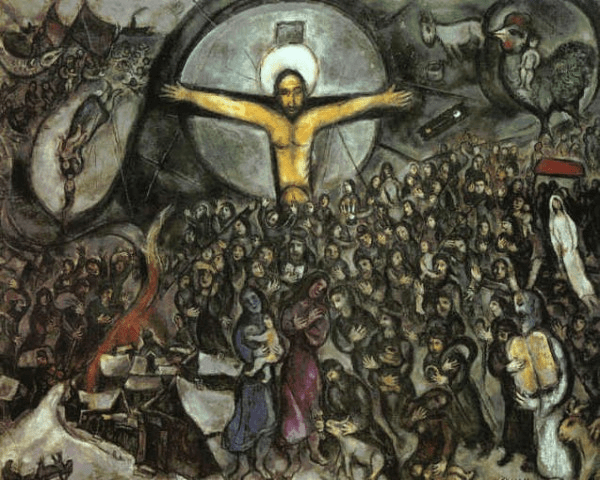
Exodus by Marc Chagall, 1952

Now the main point of what we are saying is this: We do have such a high priest, who sat down at the right hand of the throne of the Majesty in heaven, and who serves in the sanctuary, the true tabernacle set up by the Lord, not by a mere human being.

Every high priest is appointed to offer both gifts and sacrifices, and so it was necessary for this one also to have something to offer. If he were on earth, he would not be a priest, for there are already priests who offer the gifts prescribed by the law. They serve at a sanctuary that is a copy and shadow of what is in heaven. This is why Moses was warned when he was about to build the tabernacle: “See to it that you make everything according to the pattern shown you on the mountain.” But in fact the ministry Jesus has received is as superior to theirs as the covenant of which he is mediator is superior to the old one, since the new covenant is established on better promises.

For if there had been nothing wrong with that first covenant, no place would have been sought for another. (New International Version)

Jesus Christ is superior to everyone and everything – that is the overarching theme of the New Testament book of Hebrews. Jesus is above the angels, over Moses, and the great high priest of a new covenant. In Christ, the sin issue has been taken care of, once and for all.

Through Jesus, every good promise of God is fulfilled. Christ’s priesthood and intercessory ministry is permanent. His sacrifice for sin is thorough and complete. Jesus lives forever. He saves completely. Christ meets our need. He has been made perfect forever. (Hebrews 7:23-28). 

Frankly, these bold statements from the author of Hebrews are some audacious claims. In fact, they’re downright radical. And yet, say any of those statements in the typical church, and hardly an eyebrow gets raised – they almost seem ho-hum. Our blank affect testifies that we have lost a great deal of the original force and impact of Christianity.

In the first century, to have one sacrifice to end all sacrifices was unthinkable. Every ancient person understood that sacrifices were temporary; you had to keep offering them over and over again. 

Christianity, however, asked the world to have a new understanding of sacrifice. No longer would there be any sacrifice – no grain sacrifice; no offerings of first fruits; no animal sacrifices; no sacrifices, period. There was no longer any need for them because Jesus himself is the sacrifice to end all sacrifices. 
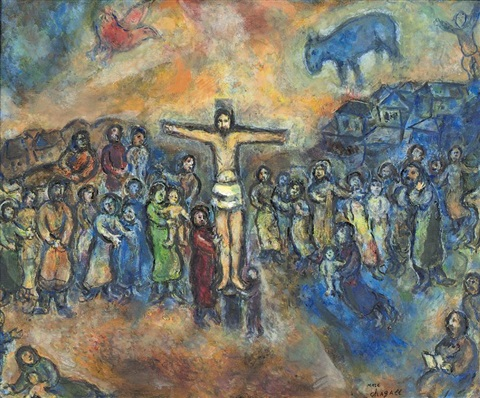
Crucifixion by Marc Chagall, 1966

This was such a ridiculous notion for so many people that they mocked Christians for it. Both Jews and pagans could barely wrap their minds around such a progressive idea. It would be like saying to us today that there is no longer any need for money because somebody just became the underwriter for everything everybody does.

Despite this incredible spiritual reality, we in the contemporary church sometimes go back to the old sacrificial system, not by physically offering animal sacrifices, but treating Christ’s finished work as if it were just too good to be true. 

We reason that we need to do something to help save ourselves. However, Jesus has not just saved us partially, but fully. Grace has always been scandalous, and so, we try to tone it down a bit, mitigate it’s actual force:

  • Church attendance can subtly be looked upon as a sacrifice to appease God, as if he needed to be soothed into not becoming angry at us. 
  • Giving can become a non-bloody sacrifice that is meant to satisfy God’s furrowed brow against us. 
  • Service can degenerate into a sacrifice to assuage our guilty conscience. 

In all these kinds of instances, and more, we go back to an old sacrificial system that is obsolete. Nonetheless, the biblical and theological truth is that Jesus has thoroughly saved us from our sin, and, so, has cleansed us from all guilt, including a guilty conscience. 

Jesus meets our need and has completely satisfied God’s wrath against the power and deceit of sin. 

Jesus is our mediator and intercedes for us as we come to God’s throne of grace. That means we do not need to try and get God’s attention with performing spiritual cartwheels or some incredible sacrifice that will somehow obligate him to take notice of us. That’s because there is never a time in which we lack attention from God.

Since we have been justified by faith in Jesus, we need not worry anymore about being good enough. Since Jesus is perfect, his work is made complete in us. A constant anxiety of feeling like we don’t measure-up does not come from God. Jesus is sufficient and has taken our place so that we can live in the freedom and joy of a complete deliverance from sin, death, and hell. There is no longer any necessary sacrifice to make!

“Well,” I have been told by some, “if everybody in the church believed that then nobody would ever do anything!” No, it is just the opposite. When we feel like we don’t measure up, we do less, not more. A low level discouragement sets in and we do nothing because we intuitively know it will never be enough. We do just enough to squeak by, never quite knowing if it is doing anything. 

In such a state, we may consider giving up because Christianity doesn’t work for us (which was the state of the believers in the book of Hebrews). But when we grasp the New Covenant of Christ’s sacrifice to end all sacrifices, and are overwhelmed by grace, then everything we do in the Christian life is a “thank you” with our life and our lips. 

It is the grace, and not the wrath, of God that teaches us to say “no” to ungodliness and worldly passions and to live upright and godly lives (Titus 2:11-12).

We are justified and made right by faith in Jesus Christ, and not by our own accomplishments, pedigree, or effort.  Trusting in our heritage, relying on our family’s faith, or believing our hard work gives us a leg-up toward heaven will only end in despair. 

But if we trust in Christ’s perfect sacrifice, then a whole new world of mercy opens before us. Because the grace of God in Christ is superior to everything.

Soli Deo Gloria

He Has Done Great Things For Me (Luke 1:46-55)

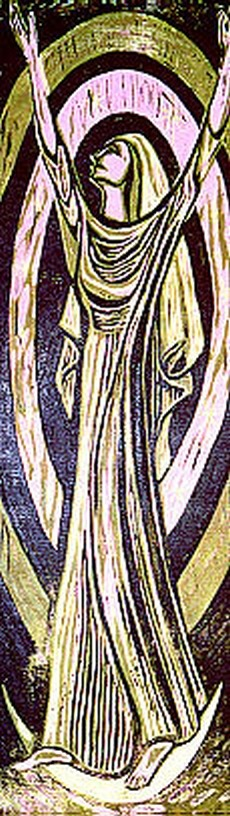
Madonna of the Magnificat by Sr. Mary Grace Thul

And Mary said,

“My soul magnifies the Lord,
    and my spirit rejoices in God my Savior,
for he has looked with favor on the lowly state of his servant.
    Surely from now on all generations will call me blessed,
for the Mighty One has done great things for me,
    and holy is his name;
indeed, his mercy is for those who fear him
    from generation to generation.
He has shown strength with his arm;
    he has scattered the proud in the imagination of their hearts.
He has brought down the powerful from their thrones
    and lifted up the lowly;
he has filled the hungry with good things
    and sent the rich away empty.
He has come to the aid of his child Israel,
    in remembrance of his mercy,
according to the promise he made to our ancestors,
    to Abraham and to his descendants forever.” (New Revised Standard Version)

Mary’s great song of praise, her “Magnificat” came from having grasped the reality of being pregnant with the Messiah. She affirmed that the all-powerful God “has done great things for me.” 

Indeed, the Lord shows mercy to everyone who worships and adores such mighty acts. It strikes me that Mary, instead of being full of worry and afraid of the future, and as an unmarried teen with child, is full of the Spirit and faith. 

Mary, the mother of Jesus, neither complained nor fretted for the nine months of her pregnancy; she praised God and had clear-headed faith about the grace shown to her. Mary’s canticle gives us insight into the mystery of the Christ’s incarnation: God chooses the weak, those of low esteem, and the powerless.

Mary was quite ordinary for her day. She had no wealth. There was nothing which caused anyone to pick her out of a crowd. Yet, she is the one chosen by God.

Her wonderful response to God’s grace demonstrated that there is so much more to any person than what we can see with our eyes and perceive through our earthly glasses of high positions and strength of personalities.

What’s more, Mary had the wisdom to discern that her situation typified the Lord’s egalitarian work of leveling the field so that all persons have what they need.

Her son, the Messiah, would carry this into his own life and ministry – declaring good news to the poor, comforting the brokenhearted, proclaiming freedom for captives, telling those who mourn that the time of the Lord’s favor has come.

Statue of Mary, Stella Maris Chapel, St. Joseph, Minnesota

God is full of grace, mercy, and strength to those who are powerless and in need of help. The Lord has our back. Perhaps if we all, both individually and corporately, continually used our words to identify and declare the great things God has done, then we would realize and have awareness of the Lord’s abiding blessing. 

One good way of gaining a greater awareness and appreciation of God’s gravity of grace is by journaling.

I encourage you to take some time today and write out some of the ways God has been good to you in the past days, weeks, or months.

Perhaps you might even craft your own song of praise, like Mary, and poetically and/or musically express your gratitude. Or maybe, instead of using words, a sketch or a painting may better communicate the great things God has done for you.

However you choose to do it, like Mary, offer praise for each act of mercy which comes to your memory. 

An outsider, looking in, might judge Mary to be helpless and weak, not the sort of a person who could carry a Messiah. Yet, we get a view from the inside, a glimpse into Mary’s heart. All along, she had her heart calibrated to detect the grace of God when it was present.

May we all follow her example of faith and confidence.

My Soul Magnifies The Lord ~ Chris Tomlin 

O Lord Jesus Christ, Son of God, Son of Humanity: Make me worthy to understand the profound mystery of your holy incarnation, which has happened for our sake and for our salvation.

Truly there is nothing so great and wonderful that you, my God, the Creator and Sustainer of all things, should become a creature, so that we might become children of God.

You have humbled yourself and made yourself small that we might be made mighty.

You have taken the form of a servant, so that you might confer upon us a royal and divine beauty.

You, who are beyond our understanding, have made yourself understandable to us in Jesus Christ.

You, who are the uncreated God, have made yourself a creature for us.

You, who are the untouchable One, have made yourself touchable to us.

You, who are Most High, make us capable of understanding your amazing love and the wonderful things you have done for us.

Make us able to understand the mystery of your incarnation, the mystery of your life, example, and doctrine, the mystery of your cross and passion, the mystery of your resurrection and ascension. Blessed are you, O Lord, for coming to earth as a man.

You have done great things for me!

Amen, and amen.

The Wonder of Christ’s Resurrection

Welcome, friends! In the New Testament Gospel of Luke 24:1-12, we find an account of women approaching the grave of Jesus, only to find an empty tomb. Today, people search for reality in all kinds of empty places. There is, however, hope, because Christ is risen! He is risen, indeed! Click the videos below and let us enjoy and be in awe that Jesus is alive!

Pastor Tim Ehrhardt, Luke 24:1-12

May the glory and the promise of this joyous time of year bring peace and happiness to you and those you hold most dear.

And may Christ, Our Risen Savior, always be there by your side to bless you most abundantly and be your loving guide. Amen.

John 12:1-11 – Monday of Holy Week

Six days before the Passover, Jesus went to Bethany, the home of Lazarus, the man he had raised from death. They prepared a dinner for him there, which Martha helped serve; Lazarus was one of those who were sitting at the table with Jesus. Then Mary took a whole pint of a very expensive perfume made of pure nard, poured it on Jesus’ feet, and wiped them with her hair. The sweet smell of the perfume filled the whole house. One of Jesus’ disciples, Judas Iscariot—the one who was going to betray him—said, “Why wasn’t this perfume sold for three hundred silver coins and the money given to the poor?” He said this, not because he cared about the poor, but because he was a thief. He carried the money bag and would help himself from it.

But Jesus said, “Leave her alone! Let her keep what she has for the day of my burial. You will always have poor people with you, but you will not always have me.”

A large number of people heard that Jesus was in Bethany, so they went there, not only because of Jesus but also to see Lazarus, whom Jesus had raised from death.So, the chief priests made plans to kill Lazarus too, because on his account many Jews were rejecting them and believing in Jesus. (Good News Translation)

Jesus entered Jerusalem, the day before, on Sunday, with the people waving and lying down palm branches, along with shouts of “hosanna!” Although Jesus had been speaking about his death, weeks before his triumphal entry, most folks were clueless as to what was about to happen.

But Mary Magdalene did. She truly listened to the Master. Her spiritual ears and eyes were fully opened to the significance of this week. Mary was completely aware.

A woman with a sordid background, Mary Magdalene had her life thoroughly transformed through meeting Jesus. She became a follower, in every sense of the word. As an attentive disciple, Mary knew her Lord. She observed every little thing about Jesus, hung on every word, knew each voice inflection and every gesture.

Now, near the end of Christ’s earthly life, and only days from being arrested, tried, tortured, and killed, Mary sensed what was happening. She saw the pained affect on her Lord’s face that no one else noticed. She was cognizant of what was happening, while the others seemed clueless.

Mary’s own brokenness cracked open to her the true reality of life, the real meaning of the unfolding days, and the deep gravity of this week.

The surface event itself is a touching and tender moment in history. This woman, whom everyone knew as a damaged person, took a high-end perfume, and broke the entire thing open.

Mary then proceeded to anoint Christ’s feet with it. You can imagine the aroma filling the house with an expensive perfume for all to smell. Giving what she had to Jesus, Mary demonstrated the path of true discipleship.

Mary’s act of faith in anointing Jesus was deeply symbolic:

  • The broken jar of perfume shows us the brokenness of Mary and our need to be broken. (Matthew 5:3-4)
  • Mary used an extraordinary amount of perfume, picturing her overflowing love for Jesus. (John 20:1-18)
  • Mary applied the perfume to Jesus with her hair (hair is a cultural symbol of submission and respect). (1 Corinthians 11:14)
  • The perfume directs us to the death of Jesus. (John 19:38-42)
  • The perfume highlights for us the aroma of Christ to the world. (2 Corinthians 2:15-17)
  • There is more to Judas than his words about perfume; he is not actually concerned for the poor. (Matthew 26:15)
  • Judas and Mary serve as spiritual contrasts: Mary opens herself to the sweet aroma of Christ; Judas just plain stinks.
  • The perfume presents a powerful picture of the upcoming death of Christ, for those with eyes to see; he was broken and poured out for our salvation. (Luke 23:26-27:12)

Christianity was never meant to be a surface religion which merely runs skin deep. The follower of Christ is meant for deep personal transformation, inside and out, so that there is genuine healing, spiritual health, and authentic concern for the poor and needy. 

Keeping up appearances is what the Judas’s of this world do. But the Mary’s among us dramatically point others to Jesus with their tears, humility, vulnerability, openness, and love.

In our contemporary social and cultural landscape of fragmented human ecology, our first step toward wholeness and integrity begins with a posture of giving everything we have – body, soul, and spirit – to the Lord Jesus.

Sometimes it takes a woman to show us the way.

On this Monday of Holy Week, a tangible act may help us to express and deepen our faith. Take a bottle of unopened perfume or cologne, pour it completely out into a used tin can, and set the can in a central place in your home, just for the day* The aroma will likely linger into the next few days, as well. Let the smell be a continual reminder of both the sadness of death and the joy of salvation.

Loving Lord Jesus, my Savior, and my friend, you have gone before us and pioneered deliverance from an empty way of life and into a life of grace and gratitude. May I and all your followers emulate the path of Mary and realize the true freedom which comes from emptying oneself out for you. Amen.

*When you are ready, it is appropriate to dispose of the perfume by pouring it down the drain. Even this can be a ritual in which you visualize discarding your old life in order to take up a new one on Easter Sunday.