Descending Into Greatness

Welcome, friends! Philippians 2:5-11 is an appropriate place for us to be on Palm Sunday. Christians everywhere are reminded that Jesus humbled himself by coming and submitting to death. In so doing, Christ absorbed all the guilt and shame of the world on a cruel cross. As we enter this Christian Holy Week, let us do so embracing the mindset of Jesus as a servant to all. Click the videos below and let us declare that Jesus is Lord to the glory of God.

Pastor Tim Ehrhardt, Philippians 2:5-11

God of our salvation,
help us to enter with joy
into the celebration of those mighty acts by which you have given us fullness of life;
through Jesus Christ our Redeemer. Amen.

Philippians 2:5-11 – Descending Into Greatness

In your relationships with one another, have the same mindset as Christ Jesus:

Who, being in very nature God,
    did not consider equality with God something to be used to his own advantage;
rather, he made himself nothing
    by taking the very nature of a servant,
    being made in human likeness.
And being found in appearance as a man,
    he humbled himself
    by becoming obedient to death—
        even death on a cross!

Therefore, God exalted him to the highest place
    and gave him the name that is above every name,
that at the name of Jesus every knee should bow,
    in heaven and on earth and under the earth,
and every tongue acknowledge that Jesus Christ is Lord,
    to the glory of God the Father. (New International Version)

So, what kind of people (and what kind of church) would we be if we resembled these verses of Holy Scripture?  

The Apostle Paul said to the church in Philippi that their “attitude” or “mindset” should be the same as Christ Jesus. Their thinking ought to be like the mind of Christ. To think well, live well, and be well, we need the mind of Christ.

To relate to others in a godly way, to navigate this fallen world with integrity and truth, to make an impact on those around us, we must adopt the mindset and attitude of Jesus.  

Everything comes down to God – how we should think and how we ought to live. Within the life of the one true God, exists three persons: Father, Son, and Spirit. Within the Holy Trinity, there exists perfect love, absolute holiness, united harmony, and constant respect. 

Just as God is holy, we are to be holy.

Therefore, once you have your minds ready for action and you are thinking clearly, place your hope completely on the grace that will be brought to you when Jesus Christ is revealed. Don’t be conformed to your former desires, those that shaped you when you were ignorant. But, as obedient children, you must be holy in every aspect of your lives, just as the one who called you is holy. It is written, You will be holy, because I am holy. (1 Peter 1:13-16, CEB)

Just as God is love, so we are to love one another.

Dear friends, we should love each other, because love comes from God…. This is how God showed his love to us: He sent his one and only Son into the world so that we could have life through him. This is what real love is: It is not our love for God; it is God’s love for us. He sent his Son to die in our place to take away our sins. Dear friends, if God loved us that much, we also should love each other. (1 John 4:7-11, NCV)

Just as Jesus is a humble servant, so we are to practice humble service in all relationships.

Everyone must live in harmony, be sympathetic, love each other, have compassion, and be humble. Don’t pay people back with evil for the evil they do to you, or ridicule those who ridicule you. Instead, bless them, because you were called to inherit a blessing. (1 Peter 3:8-9, GW)

Humility is vital to Christian existence, and not optional. There is no place in the believer’s life for pride, posturing, and power-broking. Instead, we are to take the posture of lowliness, using any kind of influence for the benefit and encouragement of others – just like Jesus did while on this earth. 

In a world pre-occupied with power and control, safety and security, influence and throwing its weight around, there is Jesus. Christ did the opposite of engaging in upward mobility; he practiced downward mobility. In doing so Jesus Christ descended into greatness as Lord and Savior.

To have the mind and attitude of Christ happens through emulating our Lord’s example of humility. Jesus is God. Yet, despite that reality, the pre-incarnate Christ did not sit in heaven as the second person of the Trinity and hold onto his lofty position with tight fists. 

Jesus came to this earth with a humble willingness to open his hands and relinquish his rights and privileges as God. Christ divested himself of all his privilege. He became a slave. Jesus gladly emptied himself and held nothing back. Christ completely gave himself up for us.

Jesus became one of us, yet never ceased being the Lord of all. It’s just that he willingly put his kingly robe in the closet and put on Dickies and work boots. Jesus came among us and purposely limited himself to identify with us fully – and secured for us the greatest generosity imaginable: an answer to the problem of guilt and shame through forgiveness of sins.

Jesus became a servant, a bond-slave. Christ completely tied himself to us, not coming to this earth seeking to be served, but serving and giving his life as a ransom for many. 

What’s more, Christ kept going lower and lower to the point of descending to the greatest humiliation and shame of all – death on a cross. The King of the universe was killed by sinful humanity so that he might redeem and save those very same people from their terrible plight of bondage to the power of sin.

Therefore, we are to be humble, embracing the lowly status of being slaves to God and to one another. The Philippian church had a real problem with pride. Hear the exhortations given to the Philippian church so that they would practice humility in all their relationships: 

  • Live your life in a manner worthy of the gospel of Christ, so that, whether I come and see you or am absent and hear about you, I will know you are standing firm in one spirit, striving side by side with one mind for the faith of the gospel (Philippians 1:27, NRSV)
  • Don’t be jealous or proud but be humble and consider others more important than yourselves. (Philippians 2:3, CEV)
  • You must continue to live in a way that gives meaning to your salvation. (Philippians 2:12, ERV)
  • Do all things without murmuring and arguing. (Philippians 2:14, NRSV)
  • Brothers and sisters, imitate me, and pay attention to those who live by the example we have given you. (Philippians 3:17, GW)
  • Do not be anxious [tight-fisted control] about anything, but in every situation, by prayer and petition, with thanksgiving [open-handed humility] present your requests to God. (Philippians 4:6, NIV)

As a result of Christ’s humble obedience to the Father, he was exalted from the lowest place to the highest place. King Jesus is on the throne, above everyone and everything. Because of his descent to this earth, he ascended in glory and honor. We now see God in a new way, through Jesus – and it causes us to bend the knee and confess with the tongue that Jesus Christ is Lord.

In the ancient Roman world, Jesus as Lord was subversive language. Because if Jesus is Lord, Caesar is not, and ultimate allegiance does not belong to the Empire. And it is no different in our day. The issue of who we pledge our fealty to, still pertains to us. If Jesus is Lord, no earthly politician or religious figure is owed lordship status.

To follow Jesus, one must practice downward mobility and embrace humility.

Bowing the knee to Christ becomes second nature whenever we give our unflagging allegiance to him. We accept that we are the creatures and God is the Creator, that God is God, and we are not.

As we enter Holy Week, hear the prophet Isaiah’s words of humiliation and exaltation:

Just watch my servant blossom!
    Exalted, tall, head and shoulders above the crowd!
But he didn’t begin that way.
    At first everyone was appalled.
He didn’t even look human—
    a ruined face, disfigured past recognition.
Nations all over the world will be in awe, taken aback,
    kings shocked into silence when they see him.
For what was unheard of they’ll see with their own eyes,
    what was unthinkable they’ll have right before them.

Who believes what we’ve heard and seen?
    Who would have thought God’s saving power would look like this?

The servant grew up before God—a scrawny seedling,
    a scrubby plant in a parched field.
There was nothing attractive about him,
    nothing to cause us to take a second look.
He was looked down on and passed over,
    a man who suffered, who knew pain firsthand.
One look at him and people turned away.
    We looked down on him, thought he was scum.
But the fact is, it was our pains he carried—
    our disfigurements, all the things wrong with us.
We thought he brought it on himself,
    that God was punishing him for his own failures.

But it was our sins that did that to him,
    that ripped and tore and crushed him—our sins!
He took the punishment, and that made us whole.
    Through his bruises we get healed.
We’re all like sheep who’ve wandered off and gotten lost.
    We’ve all done our own thing, gone our own way.
And God has piled all our sins, everything we’ve done wrong,
    on him, on him.

He was beaten, he was tortured,
    but he didn’t say a word.
Like a lamb taken to be slaughtered
    and like a sheep being sheared,
    he took it all in silence.
Justice miscarried, and he was led off—
    and did anyone really know what was happening?
He died without a thought for his own welfare,
    beaten bloody for the sins of my people.
They buried him with the wicked,
    threw him in a grave with a rich man,
Even though he’d never hurt a soul
    or said one word that wasn’t true.

Still, it’s what God had in mind all along,
    to crush him with pain.
The plan was that he give himself as an offering for sin
    so that he’d see life come from it—life, life, and more life.
    And God’s plan will deeply prosper through him.

Out of that terrible travail of soul,
    he’ll see that it’s worth it and be glad he did it.
Through what he experienced, my righteous one, my servant,
    will make many “righteous ones,”
    as he himself carries the burden of their sins.
Therefore I’ll reward him extravagantly—
    the best of everything, the highest honors—
Because he looked death in the face and didn’t flinch,
    because he embraced the company of the lowest.
He took on his own shoulders the sin of the many,
    he took up the cause of all the black sheep. (Isaiah 52:13-53:12, MSG)

Lord Jesus, Son of God, you walked the earth with humility, despite being Lord of all. Your meekness confused the proud and arrogant. Your nobly attended to the needy and destitute. Teach me to model my life after you, to live with a humble spirit. Help us to never view ourselves as greater or better than others. Let our hearts always imitate your humility. Amen.


Romans 10:8b-13 – Believe and Confess

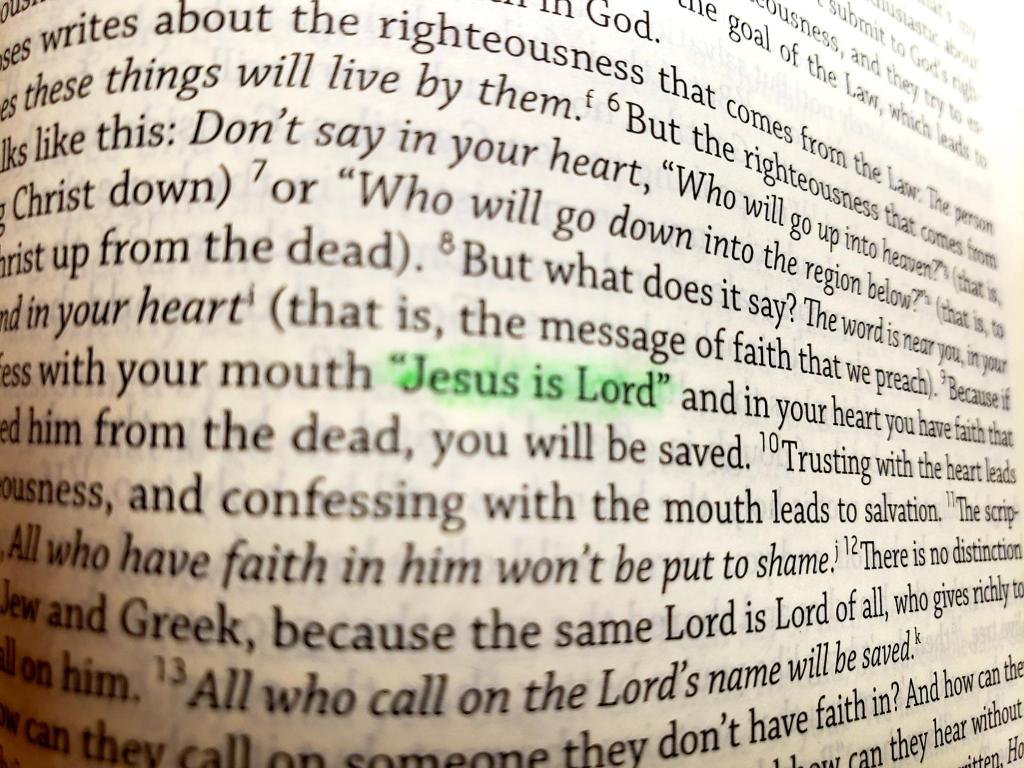
“The word is near you; it is in your mouth and in your heart,” that is, the message concerning faith that we proclaim: If you declare with your mouth, “Jesus is Lord,” and believe in your heart that God raised him from the dead, you will be saved. For it is with your heart that you believe and are justified, and it is with your mouth that you profess your faith and are saved. As Scripture says, “Anyone who believes in him will never be put to shame. ”For there is no difference between Jew and Gentile—the same Lord is Lord of all and richly blesses all who call on him, for, “Everyone who calls on the name of the Lord will be saved.” (New International Version)

Confess with the Mouth

John Wesley (1703-1791) was an Oxford don who became an Anglican priest. He had all the intellectual tools to rightly handle the intricacies of theology and teach the Bible. Yet, when he first started out, there was no heart behind it. 

On a voyage across the Atlantic to America, Wesley spent much of the time on the ship with a group of German pietists – men and women who had a heart behind their practice of Christianity. The Germans deeply impressed Wesley, and he realized there was something important missing from his own religion. 

The ship encountered a storm and Wesley was afraid for his life. But the German believers seemed unfazed, having a heart-faith that John could not explain. He wanted what they had. Wesley was fearful and found little comfort in his religion. So, he confessed to one of them his growing misery and decision to give up the ministry. One of the Pietists advised, “Preach faith till you have it. And then, because you have it, you will preach faith.”

John Wesley acted on the advice. He led a prisoner to Christ by preaching faith in Christ alone for forgiveness of sins. He was astonished. Here was a man transformed instantly. Wesley cried out, “Lord, help my unbelief!” However, he still felt dull inside and little motivation even to pray for his own salvation. 

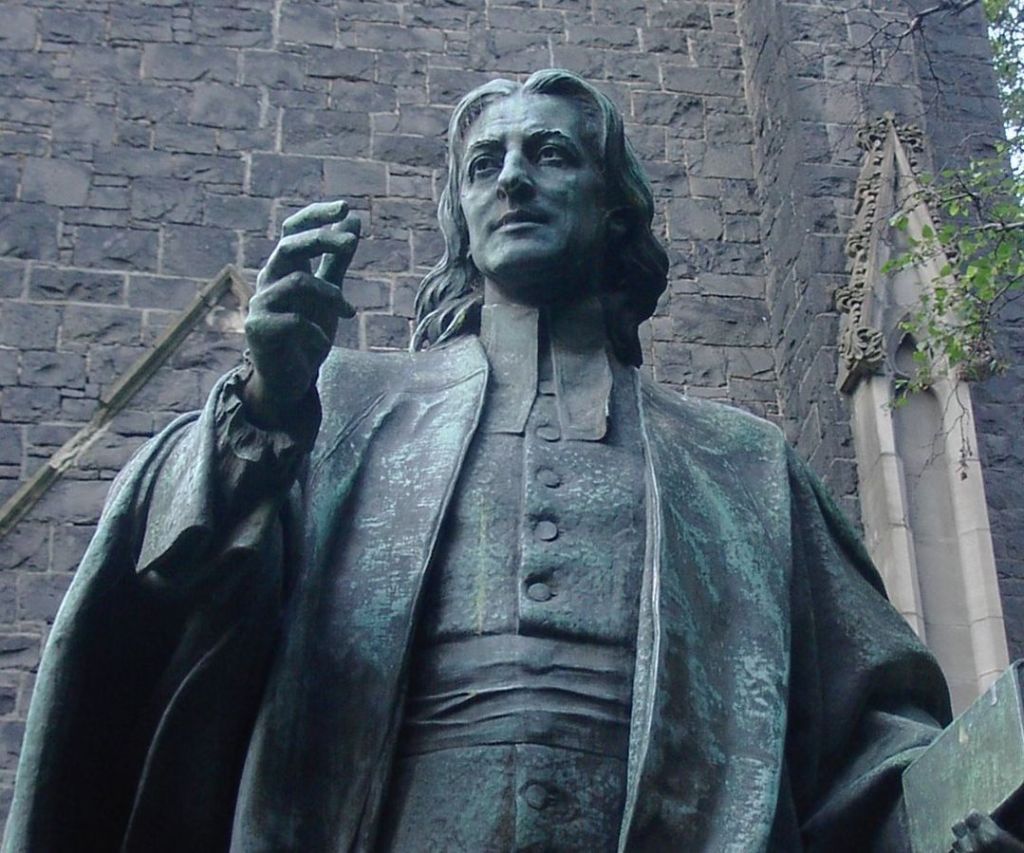
Statue of John Wesley as a young preacher, by Adam Carr, located in Melbourne, Australia

Having returned back to England, Wesley was in a church service listening to Romans expounded by the preacher. He recalled the experience years later: “While he was describing the change which God works in the heart through faith in Christ, I felt my heart strangely warmed. I felt I did trust in Christ, Christ alone for salvation; and an assurance was given me that He had taken away my sins, even mine, and saved me from the law of sin and death.”

Believe with the Heart

Simply uttering the words with our mouths, “Jesus is Lord,” by itself does not create deliverance and salvation. The heart needs to be involved. Yet, we must also consider the reality that only focusing on the heart, without having the mouth involved, is an insufficient faith. Christian belief has a solid objective real historical base from which our hearts can tether themselves. Christian confession affirms that Jesus is, indeed, risen from death and is Lord of all, having secured salvation for us through his shed blood on the cross.

Consider two hypothetical men at the time of the Passover in Egypt: Eleazar Ben Macaroni and Yakov Yarmulke. Eleazar and Yakov are talking together on the night the angel of death is about to pass through Egypt and the firstborn son in every family would be killed – that is, unless the blood from a sacrificial lamb was over the door of the house so that the angel would “pass over” the house and no one would be killed. 

Passover Angel of Death, by Arthur Hacker (1858-1919)

Yakov says to Eleazar, “Can you believe all that has been happening around here?  It’s all very scary!  All of those plagues, the disaster around us, and now this night!”  Eleazar asks, “Well, haven’t you put the blood over the door?”  “Yes, I’ve done all that – but it all is still disturbing.  My heart is troubled.  What do think will happen?” “Will we be okay?” asks Yakov nervously.  Eleazar responds, “I trust in the promises of God; let the angel come!”

So, when the angel of death came, which house do you suppose lost his firstborn son: Eleazar ben Macaroni, or Yakov Yarmulke?  The answer: neither of them. The angel of death did not come to either man’s house because deliverance is determined by the blood of the lamb and not by the quality or intensity of faith of the person. 

“For me His precious blood he shed – for me His life He gave. I need no other argument, I need no other plea; it is enough that Jesus died, and that he died for me.”

My Faith Has Found a Resting Place, hymn by Eliza Edmunds Hewitt (1851-1920)

If we only focus on the heart, our hearts will condemn us. We need to say the words of our faith, to confess them with our mouths, repeatedly, again and again, until we believe them. We are not to wait for our hearts to feel like having faith and living for God, because our hearts can be desperately wicked, and they will keep deceiving us. The heart needs to be informed by God’s Word and accept the words of Holy Scripture by faith:

“If we confess our sins, he is faithful and just to forgive us our sins, and to purify us from all unrighteousness.” (1 John 1:9, NIV)

Have the Heart and Mouth Work Together

We need both a right confession with our mouths and a right confession in our hearts for saving faith. When the heart receives grace, and the mouth expresses the beauty of faith – when heart and mouth work in concert with each other – something beautiful and gracious happens: 

“Everyone who calls on the name of the Lord will be saved.”

Romans 10:13

When Holy Scripture says “everyone,” it means “everyone.” All who cry out to God with their mouths, from a heart desiring God, will be saved. It does not matter whether that call is melodious, sweet, and in tune; or whether the call is a jumbled off-key joyful noise. It makes no difference; both will be saved. 

Only uttering the right words like some magical incantation does not save us. Only sincerity of heart does not save us. One does not achieve salvation through self-effort or trying to be worthy. No one is saved by finding the right combination of words in prayer or having a nice feeling.

Calling on the name of the Lord with both mouth and heart, trusting in the redemptive events of Jesus Christ, is what saves us.

Whether Jew or Gentile, rich or poor, American or Arab, famous or infamous, it is no matter – because salvation isn’t dependent on our looks, our past, or our zeal in doing good works. Salvation is completely from God and freely given to all who call upon the name of the Lord.

Make No Room for Shame

What’s more, all who trust in Jesus Christ will never be put to shame. In ancient Roman society, nearly three-fourths of all the people in the Empire were slaves to the other one-fourth. It was a culture built around the concept of honor and shame. It was shameful to be a slave, and honorable to be privileged, wealthy, and influential with a good Roman pedigree and citizenship. It was beneath such people to interact with those who served them because dealing with shameful people would make them shameful, as well.

Jesus forsook his honorable position in order to hob-nob with us rabble. He became one of us to save us and lift us up with him.

“For you know the grace of our Lord Jesus Christ, that though he was rich, yet for your sakes he became poor, so that you, through his poverty, might become rich.” 

2 Corinthians 8:9, NIV

Jesus embraced the shame of the cross. Therefore, we need never live in a state of shame ever again. Our hearts need not condemn us. Jesus has already taken care of shame, once for all.

“Let us fix our eyes on Jesus, the author and perfecter of our faith, who for the joy set before him endured the cross, scorning its shame, and sat down at the right hand of the throne of God.  Consider him who endured such opposition from sinful men, so that you will not grow weary and lose heart.” (Hebrews 12:2-3, NIV)

Put a Focus on Lent

The season of Lent lets us know we are neither brains-on-a-stick nor walking-headless-hearts. We have both heart and mouth, both deep feeling and real intellectual knowledge. Together, they form belief and confession. Lent is an invitation to prepare our hearts for Christ’s passion and resurrection. It includes an examination of our hearts so that we can deepen our piety and devotion to Jesus. And it incorporates confession of Jesus with the mouth.

The good news is this: Jesus is Savior and Lord; he has risen from death; and there is forgiveness of sins and deliverance from guilt and shame through is cross. When all is said and done, people need the Lord.

“I have not come to call the righteous, but sinners,” said Jesus. (Matthew 9:13)

Repentance involves both heart and mouth. And Lent is just the season for it, to turn from everything we have previously been living for other than Jesus. It’s an opportunity to start afresh with new life in Christ. It’s enough to make old John Wesley smile from the grave.

Have mercy on me, O God, according to your unfailing love; according to your great compassion blot out my transgressions. Wash away all my iniquity and cleanse me from my sin. 

Create in me a pure heart, O God, and renew a steadfast spirit within me. Restore to me the joy of your salvation and grant me a willing spirit, to sustain me.

Save me from guilt and shame and my tongue will sing of your righteousness. Open my lips, and my mouth will declare your praise. You do not delight in sacrifice, or I would bring it; you do not take pleasure in burnt offerings. The sacrifices of God are a broken spirit; a broken a contrite heart, O God, you will not despise. Amen.

Ephesians 1:15-23 – Our Authority in Christ

Hello, friends! Welcome to Christ the King Sunday, a day which reminds us that in the coming Advent season, we look for both a baby and a king. Click the video below and let us acknowledge and worship King Jesus…

There is perhaps no better hymn for this day than Crown Him with Many Crowns:

For a contemporary song, it is appropriate today and every day to Sing to the King:

Now to Him who is able to keep you from stumbling,
And to present you faultless
Before the presence of His glory with exceeding joy,
To God our Savior,
Who alone is wise,
Be glory and majesty,
Dominion and power,
Both now and forever.
Amen.