Acts 2:1-21 – The Day of Pentecost

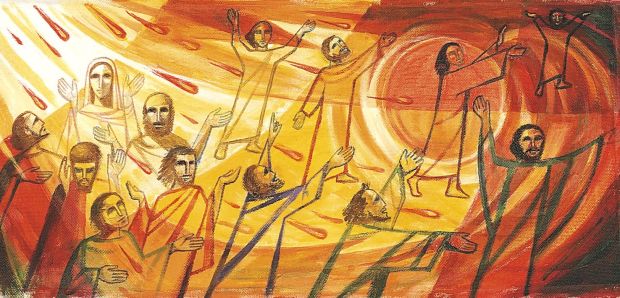
When Pentecost Day arrived, they were all together in one place. Suddenly a sound from heaven like the howling of a fierce wind filled the entire house where they were sitting. They saw what seemed to be individual flames of fire alighting on each one of them. They were all filled with the Holy Spirit and began to speak in other languages as the Spirit enabled them to speak.

There were pious Jews from every nation under heaven living in Jerusalem. When they heard this sound, a crowd gathered. They were mystified because everyone heard them speaking in their native languages. They were surprised and amazed, saying, “Look, aren’t all the people who are speaking Galileans, every one of them? How then can each of us hear them speaking in our native language? Parthians, Medes, and Elamites; as well as residents of Mesopotamia, Judea, and Cappadocia, Pontus and Asia, Phrygia and Pamphylia, Egypt and the regions of Libya bordering Cyrene; and visitors from Rome (both Jews and converts to Judaism), Cretans and Arabs—we hear them declaring the mighty works of God in our own languages!” They were all surprised and bewildered. Some asked each other, “What does this mean?” Others jeered at them, saying, “They’re full of new wine!”

Peter stood with the other eleven apostles. He raised his voice and declared, “Judeans and everyone living in Jerusalem! Know this! Listen carefully to my words! These people aren’t drunk, as you suspect; after all, it’s only nine o’clock in the morning! Rather, this is what was spoken through the prophet Joel:

In the last days, God says,
I will pour out my Spirit on all people.
    Your sons and daughters will prophesy.
    Your young will see visions.
    Your elders will dream dreams.
    Even upon my servants, men and women,
        I will pour out my Spirit in those days,
        and they will prophesy.
I will cause wonders to occur in the heavens above
    and signs on the earth below,
        blood and fire and a cloud of smoke.
The sun will be changed into darkness,
    and the moon will be changed into blood,
        before the great and spectacular day of the Lord comes.
And everyone who calls on the name of the Lord will be saved. (Common English Bible)
The Holy Spirit is the distinguishing mark of the believer in Jesus Christ.

Therefore, since the Spirit is given, the main responsibility of Christians is to receive. 

Christianity is distinctive in this sense – it is primarily a religion of receiving. The Christian life is lived by the power of the Holy Spirit, and not in our own strength. The function of faith is to receive what grace offers. 

We are saved and sanctified by grace alone through faith. God lives in and through us by means of the Spirit. The miraculous and the supernatural cannot, obviously, be done by any human person.  It can, however, be accomplished through the power of the Holy Spirit.

People tend to put a lot of pressure on themselves to be a certain way and to do certain things. The result? Tiredness. Discouragement. Imbalance. Lots of giving. Little receiving.

Christianity is not chiefly about giving but receiving. The Christian life is about putting oneself in a position to receive through prayer and humility. In Christianity, the opposite of receiving is not giving – it’s pride. 

Maybe this kind of talk makes you uncomfortable. I’m not talking about being passive or lazy. I’m highlighting the need of receiving grace from God by means of the Holy Spirit. Then, the Spirit to work in and through us. 

Jesus said we would do greater works than even he himself with the advent of the Spirit! (John 14:12-14)

The question then becomes: Will we let God be God? Will we allow the Spirit to do work in us?
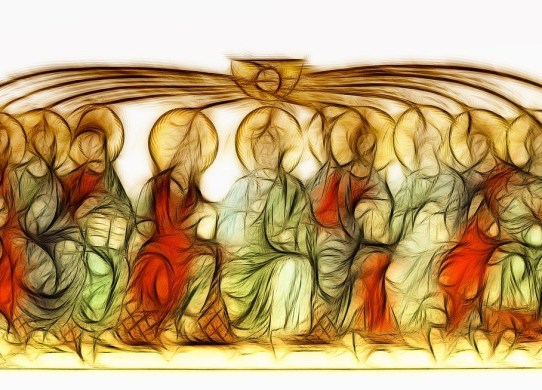
The Spirit is elsewhere described in Holy Scripture as a gentle presence, an encourager, counselor, and comforter. Yet, not here at Pentecost – the Spirit is portrayed like a violent wind and an unusual fire.

The Holy Spirit on the Day of Pentecost was not some gentleman caller entering politely when invited. Instead, the Spirit appears more like a drunken sailor who bursts into the room and causes a big ruckus. There’s nothing subtle about the Spirit at Pentecost. The Spirit is electric, bombastic, and volcanic, causing a huge scene and upheaving the status quo.

Because of Pentecost, Christians are marked and defined by God’s Spirit living within them and being full of the Spirit. God wants to pour out the Spirit on all kinds of people to overflowing so that what comes out of them is “prophecy.” 

The prophet Joel and the Apostle Peter do not intend the word “prophecy” to mean predicting the future. Rather, they are referring to inspired speech coming from a heart overflowing with the Spirit. 

Just as an inebriated person says and does things they would not typically say or do because they are filled with alcohol, so the person filled with God’s Spirit says things and does things they would not typically say or do because their inspiration and courage come as a result of God within them.

Thus, we must cast off the unholy spirits of inebriation and receive the Holy Spirit of God.

Descent of the Holy Spirit at Pentecost mosaic by Anna Wyner

God sobered-up the little band of Christ followers from learners to practitioners, sending them into the world with a mission.

Being on a mission from God is not really about ability; it’s about being filled and sent. 

First time parents may read and learn all they can about parenting before their child is born. Yet, when that little bundle comes into the world, and the hospital puts this kid in your arms and sends you out, you feel inadequate for the task. Parenting becomes a kind of supernatural affair where you pray and learn on the fly, finding out that you need something beyond yourself to get anywhere in raising this screaming, pooping, sleeping person who depends completely on you for everything. 

God sends us into the world to make disciples. And we may feel very inadequate for the task. However, this has more to do with receiving the Spirit. The Spirit comes looking to turn our lives upside-down with new life in Jesus Christ. 

Pentecost means that the Spirit came to shake things up and accomplish among God’s people what they could never do on their own.

Everyone who calls on the name of the Lord will be saved. 

The Church in the New Testament was not a country club for people to simply enjoy the perks of membership.  The community of the redeemed, the Church, is actually more like a place where the people seem drunk because they are all talking with inspired speech from the Holy Spirit. 

Maybe we don’t need to be saved in the sense that we have already called on the name of the Lord concerning forgiveness in Christ. Yet, maybe we need to call on the name of the Lord to be delivered from our misguided attempts to see the Christian life as a pleasant affair.

Perhaps we need deliverance from disordered priorities and misguided loves. We may need to be saved from ourselves so that we are open to the Holy Spirit with palms up receiving from God whatever it is the Spirit wants to do in and through us, rather than telling God how we think things ought to go. 

Prayer, then, is more about receiving the Spirit and God’s purposes for us rather than giving God an earful and expecting the Lord to bless our plans.

Pentecost is the launching pad of the church’s mission – it was explosive because the Spirit is a kind of wild man who fills people up to overflowing so that what comes out of them is inspired speech and missional actions.

If a language barrier cannot stop the Spirit from operating, then how much more can God transform us and use us in the lives of those around us?

Joel’s prophecy, quoted by Peter, is only partially fulfilled. Events have been set in motion by Pentecost for the complete fulfillment of God’s justice. So, there’s some urgency for people to fill their vacuous souls with the grace freely offered to them in Christ.

The outpouring of the Spirit is a sign: The end is near. And the generous giving of the Spirit is inclusive – there is room for all kinds of people. Through the Spirit, God saves all who call on the name of the Lord.

Today is not just another day on the calendar. It is the Day of Pentecost! 

Just as marriages occasionally need a spark and a fire and a fresh wind, so we need the Holy Spirit to breathe on us, comfort us, and inspire us.

May we be filled with the Spirit as we anticipate what our God will do now, and in the years to come.

Spirit of the living God, through the reading and proclamation of the Word, may you refresh our spirits, reshape our desires, recreate our hearts, and reform our ways so that we will shine with your enduring glory, through Jesus Christ, our risen and ascended Lord. Amen. 

Luke 9:18-27 – Jesus Makes All the Difference

Christ the Redeemer, Rio De Janeiro, Brazil

Once when Jesus was praying in private and his disciples were with him, he asked them, “Who do the crowds say I am?”

They replied, “Some say John the Baptist; others say Elijah; and still others, that one of the prophets of long ago has come back to life.”

“But what about you?” he asked. “Who do you say I am?”

Peter answered, “God’s Messiah.”

Jesus strictly warned them not to tell this to anyone. And he said, “The Son of Man must suffer many things and be rejected by the elders, the chief priests and the teachers of the law, and he must be killed and on the third day be raised to life.”

Then he said to them all: “Whoever wants to be my disciple must deny themselves and take up their cross daily and follow me. For whoever wants to save their life will lose it, but whoever loses their life for me will save it. What good is it for someone to gain the whole world, and yet lose or forfeit their very self? Whoever is ashamed of me and my words, the Son of Man will be ashamed of them when he comes in his glory and in the glory of the Father and of the holy angels.

“Truly I tell you, some who are standing here will not taste death before they see the kingdom of God.” (New International Version)

In my work as both a church pastor and hospital chaplain, not to mention just being a regular guy, I rarely encounter people who characterize Christians as setting self-interest aside to follow Jesus completely with humble ministry which is willing to suffer on behalf of others.

Instead, I daily interact with folks who have long left the Church with stories of Christians squelching genuine questions about God and faith; being judgmental toward others who are not like them; having a hypocritical double-standard approach to most issues; and verbally abusing individuals who don’t conform to their cultural ideas and biblical interpretations.

We need Christians who make a difference in this world. We need Jesus.   

A right and real confession of Jesus by his Church speaks a relevant word into the culture; proclaims the gospel of grace (not judgment); and consistently and lives what it believes.

Confessing Jesus as Lord makes all the difference.

After interacting with a lot of people on their ministry journeys, Jesus asked two questions of his disciples: “Who do people say I am?” and “Who do you say I am?” Out of all the questions we can ask people, these are two good ones: “Who do others say Jesus is?” and “Who do you say Jesus is?”  

The disciples gave a variety of answers, which is to be expected. Today, you will also get variegated answers, such as, Jesus is a good teacher, a model humanitarian, a myth or a legend. A few times I’ve been told that Jesus was an alien from another planet. My all-time personal favorite response is that Jesus was a nudist and that if we all just took off our clothes, there would be peace in the world.

Although the disciples are sometimes clueless, Peter as the spokesperson, gave an insightful answer: “You are God’s Messiah.” 

Messiah or Christ literally means, “The Answer.”  Peter confessed Jesus as being The Answer, the person for whom it all comes down to. Peter may not have fully understood what he was saying, but he said it, nevertheless.

Being called by God makes all the difference.

“The Answer” was revealed to Peter by the heavenly Father. Faith in Jesus Christ is a gift given to us by God.

“My Father has entrusted everything to me. No one truly knows the Son except the Father, and no one truly knows the Father except the Son and those to whom the Son chooses to reveal him.” (Matthew 11:27, NLT)

Peter was blessed – not because he did anything to deserve it – but because of sheer grace. It was revealed to Peter who Jesus really is, The Answer. We know who God is and who Jesus is by revelation, by God’s gracious self-revealing to people. Scripture is God’s revelation, a self-disclosure. It is through Scripture that we know. 

Revelation isn’t just a matter of waiting for some spiritual zap to occur, in which God bonks me in the brain and deposits the knowledge and understanding of who Jesus is. 

Peter put himself in a position to know by obeying the voice of Jesus to follow him. Then, Peter got to know Jesus over time.

Since it took years of being with Jesus for Peter and the other disciples to make a right confession of faith, then we need to have a great deal of patience for others, as well as ourselves. Others need time to get to know us, they need some time in the Scriptures, and they need some time with Jesus, too.

People do not typically come to a right confession of Jesus without having spent a good deal of time around us and within Holy Scripture.

Denying self, taking up our cross, and following Jesus makes all the difference.

God chooses to use you and me. The Lord only knows why. We are most certainly an imperfect people. Yet, it seems that our imperfections are the very thing God keeps using to reveal Jesus to others. Another way to put the matter is this: Genuine openness and vulnerability is needed, and not perfection or keeping up a tidy appearance.

Most people aren’t crazy about the word “vulnerable.”  We might expect openness in others yet have no intention of being vulnerable ourselves. If you have ever poured out your heart to someone or a group of people and only got blank stares in return; sincerely loved someone and they did not love you back; shared your genuine thoughts on something important to you and received only criticism; well then, we may believe vulnerability is a bad thing and not worth the emotional effort.

However, Jesus became vulnerable – descending from heaven, submitting to the machinations of evil persons, and exposed on a cruel cross. (Philippians 2:5-11)

In the Gospel of John, Mary displayed vulnerability in pouring expensive perfume on Jesus’ feet and wiping them with her hair, all the while exposing her true feelings for her Lord. In return, Mary got pushback and criticism from Judas. But Jesus upheld Mary’s actions and told Judas to leave her alone. (John 12:1-8).

In the Psalms, even a cursory reading reveals a boatload of vulnerability on the part of the psalmists. They were unafraid to explore the depth of human emotion, misery, joy, and praise of God.

Maybe we need the person who will stand up and say they are finally learning patience by being among a group of really annoying co-workers. Perhaps instead of laboring so hard to keep our thoughts and emotions in check, we need a church environment that lends itself to a person bawling their eyes out, while others just sit and cry with them.

That kind of vulnerability won’t happen unless we ourselves are real with God, who is never fooled by our deceitful hearts. Our evil-radar might be carefully attuned to others’ sin, but we are woefully inept at identifying the blackness within ourselves.

Jesus became completely exposed, naked, abandoned, alone and vulnerable on a cruel cross. Yet, instead of being shamed by the whole thing, Jesus scorned the shaming power of his crucifixion and embraced the suffering as the means of victory for our salvation. 

Vulnerability might seem ugly, but it turns whatever it touches into beauty. God can change our weakest, worst, and most shameful places into incredible strength and newfound love.

The broken and despised, the struggling and the lost, are the ones worthy of God’s kingdom. 

Whenever we are too afraid to walk into the mud of people’s lives, including our own, and are enamored instead with every spiritual shiny thing that comes along, we may have lost sight of our Lord, whom we are to imitate in his vulnerability. 

Christians don’t  have all the answers. But we do know the One who knows all things.

Methinks people will be drawn to Jesus when they observe Christians forsaking the path of the self-righteous prick, in favor of the humble servant who loses their life, only to find it.

Exodus 40:16-38 – No Matter Where We Go, God Is with Us

Israel Encamped Roundabout the Tabernacle in the Wilderness of Sinai
John W. Kelchner (1866-1942)

Moses followed the Lord’s instructions. And on the first day of the first month of the second year, the sacred tent was set up. The posts, stands, and framework were put in place, then the two layers of coverings were hung over them. The stones with the Ten Commandments written on them were stored in the sacred chest, the place of mercy was put on top of it, and the carrying poles were attached. The chest was brought into the tent and set behind the curtain in the most holy place. These things were done exactly as the Lord had commanded Moses.

The table for the sacred bread was put along the north wall of the holy place, after which the bread was set on the table. The lampstand was put along the south wall,then the lamps were attached to it there in the presence of the Lord. The gold incense altar was set up in front of the curtain, and sweet-smelling incense was burned on it. These things were done exactly as the Lord had commanded Moses.

The curtain was hung at the entrance to the sacred tent. Then the altar for offering sacrifices was put in front of the tent, and animal sacrifices and gifts of grain were offered there. The large bronze bowl was placed between the altar and the entrance to the tent. It was filled with water, then Moses and Aaron, together with Aaron’s sons, washed their hands and feet. In fact, they washed each time before entering the tent or offering sacrifices at the altar. These things were done exactly as the Lord had commanded Moses.

Finally, Moses had the curtains hung around the courtyard and at the entrance.

Suddenly the sacred tent was covered by a thick cloud and filled with the glory of the Lord. And so, Moses could not enter the tent. Whenever the cloud moved from the tent, the people would break camp and follow; then they would set up camp and stay there, until it moved again. No matter where the people traveled, the Lord was with them. Each day his cloud was over the tent, and each night a fire could be seen in the cloud. (Contemporary English Version)

There is no place we can go where God is not.

The presence of God is an overarching theme, not only of the book of Exodus, but of the entire Bible.

In the beginning, God created the heavens and the earth, and formed man and woman as the apex of divine creative work. Humans alone bear the stamp of God’s image and likeness. People were created to be with God. 

Sadly, however, humanity took their own path, apart from God, and fell into the suffering of guilt, shame, and misplaced love. 

“No one can hide so that I can’t see him,” declares the Lord.
“I fill heaven and earth!” declares the Lord.

Jeremiah 23:24, GW

Ever since the fall of humanity from their majestic position with the Lord, God has been on a determined, yet patient, mission to restore, reconcile, and reclaim lost humanity so that they can be together again. The Lord longs for people to find their way back to the peace and rest of the garden.

God chose Abraham and set apart his descendants, the Hebrews, to be a people and a kingdom of priests, to reverse the curse. 

The Lord chose Moses to free the people from bondage, giving them laws and commandments to communicate that the divine presence is among them. For the ancient Hebrews, God was like a pillar of cloud, a sentinel watching over them. 

Eventually, in the fullness of time, when it was ripe for the promised Savior to come, God sent the Son, the Lord Jesus, the “Immanuel,” meaning “God with us.”

Jesus lived a holy life, died a cruel death on our behalf to atone for all guilt and shame. Christ rose from death so that people might experience new life and once again connect with God and enjoy the divine presence forever. The Lord Jesus ascended to heaven, and now watches over us, interceding on our behalf. 

And that’s not all; until Christ comes again to this earth, to judge the living and the dead, God’s Holy Spirit has been sent to be the continuing presence of Jesus for this present time. The Spirit is with God’s people, always.

There is no place you can go where the Spirit of God is not already there.

It just doesn’t matter where we are located geographically; it doesn’t matter if we screw up; and doesn’t matter what kind of situation we find ourselves in. The truth of the matter is this: God is with us. Nothing can separate us from the love of God in Christ. 

God’s eyes are on human ways,
   and he sees all their steps.

Job 34:21, CEB

There are no guarantees in this life that things will turn out well, or that everything will go our way, just because we are believers. In fact, we are promised the opposite – that there will be suffering and hardship. Yet, what makes all the difference for the believer, is that we have the abiding presence of God with us.

The Lord has gone to the greatest lengths possible to make relational connection happen. And it is the persistent and pervasive presence of God that enables God’s people to face and endure all things with faith and confidence.

No matter where we travel, God is with us.

Ever-present God, your grace and mercy overwhelm the universe. Thank you for your constant and abiding love, even in the midst of hate and violence. Enable me to always live in awareness of this reality so that my life might confidently follow you anytime and anywhere; through Jesus Christ, my Lord, in the power of the Holy Spirit. Amen.

John 17:20-26 – The Need for and Importance of Unity

“My prayer is not for them alone. I pray also for those who will believe in me through their message, that all of them may be one, Father, just as you are in me, and I am in you. May they also be in us so that the world may believe that you have sent me. I have given them the glory that you gave me, that they may be one as we are one—I in them and you in me—so that they may be brought to complete unity. Then the world will know that you sent me and have loved them even as you have loved me.

“Father, I want those you have given me to be with me where I am, and to see my glory, the glory you have given me because you loved me before the creation of the world.

“Righteous Father, though the world does not know you, I know you, and they know that you have sent me. I have made you known to them and will continue to make you known in order that the love you have for me may be in them and that I myself may be in them.” (New International Version)

What is the Church’s identity?

What is the Church all about?

Why is the Church important?

The Church’s Identity

The Church is made up of people who have been reconciled to God through Christ’s sacrificial death on the cross and brought to new life in the Spirit. This special relationship that believers and Jesus enjoy with their God is a covenant relationship, and, so, the Church is a covenant community – receiving the blessings first promised to Abraham in the Old Testament that all nations would be blessed by grace through faith. 

God mercifully acts on the Church’s behalf through choosing, adopting, and redeeming people. This new covenant community receives the promises of God and exists to follow Jesus Christ in all things. 

So then, the Church is not a voluntary society, like other human institutions. Rather, it is divinely called by God. The Church is the community of the redeemed whom God has joined through the Spirit to Christ. Therefore, an individual, theologically speaking, does not join a church; instead, God joins the Church to Jesus.

The Nicene Creed

This ancient ecumenical creed describes the Church with four identifying marks:

  1. The Church is one. The unity of the Church comes from being in fellowship with God through Jesus in the Spirit – expressed through the bond of love and a common worship which includes the spiritually forming practices of preaching, liturgy, and sacraments. Since believers serve a triune God of Father, Son, and Spirit who exists in unity, so Christians are to work toward maintaining their unity through the bond of peace.
  2. The Church is holy. The Church is holy by virtue of Christ’s finished work. Therefore, the members of the Church are saints, called by God to live in holiness and participate with him in carrying out his purposes on earth. As God is holy, so believers are to be holy in all they do. Since Christians are holy through God’s justification in Christ, so the Church as saints must uphold justice in the world.
  3. The Church is catholic. This means that God’s people are found in all parts of the world throughout all times in history, including every race, class, gender, and ethnicity. Since the Church includes all kinds of people from different cultures, these believers must work together. The Church, across all kinds of denominations, ought to minister together to the total life of all people through gospel proclamation and good works done in the Spirit.
  4. The Church is apostolic. Apostolic means “to be sent.” The Church is not only a people who are gathered for worship and teaching; they are also sent into the world as salt and light to those who remain in darkness. Where the Church goes, the rule and reign of Jesus goes with them so that good news is spread to all nations.

The Church’s Mission

  1. The Church is called to love God.  The Church is the temple of the Holy Spirit, and the house where God dwells. The Church exists to glorify God and enjoy him forever. Christians are to develop intimacy with Jesus through the Spirit.
  2. The Church is called to love one another. The Church is the Body of Christ and is to be a haven for saints. The Church exists for community and is the place where believers are strengthened in faith through the proclamation of the Word in preaching and sacrament.
  3. The Church is called to love its neighbors. The Church is the people of God, being a hospital for sinners. The Church exists to serve the kingdom of God so that God’s benevolent and gracious rule might extend to all creation.

These three dimensions define the Church as being a “missional” community of redeemed persons who are concerned and focused on making disciples of Jesus Christ. The forward direction of the Church is to come ever closer to Christ through faith, be strengthened in that faith together through the Word of God, confidently stepping into the world to engage it with the love and grace of God so that others may come to faith in Jesus Christ.

The Church’s Importance

  1. The Church is a Trinitarian community, birthed as a free expression of God’s love through Word and Spirit. As people created in the image and likeness of God and redeemed for his purposes, believers reflect the image of the triune God.  The Church was important enough for Christ to die for.
  2. What the Church “does” flows from its identity as a redeemed community, being the people of God. So, then, the Church’s mission is not so much about establishing evangelistic programs so much as it is to listen to the Spirit of God and live in the power of the Spirit as it rubs shoulders with unbelievers.
  3. Just as the Father sent the Son, and the Son sent the Spirit, so the Church is sent into the world armed with the grace and love of God as if believers were ambassadors for Christ in a ministry of reconciliation.
  4. God has moved in a “downwardly mobile” way to bring reconciliation to all of creation. God has gathered the Church on earth to be sent as witnesses of Christ’s person and work through humility, meekness, and gentleness so that God’s mercy and peace might become realities in this world.

Therefore, the Church is to glorify the triune God by embracing its missional identity and mandate by making disciples of Jesus Christ through worship, community, and outreach. The Church is to aim its love toward God, one another, and neighbor through Jesus Christ in the power of the Spirit.

The Belhar Confession

This Reformed Confession of faith directly addresses the need for and importance of Christian unity, which was of great significance to Jesus in his high priestly prayer.

We believe in one holy, universal Christian church, the communion of saints called from the entire human family.

We believe that Christ’s work of reconciliation is made manifest in the church as the community of believers who have been reconciled with God and with one another.

We believe that this unity of the people of God must be manifested and be active in a variety of ways:

That we love one another;

That we experience, practice, and pursue community with one another; that we are obligated to give ourselves willingly and joyfully to be of benefit and blessing to one another;

That we share one faith, have one calling, are of one mind; have one God and Father, are filled with one Spirit, are baptized with one baptism, eat of one bread and drink of one cup, confess one name, are obedient to one Lord, work for one cause, and share one hope.

That together we come to know the height and the breadth and the depth of the love of Christ;

Together are built up to the stature of Christ, to the new humanity;

Together know and bear one another’s burdens, thereby fulfilling the law of Christ that we need one another and upbuild one another, admonishing and comforting one another;

That we suffer with one another for the sake of righteousness; pray together; together serve God in this world; and together fight against all which may threaten or hinder this unity.

Amen.