Galatians 3:23-29 – A Ministry of Equals

Before the coming of this faith, we were held in custody under the law, locked up until the faith that was to come would be revealed. So, the law was our guardian until Christ came that we might be justified by faith. Now that this faith has come, we are no longer under a guardian.

So, in Christ Jesus you are all children of God through faith, for all of you who were baptized into Christ have clothed yourselves with Christ. There is neither Jew nor Gentile, neither slave nor free, nor is there male and female, for you are all one in Christ Jesus. If you belong to Christ, then you are Abraham’s seed, and heirs according to the promise. (New International Version)

So far, this year…

we have journeyed through Advent to see the Christ child…

followed the light of Epiphany with Jesus as the light of the world…

traveled in Lent to see ourselves in the light of Christ…

experienced Holy Week with the crucifixion, death, and resurrection of Jesus Christ…

exulted in the spiritual victory of Easter(tide)…

observed the Lord’s ascension to heaven…

and celebrated the incredible giving of the Holy Spirit to us as believers in and followers of Jesus.

Now…

we have entered the longest Christian season of the year: Ordinary Time or Proper Time.

Armed with the redemptive events of Jesus and with the Spirit as our Teacher, Guide, and Advocate, it is the ordinary ministry and proper life of every Christian to utilize our identity and belonging to spiritually grow and mature in Christ – and spread the seeds of the Gospel everywhere we go. This is simply the normative behavior of every Christian.

We are to bring…

faith, hope, and love to a world in need of God’s grace and peace – a world so often characterized by the chaos of hate, conflict, war, and unrest…

connection where there is disconnection, restoration where there is fragmentation, and inclusion wherever there is exclusion.

Ever since…

the fall of humanity, people have had the predilection to organize themselves in groups that keep them distinct from other groups. Whether it is high school peer groups or office politics; whether class warfare or church cliques; there has always existed a tendency to think better about the groups we identify with, and to look down and believe the worst about those we don’t understand or just don’t like.

But Jesus…

is the person who changes it all. Faith in Christ makes each of us equal with each other, whether Jew or a Greek, in bondage or in freedom, a man or a woman. The cross of Christ not only brought deliverance from sin, death, and hell; the work of Jesus Christ ushered-in a new egalitarian society.

I’m not sure the English translations of the Apostle Paul’s phrasing to the Galatian Church truly capture his passion about this issue. For Paul, Christ’s cross has done so much more than bring personal salvation; it has completely eradicated prejudice, discrimination, and division. 

Therefore…

the Church is to be the one place on earth where divisions no longer exist. It is to be a foretaste of heaven. The Church is to be a new society, a community of the redeemed, based in equity, diversity, and inclusion, from every people group, race, ethnicity, and gender.

Together as one, just as God is One, the Church lives the kingdom values of Christ’s words and ways in a fragmented and chaotic world.

Since then…

the ground is level at the cross, we are to live into our Christian unity with humble attitudes and loving actions. To do otherwise is to be immature. We (hopefully) expect kids to be kids and not be like adults. They need teaching, training, and tutoring to learn. When kids grow up and get into adulthood, we then expect them act like an adult. If they continue in childish behavior, they are immature.

Many adult Christians are still stuck in spiritual childhood. The evidence of this is seen in trying to stratify church society into insiders and outsiders, those who have always been in the church and newcomers who haven’t, or the committed servants and the lax pew sitters, or the givers and the takers, or the theological conservatives and theological liberals.

Rather than…

all of that dividing of people, our spiritual energy, powerfully given to us by the Spirit, is to be placed with living into the egalitarian society inaugurated by Jesus (and Paul). Not taking women’s leadership seriously, or avoiding relationships with the poor, or being xenophobic, or excluding gays, all come from a place of immaturity. It is childish behavior. And Jesus expects better.

Embracing an egalitarian society neither means we are all the same nor should act alike. The diverse backgrounds and experiences of people help make a rich mosaic of support for one another in the Body of Christ.

Being egalitarian means…

all people are created in the image and likeness of God – no exceptions. All persons, therefore, deserve morally equal treatment, respect, and justice. A just and good Christian ethic ensures all believers are handled with love, given sound instruction, and are free to explore their gifts and abilities within the church.

Pursuing equality means more than acknowledging our differences and saying we include others. We need the further step of becoming curious about other cultures, ethnicities, races, and peoples of all kinds.

We need curiosity…

about class differences, health disparities, and political views. It is good for us to actively seek to learn about things like gerrymandering and why its so important; or about what white privilege is and why that’s a big deal; or about mental illness or poverty or crime or any issue that impacts the human condition around us.

In other words, we become curious simply because, as Christians, we care about people.

The Church is…

at its heart, is a community of equals. Thus, the Church, as an egalitarian community, must actively reject racism, sexism, and all forms of discrimination while purposefully seeking ways to create and maintain a unified community without divisions.

Jesus reached out…

to the misfits and marginalized in society who were suffering from political, cultural, gender, and religious oppression and discrimination. The community of persons Christ formed included people of all ages and backgrounds. Children were welcome. Women sat down with men to learn and became active participants alongside one another.

Christ’s conversation with the Samaritan woman at the well, the parable of the good Samaritan, and the healing of the Canaanite woman’s daughter, all illustrate that ministry is to reach beyond our own familiar group. In short, Jesus practiced a radical hospitality. He loved and welcomed the stranger.

We Christians…

would do well to emulate our Lord, as well as take our cues on ministry from Paul, who grounded both his theory and practice of Christian mission and service in a Trinitarian theology of equals.

Gracious God, you have abolished barriers through the redemption of Christ. Prevent me from erecting walls that would divide and use me to be a bridge so that others may experience equality in Jesus. Amen.

Matthew 9:27-34 – How To Use Your Faith

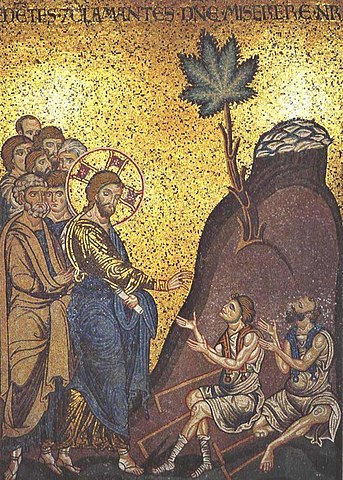
Jesus healing two blind men, 11th century mosaic, Sicily

As Jesus went on from there, two blind men followed him, calling out, “Have mercy on us, Son of David!”

When he had gone indoors, the blind men came to him, and he asked them, “Do you believe that I am able to do this?”

“Yes, Lord,” they replied.

Then he touched their eyes and said, “According to your faith let it be done to you”; and their sight was restored. Jesus warned them sternly, “See that no one knows about this.” But they went out and spread the news about him all over that region.

While they were going out, a man who was demon-possessed and could not talk was brought to Jesus. And when the demon was driven out, the man who had been mute spoke. The crowd was amazed and said, “Nothing like this has ever been seen in Israel.”

But the Pharisees said, “It is by the prince of demons that he drives out demons.” (New International Version)

Every day the news is a steady stream of disease, death, war, and outright human suffering. It’s as if the phrase, “slow news cycle,” is a thing of the past.

As we stare into the face of trouble, I find myself uttering the ancient prayer of the Church: “Lord have mercy.  Christ, have mercy.  Lord have mercy and grant us your peace.” 

We collectively feel the weight of the world’s suffering, experience the heaviness of concern for family and friends, and perhaps wonder how much more people can take.

It’s in the topsy-turvy times that I come back again and again to the deep spiritual convictions which inform what I do each day. One of those underlying creeds and affirmations is this:

Jesus is trustworthy, no matter whether my faith or the faith of others is small or great.

In our Gospel lesson for today, two blind men were healed according to their faith in Jesus. The diverse healing accounts of Jesus in the New Testament, whether the faith was large or small in those healed, leads me to the conclusion that:

It isn’t faith itself that heals, saves, or transforms – it is Jesus.

All the healing accounts in the New Testament Gospels have something in common: They all directly point to Jesus as the object of faith. 

It isn’t about the level or amount of faith, but about where the faith is placed. 

For the Christian, faith itself doesn’t mean much if it isn’t in Jesus.

If I place a large and sincere faith in an inanimate object such as money; in a position of power; or, even in my own independence, my faith isn’t worth much. 

If I have a huge faith in a doctor or a psychiatrist to heal my body or my mind, I will quickly discover there are limits to their abilities. 

If I have a confident faith that my family will meet all my needs, my faith will eventually run into failure when they let me down. That’s because the ultimate object of faith is Jesus. 

If all my faith eggs are in the church basket, my faith will eventually face a crisis because it is a misplaced faith.  Furthermore, the answer I provide for others is not simply getting them to attend church or to adopt my moral code.

There should be a consistency that runs through us all. For Jesus doesn’t change—yesterday, today, tomorrow, he’s always totally himself.

Hebrews 13:8, MSG

We know with certainty that circumstances change, as everyday seems to bring new levels and permutations of unprecedented alterations to our lives – and through it all, Jesus remains as the ever-present Savior, seated at the right hand of God ceaselessly interceding on behalf of those who offer even the slightest mustard seed of faith.

“For truly I tell you, if you have faith the size of a mustard seed, you will say to this mountain, ‘Move from here to there,’ and it will move, and nothing will be impossible for you.”

Jesus (Matthew 17:20-21, NRSV)

It says something about our modern Western society that whenever we hear the words of Jesus on faith that we interpret the mountain moving as an immediate event that happens almost instantaneous, like a snap of the finger. Yet, there is nothing in those words that says that. There is also nothing that says an individual necessarily does it.

The fact of the matter is this: Jesus heals, transforms, and delivers people from sickness, sin, trouble, and overwhelming circumstances in his own good time, not ours.

Just because we pray without ceasing for days, weeks, months, and even years for something doesn’t mean we lack faith if the prayer isn’t answered immediately. It could be that God wants others involved, maybe even across generations, for the impossible mountain to be moved.

It is misplaced faith which expects microwave results. Faith placed appropriately in Jesus as the object of belief discerns that faithful prayer is consistently prayed until there is an answer.

Healing and restoration will happen – just maybe not always how or when we think it will.

Almighty God, you know that we have no power in ourselves to help ourselves: Keep me both outwardly in my body and inwardly in my soul, that I may be defended from all adversities which may happen to the body, and from all evil thoughts which may assault and hurt the soul; through Jesus Christ our Lord, who lives and reigns with you and the Holy Spirit, one God, forever and ever. Amen.

1 Corinthians 2:1-11 – Relying on Spiritual Power

Brothers and sisters, when I came to you, I didn’t speak about God’s mystery  as if it were some kind of brilliant message or wisdom. While I was with you, I decided to deal with only one subject—Jesus Christ, who was crucified. When I came to you, I was weak. I was afraid and very nervous. I didn’t speak my message with persuasive intellectual arguments. I spoke my message with a show of spiritual power so that your faith would not be based on human wisdom but on God’s power.

However, we do use wisdom to speak to those who are mature. It is a wisdom that doesn’t belong to this world or to the rulers of this world who are in power today and gone tomorrow. We speak about the mystery of God’s wisdom. It is a wisdom that has been hidden, which God had planned for our glory before the world began. Not one of the rulers of this world has known it. If they had, they wouldn’t have crucified the Lord of glory. But as Scripture says:

“No eye has seen,
no ear has heard,
and no mind has imagined
the things that God has prepared
for those who love him.”

God has revealed those things to us by his Spirit. The Spirit searches everything, especially the deep things of God. After all, who knows everything about a person except that person’s own spirit? In the same way, no one has known everything about God except God’s Spirit. (God’s Word Translation)

We need the Holy Spirit of God.

Without the Spirit’s help, Jesus is just one guy out of thousands who were crucified in history – merely an example of someone martyred for his faith. Yet, Jesus was infinitely more. Christians discern Jesus as the Son of God and Savior of the world. 

Because of Christ’s life, death, resurrection and ascension, people can be redeemed from empty lives, saved from destructive life-patterns, and given the kind of security and purpose which God intended from the beginning. The Spirit’s role is to take these redemptive events of Jesus and apply them to our lives. 

Christian Trinitarian theology understands we are unable to see the truth about the cross of Jesus Christ unless God the Holy Spirit, sent by God the Father and the Son, breaks into our lives and does an intervention, showing us our denial about how we are really doing – as well as our delusions about who we really are.

Admitting we need the Holy Spirit of God means the power of Christianity and the Christian life rests with Jesus Christ and him crucified, and not with us.

We are, in many ways, powerless. I realize this is not a popular message, especially in Western society. Tell the average American they are powerless, and they’ll think you’re off your rocker. It sounds ridiculous. Some would argue that we have done quite well, thank you very much, on our own. We have a couple of cars, a house, a job, and a family. After all, we worked hard, and we did it.

However, any worldly success we gain, and getting the things we want, may lead us to the delusion we have the power to do whatever we want.

Oh, sure, we might reason, we have problems just like everybody else. After all, we cannot control everything.  But we are not completely powerless. Just because we have difficult circumstances and a few problem people in our lives doesn’t mean I am weak, right? God will step in a take-over where I leave off, right?…

Wrong. Apart from the Holy Spirit of God, we are unable to become Christians and live the Christian life.

If we believe we manage our lives fine, with some help from God, then we might be in denial about how much we place ourselves at the center of the world. Whenever our consistent response to adversity, or the realization we are not handling something well, is to try and fix ourselves, we are living the delusion we have the power to independently change.

A reflexive response in asking Google to find answers to our problems; or dealing privately with our personal issues; or expecting our willpower to be enough; or passively resigning ourselves to mediocre lives because we have tried to change or be different; then we are feeding the delusion we don’t really need the Holy Spirit of God. I just need more effort or information to overcome my problems, right?

Wrong. More won’t solve our issues. And when it doesn’t, we easily become discouraged. We might even chide ourselves for our inability to deal with problems.

Our real need is for the true power source of the Christian life. We need the Holy Spirit applying the work of Jesus Christ to our lives so that we can live a victorious life.

Unfortunately, it typically takes a tragedy or crisis to break our delusion of power – a bad marriage, a family member’s addiction, a runaway child, a terminal illness, a bankruptcy, a death.

How bad do you and I need to hurt before we will admit we are not managing our lives well, at all, and that the real power to change resides with the Holy Spirit?

There is power in the cross of Jesus Christ. The Apostle Paul believed this with all his heart. Although Paul was an intelligent and learned person, he did not rely on his abilities but on proclaiming the power of Jesus and him crucified.

The crucifixion of Christ was a past action with continuing and forceful ripples into the present time.

The cross of Jesus is more than an historical event; it is an ongoing reality to experience for victory over all the brokenness of this world and all the mess we have made of things putting ourselves at the center of the universe.

The Reformer, John Calvin, repeatedly instructed and encouraged his Geneva congregation that the Spirit joins us to Christ, assures us of salvation, and grows us in confidence through the Scriptures. Calvin, although a genius, did not rely on his intellect or abilities but insisted we need the Spirit’s witness to mature as followers of Jesus.

There are tough situations and incredibly sad realities which are mysteries beyond our comprehension. They defy simplistic answers and are greater than our attempts to explain them. Hard problems stretch our faith. And they ought to cause us to cry out to God and Christ’s Church for help because we are powerless to manage our lives.

We absolutely and totally need the Holy Spirit of God. Without the Spirit, we are lost. But with the Spirit we experience the saving power of Christ’s cross to deal with everything in our lives.

The Serenity Prayer: God grant me the serenity to accept the things I cannot change; courage to change the things I can; and wisdom to know the difference.  Living one day at a time; enjoying one moment at a time; accepting hardships as the pathway to peace; taking, as Jesus did, this sinful world as it is, not as I would have it; trusting that he will make all things right if I surrender to his will; that I may be reasonably happy in this life and supremely happy with him forever in the next. Amen.

Acts 2:1-21 – The Day of Pentecost

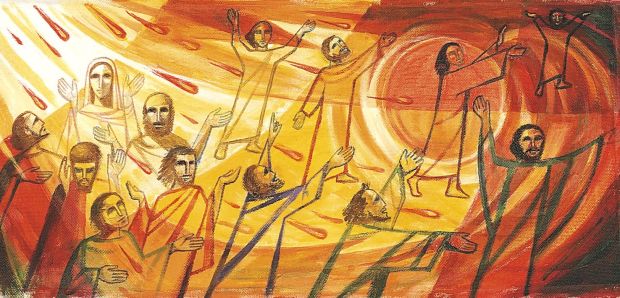
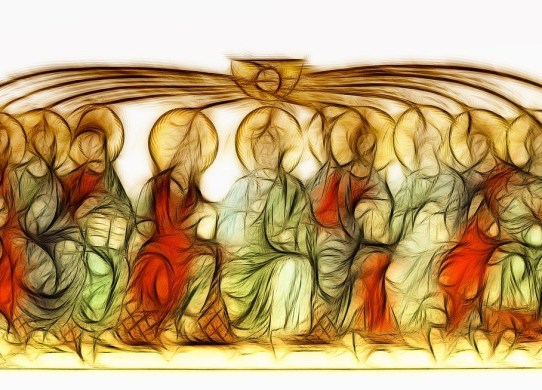
When Pentecost Day arrived, they were all together in one place. Suddenly a sound from heaven like the howling of a fierce wind filled the entire house where they were sitting. They saw what seemed to be individual flames of fire alighting on each one of them. They were all filled with the Holy Spirit and began to speak in other languages as the Spirit enabled them to speak.

There were pious Jews from every nation under heaven living in Jerusalem. When they heard this sound, a crowd gathered. They were mystified because everyone heard them speaking in their native languages. They were surprised and amazed, saying, “Look, aren’t all the people who are speaking Galileans, every one of them? How then can each of us hear them speaking in our native language? Parthians, Medes, and Elamites; as well as residents of Mesopotamia, Judea, and Cappadocia, Pontus and Asia, Phrygia and Pamphylia, Egypt and the regions of Libya bordering Cyrene; and visitors from Rome (both Jews and converts to Judaism), Cretans and Arabs—we hear them declaring the mighty works of God in our own languages!” They were all surprised and bewildered. Some asked each other, “What does this mean?” Others jeered at them, saying, “They’re full of new wine!”

Peter stood with the other eleven apostles. He raised his voice and declared, “Judeans and everyone living in Jerusalem! Know this! Listen carefully to my words! These people aren’t drunk, as you suspect; after all, it’s only nine o’clock in the morning! Rather, this is what was spoken through the prophet Joel:

In the last days, God says,
I will pour out my Spirit on all people.
    Your sons and daughters will prophesy.
    Your young will see visions.
    Your elders will dream dreams.
    Even upon my servants, men and women,
        I will pour out my Spirit in those days,
        and they will prophesy.
I will cause wonders to occur in the heavens above
    and signs on the earth below,
        blood and fire and a cloud of smoke.
The sun will be changed into darkness,
    and the moon will be changed into blood,
        before the great and spectacular day of the Lord comes.
And everyone who calls on the name of the Lord will be saved. (Common English Bible)

The Holy Spirit is the distinguishing mark of the believer in Jesus Christ.

Therefore, since the Spirit is given, the main responsibility of Christians is to receive. 

Christianity is distinctive in this sense – it is primarily a religion of receiving. The Christian life is lived by the power of the Holy Spirit, and not in our own strength. The function of faith is to receive what grace offers. 

We are saved and sanctified by grace alone through faith. God lives in and through us by means of the Spirit. The miraculous and the supernatural cannot, obviously, be done by any human person.  It can, however, be accomplished through the power of the Holy Spirit.

People tend to put a lot of pressure on themselves to be a certain way and to do certain things. The result? Tiredness. Discouragement. Imbalance. Lots of giving. Little receiving.

Christianity is not chiefly about giving but receiving. The Christian life is about putting oneself in a position to receive through prayer and humility. In Christianity, the opposite of receiving is not giving – it’s pride. 

Maybe this kind of talk makes you uncomfortable. I’m not talking about being passive or lazy. I’m highlighting the need of receiving grace from God by means of the Holy Spirit. Then, the Spirit to work in and through us. 

Jesus said we would do greater works than even he himself with the advent of the Spirit! (John 14:12-14)

The question then becomes: Will we let God be God? Will we allow the Spirit to do work in us?

The Spirit is elsewhere described in Holy Scripture as a gentle presence, an encourager, counselor, and comforter. Yet, not here at Pentecost – the Spirit is portrayed like a violent wind and an unusual fire.

The Holy Spirit on the Day of Pentecost was not some gentleman caller entering politely when invited. Instead, the Spirit appears more like a drunken sailor who bursts into the room and causes a big ruckus. There’s nothing subtle about the Spirit at Pentecost. The Spirit is electric, bombastic, and volcanic, causing a huge scene and upheaving the status quo.

Because of Pentecost, Christians are marked and defined by God’s Spirit living within them and being full of the Spirit. God wants to pour out the Spirit on all kinds of people to overflowing so that what comes out of them is “prophecy.” 

The prophet Joel and the Apostle Peter do not intend the word “prophecy” to mean predicting the future. Rather, they are referring to inspired speech coming from a heart overflowing with the Spirit. 

Just as an inebriated person says and does things they would not typically say or do because they are filled with alcohol, so the person filled with God’s Spirit says things and does things they would not typically say or do because their inspiration and courage come as a result of God within them.

Thus, we must cast off the unholy spirits of inebriation and receive the Holy Spirit of God.

Descent of the Holy Spirit at Pentecost mosaic by Anna Wyner

God sobered-up the little band of Christ followers from learners to practitioners, sending them into the world with a mission.

Being on a mission from God is not really about ability; it’s about being filled and sent. 

First time parents may read and learn all they can about parenting before their child is born. Yet, when that little bundle comes into the world, and the hospital puts this kid in your arms and sends you out, you feel inadequate for the task. Parenting becomes a kind of supernatural affair where you pray and learn on the fly, finding out that you need something beyond yourself to get anywhere in raising this screaming, pooping, sleeping person who depends completely on you for everything. 

God sends us into the world to make disciples. And we may feel very inadequate for the task. However, this has more to do with receiving the Spirit. The Spirit comes looking to turn our lives upside-down with new life in Jesus Christ. 

Pentecost means that the Spirit came to shake things up and accomplish among God’s people what they could never do on their own.

Everyone who calls on the name of the Lord will be saved. 

The Church in the New Testament was not a country club for people to simply enjoy the perks of membership.  The community of the redeemed, the Church, is actually more like a place where the people seem drunk because they are all talking with inspired speech from the Holy Spirit. 

Maybe we don’t need to be saved in the sense that we have already called on the name of the Lord concerning forgiveness in Christ. Yet, maybe we need to call on the name of the Lord to be delivered from our misguided attempts to see the Christian life as a pleasant affair.

Perhaps we need deliverance from disordered priorities and misguided loves. We may need to be saved from ourselves so that we are open to the Holy Spirit with palms up receiving from God whatever it is the Spirit wants to do in and through us, rather than telling God how we think things ought to go. 

Prayer, then, is more about receiving the Spirit and God’s purposes for us rather than giving God an earful and expecting the Lord to bless our plans.

Pentecost is the launching pad of the church’s mission – it was explosive because the Spirit is a kind of wild man who fills people up to overflowing so that what comes out of them is inspired speech and missional actions.

If a language barrier cannot stop the Spirit from operating, then how much more can God transform us and use us in the lives of those around us?

Joel’s prophecy, quoted by Peter, is only partially fulfilled. Events have been set in motion by Pentecost for the complete fulfillment of God’s justice. So, there’s some urgency for people to fill their vacuous souls with the grace freely offered to them in Christ.

The outpouring of the Spirit is a sign: The end is near. And the generous giving of the Spirit is inclusive – there is room for all kinds of people. Through the Spirit, God saves all who call on the name of the Lord.

Today is not just another day on the calendar. It is the Day of Pentecost! 

Just as marriages occasionally need a spark and a fire and a fresh wind, so we need the Holy Spirit to breathe on us, comfort us, and inspire us.

May we be filled with the Spirit as we anticipate what our God will do now, and in the years to come.

Spirit of the living God, through the reading and proclamation of the Word, may you refresh our spirits, reshape our desires, recreate our hearts, and reform our ways so that we will shine with your enduring glory, through Jesus Christ, our risen and ascended Lord. Amen.