Lord, Have Mercy (Mark 10:46-52)

“Christ Healing the Blind Man” by Robert Hodgell

Then they came to Jericho. As Jesus, his disciples, and many people were leaving Jericho, a blind beggar named Bartimaeus, son of Timaeus, was sitting by the road. When he heard that Jesus from Nazareth was passing by, he began to shout, “Jesus, Son of David, have mercy on me!”

The people told him to be quiet. But he shouted even louder, “Son of David, have mercy on me!”

Jesus stopped and said, “Call him!” They called the blind man and told him, “Cheer up! Get up! He’s calling you.” The blind man threw off his coat, jumped up, and went to Jesus.

Jesus asked him, “What do you want me to do for you?”

The blind man said, “Teacher, I want to see again.”

Jesus told him, “Go, your faith has made you well.”

At once he could see again, and he followed Jesus on the road. (God’s Word Translation)

“I’d like to live my life so close to the bottom that when the system collapses I don’t have far to fall.” Dorothy Day

This is one of my very favorite stories in the entirety of Holy Scripture. And I will tell you why….

Because Jesus listens with ears of mercy

Jesus was headed to Jerusalem and had a lot on his mind and his heart. He knew what was coming, that his passion and death awaited him. No one would fault Jesus for not hearing a blind man shouting. But Jesus was listening so that he might hear someone just like the needy blind man. Rather than being distracted and lost in his head, Jesus was just the opposite – being attentive and aware of the humble folk right in front of him.

The Lord is always and continually listening for honesty and vulnerability. His ears of mercy are specially tuned, even today, for those who cry out to him from a place of genuine openness and humility.

Because Jesus speaks with words of mercy

Once Jesus listened, he responded by asking a question. I am impressed with Jesus throughout the Gospels. Christ gave people the gift of choice. He acknowledged people and respected them by not simply and indiscriminately healing, as if he were some fix-it guy. Jesus Christ bestowed on the lowliest of people the human dignity of choice by empowering them to answer a question.

Whereas everyone around Bartimaeus was looking down on him, both literally and figuratively, Jesus granted him the gift of dignity and basic human kindness – which are gifts we can all bestow on one another.

Because Jesus pays attention with a divine appointment of mercy

Our Lord took the time to heal blind Bartimaeus. Jesus could have simply healed him without even stopping his journey. He could have just waved his hand and the man would be healed. What’s more, Jesus could have even started a healing factory where everyone with a need got healed: bring ‘em in, move ‘em out, and keep the line moving!

Jesus was doing more than giving sight; he was giving a man the blessing of time and personal attention. The Gospel is never impersonal, which is why we ought to resist being non-relational in ministry to others. Christian ministry isn’t simply about meeting a need; it’s about blessing other people with the gift of relationship.

Coptic Church icon of Christ healing the blind man

Because Jesus reaches out with the touch of mercy

Jesus touched the man’s eyes (included in Matthew 20:29-34). He didn’t have to do that. The Lord of all most certainly could have healed without touching. In fact, it most likely may have been downright gross. A lot of people had eye diseases with runny pussy eyes in the ancient world.

Because the blind man didn’t listen to the crowd

I really love that! Maybe it’s the rebel in me. I just believe it is such a beautiful thing whenever someone refuses to be shamed by another and embraces their need. That is exactly what the blind man did. He not only refused to give-in to peer pressure, but he also responded to them by shouting all the louder. May his tribe increase!

Blind Bartimaeus teaches us that, when we know Love is there, we can freely acknowledge our needs, our wants, and our pain. With Jesus, who is Love incarnate, it doesn’t matter what anyone else thinks around us; there is no pretense, no propping up a false self to present for others to see. The true self is able to express what is really on the inside.

Because the blind man could actually see

In truth, Bartimaeus already had sight – not physical sight but spiritual eyes which could see better than anyone else in the crowd. One of the great ironies throughout the Gospels is that the sighted crowd seems to never see who Jesus really is, while blind folk see Christ clearly for who he is: the Son of David, the rightful king, the Savior of all.

It matters not how much faith one possesses; but it very much matters in whom that faith is placed. A thimble-full of faith is enough to move mountains, whereas a water tower full of misplaced faith in someone else cannot even provide a single glass of refreshment.

Because the blind man followed Jesus

Throughout the healing ministry of Jesus, there were plenty of persons who simply walked away and went about their lives after receiving what they desired. Yet, Bartimaeus, now given the gift of physical sight, immediately started following Jesus on the road.

This account feels a lot like my own testimony of experiencing the love of God in Christ and not ever wanting to leave it. So, I’ve been following Jesus for over forty years, still profoundly grateful in my heart for the One who loves and heals.

Because one lowly non-descript blind man made a difference

I don’t think Bartimaeus ever set out to change the world. And yet, he did. Here we are reading his testimony all these millennia later. One person, becoming a simple follower of Jesus and living a life of discipleship, changes a crowd from being a group of shushing church ladies to a robust throng of worshipers.

One individual makes a difference. Don’t let anyone tell you otherwise.

Lord Jesus Christ, Son of God, have mercy on me, a sinner.

Lord Jesus Christ, Son of David, heal me, a broken person.

Lord Jesus Christ, Son of Man, help me, a lost and lonely individual.

Lord have mercy, Christ have mercy, Lord have mercy on my love-starved soul and grant me your peace.

Amen.

The Kingdom of God Is Here (Matthew 10:5-15)

Jesus sent his twelve harvest hands out with this charge:

“Don’t begin by traveling to some far-off place to convert unbelievers. And don’t try to be dramatic by tackling some public enemy. Go to the lost, confused people right here in the neighborhood. Tell them that the kingdom is here. Bring health to the sick. Raise the dead. Touch the untouchables. Kick out the demons. You have been treated generously, so live generously.

“Don’t think you have to put on a fund-raising campaign before you start. You don’t need a lot of equipment. You are the equipment, and all you need to keep that going is three meals a day. Travel light.

“When you enter a town or village, don’t insist on staying in a luxury inn. Get a modest place with some modest people and be content there until you leave.

“When you knock on a door, be courteous in your greeting. If they welcome you, be gentle in your conversation. If they don’t welcome you, quietly withdraw. Don’t make a scene. Shrug your shoulders and be on your way. You can be sure that on Judgment Day they’ll be mighty sorry—but it’s no concern of yours now. (The Message)

“People can’t observe the coming of God’s kingdom. They can’t say, ‘Here it is!’ or ‘There it is!’ You see, God’s kingdom is within  you.” Jesus, from Luke 17:20-21, GW

When Jesus told his followers that the kingdom of God is here, he didn’t simply mean that it all of a sudden showed up. No, it’s already here. It always has been. We just haven’t paid attention. And we haven’t noticed because we keep looking for a location, somewhere outside of ourselves. But, as it turns out, we already have what we’ve been searching for.

Christianity, at its core, is about following Christ. And that journey with Jesus is first and foremost a journey into oneself. This is why the Lord tells the disciples not to go first to outsiders. There’ll be a time for that. But now, the journey to their fellow Jews was to be an internal walk into the very depths of their own souls and the soul of a nation.

The singular message of this particular mission was to proclaim that the kingdom of God is near. It is here. In fact, it is so near and here that it is actually within you. But the disciples needed to discover this for themselves by going out and removing all obstacles to awareness of God’s light.

Jesus sent the disciples out and told them not to take anything with them because they already had what they needed. The kingdom of God is already within them.

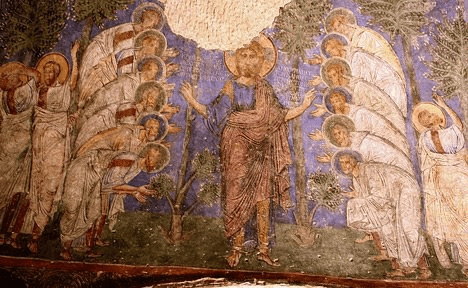
A Byzantine fresco of Jesus sending the disciples, 12th century

So, they were to leave all their baggage and their stuff behind. The disciples were to be stripped of all their trusted outer resources so that they had the ability to see themselves, to others, and human need – and then to be moved in their hearts with compassion, just as Jesus is. 

Whenever we take all our pre-packaged stuff with us into relationships and the doing of Christ’s mission, we already assume we know what other people need. If we have nothing with us, then we are able to see people for who they actually are; we can genuinely listen to what they are saying. 

You have freely received compassion from God, so freely give it away. Not everyone will respond, but that’s not your business; they will have to deal with God on that later.

Compassion is to be our response to human need. Yet, we don’t always respond with compassion because of the obstacles within our own hearts and lives prevent us from seeing others and their needs.

The following are a few of obstructions which hinder us from compassion and perceiving the kingdom of God within us, and how to deal with them:

  1. Contempt. Contempt breeds contempt. Unacknowledged and unresolved anger produces bitterness. Hatred feeds more hatred. Our environment makes a difference. For example, if you find you have to check your heart at the workplace in order to do your job, then you need to either you quit your, or bring forth the kingdom of God by tirelessly advocating for compassionate treatment of people.
  2. Busyness. I’m referring to an unhealthy pace of life. Many of us work too much and do too many things. We cannot have compassionate hearts by moving so fast that we fail to see other people’s needs. Slow down. No one is going to come to the end of their life and wished they had been workaholics. Make a thoughtful plan to slow down enough so you can tune into the needs of others and have emotional energy for them.
  3. Resentment. It’s possible to become coldhearted by excessive and unrelenting caregiving. This is the same sort of problem as an unhealthy pace of life; you give so much that you actually begin to resent the people you care for. Caregiving has to be meticulously balanced with self-care. There’s a time for everything, including rest and recuperation.
  4. Inaction. Only receiving and not giving is what I call “spiritual constipation.” It’s when a person listens to hundreds and thousands of sermons and podcasts but doesn’t listen to their neighbor. They have no intention of putting anything they hear into practice.

However, with nothing restricting or obstructing God’s kingdom within us, we can see the divine image within each person and within ourselves. We can begin to radiate that divine presence and be transformed by it’s inner light.

Like Jesus, transfigured before the disciples on Mount Tabor, we too, become transfigured by God’s energy of love touching our hidden divine energy as image-bearers. That energy now comes forth because we have left everything behind to follow Christ and experience the generosity which, ironically, only comes from having nothing.

This is a spiritual walk we cannot take alone. The road we travel is the way of community. Just as God is community – Father, Son, and Spirit – always in a unity of love, so we, as God’s image-bearers with the divine light within us, must strip ourselves of everything that hinders and the sin that so easily entangles and run with perseverance the race marked out for us.

We are to fix our eyes on Jesus and see him, the pioneer of our faith, the Light of the World, the Living Water, and Bread for the world, who endured all things for the redemption of humanity and all creation.

Almighty God, you sent your Son Jesus Christ to reconcile the world to yourself: We praise and bless you for those whom you have sent in the power of the Spirit to proclaim that the kingdom of God is near. We thank you that in all parts of the earth a community of love has been gathered together by their prayers and labors, and that in every place your servants call upon your Name; for the kingdom and the power and the glory are yours forever. Amen.

Give Thanks and Praise (Luke 17:11-19)

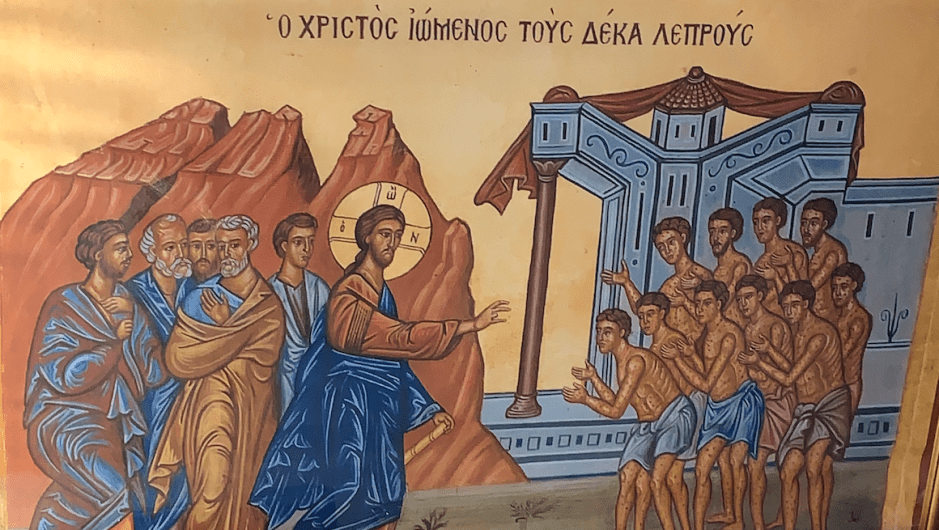
Eastern Orthodox depiction of Jesus Christ healing the ten lepers

Now on his way to Jerusalem, Jesus traveled along the border between Samaria and Galilee. As he was going into a village, ten men who had leprosy met him. They stood at a distance and called out in a loud voice, “Jesus, Master, have pity on us!”

When he saw them, he said, “Go, show yourselves to the priests.” And as they went, they were cleansed.

One of them, when he saw he was healed, came back, praising God in a loud voice. He threw himself at Jesus’ feet and thanked him—and he was a Samaritan.

 Jesus asked, “Were not all ten cleansed? Where are the other nine? Has no one returned to give praise to God except this foreigner?” Then he said to him, “Rise and go; your faith has made you well.” (New International Version)

Today’s Gospel story is both joyous and sad. The healing of ten lepers is astonishing and elicits praise and thanks… from only one. Maybe it’s because they stood at a distance. After all, it’s a close connection to God which causes praise and gratitude to arise within us – and not some appreciation from afar. Therefore, methinks we ought to consider what the nature of our own connection is. 

“Thanksgiving” to most Americans is Thanksgiving Day – a holiday filled with food, football, and family, the trifecta of American celebration. I myself admit to liberally indulging in all three. Although Thanksgiving has become a form of secular liturgical worship, I believe that underneath all the gravy, naps at halftime, and the occasional obnoxious relative, we know why we celebrate: To praise God and give thanks for our abundant blessings. 

It seems that even those who do not readily acknowledge the Divine intuitively know there is a power and source of blessing well beyond themselves which makes all good things occur.

Celebrations are a spiritual activity. God invented parties. When Israel was preparing for a new national life in the Promised Land, God told them to celebrate the Feast of Harvest with the first fruits of the crops (Exodus 23:16). The Levitical law prescribed how to go about giving thanksgiving offerings and offering praise (Leviticus 7:11-34).

Gratitude and praise was commanded, expected, and an important dimension of Old Testament worship. King David established a group of 288 full-time musicians to do nothing but praise and give thanks before God day and night (1 Chronicles 25).

Let us come into his presence with thanksgiving; let us make a joyful noise to him with songs of praise!

Psalm 95:2, NRSV

Enter his gates with thanksgiving
    and his courts with praise.
    Give thanks to him; bless his name.

For the Lord is good;
    his steadfast love endures forever
    and his faithfulness to all generations. (Psalm 100:4-5, NRSV)

It ought to have been reflexive for all ten lepers healed by Jesus to offer their worship to Jesus. A Samaritan, considered by many of the time as the lowliest of the low, a “half-breed,” was the lone person who came and fell at Christ’s feet with effusive praise and heartfelt gratitude. While the other nine went about their lives, free from disease and glad for it, only one guy took the time to thank Jesus and give glory to God. 

The Samaritan leper alone gives thanks to Christ, by Unknown artist

Sometimes we need to be reminded that celebration is a spiritual practice. It’s important to celebrate Jesus and for the ways God has provided and blessed us. In Holy Scripture, it is often the homeless, the sick, the lowly, and the outsiders who lead the way and demonstrate what genuine praise and honest thanksgiving looks like.

We, the Church, who belong to God and possess the Spirit, are to always remember and be mindful of what we truly have in Jesus Christ:

So then, just as you received Christ Jesus as Lord, continue to live your lives in him, rooted and built up in him, strengthened in the faith as you were taught, and overflowing with thankfulness. (Colossians 2:6-7, NIV)

We, like King David of old, are to establish continual worship of God:

Rejoice always, pray continually, give thanks in all circumstances; for this is God’s will for you in Christ Jesus.

1 Thessalonians 5:16-18, NIV

Our sacrifice as Christians is not with the blood of animals but with our lips and our lives:

Through Jesus, therefore, let us continually offer to God a sacrifice of praise—the fruit of lips that openly profess his name. (Hebrews 13:15, NIV)

And the worship service is eternal; it will never end:

And the twenty-four elders, who were seated on their thrones before God, fell on their faces and worshiped God, saying:

“We give thanks to you, Lord God Almighty,
    the One who is and who was,
because you have taken your great power
    and have begun to reign.” (Revelation 11:16-17, NIV)

Praising God and giving thanks to the Lord go together like mashed potatoes and gravy. Since God created everything, and since Jesus has brought healing to us through the cross, every juicy morsel of goodness we have is to be received with the full cognizance that God is behind it all.

Our lives need to be punctuated with times of celebration, praise, gratitude, and even blowout parties. Otherwise, we become dull, boring, lifeless, and bereft of Christ’s lifeblood coursing through our spiritual veins. A joyous and raucous group of healed believers jabbering incessantly with thanksgiving of God’s goodness are winsome and peculiar (in a good way and not in the strange way of your weird uncle who wants the turkey neck to gnaw on at the Thanksgiving meal).

Seems to me that Christians really ought to be at the forefront of having maximum fun because we are forgiven people; we know and experience the presence of God; our lives are hidden with God in Christ; we are confident and can approach the throne of God with boldness; and we possess the power of the Spirit and the shepherding ministry of Jesus.

Remember to give thanks. Plan to praise – out loud and with others – for the God who stands behind every good gift of creation. Let thanksgiving (not complaint) shape your life. Be the person who comes back to Jesus and offers praise and gratitude – and see how such gratefulness and glory can change the world.

Gracious God, Father of all mercies, we your unworthy servants give you humble thanks for all your goodness and steadfast love to us and to all whom you have made. We bless you for our creation, preservation, and all the blessings of this life; but above all praise you for your immeasurable love in the redemption of the world by our Lord Jesus Christ; for the means of grace, and for the hope of glory.

Give us such an awareness of your mercies, that with truly thankful hearts we may show forth your praise, not only with our lips, but in our lives, by giving up ourselves to your service, and by walking before you in holiness and righteousness all the days of our lives, through Jesus Christ our Lord, who with you and the Holy Spirit, be honor and glory throughout all ages and forevermore. Hallelujah! Amen!

Jesus: Introvert or Extrovert? (Luke 5:12-16)

A 4th century mural of Jesus from the Catacomb of Commodilla, Rome, Italy

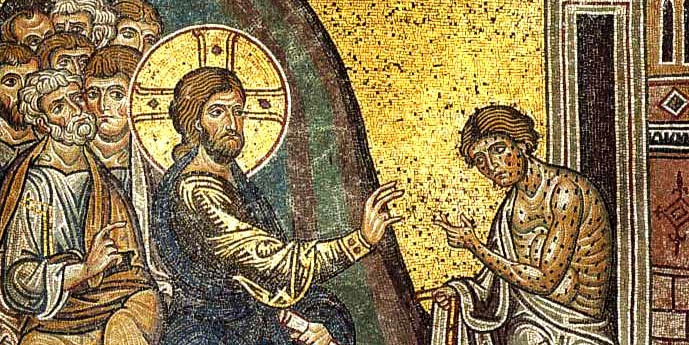
While Jesus was in one of the towns, a man came along who was covered with leprosy. When he saw Jesus, he fell with his face to the ground and begged him, “Lord, if you are willing, you can make me clean.”

Jesus reached out his hand and touched the man. “I am willing,” he said. “Be clean!” And immediately the leprosy left him.

Then Jesus ordered him, “Don’t tell anyone, but go, show yourself to the priest and offer the sacrifices that Moses commanded for your cleansing, as a testimony to them.”

Yet the news about him spread all the more, so that crowds of people came to hear him and to be healed of their sicknesses. But Jesus often withdrew to lonely places and prayed. (New International Version)

Occasionally, I ask fellow clergy colleagues this question: “Was Jesus an introvert, or an extrovert?”

Let me be clear that extroversion and introversion are neither sinful nor blessed – they both are personality traits that cannot be changed any more than tiger stripes. That’s important to state upfront because some clergy make it about personal choices instead of inherent brain wiring.

So, setting aside the anti-reality kooky answers to my question, I’ve found that extroverted pastors, almost without fail, tell me Jesus was an extrovert. And they make a solid case for it. 

Conversely, with solid consistency, introverted pastors tell me Jesus was an introvert. And they give compelling reasons for it, as well. 

I believe the answer to my own question is that both are correct. Jesus, as the perfect human, displays the best of both extroversion and introversion. And Christ’s personality comes through wonderfully in today’s Gospel lesson.

This short story of healing begins with Jesus fully engaged in walking the city, a man of the people, interacting with the crowd, attentive to even the most marginal of them. Christ’s extroverted nature is on full display. Jesus, as the superb Son of God, is willing and ready; he fully heals the man from his leprosy. 

Jesus healing the leper, 12th century mosaic, Monreale Cathedral, Sicily, Italy

As the news of this people-centered Healer spread, more and more people flock to Jesus. An extroverted person would bask in the situation of having more people to connect with. 

However, the story ends with the note that, instead of engaging the mass of people and gaining energy from the crowd, Jesus would withdraw to quiet and deserted places in order to pray. I can think of no better description of an introvert that could be said.

Jesus lived on this earth in a way that modeled and demonstrated how humanity was truly meant to live. 

Christ had consistent rhythms of both human and divine engagement. He spent time with people – lots of them. The Lord talked and taught, healed and moved, from one person to next with all the seeming random activity of the extrovert. 

Yet, the Lord Jesus also consistently withdrew from all the people to be in solitude. He spent healthy amounts of extended time alone with his heavenly Father, deeply connected with him. 

We, too, need good healthy rhythms of being with others in effective and prolonged interaction, as well as extended time alone with God in silence and solitude.

Extroverts must understand that nowhere in Holy Scripture will you find that we have been called by God to be talkers. But instead, you will find a lot of biblical references on being called to servanthood. The Lord does not accept us because of our many words; God approves of us because of divine grace and the state of our hearts. 

My children, we should love people not only with words and talk, but by our actions and true caring. (1 John 3:18, NCV)

Too much talk leads to sin. Be sensible and keep your mouth shut. (Proverbs 10:19, NLT)

And introverts need to appreciate that the spoken word, not just the written word, is important and powerful. The world was created through divine speech. Jesus healed with words that people heard. And conversations with others are the effective means of restoring this fallen planet to Paradise.

By speaking the truth with love, let’s grow in every way into Christ. (Ephesians 4:15, CEB)

Encourage each other every day while you have the opportunity. If you do this, none of you will be deceived by sin and become stubborn. (Hebrews 3:13, GW)

Perhaps we might encounter more of the miraculous in our lives if we emulated the healthy rhythms of Jesus. The Spirit works in us and through us so that the words and ways of Jesus on this earth may impact a mass of humanity that desperately needs Christ’s healing from a heart that is deeply connected to God.

Loving Lord Jesus, I am in awe of your capacity to engage all kinds of people, as well as your close relationship to the heavenly Father. Let me be like you in the ability to move freely and effectively between human interaction and divine prayer so that the church is edified, and the world is blessed. Amen.