Give Thanks and Praise (Luke 17:11-19)

Eastern Orthodox depiction of Jesus Christ healing the ten lepers

Now on his way to Jerusalem, Jesus traveled along the border between Samaria and Galilee. As he was going into a village, ten men who had leprosy met him. They stood at a distance and called out in a loud voice, “Jesus, Master, have pity on us!”

When he saw them, he said, “Go, show yourselves to the priests.” And as they went, they were cleansed.

One of them, when he saw he was healed, came back, praising God in a loud voice. He threw himself at Jesus’ feet and thanked him—and he was a Samaritan.

 Jesus asked, “Were not all ten cleansed? Where are the other nine? Has no one returned to give praise to God except this foreigner?” Then he said to him, “Rise and go; your faith has made you well.” (New International Version)

Today’s Gospel story is both joyous and sad. The healing of ten lepers is astonishing and elicits praise and thanks… from only one. Maybe it’s because they stood at a distance. After all, it’s a close connection to God which causes praise and gratitude to arise within us – and not some appreciation from afar. Therefore, methinks we ought to consider what the nature of our own connection is. 

“Thanksgiving” to most Americans is Thanksgiving Day – a holiday filled with food, football, and family, the trifecta of American celebration. I myself admit to liberally indulging in all three. Although Thanksgiving has become a form of secular liturgical worship, I believe that underneath all the gravy, naps at halftime, and the occasional obnoxious relative, we know why we celebrate: To praise God and give thanks for our abundant blessings. 

It seems that even those who do not readily acknowledge the Divine intuitively know there is a power and source of blessing well beyond themselves which makes all good things occur.

Celebrations are a spiritual activity. God invented parties. When Israel was preparing for a new national life in the Promised Land, God told them to celebrate the Feast of Harvest with the first fruits of the crops (Exodus 23:16). The Levitical law prescribed how to go about giving thanksgiving offerings and offering praise (Leviticus 7:11-34).

Gratitude and praise was commanded, expected, and an important dimension of Old Testament worship. King David established a group of 288 full-time musicians to do nothing but praise and give thanks before God day and night (1 Chronicles 25).

Let us come into his presence with thanksgiving; let us make a joyful noise to him with songs of praise!

Psalm 95:2, NRSV

Enter his gates with thanksgiving
    and his courts with praise.
    Give thanks to him; bless his name.

For the Lord is good;
    his steadfast love endures forever
    and his faithfulness to all generations. (Psalm 100:4-5, NRSV)

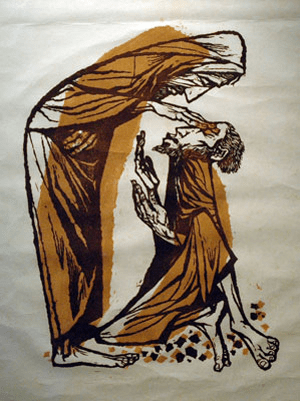
It ought to have been reflexive for all ten lepers healed by Jesus to offer their worship to Jesus. A Samaritan, considered by many of the time as the lowliest of the low, a “half-breed,” was the lone person who came and fell at Christ’s feet with effusive praise and heartfelt gratitude. While the other nine went about their lives, free from disease and glad for it, only one guy took the time to thank Jesus and give glory to God. 

The Samaritan leper alone gives thanks to Christ, by Unknown artist

Sometimes we need to be reminded that celebration is a spiritual practice. It’s important to celebrate Jesus and for the ways God has provided and blessed us. In Holy Scripture, it is often the homeless, the sick, the lowly, and the outsiders who lead the way and demonstrate what genuine praise and honest thanksgiving looks like.

We, the Church, who belong to God and possess the Spirit, are to always remember and be mindful of what we truly have in Jesus Christ:

So then, just as you received Christ Jesus as Lord, continue to live your lives in him, rooted and built up in him, strengthened in the faith as you were taught, and overflowing with thankfulness. (Colossians 2:6-7, NIV)

We, like King David of old, are to establish continual worship of God:

Rejoice always, pray continually, give thanks in all circumstances; for this is God’s will for you in Christ Jesus.

1 Thessalonians 5:16-18, NIV

Our sacrifice as Christians is not with the blood of animals but with our lips and our lives:

Through Jesus, therefore, let us continually offer to God a sacrifice of praise—the fruit of lips that openly profess his name. (Hebrews 13:15, NIV)

And the worship service is eternal; it will never end:

And the twenty-four elders, who were seated on their thrones before God, fell on their faces and worshiped God, saying:

“We give thanks to you, Lord God Almighty,
    the One who is and who was,
because you have taken your great power
    and have begun to reign.” (Revelation 11:16-17, NIV)

Praising God and giving thanks to the Lord go together like mashed potatoes and gravy. Since God created everything, and since Jesus has brought healing to us through the cross, every juicy morsel of goodness we have is to be received with the full cognizance that God is behind it all.

Our lives need to be punctuated with times of celebration, praise, gratitude, and even blowout parties. Otherwise, we become dull, boring, lifeless, and bereft of Christ’s lifeblood coursing through our spiritual veins. A joyous and raucous group of healed believers jabbering incessantly with thanksgiving of God’s goodness are winsome and peculiar (in a good way and not in the strange way of your weird uncle who wants the turkey neck to gnaw on at the Thanksgiving meal).

Seems to me that Christians really ought to be at the forefront of having maximum fun because we are forgiven people; we know and experience the presence of God; our lives are hidden with God in Christ; we are confident and can approach the throne of God with boldness; and we possess the power of the Spirit and the shepherding ministry of Jesus.

Remember to give thanks. Plan to praise – out loud and with others – for the God who stands behind every good gift of creation. Let thanksgiving (not complaint) shape your life. Be the person who comes back to Jesus and offers praise and gratitude – and see how such gratefulness and glory can change the world.

Gracious God, Father of all mercies, we your unworthy servants give you humble thanks for all your goodness and steadfast love to us and to all whom you have made. We bless you for our creation, preservation, and all the blessings of this life; but above all praise you for your immeasurable love in the redemption of the world by our Lord Jesus Christ; for the means of grace, and for the hope of glory.

Give us such an awareness of your mercies, that with truly thankful hearts we may show forth your praise, not only with our lips, but in our lives, by giving up ourselves to your service, and by walking before you in holiness and righteousness all the days of our lives, through Jesus Christ our Lord, who with you and the Holy Spirit, be honor and glory throughout all ages and forevermore. Hallelujah! Amen!

Jesus: Introvert or Extrovert? (Luke 5:12-16)

A 4th century mural of Jesus from the Catacomb of Commodilla, Rome, Italy

While Jesus was in one of the towns, a man came along who was covered with leprosy. When he saw Jesus, he fell with his face to the ground and begged him, “Lord, if you are willing, you can make me clean.”

Jesus reached out his hand and touched the man. “I am willing,” he said. “Be clean!” And immediately the leprosy left him.

Then Jesus ordered him, “Don’t tell anyone, but go, show yourself to the priest and offer the sacrifices that Moses commanded for your cleansing, as a testimony to them.”

Yet the news about him spread all the more, so that crowds of people came to hear him and to be healed of their sicknesses. But Jesus often withdrew to lonely places and prayed. (New International Version)

Occasionally, I ask fellow clergy colleagues this question: “Was Jesus an introvert, or an extrovert?”

Let me be clear that extroversion and introversion are neither sinful nor blessed – they both are personality traits that cannot be changed any more than tiger stripes. That’s important to state upfront because some clergy make it about personal choices instead of inherent brain wiring.

So, setting aside the anti-reality kooky answers to my question, I’ve found that extroverted pastors, almost without fail, tell me Jesus was an extrovert. And they make a solid case for it. 

Conversely, with solid consistency, introverted pastors tell me Jesus was an introvert. And they give compelling reasons for it, as well. 

I believe the answer to my own question is that both are correct. Jesus, as the perfect human, displays the best of both extroversion and introversion. And Christ’s personality comes through wonderfully in today’s Gospel lesson.

This short story of healing begins with Jesus fully engaged in walking the city, a man of the people, interacting with the crowd, attentive to even the most marginal of them. Christ’s extroverted nature is on full display. Jesus, as the superb Son of God, is willing and ready; he fully heals the man from his leprosy. 

Jesus healing the leper, 12th century mosaic, Monreale Cathedral, Sicily, Italy

As the news of this people-centered Healer spread, more and more people flock to Jesus. An extroverted person would bask in the situation of having more people to connect with. 

However, the story ends with the note that, instead of engaging the mass of people and gaining energy from the crowd, Jesus would withdraw to quiet and deserted places in order to pray. I can think of no better description of an introvert that could be said.

Jesus lived on this earth in a way that modeled and demonstrated how humanity was truly meant to live. 

Christ had consistent rhythms of both human and divine engagement. He spent time with people – lots of them. The Lord talked and taught, healed and moved, from one person to next with all the seeming random activity of the extrovert. 

Yet, the Lord Jesus also consistently withdrew from all the people to be in solitude. He spent healthy amounts of extended time alone with his heavenly Father, deeply connected with him. 

We, too, need good healthy rhythms of being with others in effective and prolonged interaction, as well as extended time alone with God in silence and solitude.

Extroverts must understand that nowhere in Holy Scripture will you find that we have been called by God to be talkers. But instead, you will find a lot of biblical references on being called to servanthood. The Lord does not accept us because of our many words; God approves of us because of divine grace and the state of our hearts. 

My children, we should love people not only with words and talk, but by our actions and true caring. (1 John 3:18, NCV)

Too much talk leads to sin. Be sensible and keep your mouth shut. (Proverbs 10:19, NLT)

And introverts need to appreciate that the spoken word, not just the written word, is important and powerful. The world was created through divine speech. Jesus healed with words that people heard. And conversations with others are the effective means of restoring this fallen planet to Paradise.

By speaking the truth with love, let’s grow in every way into Christ. (Ephesians 4:15, CEB)

Encourage each other every day while you have the opportunity. If you do this, none of you will be deceived by sin and become stubborn. (Hebrews 3:13, GW)

Perhaps we might encounter more of the miraculous in our lives if we emulated the healthy rhythms of Jesus. The Spirit works in us and through us so that the words and ways of Jesus on this earth may impact a mass of humanity that desperately needs Christ’s healing from a heart that is deeply connected to God.

Loving Lord Jesus, I am in awe of your capacity to engage all kinds of people, as well as your close relationship to the heavenly Father. Let me be like you in the ability to move freely and effectively between human interaction and divine prayer so that the church is edified, and the world is blessed. Amen.

Less Is More (Luke 17:5-10)

The apostles said to the Lord, “Increase our faith!”

He replied, “If you have faith as small as a mustard seed, you can say to this mulberry tree, ‘Be uprooted and planted in the sea,’ and it will obey you.

“Suppose one of you has a servant plowing or looking after the sheep. Will he say to the servant when he comes in from the field, ‘Come along now and sit down to eat’? Won’t he rather say, ‘Prepare my supper, get yourself ready and wait on me while I eat and drink; after that you may eat and drink’? Will he thank the servant because he did what he was told to do? So, you also, when you have done everything you were told to do, should say, ‘We are unworthy servants; we have only done our duty.’” (New International Version)

You and I do not need control. Authority and power belong to God. And we are not God.

You and I need faith. And, since we belong to God, who is the ultimate authority and controls all things, we already have it.

You already have what you need: Jesus. There is no need to hustle and cajole for something you do not need.

Jesus tells his disciples two parables designed to reorient their thinking and their lives around God, and not around the typical worldly tools of power and authority.

We find self-control something very hard. We’d rather have plain old control.

In the 1990s, The Department of Transportation set aside $200 million dollars for research and testing of an automated Highway System. The plan was that this system would relieve traffic problems by placing all cars that entered the highway on “super cruise control,” allowing them to move in unison as they traveled in heavily congested cities.  

Such travel would be made possible by using special magnets embedded in the asphalt every four feet, which would transfer signals between the vehicles and a main computer system.  

Steering, acceleration and braking would be controlled by sensors, computer navigation systems and cameras along the side of the road. Control would be returned to drivers as they exited the highway.  According to the technology manager of the project, “The only thing we can’t do yet is get people to comfortably trust the system. It’s not a technology issue.”

The grace of God in Jesus Christ is our fail-safe system designed to put us in “super cruise control” when dealing with circumstances and relating to people. There is just one difficulty with the system: Getting people to comfortably trust it.

The real problem is that we prefer to retain control of life’s steering wheel, even though it is this tendency that drives us to discontentment and endless relational conflict. Rather than insisting on doing life our way, we need Jesus to take the wheel.

And the irony to all this is that we already have what we so desperately seek.

Just a little bit of Jesus makes a large impact on the world.

            Our Lord’s entire kingdom movement looked as insignificant as a mustard seed. Christ’s little band of disciples were, at best, a motley crew of very human characters who vacillated between faith and doubt; they spent as much time arguing amongst themselves as they did engaging in ministry. Yet, it was these same people who ended up turning the world upside-down.

            The insignificant and small looking mustard seed eventually becomes a world-sheltering tree. In the same way, a barbaric, bloody, seemingly insignificant cross became the means of changing the world.

            We, even though imperfect and small, can become, with Jesus in us, a healing force for the world. Little is much when God is in it. Although Gideon believed he needed to be in charge of a large army to defeat Israel’s enemies, God whittled his soldiers down to just 300, against a force described as an army with men as many as the sand on the seashore. Victory was no problem. Gideon already had what he needed: God. (Judges 7:1-25)

Never underestimate the potency of our little bit of ministry with Jesus animating it. Our…

Kind words spoken in the name of Jesus…

Hidden prayers uttered silently behind closed doors…

Secret giving in which the right hand doesn’t know what the left is doing…

Gentleness in the face of violence…

Humility in the midst of pride…

Mercy given instead of judgment…

Peacemaking wherever frustration exists…

These and so much more, when energized by Jesus, becomes a mighty force for good and change in this old fallen world.

Yet so many Christians think they need all kinds of power, authority, and control – then mountains can be moved, trees uprooted, and things can happen.

With this misguided notion, we too easily succumb to the temptations of winning success, spinning a superior self-image, and pinning down power to get what we want and need.

However, we already have what we need, Jesus, and we do not need what he has – power and authority; we just need him.

The Lord Jesus has shown us the way in this. In Christ’s incarnation, he emptied himself and became like one of us – eschewing the typical power dynamics of the world. At the beginning of his ministry, Jesus spends 40 days in the desert fasting – making himself empty.

And at the end of that time, the devil came to Christ and tempted him in the very same ways we are tempted (Matthew 4:1-11):

Satan: “You need to be successful.”

Jesus: “Nope, don’t need that.”

Satan: “Well, you definitely need to be on the right religious track.”

Jesus: “Get out of my face. I don’t need to play that game.”

Satan: “It’s simple. You can do your Father’s will with the tools of power I have.”

Jesus: “I’m not going there. I don’t need your sort of help.”

In submitting to his Father’s plan and will, Jesus showed us the way to live as his followers.

We, too, have to stare the same three temptations in the eye: the belief that I need to be successful, to be right, and to have everything under control.

The truth, however, is just the opposite. In actuality, we need to be poor in spirit, powerless,  and humble – not full of strength and control.

Jesus said, “My grace is sufficient for you, for my power is made perfect in weakness.” And Paul responded, “Therefore, I will boast all the more gladly about my weaknesses, so that Christ’s power may rest on me. That is why, for Christ’s sake, I delight in weaknesses, in insults, in hardships, in persecutions, in difficulties. For when I am weak, then I am strong.” (2 Corinthians 12:9-10, NIV)

In reality, we need to be open and vulnerable – not spinning a self-image which projects strength, authority, and power.

 In your relationships with one another, have the same mindset as Christ Jesus:

Who, being in very nature God,
    did not consider equality with God something to be used to his own advantage;
rather, he made himself nothing
    by taking the very nature of a servant,
    being made in human likeness.
And being found in appearance as a man,
    he humbled himself
    by becoming obedient to death—
        even death on a cross! (Philippians 2:5-8, NIV)

We need to be meek and gentle – just like our Lord – not puffing our chests out with a show of strength and authority.

Jesus said, “Come to me, all you who are weary and burdened, and I will give you rest.Take my yoke upon you and learn from me, for I am gentle and humble in heart, and you will find rest for your souls. For my yoke is easy and my burden is light.” (Matthew 11:28-30, NIV)

Less is truly more. Only those who have nothing to prove and nothing to protect can receive Christ. And Jesus himself will lead us on this path of self-emptying.

We already have Jesus. Therefore, we already have everything we need. Even a smidgeon of Christ is more than enough for us. What we may think we need – to win at success, to spin a narrative of rightness, and to pin down control through power and authority – amounts to nothing in the kingdom of God.

Instead, what we really need is to walk in the way of Jesus – to be weak through self-emptying, to leak out our pride and embrace humility and vulnerability, and to be meek by having a gentle spirit.

Being a servant is a good thing. And being a servant of the Lord Jesus Christ – the author and perfecter of our faith – is the only vocation we need. With Jesus, less is more.

Almighty and everlasting God, we are far too often influenced by what others think of us. We pretend to be in control, with it, in charge, and strong. Prevent us from trying to attract attention. Don’t let us gloat over praise on one hand or be discouraged by criticism on the other. Nor let us waste time weaving imaginary situations in which the most heroic, put together, and powerful person present is me. Rather, show us how to be humble of heart, just like your Son, our Lord, Jesus Christ, who with you and the Holy Spirit are one God, now and forever. Amen.

How, Then, Shall We Live? (Luke 16:19-31)

The Rich Man and the Poor Man by Laura Jeanne Grimes, 2005

“There was a rich man who was dressed in purple and fine linen and lived in luxury every day. At his gate was laid a beggar named Lazarus, covered with sores and longing to eat what fell from the rich man’s table. Even the dogs came and licked his sores.

 “The time came when the beggar died, and the angels carried him to Abraham’s side. The rich man also died and was buried.In Hades, where he was in torment, he looked up and saw Abraham far away, with Lazarus by his side. So, he called to him, ‘Father Abraham, have pity on me and send Lazarus to dip the tip of his finger in water and cool my tongue, because I am in agony in this fire.’

 “But Abraham replied, ‘Son, remember that in your lifetime you received your good things, while Lazarus received bad things, but now he is comforted here, and you are in agony. And besides all this, between us and you a great chasm has been set in place, so that those who want to go from here to you cannot, nor can anyone cross over from there to us.’

 “He answered, ‘Then I beg you, father, send Lazarus to my family, for I have five brothers. Let him warn them, so that they will not also come to this place of torment.’

 “Abraham replied, ‘They have Moses and the Prophets; let them listen to them.’

 “‘No, Father Abraham,’ he said, ‘but if someone from the dead goes to them, they will repent.’

 “He said to him, ‘If they do not listen to Moses and the Prophets, they will not be convinced even if someone rises from the dead.’” (New International Version)

Many people look for a miracle at some point in life, especially for family. Whenever we see relatives walking far from God or siblings living without much thought to the words and ways of Jesus, it can be disconcerting. We may reason that if they could just experience or see some great miracle, then they will surely believe and embrace Jesus as Savior and Lord. 

Yet, Christ’s parable to us of the rich man and Lazarus graphically depicts an important message: God has already revealed divinity to humanity through Moses and the Prophets (the Old Testament). 

If people are not convinced by what already exists and what has existed for a long time, they likely will not respond when the miraculous slaps them in the face.

Maybe we too often look for the dramatic because the mundane typically rules the day. Perhaps what we are really looking for is already present in God’s revelation to us. It could be that the greatest task we have is not to beg for a miracle (even though there is nothing wrong with that!) but first to be quiet and listen to the Spirit of God speak through the Word of God so that our prayers to God arise in God’s way and God’s time.

Today’s Gospel story gets at the heart of where we immediately and reflexively turn when in dire straits. There is nothing wrong with turning to others, consulting trusted resources, or even Google. Yet, Holy Scripture is timeless. It contains everything we need for life and godliness in this present age. And I believe it has the answers to life’s most pressing questions.

Everyone has their trusted sources, as well as sources we don’t trust. If a person has a pattern of not consulting or investigating Holy Scripture, then it doesn’t matter who encourages them, even if it is a trusted person who shows up from the grave, to look into the Bible’s contents and believe it’s message.

If we look closely at the story, we are told the poor man’s name: Lazarus. And we are not told the rich man’s name. You see, the poor man, Lazarus, had his name written in the Book of Life. The rich man’s name cannot be spoken because it is not found there.

There are two choices in life, two opposing paths we can take. One is to choose pleasure and overlook the great needs of the earth. Like old Jacob Marley in the Christmas Carol, it is to forge a chain, link by link, day after day, which will eventually leave one in bondage and regret.

The other choice is hope. To look ahead by faith and see the eternal things which are coming, then shaping our existence to act in sync with permanent values, is to choose life. Although this may bring deprivation, even suffering, in this present existence, the decision to forego temporary pleasure for eternal glory shall be rewarded. It is to live for future prosperity through present affliction.

So, how shall we then live?

  • Will we anchor our souls in the good bosom of bettering our fellow humanity?
  • Is there an acknowledgment that the measure we give to others shall eventually be given to us?
  • Do we seek to hold faith with a neighbor in their poverty?
  • Are we trusting so much in our five senses – sight, smell, taste, hearing, touch – that we either cannot or will not trust in the sixth sense of the spirit which tells us to believe Moses and the prophets?

Christ has risen. Christ is coming again. If we align our lives with spiritual truth, we shall find our names written in the Book of Life. Let us actively look for Lazarus in our lives, so that we don’t carelessly step over him day after day while selfishly indulging in the good things of this life.

Mighty God, you have done miraculous things. Help me see what you have already done and teach me to listen so that your revelation becomes alive to me. Holy Spirit, impress the redemptive event of Christ’s resurrection on the hearts of all who do not know you so that they might know your amazing grace. Amen.