The Sheep Need Boundaries (Jeremiah 23:1-8)

“What sorrow awaits the leaders of my people—the shepherds of my sheep—for they have destroyed and scattered the very ones they were expected to care for,” says the Lord.

Therefore, this is what the Lord, the God of Israel, says to these shepherds: “Instead of caring for my flock and leading them to safety, you have deserted them and driven them to destruction. Now I will pour out judgment on you for the evil you have done to them. But I will gather together the remnant of my flock from the countries where I have driven them. I will bring them back to their own sheepfold, and they will be fruitful and increase in number. Then I will appoint responsible shepherds who will care for them, and they will never be afraid again. Not a single one will be lost or missing. I, the Lord, have spoken!

“For the time is coming,”
    says the Lord,
“when I will raise up a righteous descendant
    from King David’s line.
He will be a King who rules with wisdom.
    He will do what is just and right throughout the land.
And this will be his name:
    ‘The Lord Is Our Righteousness.’
In that day Judah will be saved,
    and Israel will live in safety.

“In that day,” says the Lord, “when people are taking an oath, they will no longer say, ‘As surely as the Lord lives, who rescued the people of Israel from the land of Egypt.’ Instead, they will say, ‘As surely as the Lord lives, who brought the people of Israel back to their own land from the land of the north and from all the countries to which he had exiled them.’ Then they will live in their own land.” (New Living Translation)

All of the Old Testament prophets have something to say on the subject of caring for the flock, that is, on the religious leaders of the people and their sacred responsibility to spiritually meet the needs of others.

God cares for each and every sheep (person) and will do whatever it takes to ensure the flock has everything they need for life and godliness.

So, the Lord’s ire is raised whenever shepherd-leaders don’t do their proper job and fail to live into their vocation of responsibly caring for the flock by watching over it and providing for them.

One of the modern forms this takes is expecting worshipers to serve the institution, rather than the institution existing to serve the worshiper. The telltale signs of institutional centrality in the Church (instead of Christo-centric religion) is continually pursuing the priorities of attendance, money, and the church building.

To put it more crassly, some churches seem to only care about buildings, budgets, and butts in the pew. This makes the people the burden-bearers of supporting the system, rather than the system of leaders supporting the people.

“You get what you tolerate.”

Henry Cloud

Admittedly, I just painted a picture with a broad stroke; furthermore, there is nothing inherently wrong with institutional religion (after all, I’m part of the established religion scene). It’s just that shepherds need to be continually vigilant about focusing their pastoral goals and efforts in ways which spiritually care for the common good of all the flock.

A major reason why there is so much fear and anxiety amongst believers is twofold:

  1. Spiritual leaders have too much power and responsibility over too many things, and so, less time and effort is put into pastoral care and compassionately ministering to the flock of God
  2. Churches give spiritual leaders too much power and responsibility, having unreasonable expectations for pastors
  3. Believers aplenty have given up on church

You might conclude (wrongly) that institutional forms of religion, such as churches, just need to be avoided. However, none of us can completely avoid systemic sin because it resides everywhere. Instead, we need to clarify what we will tolerate and not tolerate.

Abusive situations occur when there are no fences to keep everyone safe, secure, and well-fed. It’s important to have boundaries in place for the life and health of everyone.

What are “boundaries?”

Boundaries define who we are. A boundary shows me where I end and someone else begins, leading me to a sense of ownership. Knowing what I am to take and not take responsibility for gives me freedom.

No is a complete sentence.”

Anne Lamott

Why is it important to set boundaries?

  • Boundaries help us keep the good in and the bad out. Setting boundaries involves taking responsibility for your choices. You are the one who makes them, and the one who must live with their consequences.
  • Boundaries help protect us from “gaslighting.” Gaslighting is a form of emotional abuse in which one person manipulates another into doubting their thoughts, feelings, judgments, perceptions, and/or memories. Gaslighting convinces someone to accept the gaslighter’s version of reality at the expense of their own.
  • Boundaries hold people accountable for their words and actions. Without boundaries, we can easily feel used and mistreated.

What are some ways to set healthy boundaries?

  1. Clarify your values. Is this about preserving personal space? Do you want to make sure your emotions are not dismissed or invalidated? Are you trying to take back control of your time, energy, or resources?
  2. Decide where the fence will go. Where is your boundary line? What behaviors can you tolerate?  At what point does someone cross the line with you?
  3. Identify specific, problematic behaviors. What specific behaviors constitute unwanted trespassing on your life?
  4. Identify how a boundary violation is handled. Will you remove yourself from the situation, or step away from an unfinished argument?
  5. Follow through on the consequences. This is essential. If you’ve stated clearly what your boundaries are and they are crossed, make sure to do what you said you will do.

God makes and keeps boundaries and puts up reasonable fences in order that God’s people will be safe and cared for. The Lord also enforces those boundaries and has clear consequences when they are crossed.

The sooner we respect those divine fences, the better off we will be.

Almighty and everlasting God, breathe your Holy Spirit into our hearts and inspire us with love for goodness and truth. May we respect and honor you, and have no fear to hinder us from doing your will. Help us to be compassionate leaders and followers, knowing your compassion, being mindful of your love, and serving you faithfully, through Jesus Christ our Lord. Amen.

Who Are We Listening To? (Jeremiah 23:9-22)

My head is reeling,
    my limbs are limp,
I’m staggering like a drunk,
    seeing double from too much wine—
And all because of God,
    because of his holy words.

Now for what God says regarding the lying prophets:

“Can you believe it? A country teeming with adulterers!
    faithless, promiscuous idolater-adulterers!
They’re a curse on the land.
    The land’s a wasteland.
Their unfaithfulness
    is turning the country into a cesspool,
Prophets and priests devoted to desecration.
    They have nothing to do with me as their God.
My very own Temple, mind you—
    mud-spattered with their crimes.” God’s Decree.
“But they won’t get by with it.
    They’ll find themselves on a slippery slope,
Careening into the darkness,
    somersaulting into the pitch-black dark.
I’ll make them pay for their crimes.
    It will be the Year of Doom.” God’s Decree.

“Over in Samaria I saw prophets
    acting like silly fools—shocking!
They preached using that no-god Baal for a text,
    messing with the minds of my people.
And the Jerusalem prophets are even worse—horrible!—
    sex-driven, living a lie,
Subsidizing a culture of wickedness,
    and never giving it a second thought.
They’re as bad as those wretches in old Sodom,
    the degenerates of old Gomorrah.”

So, here’s the Message to the prophets from God-of-the-Angel-Armies:

“I’ll cook them a supper of maggoty meat
    with after-dinner drinks of strychnine.
The Jerusalem prophets are behind all this.
    They’re the cause of the godlessness polluting this country.”

A Message from God-of-the-Angel-Armies:

“Don’t listen to the sermons of the prophets.
    It’s all hot air. Lies, lies, and more lies.
They make it all up.
    Not a word they speak comes from me.
They preach their ‘Everything Will Turn Out Fine’ sermon
    to congregations with no taste for God,
Their ‘Nothing Bad Will Ever Happen to You’ sermon
    to people who are set in their own ways.

“Have any of these prophets bothered to meet with me, the true God?
    bothered to take in what I have to say?
    listened to and then lived out my Word?
Look out! God’s hurricane will be let loose—
    my hurricane blast,
Spinning the heads of the wicked like tops!
    God’s raging anger won’t let up
Until I’ve made a clean sweep,
    completing the job I began.
When the job’s done,
    you’ll see that it’s been well done.

“I never sent these prophets,
    but they ran anyway.
I never spoke to them,
    but they preached away.
If they’d have bothered to sit down and meet with me,
    they’d have preached my Message to my people.
They’d have gotten them back on the right track,
    gotten them out of their evil ruts. (The Message)

Jeremiah had a hard gig as a prophet of the Lord. And what made it especially difficult was the continual stream of false prophets, preaching their “everything will turn out just fine” sermons in the face of economic injustice, social unrighteousness, emotional denial, and spiritual adultery.

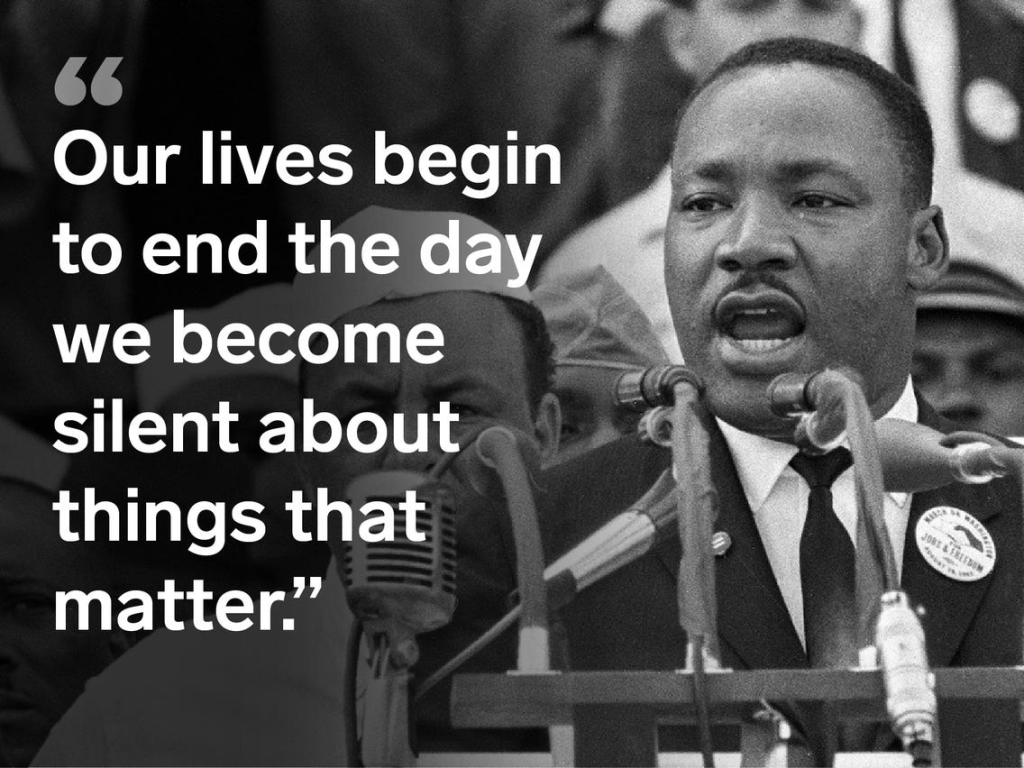
Methinks that Martin Luther King, Jr. must have felt a kinship with the prophet Jeremiah. After all, he was much like a modern-day prophet. In word and deed, he kept asking people to close the distance between the values they espoused and their actual behavior. 

The terrible treatment King and his allies received during the civil rights movement through non-violent marches and demonstrations, brought-out the awful gap between espoused American values of freedom, fairness, and tolerance, and the reality that Blacks really did not possess these in any manner close to the white population. 

Every prophetic ministry compels people to come face-to-face with the disparity between beliefs and behaviors.

Jeremiah knew all about the gulf between expressed values and actual conduct. And he faced a very large chasm between the two. 

Like Reverend King, Jeremiah was imprisoned, had rocks thrown at him, and was jeered for his message of calling people to live up to God’s agenda for humanity. 

White supremacy, or at least white privilege, was taken for granted in much of America before King. In the same way, Israelite privilege was taken for granted in Jerusalem, in Jeremiah’s day. Unfaithful prophets kept proclaiming Jewish supremacy and insisted that the Lord would be on their side of things. 

But the Lord insisted that these supposed prophets have neither attended a meeting of any divine council in heaven nor ever heard God speak to them.

I urge you, brothers and sisters, to keep an eye on those who create dissensions and hindrances, in opposition to the teaching that you have learned; avoid them. For such people do not serve our Lord Christ but their own appetites, and by smooth talk and flattery they deceive the hearts of the simple-minded. (Romans 16:17-18, NRSV)

The spirit of the age simply accepted power, privilege, and pedigree as the norm that ought to always endure. But God thinks differently about it. And so, the Lord sends prophets to call people back to justice, righteousness, and peace for the benefit of all persons.  

The zeitgeist of our own age is one of turmoil, uncertainty – and even chaos, violence, and death. We have our own contemporary self-appointed prophets who proclaim peace where there is no peace; safety, at the expense of others’ protection; militant forms of xenophobia; and an American exceptionalism which places a thin veneer of respectability over the graves of dead people’s bones.

The Lord will not contend with this forever.

An exercise in healthy introspection would be to consider these questions:

  • What are our most cherished values?
  • Where did we get them? Who are we listening to?
  • Are they God’s values? 
  • Who is really in control as the arbiter of values?
  • How might godly values of justice, righteousness, and peace be expressed in our everyday actions and behaviors?
  • Will we seek to engraft such values into our organizations, systems, faith communities, neighborhoods, and governments?
  • Can we work together in humility?
  • Do we have the courage to change, to share power, and to seek the common good of all persons?

Lord, have mercy, and grant us your peace.

All-Seeing God, you know the true state of every heart and every people group. Do your work of making me holy in all I do and say so that your values, and the words and ways of Jesus, might be expressed through me in the power of the Holy Spirit. Amen.