The Power of a Blessing (Genesis 27:30-46)

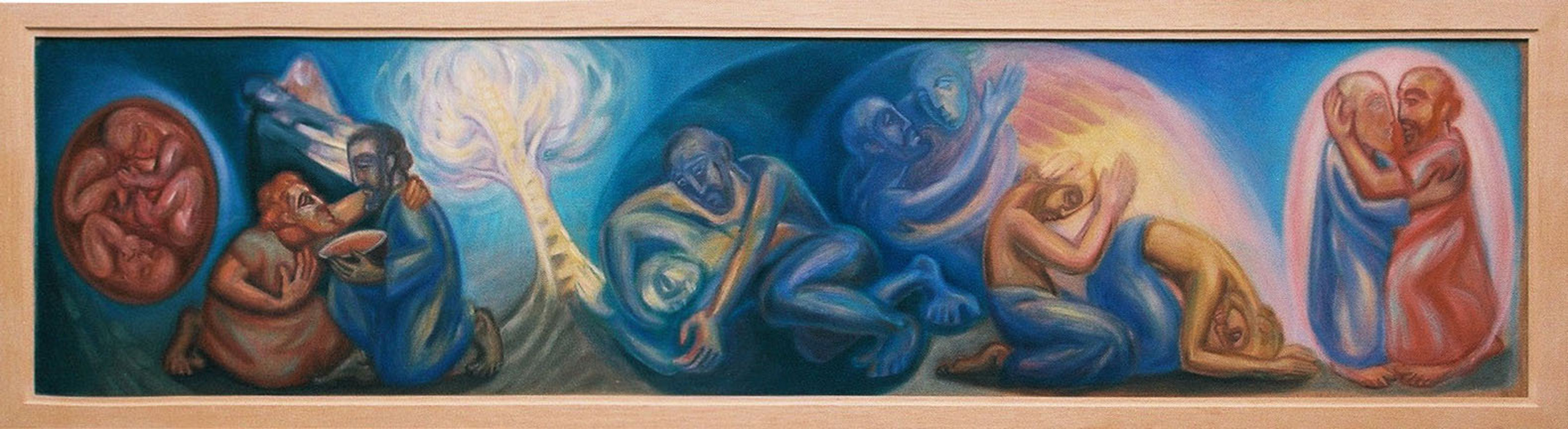
Isaac Blesses Jacob, by Yoram Raanan

After Isaac had finished blessing Jacob, and just as Jacob left his father Isaac, his brother Esau came back from his hunt. He too made some delicious food, brought it to his father, and said, “Let my father sit up and eat from his son’s game so that you may bless me.”

His father Isaac said to him, “Who are you?”

And he said, “I’m your son, your oldest son, Esau.”

Isaac was so shocked that he trembled violently. He said, “Who was the hunter just here with game? He brought me food, and I ate all of it before you came. I blessed him, and he will stay blessed!”

When Esau heard what his father said, he let out a loud agonizing cry and wept bitterly. He said to his father, “Bless me! Me too, my father!”

Isaac said, “Your brother has already come deceitfully and has taken your blessing.”

Esau said, “Isn’t this why he’s called Jacob? He’s taken me twice now: he took my birthright, and now he’s taken my blessing.” He continued, “Haven’t you saved a blessing for me?”

Isaac replied to Esau, “I’ve already made him more powerful than you, and I’ve made all of his brothers his servants. I’ve made him strong with grain and wine. What can I do for you, my son?”

Esau said to his father, “Do you really have only one blessing, Father? Bless me too, my father!” And Esau wept loudly.

His father Isaac responded and said to him,

“Now, you will make a home
    far away from the olive groves of the earth,
        far away from the showers of the sky above.
You will live by your sword;
        you will serve your brother.
But when you grow restless,
        you will tear away his harness
        from your neck.”

Esau was furious at Jacob because his father had blessed him, and Esau said to himself, When the period of mourning for the death of my father is over, I will kill my brother.

Rebekah was told what her older son Esau was planning, so she summoned her younger son Jacob and said to him, “Esau your brother is planning revenge. He plans to kill you. So now, my son, listen to me: Get up and escape to my brother Laban in Haran. Live with him for a short while until your brother’s rage subsides, until your brother’s anger at you goes away and he forgets what you did to him. Then I will send for you and bring you back from there. Why should I suffer the loss of both of you on one day?”

Rebekah then said to Isaac, “I really loathe these Hittite women. If Jacob marries one of the Hittite women, like the women of this land, why should I go on living?” (Common English Bible)

Jacob and Esau

The twins Esau and Jacob are the very definition of sibling rivalry. Even at their birth, they jostled and positioned for their entry into the world. Although brothers, they were different from one another in every way. As their aged father, Isaac, was near the end of his days, he was looking to pass on a family blessing to Esau, the firstborn. And that’s where things got dicey.

Jacob, always the trickster, was still playing out the rivalry. When his brother Esau was out hunting and preparing to receive his father’s blessing, Jacob posed as his brother and deceitfully gained the blessing of Isaac.

Both Isaac and Esau were shocked to discover what happened. Esau’s response was one of grief, disappointment, bitterness, with tears and weeping. Despite Esau not being known for his sensitivity to God or family before this event, we can certainly feel his cry: “Do you have only one blessing, my father? Bless me too, my father!”

The Blessing

As a Pastor and a Chaplain who works with a variety of people, I have heard many times over the lament of individuals without a blessing from their father. As people created in the image and likeness of God, we were meant to be blessed – to have a loving and enduring stamp of approval from both our heavenly Father and our earthly fathers.

And when an earthly father, or father figure, either cannot or will not extend a vital blessing to children, it is a terrible wound – like an invisible open putrid abscess which continually leaves the person emotionally and spiritually sick.

Blessing is needed. Without blessing we flounder in the world, struggling to see hope, wondering if we are loved, and lacking confidence in our faith. To be blessed is to receive a beautiful gift.

The term “blessing” in Scripture is a powerful communication of God’s presence and approval.

So, when humans bless one another, we offer commitments of love and connection. We provide powerful words of encouragement and picture a special future for those we are close to.

None of this is optional. To bless others is the way of building up one another and fortifying each other for the rigors of this world. When blessing is withheld, and even worse, when it is replaced with cursing, then individuals are left untethered, bereft of support to face stressful situations. Like a ship adrift without any power or wind, so the person trying to live in this world without blessing is dead in the water.

Jesus Blesses

Where there is no blessing, like Esau, revenge fills our hearts. But Jesus clearly understood the need and the power of blessing, and he was not deterred in deliberately offering it:

People were bringing little children to Jesus for him to place his hands on them, but the disciples rebuked them. When Jesus saw this, he was indignant. He said to them, “Let the little children come to me, and do not hinder them, for the kingdom of God belongs to such as these. Truly I tell you, anyone who will not receive the kingdom of God like a little child will never enter it.” And he took the children in his arms, placed his hands on them and blessed them. (Mark 10:13-16, NIV)

I wonder how this simple encounter affected the lives of those children on that day in which Jesus blessed them. I am curious in what ways they grew-up and how Christ’s blessing shaped their lives. Because that is what blessing does: it forms us into the kind of people we were meant to be.

So, receive today this blessing from Holy Scripture:

The Lord bless you and keep you;
the Lord make his face to shine upon you, and be gracious to you;
the Lord lift up his countenance upon you, and give you peace. Amen. (Numbers 6:24-26)

Genesis 33:1-17 – Reconciled

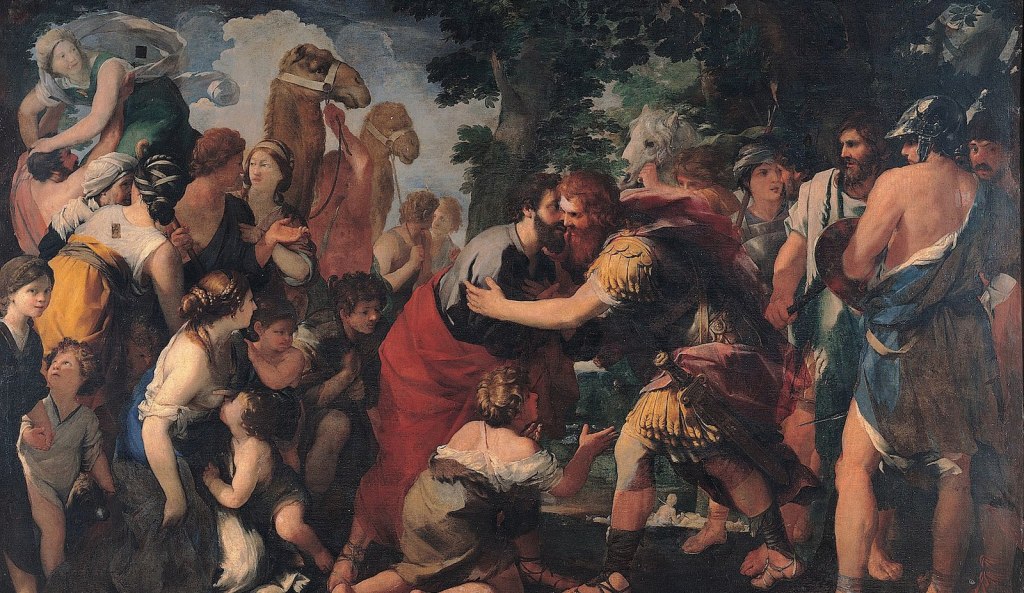
Meeting Between Jacob and Esau by Italian painter Bottalla Raffaellino (1613-1644)

Later that day Jacob met Esau coming with his four hundred men. So, Jacob had his children walk with their mothers. The two servant women, Zilpah and Bilhah, together with their children went first, followed by Leah and her children, then by Rachel and Joseph. Jacob himself walked in front of them all, bowing to the ground seven times as he came near his brother.

But Esau ran toward Jacob and hugged and kissed him. Then the two brothers started crying.

When Esau noticed the women and children he asked, “Whose children are these?”

Jacob answered, “These are the ones the Lord has been kind enough to give to me, your servant.”

Then the two servant women and their children came and bowed down to Esau. Next, Leah and her children came and bowed down; finally, Joseph and Rachel also came and bowed down.

Esau asked Jacob, “What did you mean by these herds I met along the road?”

“Master,” Jacob answered, “I sent them so that you would be friendly to me.”

“But, brother, I already have plenty,” Esau replied. “Keep them for yourself.”

“No!” Jacob said. “Please accept these gifts as a sign of your friendship for me. When you welcomed me and I saw your face, it was like seeing the face of God. Please accept these gifts I brought to you. God has been good to me, and I have everything I need.” Jacob kept insisting until Esau accepted the gifts.

“Let’s get ready to travel,” Esau said. “I’ll go along with you.”

But Jacob answered, “Master, you know traveling is hard on children, and I have to look after the sheep and goats that are nursing their young. If my animals travel too much in one day, they will all die. Why don’t you go on ahead and let me travel along slowly with the children, the herds, and the flocks. We can meet again in the country of Edom.”

Esau replied, “Let me leave some of my men with you.”

“You don’t have to do that,” Jacob answered. “I am happy, simply knowing that you are friendly to me.”

So, Esau left for Edom. But Jacob went to Succoth, where he built a house for himself and set up shelters for his animals. That’s why the place is called Succoth. (Contemporary English Version)

Repentance includes more than saying sorry. It also involves admitting wrong and making things right. Turning from erroneous thinking and forsaking past hurtful actions, lays the groundwork for an earnest attempt at reconciliation. 

For example, the Christian does more than a simple acceptance and acquiescence of Jesus, as if merely adding a bit of Christ to life will dash it up and make it better. Rather, we are invited into the very life of Christ. This life turns us upside-down and inside-out in a new and radical allegiance.

Repentance and reconciliation are a way of life. They are necessary skills requiring development through continual practice and use.

Broken relationships are the stuff of life. So, we need gracious approaches to deal with them so that bitterness does not take root in our souls. Connection and peace between two people are a beautiful thing. They bring emotional health, spiritual wholeness, and life enrichment.

From the get-go, twin brothers Jacob and Esau in the Old Testament book of Genesis had a contentious relationship. Their relations became so bad that Esau had homicidal ideation toward his brother. Neither Esau nor Jacob handled things well. Jacob ended up leaving, finding a wife, growing a family, and becoming wealthy.

Twenty years passed before they came together again.

Jacob, knowing he was about to meet his brother, had an encounter with God. It changed his identity from the old deceiver to the new Israel (Genesis 32:22-31).  In a demonstration of his new identity as Israel, Jacob worked at making amends for his old cheating ways. He sought to give the blessing he had stolen from his brother.

Jacob understandably had some dread in meeting Esau. He had connived and manipulated to take the family birthright and blessing from his brother. Fresh from wrestling with God, Jacob demonstrated a newfound courage and humility. He offered Esau respect, gifts, and honor – reversing his past pattern of disrespect, stealing, and dishonor.

True repentance is making things right. Merely having feelings of remorse is not repentance. To repent involves genuine sorrow; an earnestness to make restitution and reconciliation; an indignation over what happened; and, perhaps most importantly, a deep concern for the person(s) harmed by our wrongdoing (2 Corinthians 7:8-11).

The reconciliation between the brothers was a surprise. Jacob was not expecting Esau’s response. It seems Jacob was bracing for the worse, which explains his high anxiety before the encounter.

Esau’s gracious response was an answer to Jacob’s prayer.  For Jacob, seeing Esau’s face was like seeing the face of God. In fact, he saw both faces and lived! Jacob likely would not have seen his brother’s face until he had first seen God’s. His divine experience prepared the way for the human encounter.

We all experience times when relationships unravel and need to be mended. Jacob procrastinated for twenty years before working at reconciliation with his brother. What made the difference for Jacob was trusting God, who always works out divine promises, despite our human foibles. 

May you know and experience the God who reconciles and restores, and in so doing, extend that same earnestness to others.

Merciful God, I confess that I have sinned against you and against others through my own fault by thought, word and deed in things done and left undone. Especially I confess that I have _____.  I therefore repent; for these and all my sins I am terribly sorry and pray for forgiveness. I firmly intend to make amends and seek for help. I ask for strength to serve you in newness of life through Jesus Christ, my Lord, in the power of your Holy Spirit. Amen.

Genesis 33:1-17 – Brothers Reconciled

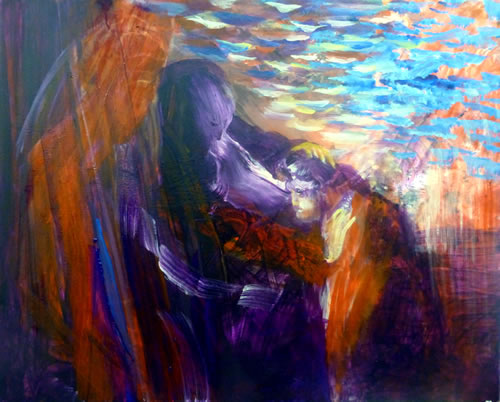
Jacob and Esau by Willow Winston
Jacob and Esau by British artist Willow Winston

Jacob looked up and saw Esau coming with his four hundred men. He divided the children between Leah and Rachel and the two maidservants. He put the maidservants out in front, Leah, and her children next, and Rachel and Joseph last. He led the way and, as he approached his brother, bowed seven times, honoring his brother. But Esau ran up and embraced him, held him tight and kissed him. And they both wept. 

Then Esau looked around and saw the women and children: “And who are these with you?” 

Jacob said, “The children that God saw fit to bless me with.” 

Then the maidservants came up with their children and bowed; then Leah and her children, also bowing; and finally, Joseph and Rachel came up and bowed to Esau. 

Esau then asked, “And what was the meaning of all those herds that I met?” 

“I was hoping that they would pave the way for my master to welcome me.” 

Esau said, “Oh, brother. I have plenty of everything—keep what is yours for yourself.” 

Jacob said, “Please. If you can find it in your heart to welcome me, accept these gifts. When I saw your face, it was as the face of God smiling on me. Accept the gifts I have brought for you. God has been good to me and I have more than enough.” Jacob urged the gifts on him, and Esau accepted. 

Then Esau said, “Let’s start out on our way; I’ll take the lead.” 

But Jacob said, “My master can see that the children are frail. And the flocks and herds are nursing, making for slow going. If I push them too hard, even for a day, I’d lose them all. So, master, you go on ahead of your servant, while I take it easy at the pace of my flocks and children. I’ll catch up with you in Seir.” 

Esau said, “Let me at least lend you some of my men.” 

“There’s no need,” said Jacob. “Your generous welcome is all I need or want.” 

So, Esau set out that day and made his way back to Seir. 

And Jacob left for Succoth. He built a shelter for himself and sheds for his livestock. That’s how the place came to be called Succoth (Sheds). (MSG) 

Repentance includes more than saying sorry. It also involves admitting wrong and making things right. This, then, lays the groundwork for an earnest attempt at reconciliation.  For example, the Christian does more than a simple acceptance and acquiescence of Jesus, if merely adding a bit of Christ to life will dash it up a bit and make it better. Rather, we are invited into the very life of Christ. This life turns us upside-down and inside-out in a new and radical allegiance.

Repentance and reconciliation are a way of life, as well as a necessary skill requiring development through continual practice and use. Broken relationships are the stuff of life, and we need gracious approaches to deal with them so that bitterness does not take root in our souls. Connection and peace between two people are a beautiful thing; it brings emotional health, spiritual wholeness, and life enrichment.

From the get-go, twin brothers Jacob and Esau in the Old Testament book of Genesis had a contentious relationship. At one point their relations were so bad that Esau was having some homicidal ideation toward his brother. Neither Esau nor Jacob handled things well between each other with Jacob leaving, finding a wife, and growing a family, and becoming wealthy. Twenty years passed before they came together again.

Jacob wrestling with God
Jacob Wrestling with the Angel of God by Jack Baumgartner, 2009

Jacob, knowing he was about to meet his brother, had an encounter with God that changed his identity from the old deceiver to the new Israel (Genesis 32:22-31).  In a demonstration of his new identity as Israel, Jacob worked at making amends for his old cheating ways by turning around the blessing he had stolen from his brother and then giving one back to him.

Jacob understandably had some dread in meeting Esau, considering what he had done to his brother in deceitfully taking both his birthright and blessing. Fresh from wrestling with God, Jacob demonstrated a newfound courage and humility through respect, gift-giving, and showing honor – reversing his past pattern of disrespect, stealing, and dishonor.

True turning away from what we have done wrong is by making things right. Merely having the feeling of being sorry is not repentance. Genuine repentance involves true sorrow; an earnestness to make restitution and reconciliation; an indignation over what happened; and, perhaps most importantly, a deep concern for the person(s) harmed by our wrongdoing (2 Corinthians 7:8-11).

The reconciliation between the brothers was a surprise because Jacob was not expecting Esau’s response. It seems Jacob was bracing for the worse, which would explain his high anxiety before the encounter. Esau’s gracious response was an answer to Jacob’s prayer.  For Jacob, seeing Esau’s face was like seeing the face of God – in fact, he saw both faces and lived!  Jacob likely would not have seen his brother’s face until he had first seen God’s. His divine experience prepared the way for the human encounter.

We all experience times when relationships unravel and need to be mended. Jacob procrastinated for twenty years before working at reconciliation with his brother. What made the difference for Jacob was trusting God, who always works out his promises, despite our human foibles.

May you know and experience the God who reconciles and restores, and in so doing extend that same earnestness to others.

Merciful God, I confess that I have sinned against you and against others through my own fault by thought, word and deed in things done and left undone. Especially I confess that I have _____.  therefore repent; for these and all my sins I am terribly sorry and pray for forgiveness. I firmly intend to make amends and seek for help. I ask for strength to serve you in newness of life through Jesus Christ, my Lord, in the power of your Holy Spirit. Amen.