Divine Intervention (Isaiah 1:24-31)

The Siege and Destruction of Jerusalem, by David Roberts (1796-1964)

So now, listen to what the Lord Almighty, Israel’s powerful God, is saying: “I will take revenge on you, my enemies, and you will cause me no more trouble. I will take action against you. I will purify you the way metal is refined, and will remove all your impurity. I will give you rulers and advisers like those you had long ago. Then Jerusalem will be called the righteous, faithful city.”

Because the Lord is righteous, he will save Jerusalem and everyone there who repents. But he will crush everyone who sins and rebels against him; he will kill everyone who forsakes him.

You will be sorry that you ever worshiped trees and planted sacred gardens. You will wither like a dying oak, like a garden that no one waters. Just as straw is set on fire by a spark, so powerful people will be destroyed by their own evil deeds, and no one will be able to stop the destruction. (Good News Translation)

Judgment does not mean that you need to leave a part of yourself behind in order to be accepted or belong. Judgment isn’t about stuffing down emotions and denying certain thoughts about things because you were told to.

Rather, judgment – divine judgment – is for those leaders, and the persons who support such leaders, who tell people they have to live a particular way, be a certain way, and think in the same way the leaders say you have to think.

Isaiah’s prophecy is first and foremost directed toward leaders – political leaders and religious leaders. Indeed, the nation of Israel had gone down a path of worship that God never condoned nor wanted.

And the Lord put the primary blame squarely upon rulers who led their people in unacceptable ways by telling them things that God never wanted. As a result, the nation as a whole, lived unjustly and unrighteously.

God was determined to do something about the situation of bad leadership: Replace the rulers and advisers. Get rid of them, just like a metallurgist gets rid of impure and worthless dross.

A lot of things in life rise and fall because of leadership. The character and competence of a leader is of upmost importance. God raises up particular people to lead. So, leaders and rulers are expected to fulfill their mandated duty with all diligence and decorum.

The city of Jerusalem fell to the invading Babylonians in 586 B.C.E. All of the Old Testament prophetic books are related to that seminal event in one way or another.

Jerusalem’s destruction, according to the prophets, had a direct relationship to the failure of political kings and religious priests to lead the people according to God’s law. And that failure was specifically tied to the lack of religious piety and leadership performance amongst the rulers of the land.

Indeed, individuals are responsible for their own thoughts and words and actions. Yet, at the same time, the leaders of a city and a nation are also responsible for whether they are leading the people into ways of justice and equity, or injustice and prejudice.

People in responsible positions of authority are to take ownership of the sort of culture they develop. And when people, as a whole, have rude and irresponsible words and actions, such behavior isn’t only on individuals – it’s on the leaders, as well.

God will hold everyone accountable – especially leaders = for what they have done, and not done, to foster a just and right society.

In the time of the prophets, the majority of those in authority led the people into a degenerate state. It had become so bad that divine judgment would intervene in order to burn out the evil, and remove the worthless dross of incompetent and inconsiderate leadership.

Only through the wholesale replacement of rulers and advisers could restoration and regeneration ever take place.

Fortunately, the Lord is a God of justice, mercy, and grace. The Lord is a redeeming God. And the theme of redemption runs throughout the Book of Isaiah. Yet, for a nation to be redeemed, it will require an elimination of rebellious evil.

The wrath of God exists precisely because of the love of God. Since the Lord has a steadfast, committed, and covenantal love for the people, God will render judgment, purging hate and injustice from the land.

When God decrees something, no one can stop it. And when God decrees destruction upon the material things which promote illegitimate worship and public injustice, you can be absolutely sure that it’s going to happen.

No one, no city, and no nation is truly autonomous, in the sense that they can do whatever the heck they want to do, regardless of whether it is right or just, or not. There is no person and no government who is free to indulge in their own selfish agenda.

We have a purpose and a mandate as people on this earth, to care for this world – the people and the environments we inhabit.

All of the ways in which individuals, groups, and governments cheapen and degrade human dignity and environmental worth, puts everyone at risk of survival and a good life on this planet.

Unjust and dysfunctional systems and structures must be purged of their impurities. And that means, in many cases, a new order of things must occur.

If we cannot learn to play well with one another, then playtime will be over; and God will call us back into the house and make us sit in the corner for a long time – or worse.

Whenever leadership fails to be neighborliness, then we have a huge problem.

Our world suffering divine devastation of all the things we know and love may not be far behind. And, quite frankly, it will be our own damn fault – and not somebody else’s.

However, in the prophetic biblical tradition, devastation and destruction never have the last word. There is always hope – a confident expectation that good, right, and just forms of social, economic, and religious communities will function yet again.

There are good leaders waiting in the wings. It’s just that no one yet sees or knows them. But God will raise them up at the proper time, to accomplish good purposes in communities, churches, families, and governments everywhere.

A divine intervention will make the last be first, and the first be last.

May it be so, for the blessing of the world, and to the glory and praise of God. Amen.

Accountability Is Real, and It Matters (Ezekiel 14:12-23)

The word of the Lord came to me: “Son of man, if a country sins against me by being unfaithful and I stretch out my hand against it to cut off its food supply and send famine upon it and kill its people and their animals, even if these three men—Noah, Daniel and Job—were in it, they could save only themselves by their righteousness, declares the Sovereign Lord.

“Or if I send wild beasts through that country and they leave it childless and it becomes desolate so that no one can pass through it because of the beasts, as surely as I live, declares the Sovereign Lord, even if these three men were in it, they could not save their own sons or daughters. They alone would be saved, but the land would be desolate.

“Or if I bring a sword against that country and say, ‘Let the sword pass throughout the land,’ and I kill its people and their animals, as surely as I live, declares the Sovereign Lord, even if these three men were in it, they could not save their own sons or daughters. They alone would be saved.

“Or if I send a plague into that land and pour out my wrath on it through bloodshed, killing its people and their animals, as surely as I live, declares the Sovereign Lord, even if Noah, Daniel and Job were in it, they could save neither son nor daughter. They would save only themselves by their righteousness.

“For this is what the Sovereign Lord says: How much worse will it be when I send against Jerusalem my four dreadful judgments—sword and famine and wild beasts and plague—to kill its men and their animals! 

“Yet there will be some survivors—sons and daughters who will be brought out of it. They will come to you, and when you see their conduct and their actions, you will be consoled regarding the disaster I have brought on Jerusalem—every disaster I have brought on it. You will be consoled when you see their conduct and their actions, for you will know that I have done nothing in it without cause, declares the Sovereign Lord.” (New International Version)

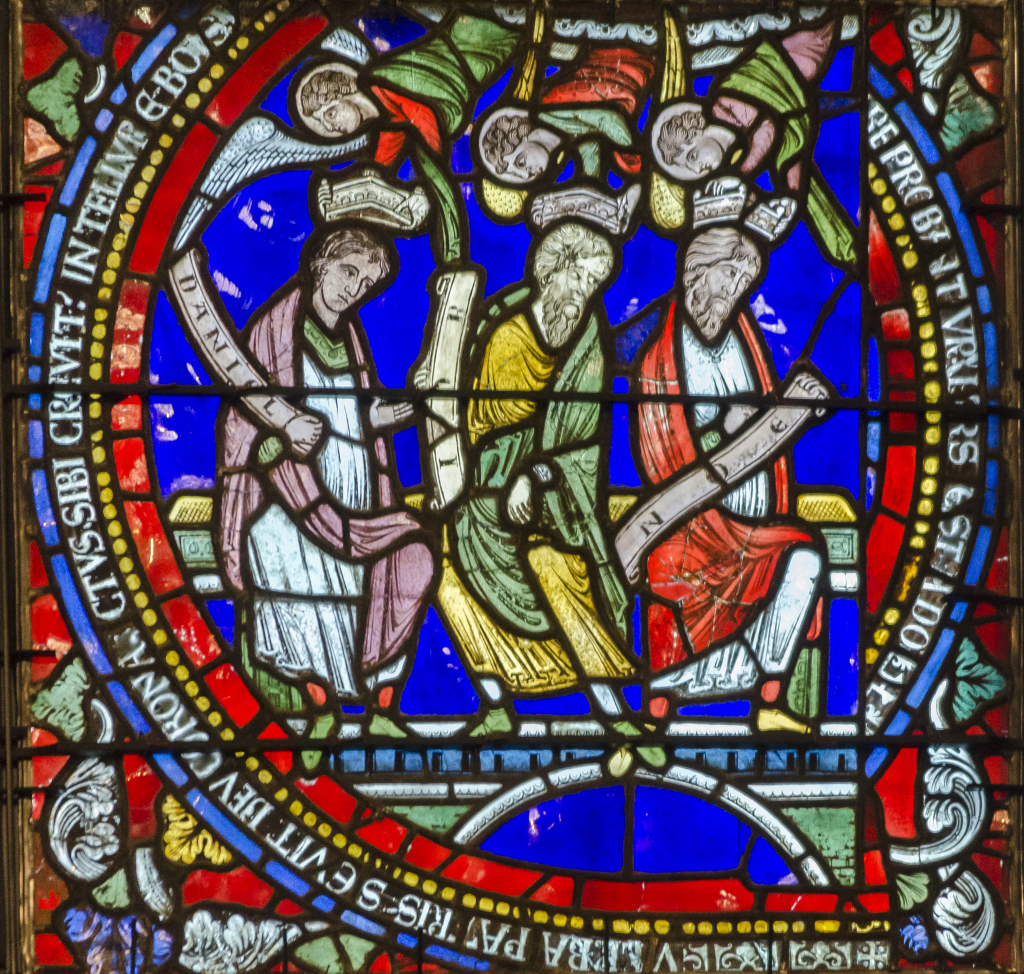
Stained glass of the three righteous men: Daniel, Job, and Noah

No person, group, institution, or nation can act unjustly forever. The prophet Ezekiel made it clear that everyone will be held accountable for injustice and wickedness, for crimes against humanity and against God.

Furthermore, there is no nation or group which can rely on a few persons who do right, while the rest of the people swim in injustice and unrighteousness. Righteous persons save only themselves; they cannot make decisions and take over the life of another person.

Ezekiel wanted to make sure his listeners got the message of individuals only saving themselves, and not riding on the coattails of others. The prophet went out of his way to communicate that each individual person will be held responsible for their own actions; they will be judged on what they themselves have done, and not what another has or has not done.

Even the family of a righteous person will not be spared divine judgment because of that individual’s righteousness. One shall be held accountable for what that one has done, period.

Specifically, in the text, God was ready to execute judgment on Jerusalem. War, wild animals, famine, and disease would come upon them because of unfaithfulness, injustice, and unrighteousness.

Just because the city had the temple, this would not save them. Just because there are a few righteous persons in the city, they would not save it. Just because a close loved one is faithful and righteous, will not mean that God would spare the city.

A few good works of a few people, do not cancel out pervasive and consistent evil which is perpetrated by many people. Each person is responsible for their own behavior. No one gets a pass, simply because they know certain people and are well-connected.

Evil is evil, no matter whether it is perpetrated by believers or unbelievers. No nation, and no person, is off the hook; all persons will be held accountable for doing justice, loving mercy, and walking humbly with God.

Even if three of the most righteous persons show up – Noah, Daniel, and Job, who were famous for their moral integrity – their combined righteousness and faithfulness would not keep away divine judgment from happening in an immoral and unethical society. Only those three alone would be delivered.

There is no such thing as salvation by proxy. Each individual person must work on themselves, without blaming others, inordinately depending on others, nor ignoring God and wishing God did not see, or does not exist at all.

Evil persons do not get any preferential treatment from God, just because they have a prominent position or are famous. The Lord, as Sovereign of the universe, has every right to exact divine retribution. And God will do it without showing favoritism.

Just as God shows mercy without prejudice, so will God extend judgment without any prejudice.

The presence of great light means that there is also the presence of great darkness. If we want a great God of love and mercy, then we must also accept the God of wrath and judgment; and vice versa.

We are made in God’s image, and not the other way around. It is our task to submit to the high, holy, and sovereign Lord of all. It is not God’s job to be the divine Santa Claus who submits to us. The Lord is no divine genie who we can keep in a bottle, and summon whenever we so desire.

No matter one’s theology or spirituality, everyone discerns that they are to be responsible in this life, and are accountable to forces greater than themselves.

This is one of those universal realities that all of us need to sync our lives with – or suffer the consequences.

Almighty God and Sovereign Lord of all, I embrace my accountability to you. Forgive me for when I live as though I need not give an account of what I said and did. I affirm that I am accountable for how I treat others; and I realize that what I do to others, positive or negative, I am doing to you, their Creator. Sustain me in faith and patience, I pray. Amen.

Use Your Freedom For Good (Exodus 33:1-6)

Then the Lord said to Moses, “You and the people you brought out of Egypt must leave this place. Go to the land I promised to Abraham, Isaac, and Jacob with an oath, saying, ‘I will give it to your descendants.’ I will send a Messenger ahead of you, and I will force out the Canaanites, Amorites, Hittites, Perizzites, Hivites, and Jebusites. Go to that land flowing with milk and honey. But I will not be with you, because you are impossible to deal with, and I would destroy you on the way.”

When the people heard this bad news, they acted as if someone had died. No one wore any jewelry. The Lord had said to Moses, “Tell the Israelites, ‘You are impossible to deal with. If I were with you, I might destroy you at any time. Now take off your jewelry, and I’ll decide what to do with you.’” After they left Mount Horeb, the Israelites no longer wore their jewelry. (God’s Word Translation)

It took little time for the covenant between God and the Israelites to be violated. The relationship between the Lord and the people was meant to be cemented through a special covenant in which Yahweh makes promises to them and gives them instructions and commandments; and the Israelites pledge their fealty and promise to obey.

But the people quickly reneged on the relationship. While Moses was up on Mount Sinai, receiving the Law from God, the Israelite grumbles and complaints came to full flower. They went their own way and made a calf idol out of gold.

So, the Lord’s judgment broke out amongst them. The Levites, to their credit, rallied around Moses and the Lord, and took out the rabble rousers in the camp. What’s more, God sent a plague that killed many.

In the aftermath of the rebellion against Moses and the Lord, God ordered the people to leave Mount Sinai – the place where everyone was to have a positive experience of Yahweh’s presence. God’s anger and wrath were so aroused that it became impossible for the divine presence to go with the people. Only Moses, as God’s emissary, would be able to guide the Israelites so that they are not completely eradicated.

Mount Sinai, by Sefira Lightstone

Yet, even after all the bad attitudes, rebellious actions, and an idolatrous spirit among the Israelites, Yahweh will still keep the divine promise to Abraham, Isaac, and Jacob to deliver them and bring them to the Promised Land.

Today’s story has the feel of a chastened child sitting in the corner, having to think about what they just did to raise the ire of the parent. The Israelites moved from Sinai in a somber mood, realizing more clearly than ever how much their lives are tied and linked to God’s divine presence.

At God’s command, the people removed their jewelry and took off their party clothes from the celebration that got them into so much trouble. It began to sink in, that the Lord departed from them because of their great sin. They started to realize, albeit too late, that they really screwed up their relationship with God.

The Israelites didn’t know how good they had it with the divine pillar of cloud by day and fire by night to lead them – and how much they actually depended on the God-given manna for their sustenance and existence.

It’s all too typical for us humans that we fail to realize what we have, until it’s gone. The ancient Israelites were freed from a cruel slavery in Egypt. They clearly did not handle their freedom well, at all. Perhaps the people were so used to being in bondage that, when they go their freedom, they just adopted a different sort of slavery – to their sinful passions.

Let’s handle our freedom with some responsibility and accountability, so that we do not go down the same rebellious path as the ancient people of God. You and I are free to choose what we do, what we think, and how we spend our time. It’s easy to blame outside forces when circumstances are hard; and to grumble whenever we don’t like something.

Freedom is a spiritual discipline; we must learn how to intentionally practice it and use it for good. The following are four areas to purposefully work on with our freedom by making good choices:

Choose your words carefully. What comes out of your own mouth is up to you. Let those words reflect who you truly are; and let your speech impact others around you for good, and not evil.

Choose your attitude with some self-awareness. With awareness comes choices. For example, if we are not aware of our own anger, it will eventually come out sideways on another person. Our sullen attitude and jaded perspective will color our relational interactions. But if we are aware of our emotions, we can choose to effectively work through them, and then decide what sort of attitude we’re going to have.

Choose your actions before you do them. Seemingly insignificant choices turn into small actions. The small actions become habits. And habits shape character and create a life. We make choices every day about what we’ll do and not do. In every sort of situation we have choices to act, such as: Will I let go, or will I try and control others? Will I walk, or drive? Will I spend, or save? Shall I prepare, or procrastinate? Be fit, or be fat? Talk or listen?… and a thousand other choices of action.

Choose your beliefs with care. Our beliefs and our faith determines how we act and behave. If we believe in a good God who has our best interests at heart, we will freely trust such a God. But if we believe God to be a capricious Being who is aloof from my concerns, then we will make choices to watch out for number one and view others with suspect.

If you are behaving in ways that aren’t working for you, examine what belief is causing that behavior. Then decide whether that’s a belief you really need to have, or not, then change it, if necessary.

Every choice we make, contributes to the person we want to become, and sets us on the path to where we want to be in life. Maybe if the ancient Israelites had more awareness of this, they might have chosen very differently.

Gracious God, grant me clarity and awareness to make wise decisions. Enlighten my heart and mind, as I seek to follow your divine guidance. In the face of uncertainty, give me the courage to trust your promises. Help me embrace the path set before me, with a spirit of love and grace. Amen.

How To Deal with Temptation (James 1:12-16)

Eve reaching for the forbidden fruit, by S.J. Grove, 1995

Blessed is the one who perseveres under trial because, having stood the test, that person will receive the crown of life that the Lord has promised to those who love him.

When tempted, no one should say, “God is tempting me.” For God cannot be tempted by evil, nor does he tempt anyone; but each person is tempted when they are dragged away by their own evil desire and enticed. Then, after desire has conceived, it gives birth to sin; and sin, when it is full-grown, gives birth to death.

Don’t be deceived, my dear brothers and sisters. (New International Version)

The slow slog of uphill adversity, at various times, is a common experience of us all. We must deal with circumstances we didn’t choose, and situations that are out of our control. Throw into the mix that many people have few resources, and you have a feeling of being totally overwhelmed.

In this state of being, it’s challenging to maintain solid decision-making, emotional stability, and spiritual support. We need both encouragement and warning so that we can be strengthened in faith.

The Apostle James sought to encourage and warn a small struggling church who were enduring difficult and unwanted situations. He reminded the believers that the person who perseveres under a time of trial and testing of faith is blessed. 

To be “blessed” is to have God’s stamp of approval. God approves of learning, enduring, and maturing through hardship. For such people, God has promised to give “the crown of life.” All the hard lessons we have under our belts, puts us in the position to connect with Jesus and enjoy God.

Don’t blame others

Sometimes, however, we face suffering not because of the circumstances which God brings in our lives, but because of our own unwise response to difficulty. 

Problems are compounded whenever we blame our troubles on others, and refuse to learn what God is trying to teach us. This sort of response has it’s origins in the Garden.  

Adam said to God, “The woman whom you gave to be with me, she gave me fruit of the tree, and I ate.” (Genesis 3:12) The implication of Adam is that he would have remained innocent, if God had not put Eve in the Garden with him. 

Ever since, blame-shifting has been a staple of human behavior. Our bruised hearts and damaged egos send us desperately looking for someone else to blame when we are confronted with our own trouble. 

“There are two eras in American history: the passing of the buffalo and the passing of the buck.”

Will Rogers

Some folks can be so desperate to justify themselves, they end up saying illogical things, such as: 

  • “I wouldn’t lose my temper if my co-workers were easier to get along with, my kids behaved better, and my spouse were more considerate.” 
  • “I would be a patient person if I didn’t have so many things to do, and if the people around me weren’t so slow and incompetent!” 
  • “I would have a pure mind if there were not so many sexual images in our culture.”
  • “I wouldn’t worry about the future if I had more money, and no health problems.”
  • “My spiritual life would be much better if the pastor did a better job.”
  • “I would follow if there were some decent leadership around here.”
  • “I could never forgive that person [or God].”
  • “My neighbor is an incredible cook; I can’t lose weight with such good food.”
  • “I’ll never be happy, as long as that person is in my life.”

So, I ask us, “What will it take?”…

  1. To stop making excuses? 
  2. To quit blame-shifting onto others? 
  3. To trust God and step out in faith?
  4. To cease worrying about what other people think and start doing what God thinks? 
  5. To look at faith as a dynamic relationship with the Lord, instead of just a static thing you possess? 
  6. To read Holy Scripture as if your life depended on it? 
  7. To minister with initiative and confidence? 
  8. To be humble, do justice, and act with mercy? 
  9. To spiritually grow?
  10. To truly enjoy life?

Don’t blame God

It seems that to err is human; to blame it on the divine is even more human.

God cannot be tempted; it’s not an option. God hates sin and disobedience; the Lord has no appeal for it, at all. It’s a moral impossibility for God to even consider attempting to do evil. Therefore, since God cannot be tempted by evil, God cannot tempt people toward evil.

Then why in the Sam Hill would we ever blame anything on God? Because it’s a cheap easy (and pathetic) way of absolving ourselves from responsibility for our own unwise choices, words, and actions. 

Certainly, God tests us, in order to improve our character, and to bring us toward greater spiritual maturity. Yet, God never forces us to make bad, immoral, or evil choices. God may have brought the trial and testing into our lives; but how we respond to it is up to us.

Take responsibility for yourself

The real culprit behind temptation is one’s own personal and strong desire. It’s the intense motive to have-to-do-it, have-to-say-it, and have-to-have-it, which are at the root of temptation. 

We all have legitimate needs, wants, and desires for love, security, companionship, and to make a difference in the world. Yet we may seek illegitimate means to satisfy those needs. We are lured to the hook by the enticing bait of temptation, and if we bite, that’s on us. Our own temptations lure us to satisfy our legitimate needs in illegitimate ways. 

And when we get ourselves in a pickle because of following our own temptations, the internal push to blame others and/or God becomes strong. It doesn’t help that blame-shifting feels good; it gets the monkey off my back – at least for a time. 

But like a bad addiction, blame-shifting needs to occur in a bigger dose, after a shorter duration of time. Before you know it, we’re caught in a destructive cycle. The temptation has enticed us and we have taken the bait.  Like a fish-eyed follower of evil, we succumb to the lust for ambition, revenge, sex, power, fame, or money.

Know the consequences of blaming others

Temptation, like a smooth operator, comes along and gives a slick pitch about how our troubles can be managed or taken away through blaming others, even God. Then, all of sudden, like a star-struck fan seeking to be satisfied, we take the bait and go to bed with the idea. 

We let sin’s temptation have its way with us. Now, it’s inside us. Like a fetus, the small sin grows within. Eventually, this pregnancy will come to full term. But instead of giving birth to life, there is the terrible agony of death.

Conclusion

Everyone struggles in some way with some sort of temptation. We don’t all wrestle with the same demons, but we’re all tempted in some manner. However, the cycle of guilt and separation from God can be broken. The glory of the gospel is that it breaks the power of sin.

So, hear the good news: 

Don’t let anyone fool you by using senseless arguments [blame-shifting]. These arguments may sound wise, but they are only human teachings. They come from the powers of this world and not from Christ… Christ has taken away your selfish desires… God let Christ make you alive when he forgave all our sins.

God wiped out the charges that were against us for disobeying. He took them away and nailed them to the cross. There Christ defeated all powers and forces… Now the forces of the universe don’t have any power over you….

Kill every selfish desire. Don’t be immoral or indecent or have evil thoughts. Don’t be greedy, which is the same as worshiping idols….  You must quit being angry, hateful, and evil. You must no longer say insulting or cruel things about others. And stop lying to each other. You have given up your old way of life with its habits….

God loves you and has chosen you as his own special people. So be gentle, kind, humble, meek, and patient. Put up with each other, and forgive anyone who does you wrong, just as Christ has forgiven you. Love is more important than anything else. It is what ties everything completely together.

Let the peace that comes from Christ control your thoughts. And be grateful. Let the message about Christ completely fill your lives, while you use all your wisdom to teach and instruct each other. With thankful hearts, sing psalms, hymns, and spiritual songs to God. Whatever you say or do should be done in the name of the Lord Jesus, as you give thanks to God the Father because of him. (Colossians 2:8-3:17, CEV)

Amen.