Be Wise and Beware (1 Kings 10:1-13)

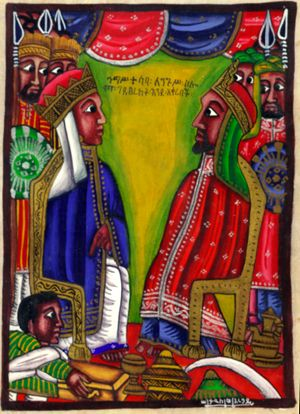
Ethiopian depiction of the Queen of Sheba and King Solomon

The Queen of Sheba heard how famous Solomon was, so she went to Jerusalem to test him with difficult questions. She took along several of her officials, and she loaded her camels with gifts of spices, jewels, and gold. When she arrived, she and Solomon talked about everything she could think of. He answered every question, no matter how difficult it was.

The Queen was amazed at Solomon’s wisdom. She was breathless when she saw his palace, the food on his table, his officials, his servants in their uniforms, the people who served his food, and the sacrifices he offered at the Lord’s temple. She said:

Solomon, in my own country I had heard about your wisdom and all you’ve done. But I didn’t believe it until I saw it with my own eyes! And there’s so much I didn’t hear about. You are wiser and richer than I was told. Your wives and officials are lucky to be here where they can listen to the wise things you say.

I praise the Lord your God. He is pleased with you and has made you king of Israel. The Lord has always loved Israel, so he has given them a king who will rule fairly and honestly.

The Queen of Sheba gave Solomon more than four tons of gold, many jewels, and more spices than anyone had ever brought into Israel.

In return, Solomon gave her the gifts he would have given any other ruler, but he also gave her everything else she wanted. Then she and her officials went back to their own country.

King Hiram’s ships brought gold, juniper wood, and jewels from the country of Ophir. Solomon used the wood to make steps for the temple and palace, and harps and other stringed instruments for the musicians. It was the best juniper wood anyone in Israel had ever seen. (Contemporary English Version)

The ancient Sabeans were a wealthy people. The kingdom of Sheba was geographically located on the southwest corner of the Arabian peninsula (present day Yemen). They were ideally situated to control all the trade in and out of the Red Sea.

Since the Sabeans were a maritime people, the Queen of Sheba made it a habit to engage in trade missions and relations with other kingdoms. King Solomon was making quite a name for himself, and his nation, through his own extensive trade endeavors. It was inevitable that the two would meet.

Solomon had wisdom and wealth because of the divine gift given to him by the Lord. It’s wonderful to have a gracious gift given by God. Most of us can relate to desiring spiritual gifts and blessings from the God we serve.

Yet, what doesn’t usually get talked about is that every divine gift given to us carries with it not only opportunities to bless the world, but also the temptation to avoid proper stewardship and use the gift for personal aggrandizement.

Slowly, over time, it can become rather easy to slip into a mode of getting more and more, of expanding influence, seeking greater honor and accolades, and increasing wealth to exorbitant extremes. For those who know the biblical storyline of Solomon, this is precisely what happened to him. Perhaps in today’s Old Testament lesson, we begin to get a glimpse of the beginnings of that slippery slope into the bottomless abyss of more.

The Queen of Sheba and King Solomon meet

The Queen of Sheba, who herself was one of the wealthiest and most influential monarchs of her day, knew what affluence looked like. So, for her to be breathless over what she observed in Solomon’s kingdom must have been over-the-top abundance and riches.

It’s telling that many contemporary Westerners can read this account and see no problem with it. In fact, some even seem to believe this is something to aspire to – to be just like King Solomon, as if this is what God wants for us.

Yet, it could be that the writer and historian of the biblical kings was leading us to a different conclusion, placing Solomon in the unfavorable light of abusing his divine gift.

After all, it’s clear Solomon used his wisdom and wealth for himself in ways that went well beyond the simple meeting of needs. Solomon was a really smart guy, familiar with God’s Law, so he knew what Moses said about all this stuff:

The king should not have many horses, especially those from Egypt. The Lord has said never to go back there again. And the king must not have a lot of wives—they might tempt him to be unfaithful to the Lord. Finally, the king must not try to get huge amounts of silver and gold.

The official copy of God’s laws will be kept by the priests of the Levi tribe. So, as soon as anyone becomes king, he must go to the priests and write out a copy of these laws while they watch. Each day the king must read and obey these laws, so that he will learn to worship the Lord with fear and trembling and not think that he’s better than everyone else.

If the king completely obeys the Lord’s commands, he and his descendants will rule Israel for many years. (Deuteronomy 17:16-20, CEV)

But Solomon ended up not heeding any of these warnings. And so, it ought to have been no surprise that, after Solomon’s death, the kingdom became divided and was never the same again.

Sheba’s Queen is the one who seemed to have both her head and her heart in the right place. She’s the one who blesses Yahweh and reminds Solomon about the need to rule with integrity and justice. The Queen was able to affirm Solomon’s gift, while at the same time reminding him of what that gift is truly for.

The wise person knows there is always a shadow side to every good gift we have. If we fail to acknowledge this, and not pay attention to it, we will find ourselves doing as much harm as we do benefit.

Generous and loving God, all we are and all that we have is a gift from you. In faith and love, help us to do your will. We offer to you this day all the facets of our lives, whether it be at home, at work, or at school. We seek to be patient, merciful, generous, and holy. Give us the wisdom and insight to understand your will for us and the fervor to carry out our good intentions. We offer to you our gifts of time, abilities, and possessions as a true act of faith, to reflect our love for you and our neighbors. Help us to reach out to others as you have reached out to us. Amen.

Luke 24:36-40 – Peace Be with You

Jesus Shows Himself to Thomas by Rowan and Irene LeCompte, National Cathedral, Washington, D.C.

While they were still talking about this, Jesus himself stood among them and said to them, “Peace be with you.”

They were startled and frightened, thinking they saw a ghost. He said to them, “Why are you troubled, and why do doubts rise in your minds? Look at my hands and my feet. It is I myself! Touch me and see; a ghost does not have flesh and bones, as you see I have.”

When he had said this, he showed them his hands and feet. (New International Version)

Christ’s disciples were abuzz. Two dudes showed up and told eleven of the original disciples that they had seen and talked to Jesus himself! This was a lot to wrap both their heads and their hearts around. Maybe they dared to hope it was true.

Peter and John encountered an empty tomb. Now these guys from Emmaus are giving this wild testimony of a risen Savior. Into the weird mix of doubt, curiosity, grief, hope, wondering, and outright confusion, Jesus materializes out of the blue and says, “Peace be with you.”

Already feeling unsettled and uncertain, the disciples had anything but a peaceful response to the presence of their Lord. Startled, troubled, and frightened they were, as if somebody had just dropped a skunk into the room.

Why the fear? Why not be overjoyed or overcome with sheer delight at seeing Jesus?

The disciples were caught off guard, as if they had zero expectation of seeing Jesus. Believing him to be dead, they immediately went to thinking this was some ghost. After all, the door was locked. Nobody could have gotten into the room without the disciples knowing it. (John 20:19)

As it turns out, faith and belief are not uniform static terms. There are layers to faith. Yes, the disciples really did believe, and their faith developed over time with Jesus. However, their belief had not yet come to full bloom. So, in this sense, they still possessed a lack of faith and were rebuked by Jesus for it. (Mark 16:14)

A full-orbed belief in the Lord Jesus Christ is more than words, more than making professions, and more than signing-off on a doctrinal statement of faith. Faith is shown for what it is through our actions. (James 1:19- 2:26)

Faith comes to fruition when the head, the heart, and the hands all align together and conspire to proclaim the gospel in thought, word, and deed. If they are misaligned or incongruent with each other, then that faith is inadequate. There is yet another level to the belief which needs to emerge.

Perhaps this is instructive for people today. While maintaining beliefs about the person and work of Jesus, and acknowledging Christ’s death and resurrection, some Christians live as though he had never risen from the grave. If Jesus were to suddenly show up and say, “Peace be with you,” like a startled puppy, they’d likely have an accident on the floor.

As Jesus had done so many times before in his earthly ministry, he invited the disciples to experience him in a real, tangible, visceral way. This is no ghost. This is a Christ who has physical flesh and bones. You can eat with this Jesus, real food and drink. Look at his hands and feet. Touch and feel them if you must. But, by all means, believe!

Jesus came to give them, and us, peace. Peace is more than a greeting, more than the absence of conflict or anxiety. It is to enjoy harmony with self, others, and God. Peace is wholeness and integrity of being, even when all is going to hell around us.

A child is born to us, a son is given to us,
    and authority will be on his shoulders.
    He will be named
    Wonderful Counselor, Mighty God,
    Eternal Father, Prince of Peace.
There will be vast authority and endless peace
    for David’s throne and for his kingdom,
    establishing and sustaining it
    with justice and righteousness
    now and forever. (Isaiah 9:6-7, CEB)

The peace of God is closely associated with the presence of God. And so, conversely, the lack of peace is to experience a sense of divine absence. God’s peace and presence are inseparable. It is, therefore, no surprise that Jesus demonstrated his actual physical presence and spoke to the disciples about peace.

On the evening of that first day of the week, when the disciples were together, with the doors locked in fear of the Jewish leaders, Jesus came and stood among them and said, “Peace be with you!” After he said this, he showed them his hands and side. The disciples were overjoyed when they saw the Lord.

Again, Jesus said, “Peace be with you! As the Father has sent me, I am sending you.” And with that he breathed on them and said, “Receive the Holy Spirit. If you forgive anyone’s sins, their sins are forgiven; if you do not forgive them, they are not forgiven.” (John 20:19-23, NIV)

Chronic spiritual anxiety usually arises from the inability to perceive a generous and hospitable God having our backs and working on our behalf. Knowing God, who is gracious and compassionate, slow to anger and abounding in steadfast love, leads to peace and settled rest. 

May the Lord bless you
    and protect you.
May the Lord smile on you
    and be gracious to you.
May the Lord show you his favor
    and give you his peace. Amen. (Numbers 6:24-26, NLT)

Psalm 101… Again

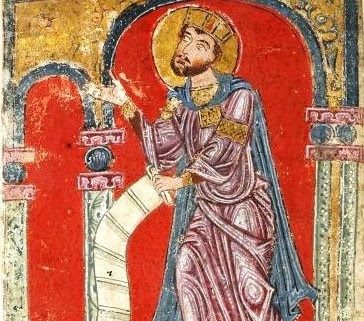
King David, by Unknown artist, c.14th century B.C.E.

I will sing of loyalty and of justice;
    to you, O Lord, I will sing.
I will study the way that is blameless.
    When shall I attain it?

I will walk with integrity of heart
    within my house;
I will not set before my eyes
    anything that is base.

I hate the work of those who fall away;
    it shall not cling to me.
Perverseness of heart shall be far from me;
    I will know nothing of evil.

One who secretly slanders a neighbor
    I will destroy.
A haughty look and an arrogant heart
    I will not tolerate.

I will look with favor on the faithful in the land,
    so that they may live with me;
whoever walks in the way that is blameless
    shall minister to me.

No one who practices deceit
    shall remain in my house;
no one who utters lies
    shall continue in my presence.

Morning by morning I will destroy
    all the wicked in the land,
cutting off all evildoers
    from the city of the Lord. (New Revised Standard Version)

Routine and repetition might seem tedious and boring. However, they are indispensable. People are designed for doing, saying, and thinking the same things over and over again. Habits help to press what is most important into our minds, our speech, and our behavior.

Transformation and change aren’t accomplished through sheer willpower. It happens through the small daily decisions of life. A mere ten minutes, dedicated specifically to a particular task each day, has the power to completely alter our lives.

The biblical psalms, read every day, out loud, through singing and praying, can bring an inside-out metamorphosis which can serve us for a lifetime. To help remind us of this, I sometimes include the psalm readings in my blog reflections two, even three, days in a row.

The Revised Common Lectionary is a method of reading through the Bible in a three-year cycle (Year A, B, C). Rather than reading the Bible from cover to cover, the Lectionary follows the seasons of the Christian Year (Advent, Christmas, Epiphany, Lent, Easter, Pentecost and Ordinary Time).

The advantage to reading the Bible with daily assigned texts from the Old Testament, Psalms, and the New Testament is that the reader has an opportunity to follow the life of Jesus through the course of a year. For a Christian who wants to grow in discipleship, the Lectionary is a helpful way of getting to know Christ better.

Another benefit of following the Lectionary readings is that they can be read slowly in about ten to fifteen minutes. This affords the opportunity to spend time reflecting and thinking about how the Bible applies to our life today. Since the daily readings relate to one another from various places in the Bible, it is a helpful way of keeping in mind the whole of Scripture.

The daily readings of the Lectionary revolve around the Sunday readings. Monday, Tuesday, and Wednesday readings reflect on the Sunday texts. Thursday, Friday, and Saturday prepare for Sunday. This has the obvious advantage for making Christian worship a special experience.

The purpose of the Lectionary is to encourage Bible reading, a well-rounded understanding of the Bible’s contents, as well as provide a good foundation for prayer. The Lectionary is meant to be a devotional reading of the Bible which draws people closer to God.

A consistent feature of the Revised Common Lectionary is that the same Psalm is read three days in a row. There is a reason for that. Psalms are meant for more than reading. They are also designed for prayer, singing, and worship.

Since I spiritually dwell a lot within the psalter, I have written out my own translation of many of them. I encourage you to read the following version out loud as a prayer to God….


God almighty, I will sing about your committed love and the exercise of your justice;
    and I will make music to and for you.
I have committed myself to wise discernment so I can walk in the way of integrity;
    so when will you come and help me?
    I will, with your assistance, establish integrity in my own home.
I refuse to set goals on worthless things which add no value to my life.
    I despise the actions of deviant and deceitful people,
    and I will not let their crud stick to me.
My mind and heart won’t go down that crooked path,
    for I will have nothing to do with the deeds of darkness.
The person who slanders another behind their back –
    well, just know, I will not put up with it!
The person who is full of themselves and looks down on others –
    believe you me, I will not tolerate it!

My eyes are fixated on pursuing trustworthy persons,

    and I will surround myself with them.

The person who walks in the way of integrity –

    for sure, will be my friend and confidant.
There is absolutely no room for deceitful hypocrites within my household,
    nor for any two-faced liar; they won’t be around me for long!
Every morning, without fail, I will practice justice,
    I will make it so evil persons cannot survive around me,
    effectively cutting-off troublemakers from your holy place.
Amen.

Psalm 101 – The Ethics of King David

I will sing to you, Lord!
    I will celebrate your kindness
    and your justice.
Please help me learn
    to do the right thing,
    and I will be honest and fair
    in my own kingdom.

I refuse to be corrupt
or to take part
    in anything crooked,
    and I won’t be dishonest
    or deceitful.

Anyone who spreads gossip
    will be silenced,
    and no one who is conceited
    will be my friend.

I will find trustworthy people
    to serve as my advisors,
    and only an honest person
    will serve as an official.

No one who cheats or lies
    will have a position
    in my royal court.
Each morning I will silence
    any lawbreakers I find
    in the countryside
    or in the city of the Lord. (Contemporary English Version)

King David was one serious dude when it came to dealing with wickedness and injustice. He had a zero tolerance policy toward people who were deceitful and proud. David was determined to deal with slanderous and arrogant people. He sought to establish a rule and reign based in his own personal integrity and practice of being a king who seeks after what is right and just.

And so, David refused to take a second look at corrupt people and things which degraded and debased others. He gathered around himself officials who genuinely care about kindness and justice.

David was not about to put up with anyone in his court who had personal agendas of power and privilege at the expense of the powerless.

For David, a diligent and conscientious application of God’s just and right law was absolutely necessary to a benevolent reign in which everyone felt secure and were able to enjoy the Promised Land. Corrupt officials had no place in the kingdom and would be summarily dealt with.

Unfortunately, there are far too many leaders in our world today who create cultures of fear, insecurity, and walking on eggshells. They are crafty and deceitful, actually using organizational codes of morality and ethics to hide their damaging and destructive effect on people.

We may not be kings like David, yet we can share his stance of not avoiding the evil in front of us and dealing with corruption, dishonesty, and disingenuous behavior from others, especially those in positions of power and authority. Toxic authority figures actively isolate us, making us feel stupid and incompetent and afraid to share our struggles with others, so that they can maintain all of the power. 

How, pray tell, might us lowly persons take on those with leverage and power over us, whether they be job bosses, church pastors, local politicians, or family members?

  • Do everything from a place of integrity. Seek the Lord in doing the right thing. Ultimate power belongs to God, not some puny person who is master of a small world.

Whoever walks in integrity walks securely, but whoever takes crooked paths will be found out. (Proverbs 10:9, NIV)

  • Refuse to play their game. Don’t resort to gossip, backbiting, or displays of your own supposed power. Be just, kind, wise, and, most of all, humble. Virtue will serve you well. Vice will not.

Gossip is spread by wicked people; they stir up trouble and break up friendships. (Proverbs 16:28, GNT)

  • Keep in mind that niceness is often used by corrupt leaders to keep others under their thumb. Dishonest and deceitful people are not necessarily bullying. They’ll use whatever means they can to get their way.

Flattery is nothing less than setting a trap. (Proverbs 29:5, CEV)

  • It is always our place to love, not judge. King Jesus is the Judge, not me, not you. Loving an unlovable person can only happen if we have a love for God which is able to see God’s image in every person we encounter, including that difficult leader. In the end, they will be held accountable – whether in this life, or in the one to come. Jesus said:

“You have heard that it was said, You must love your neighbor and hate your enemy. But I say to you, love your enemies and pray for those who harass you.” (Matthew 5:43-44, CEB)

  • Watch your back. Yes, we are to trust in the Lord. That doesn’t mean we implicitly trust everyone and/or every organization. Jesus said:

“Listen! I am sending you, and you will be like sheep among wolves. So be smart like snakes. But also, be like doves and don’t hurt anyone. Be careful!” (Matthew 10:16-17a, ERV)

We all, like King David of old, need an unequivocal commitment to a zero tolerance policy toward evil. It is simply unacceptable to flirt with it. Whatever we must do to remind ourselves of righteousness, and whatever boundaries we need to set, is most necessary, because no one who practices deceit will dwell in the Lord’s house.

Holy God of justice, I will make a covenant with my eyes to set before them no vile thing. Help me to be strong in your mighty power so that my daily walk of faith in Jesus is righteous, free of guilt, and enjoyable.  Amen.