Real vs. Delusional (2 Kings 22:29-40, 51-53)

So the king of Israel and Jehoshaphat king of Judah went up to Ramoth Gilead. The king of Israel said to Jehoshaphat, “I will enter the battle in disguise, but you wear your royal robes.” So the king of Israel disguised himself and went into battle.

Now the king of Aram had ordered his thirty-two chariot commanders, “Do not fight with anyone, small or great, except the king of Israel.” When the chariot commanders saw Jehoshaphat, they thought, “Surely this is the king of Israel.” So they turned to attack him, but when Jehoshaphat cried out, the chariot commanders saw that he was not the king of Israel and stopped pursuing him.

But someone drew his bow at random and hit the king of Israel between the sections of his armor. The king told his chariot driver, “Wheel around and get me out of the fighting. I’ve been wounded.” All day long the battle raged, and the king was propped up in his chariot facing the Arameans. The blood from his wound ran onto the floor of the chariot, and that evening he died. As the sun was setting, a cry spread through the army: “Every man to his town. Every man to his land!”

So the king died and was brought to Samaria, and they buried him there. They washed the chariot at a pool in Samaria (where the prostitutes bathed), and the dogs licked up his blood, as the word of the Lord had declared.

As for the other events of Ahab’s reign, including all he did, the palace he built and adorned with ivory, and the cities he fortified, are they not written in the book of the annals of the kings of Israel? Ahab rested with his ancestors. And Ahaziah his son succeeded him as king….

Ahaziah son of Ahab became king of Israel in Samaria in the seventeenth year of Jehoshaphat king of Judah, and he reigned over Israel two years. He did evil in the eyes of the Lord, because he followed the ways of his father and mother and of Jeroboam son of Nebat, who caused Israel to sin. He served and worshiped Baal and aroused the anger of the Lord, the God of Israel, just as his father had done. (New International Version)
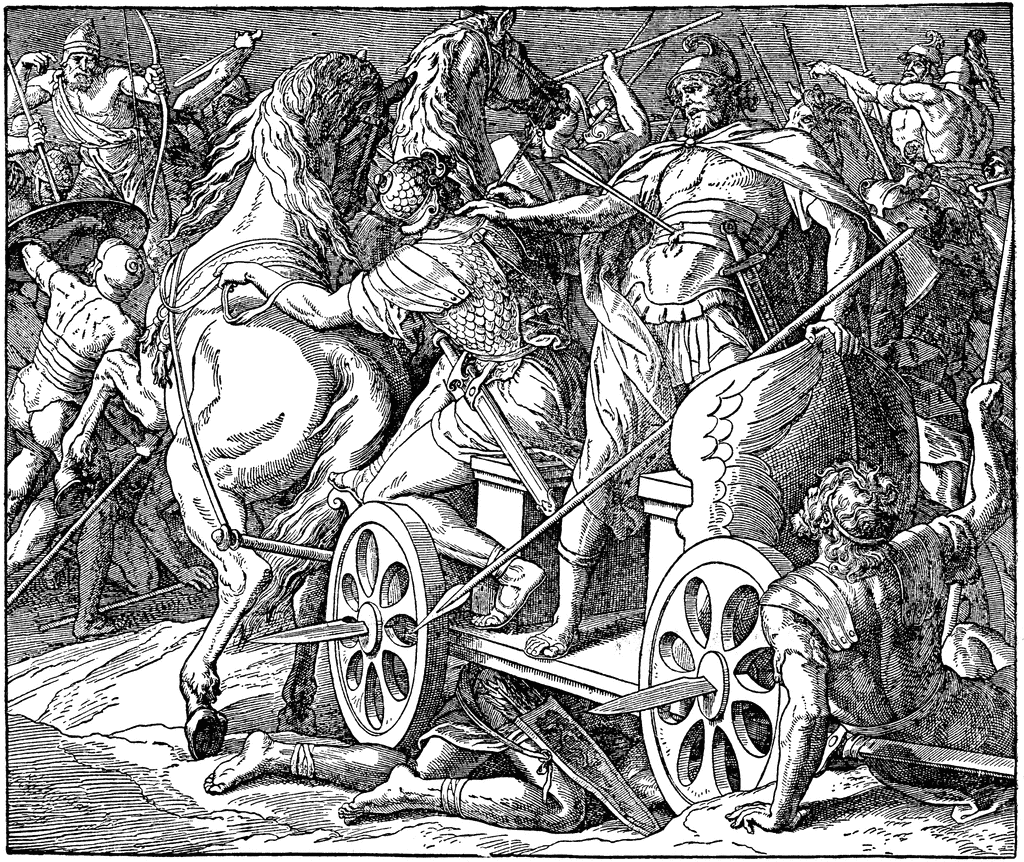
The Death of Ahab, by Julius Schnoor von Carolsfeld (1794-1872)

Whenever someone ignores or tries to get around reality, we call such a person “delusional.” It seems that the more power and authority a person possesses, the easier it is to delude themselves into thinking they can manipulate events in their favor. They then tend to listen only to what they want to hear.

King Ahab of Israel was delusional. He, like so many kings before and after him, was focused on the externals of personal power, accumulating more wealth, and exploring alternative religions. It all led to a twisted view of reality, as well as a prophetic demise.

Identifying so much with externalities, to the detriment of the internalities, is the ultimate bogus approach to life. It never ends well. Instead of exploring the image of God within himself and others, ensuring justice for all his subjects, and using his power to provide for the common good of all Israel, King Ahab went the spiritually and emotionally insecure route of listening to the wrong people.

Insecure and delusional people only listen to what is positive; and they eschew any negatives in their life. This is why the biblical prophets throughout Old Testament history typically found themselves at loggerheads, in prison, or at the end of a spear from those in power.

Ahab feigned wanting to hear what is true, but when hearing any negative aspects, he wrongly believed he could get around reality through his earthly authority and personal ingenuity. But he couldn’t. No one can outdo the stronger unseen forces in this world. (1 Kings 22:1-28)

So, Ahab laid a delusional plan to disguise himself as an ordinary soldier in battle. But although he chose to go against prophetic truth, there was no way to ignore the reality of it.

The providence and purposes of God prevail in any and all circumstances – no matter what they are. Today’s story highlights a seemingly random arrow from an enemy solider, hitting Ahab in the precise spot which could penetrate his armor.

The king was wounded and had to leave the battle. Yet, Ahab stuck to his delusional world, having his men prop him up in his chariot so that he could watch events unfolding in front of him.

Even in his powerlessness, King Ahab could not bring himself to believe that things could be different than he planned. He died at the end of the day, still stuck in his delusional and insecure world.

The editor of the Book of Kings summarized Ahab’s reign by mentioning impressive external improvements to his palace and fortified cities. Yet, these are mere incidentals. The real – and not delusional – assessment of the king’s life is that he was a religious apostate and a moral reprobate.

In the end, Ahab was nothing more than a weak and insecure individual who compromised God’s ethical law and sought to control events for his own misguided purposes. He followed Yahweh only if it aligned with his own plans.

Furthermore, it’s sad that Ahab’s approach to life, and his behavior toward others, was reflective of the Israelite nation as a whole (2 Kings 17:7-17). His own death eerily foreshadowed the death of Israel.

In our own era of incompetent leadership, morally inferior leaders, and delusional administrations, it behooves every concerned and pious believer to pray for all those in authority.

This side of heaven, there will always be cultural and societal pressures to conform to external pride, wealth, and success. But this is not the believer’s call, to take it’s cues from worldly power. Our focus is on consistently and patiently doing what is good, right, and just – accepting the unseen real over the seen delusion.

Rather than trying to continually manipulate events for our own shortsighted purposes, we must persevere in spurring-on one another to love and good deeds (Hebrews 10:24). For only together, as the one people of God, can we resist and subvert the machinations of delusional leaders.

O Lord God, Ruler of all, and whose glory exists in all the world: We commend nations and their leaders to Your divine providence, so that we may dwell secure in Your peace.

Grant to everyone in authority everywhere the wisdom and strength to know and do Your will. Fill them with the love of truth and justice; and make them mindful of their calling to serve all people with respect and reverence; through Jesus Christ our Lord, who lives and reigns with You and the Holy Spirit, one God, world without end. Amen.

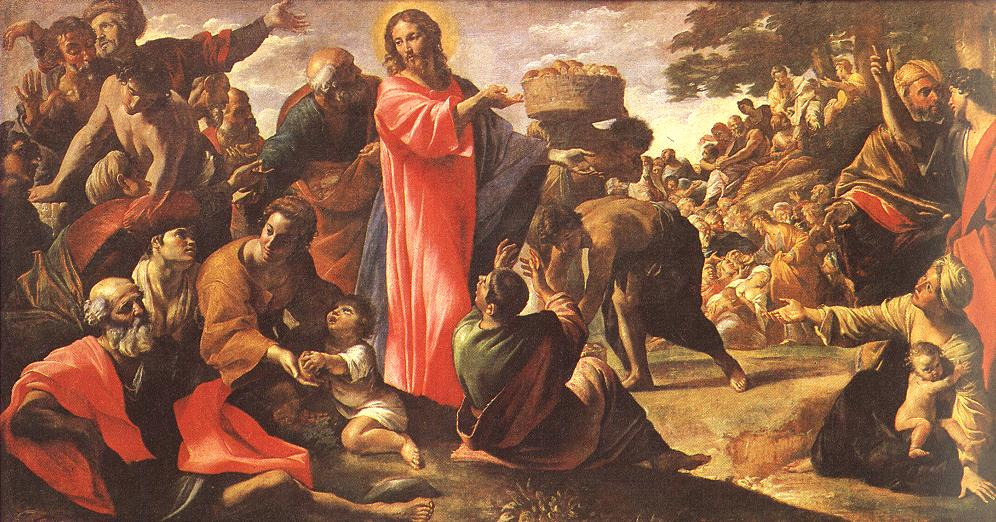
The Feeding of the Four Thousand (Mark 8:1-8)

Miracle of the Loaves and Fishes, by Giovanni Lanfranco, c.1620

In those days when there was again a great crowd without anything to eat, he called his disciples and said to them, “I have compassion for the crowd because they have been with me now for three days and have nothing to eat. If I send them away hungry to their homes, they will faint on the way—and some of them have come from a great distance.” 

His disciples replied, “How can one feed these people with bread here in the desert?” He asked them, “How many loaves do you have?” They said, “Seven.” 

Then he ordered the crowd to sit down on the ground, and he took the seven loaves, and after giving thanks he broke them and gave them to his disciples to distribute, and they distributed them to the crowd. They had also a few small fish, and after blessing them he ordered that these, too, should be distributed. 

They ate and were filled, and they took up the broken pieces left over, seven baskets full. Now there were about four thousand people. And he sent them away. And immediately he got into the boat with his disciples and went to the district of Dalmanutha. (New Revised Standard Version)

This was an incredible miracle by Jesus. And it was also an incredible lack of faith on the part of his disciples. Christ had already taught them an important faith lesson by feeding 5,000 people earlier. You’d think they would have gotten it right this time.

It appears that the disciples were anxious about the situation. After all, whenever we are given to anxiety within a stressful circumstance, we typically are not thinking wisely about what to do.

There simply was no evidence that the disciples were tapping into their wise minds – even though they could have. And there’s where the rub is: Do we have the wherewithal to pause, in order to connect with what and who we know?

Let’s notice in the story that Jesus did not seem at all perturbed by the disciples’ small faith. And he certainly was not hindered in any way by the meager supply of food which was on hand. So, a remedial lesson was provided.

All the food the disciples pulled together was given to Jesus. It wasn’t much for thousands of people. Seven loaves of bread and a few fish. Yet, Christ transformed it into enough to feed the entire crowd of mostly Gentiles, without depriving the disciples of their share. They collected enough to fill seven baskets large enough to hold a man.

So there’s the lesson redone and restated, but with a different twist. Whereas the earlier miracle of food was provided for mostly Jews, the feeding of the four thousand consisted of nearly all Gentiles.

Perhaps the disciples did not really want a miracle to begin with. Maybe they believed their ministry ought to be with Israel, and not the heathen nations around them. It could be that Christ’s disciples simply did not want to be in Gentile territory at all, let alone have to engage in ministry to them, up close and personal.

So, we may be dealing with something more than an issue of faith; we might be looking at plain old fashioned prejudice against another group of people. Discriminatory behavior shrinks one’s faith and makes it small – whereas including others, and seeing their inherent worth as God’s image-bearing creatures, increases our faith and helps it grow large.

Jesus had a heart big enough, a mind open enough, and more than enough ability to make the miracle of food happen. In other words, Christ wanted to do it. He had compassion on the people, regardless of the fact that they were not like him.

It could be that a lesson in prejudice was the teaching he wanted them to get a hold of.

We see in today’s story a trajectory of inclusion, that the kingdom of God is meant to be full of diverse people from every nation, race, and background. Jesus purposely went to the Decapolis, a geographical region with a lot of different people – mostly non-Jews.

The Decapolis (which means “Ten Cities”) was a group of ten Hellenistic cities. It was a center of Greek and Roman culture, in a region mostly populated by Jews and Arameans. Each city functioned as a sort of city-state which was dependent upon Rome. There was enough diversity within the Decapolis itself which seemed to prevent them from working together as an organized region.

When it comes to Christian ministry, there are often two issues going on, namely because ministry is all about working with people. One is that we may have a problem, like the disciples of old, in going to a place we’ve never been before – and really don’t ever want to go. We have particular ideas about the people who live there and what they’re like – and we’d rather not have to deal with them.

The second issue is that we may have a problem with ourselves. Unlike the first issue in which we wonder why Jesus would care about those people, the second is wondering if Jesus really cares about me.

In this, you have no problem believing that Jesus would go to the Decapolis and have compassion on the Gentiles. But you struggle with God caring for you, and that Jesus could ever use you in ministry to people like those in the Decapolis. You can think of all sorts of other people who could do the job much better than yourself.

Since you know yourself pretty well, you understand your own doubts, weaknesses, and sins; and have a hard time trusting that the Lord could or would want to involve you in any ministry.

We, of course, could read today’s Gospel lesson from either of the two issues. Yet, we probably need not make it an either/or issue; it may be more of a both/and issue.

That is, Christ’s disciples – including those past and present – likely struggle with both: We continually keep finding that we have personal prejudices which prevent us from reaching out to particular people; and we also have personal insecurities and inhibitions about God truly loving us enough to use us in effective ministry.

Within the story of Jesus feeding the four thousand, both issues can find their resolution. The fact of the matter is that Jesus cared about the people in the region of the Decapolis, and created a miracle in order to take care of them; and, Jesus used a group of men who probably were likely prejudiced, and also insecure about being used for such a ministry.

May you know that you are infinitely loved by God – and loved alongside all sorts of other people, as well, from everywhere in every place. And may you understand that God has you on this earth to be a blessing to all kinds of persons.

May it be so, to the glory of God. Amen.

The Redeemed and Responsive Soul (Psalm 107:1-7, 33-37)

O give thanks to the Lord, for he is good,
    for his steadfast love endures forever.
Let the redeemed of the Lord say so,
    those he redeemed from trouble
and gathered in from the lands,
    from the east and from the west,
    from the north and from the south.

Some wandered in desert wastes,
    finding no way to an inhabited town;
hungry and thirsty,
    their soul fainted within them.
Then they cried to the Lord in their trouble,
    and he delivered them from their distress;
he led them by a straight way,
    until they reached an inhabited town…

He turns rivers into a desert,
    springs of water into thirsty ground,
a fruitful land into a salty waste,
    because of the wickedness of its inhabitants.
He turns a desert into pools of water,
    a parched land into springs of water.
And there he lets the hungry live,
    and they establish a town to live in;
they sow fields and plant vineyards
    and get a fruitful yield. (New Revised Standard Version)

The responsive spirit

A soul full of spiritual abundance responds freely and organically to God with offerings of gratitude for divine rescue and redemption.

The spiritually responsive person is at peace, content, and able to love with a sensitivity to God because they have had their needs for safety, satisfaction, and relational connection fulfilled. So, as a result, they are able to:

  • worship joyfully and praise God
  • speak words of thanksgiving
  • be attentive to self-care and personal well-being
  • use their resources wisely, feeling capable and confident of making good decisions that bless both the church and the world
  • know they are secure in the loving hands of God

The reactive spirit

Conversely, a soul that is empty from spiritual deprivation reacts predictably and robotically to others with frustration and fear.

The spiritually reactive person seems perpetually upset and in chronic emotional pain, feeling rattled and worried most of the time. They do not reflexively look to the Lord. Their needs for safety, satisfaction, and relational connection have not been met. So, as a result, they are:

  • hypervigilant, on the lookout for the bad, which they are convinced is coming
  • focused narrowly with tunnel vision, having lost sight of the big picture
  • prone to overgeneralizing their negative experiences as being the only experiences they ever have
  • searching for continual stimulation, just to seem alive and feel something
  • insecure, wanting constant validation from others because they cannot give themselves any encouragement

So, what do you do when always feeling between a rock and a hard place, experiencing racing thoughts, being anxious more than not, feeling like an abandoned town in the Old West with nothing but tumbleweed moving down the street?

A redeemed soul

In your desperation, call out to God. The Lord can:

  • get you out in the nick of time and deliver you soul from trouble so that you can be grateful for divine love
  • put your feet walking on a wonderful road of grace that leads to a good place of transformation
  • meet your needs for freedom, contentment, and loving relational networks, so that your spirit is full of right relationships, purity, mercy, and peace

You can once again, or maybe for the first time, feel like:

  • A flowing river, instead of sunbaked mud
  • A fruitful orchard, instead of dry dead tree
  • A farmer with much grain and many animals, instead of a homeless person sitting on a pile of dung
  • A person loved and valued by God, instead of a waste of space, breathing air that others could have
  • A sheep who knows the shepherd is watching over them, instead of an insect that everyone steps on

Keep in mind, that the experience of blessing, the encounter of abundance, and the feeling of peace, is not like a simple math equation – as if God were a divine genie that you happened to find and got three wishes.

Rather, the fulfilling spiritual life involves a persistent faith, confident hope, and constant love. These come from God, and are accessed through humility. The proud person will not realize a life of faith, hope, and love, because they believe they already know what is best.

The humble admit their ignorance, their failings, their shame, their guilt, and their desperation.

Approaching God with humility doesn’t mean to heap deprecation and curses on oneself. It just means to be honest with where you are spiritually, emotionally, mentally, and physically. And to cry out for help, knowing you have nothing to offer in return.

In God’s economy, the currency is grace – and not some give-and-take, I’ll-scratch-your-back-if-you-scratch-mine sort of mentality. God’s steadfast love endures forever. God’s kingdom spins on the axis of grace.

The Lord is not a reactive God but a responsive God. The Lord responded to Israel’s cry for deliverance not just with food and drink, but with a city. God did not only meet the immediate needs of the ancient Israelites, for whom the psalmist is one, along with the original recipients; the Lord took care of their larger, long term needs. 

The people needed a place where they could settle down, raise their own crops and tend their own livestock, and have a dependable means of making a living. God satisfied this, and more, by giving them a city where they could settle, be safe, secure, and content.

God can do anything, you know—far more than you could ever imagine or guess or request in your wildest dreams. God does it not by pushing us around, but by working within us, the Spirit deeply and gently providing us with our deepest and greatest needs.

Blessed heavenly Father, you have filled the world with divine beauty: Open our eyes to behold your gracious hand in everything you have done, so that, rejoicing in all your creation, we may learn to serve you with gladness; for the sake of him through whom all things were made, your Son Jesus Christ, our Lord, who with you and the Holy Spirit are one God, now and forever. Amen.

Matthew 25:14-30 – The Parable of the Talents

Welcome, friends. Although we are socially distanced, let us be spiritually connected through our worldwide communion with all the saints. Click the video below and, by God’s grace, we will be linked with the blessing of Christ…

The following is an animated take on Christ’s parable of the talents…

Jesus’ Parable of the Talents. Completed 2012 from http://www.max7.org.

And consider this song as we consider our own gifts…

We All Have Gifts to Share by Susan Kay Wyatts

May each of you use whatever gift you have received to serve others, as faithful stewards of God’s grace in its various forms.