Revelation 7:9-17 – Enduring Love

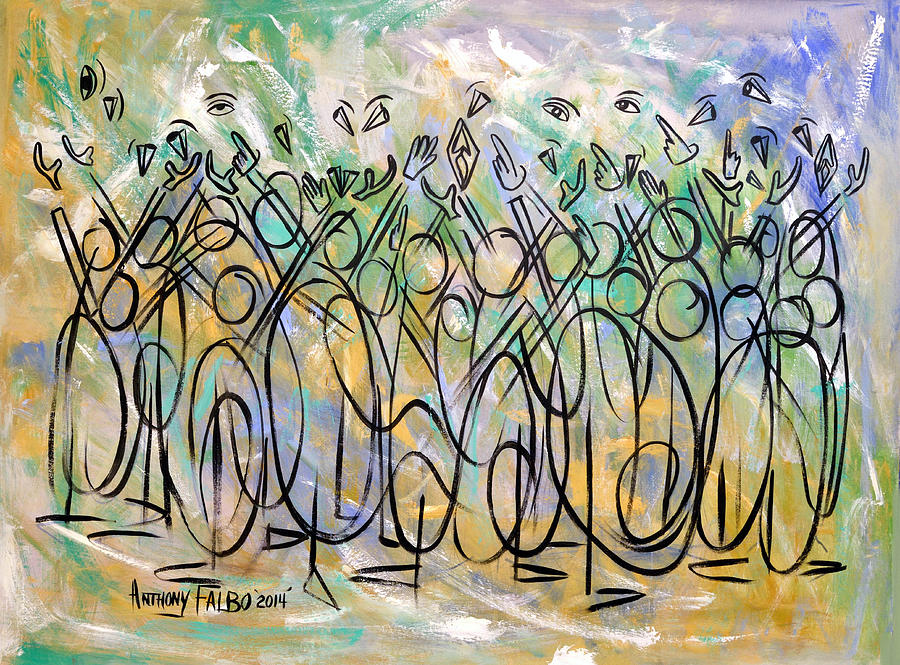
Look He’s Coming with the Clouds by Anthony Falbo, 2014

After this I looked, and there before me was a great multitude that no one could count, from every nation, tribe, people and language, standing before the throne and before the Lamb. They were wearing white robes and were holding palm branches in their hands. And they cried out in a loud voice:

“Salvation belongs to our God,
who sits on the throne,
and to the Lamb.”

All the angels were standing around the throne and around the elders and the four living creatures. They fell down on their faces before the throne and worshiped God, saying:

“Amen!
Praise and glory
and wisdom and thanks and honor
and power and strength
be to our God for ever and ever.
Amen!”

Then one of the elders asked me, “These in white robes—who are they, and where did they come from?”

I answered, “Sir, you know.”

And he said, “These are they who have come out of the great tribulation; they have washed their robes and made them white in the blood of the Lamb. Therefore,

“they are before the throne of God
    and serve him day and night in his temple;
and he who sits on the throne
    will shelter them with his presence.
‘Never again will they hunger;
    never again will they thirst.
The sun will not beat down on them,’
    nor any scorching heat.
For the Lamb at the center of the throne
    will be their shepherd;
‘he will lead them to springs of living water.’
    ‘And God will wipe away every tear from their eyes.’” (New International Version)

A simple observation of today’s text: There can only be a great multitude of people if there are a great multitude of mothers. The great multitude in the Apostle John’s vision of the end of time, had just come out of the great tribulation. And God does for them what any good mother would do: Never lets any of their children go hungry or thirsty; gets them out of harm’s way and protects them; and bends down to wipe their tears away and let them know that everything is going to be okay.

There is a day coming when followers of Jesus will see him face to face. Believers will serve the Lord continually. God’s very presence will be their permanent shelter. It will be a glorious time of unending peace, harmony, and rest.

There shall be no more worrying about how to make ends meet, no more wondering where we are going to get our needs met, and no more anxiety about the future. Injustice will be a thing of the past. Unending love and light will replace it.

First, however, before this permanent Sabbath, there will be trouble, hardship, trial, and even martyrdom. There is presently pain and suffering. Like a woman in labor, this must take place before there is the glory of new life. 

Sometimes the difficult circumstances of life seem to have no end. Yet, they will eventually pass, and we must continually keep this in mind. Christians have the hope of God’s pastoral presence forever guarding and keeping our lives if we endure to the end.

Perseverance, endurance, and pushing through hard situations are necessary to realize new and eternal life. We are not meant to just sit here on earth in some sort of holding pattern, waiting for the end to occur. Just as a pregnant woman changes her lifestyle to carry the child within, so we as Christians need to carry our souls, utilizing all kinds of spiritual practices that will help us do that well, until Jesus returns.

The Apostle John’s vision was given to believers in hardship who needed to persevere when things were tough. Giving them a glimpse of the glorious ending was one way of helping them in the present to live for Jesus Christ, despite the pain.

There’s nothing quite like a mother’s love. With the security of that love, we can live in healthy ways, enduring and persevering through difficulty and adversity. God’s love enables us to live securely in five ways:

  1. Not being afraid to fail.

That’s because, for the believer, we know the ending. We may, at times, feel like colossal failures, yet because the Lord is with us, we have nothing to fear. Being secure in our identity as God’s people enables us to step out and engage the world.

“It is not the critic who counts; not the man who points out how the strong man stumbles, or where the doer of deeds could have done them better. The credit belongs to the man who is actually in the arena, whose face is marred by dust and sweat and blood; who strives valiantly; who errs, who comes up short again and again, because there is no effort without error and shortcoming; but who does actually strive to do the deeds; who knows great enthusiasms, the great devotions; who spends himself in a worthy cause; who at the best knows in the end the triumph of high achievement, and who at the worst, if he fails, at least fails while daring greatly, so that his place shall never be with those cold and timid souls who neither know victory nor defeat.”

Theodore Roosevelt

When I am afraid,
    I put my trust in you.
I trust God, so I am not afraid of what people can do to me!
    I praise God for his promise to me. (Psalm 56:3-4, ERV)

2. Taking small steps of faith.

We can incrementally improve ourselves daily through our growth in grace. We don’t need to always do big things for God. We can do small acts of kindness with big love. That is likely what your own mother modeled for you. All big things come from small beginnings. The seed of every habit is a single, tiny decision. As that decision is repeated, over and over, a habit sprouts and grows stronger.

Continue to grow in the grace and knowledge of our Lord and Savior Jesus Christ. To him be the glory, now and forever! Amen. (2 Peter 3:18, GNT)

Love the Lord your God with all your heart, all your soul, all your mind, and all your strength. ’The second most important command is this: ‘Love your neighbor the same as you love yourself.’ These two commands are the most important. (Mark 12:30-31, ERV)

3. Being able to identify resistance.

With an awareness of God with us, we are able to name the obstacles, impediments, and challenges to perseverance. Acknowledging what hinders us, gives us the power to choose how to handle it. Our very survival depends on our ability to stay awake, to adjust to new ideas, to remain vigilant and to face the challenge of change.

We should remove from our lives anything that would slow us down and the sin that so often makes us fall. We must never stop looking to Jesus. He is the leader of our faith, and he is the one who makes our faith complete. (Hebrews 12:1-2, ERV)

4. Practicing good self-care.

The body, mind, emotions, and spirit are our vehicles to doing the will of God. So, it is imperative we steward these precious gifts of humanity with care. The only way we will make it over the long haul of our lives is through paying attention to how we carry stress in our bodies, learn to listen to it’s message, and following what we hear. Nearly everything works again if we unplug it for a few minutes… including us!

God has made us what we are. In Christ Jesus, God made us new people so that we would spend our lives doing the good things he had already planned for us to do. (Ephesians 2:10, ERV)

Surely you know that you are God’s temple and that God’s Spirit lives in you! (1 Corinthians 3:16, GNT)

5. Connecting with why you are persevering.

Losing connection with why we do what we do leads to dropping out and giving up. Yet, when we can remain vigilant to what is most important to us, it helps us push through all the sticky points of our lives. We all get stuck. And love is always the answer to getting unstuck. People don’t care what we believe; they care about why we believe it.

So, if you eat, or if you drink, or if you do anything, do it for the glory of God. (1 Corinthians 10:31, ERV)

Whatever you do, whether in speech or action, do it all in the name of the Lord Jesus and give thanks to God the Father through him. (Colossians 3:17, CEB)

Persevering and enduring throughout our lives can only be done with a great deal of encouragement – which means generous rhythms of giving love and receiving love. It’s what God does. It’s what our mothers taught and modeled for us. It’s enduring love.

Patient God, you tediously work until your plans and purposes are accomplished. As you are slowly bringing your kingdom to the world, strengthen me so that I do not give up. Help me to persevere, living and loving like Jesus, to his glory. Amen.

Ezekiel 11:1-25 – A New Heart

Then the Spirit lifted me up and brought me to the gate of the house of the Lord that faces east. There at the entrance of the gate were twenty-five men, and I saw among them Jaazaniah son of Azzur and Pelatiah son of Benaiah, leaders of the people. The Lord said to me, “Son of man, these are the men who are plotting evil and giving wicked advice in this city. They say, ‘Haven’t our houses been recently rebuilt? This city is a pot, and we are the meat in it.’ Therefore, prophesy against them; prophesy, son of man.”

Then the Spirit of the Lord came on me, and he told me to say: “This is what the Lord says: That is what you are saying, you leaders in Israel, but I know what is going through your mind. You have killed many people in this city and filled its streets with the dead.

“Therefore, this is what the Sovereign Lord says: The bodies you have thrown there are the meat, and this city is the pot, but I will drive you out of it. You fear the sword, and the sword is what I will bring against you, declares the Sovereign Lord. I will drive you out of the city and deliver you into the hands of foreigners and inflict punishment on you. You will fall by the sword, and I will execute judgment on you at the borders of Israel. Then you will know that I am the Lord. This city will not be a pot for you, nor will you be the meat in it; I will execute judgment on you at the borders of Israel. And you will know that I am the Lord, for you have not followed my decrees or kept my laws but have conformed to the standards of the nations around you.”

Now as I was prophesying, Pelatiah son of Benaiah died. Then I fell face down and cried out in a loud voice, “Alas, Sovereign Lord! Will you completely destroy the remnant of Israel?”

The word of the Lord came to me: “Son of man, the people of Jerusalem have said of your fellow exiles and all the other Israelites, ‘They are far away from the Lord; this land was given to us as our possession.’

“Therefore say: ‘This is what the Sovereign Lord says: Although I sent them far away among the nations and scattered them among the countries, yet for a little while I have been a sanctuary for them in the countries where they have gone.’

“Therefore say: ‘This is what the Sovereign Lord says: I will gather you from the nations and bring you back from the countries where you have been scattered, and I will give you back the land of Israel again.’

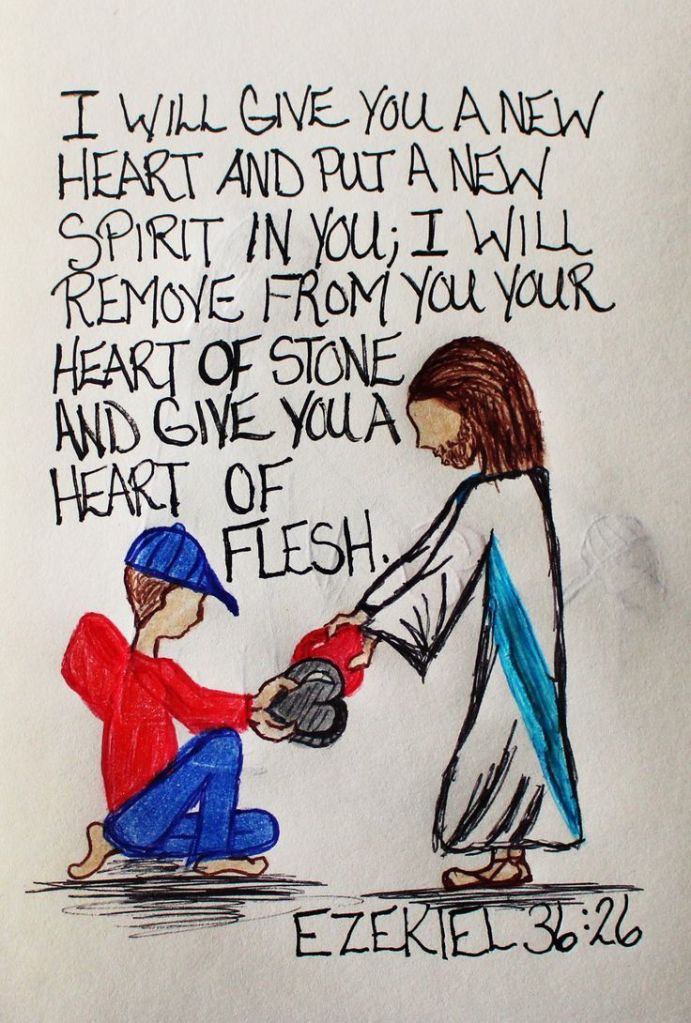
“They will return to it and remove all its vile images and detestable idols. I will give them an undivided heart and put a new spirit in them; I will remove from them their heart of stone and give them a heart of flesh. Then they will follow my decrees and be careful to keep my laws. They will be my people, and I will be their God. But as for those whose hearts are devoted to their vile images and detestable idols, I will bring down on their own heads what they have done, declares the Sovereign Lord.”

Then the cherubim, with the wheels beside them, spread their wings, and the glory of the God of Israel was above them. The glory of the Lord went up from within the city and stopped above the mountain east of it. The Spirit lifted me up and brought me to the exiles in Babylonia in the vision given by the Spirit of God.

Then the vision I had seen went up from me, and I told the exiles everything the Lord had shown me. (New International Version)

God’s heart is a heart of justice. The Lord abhors unrighteousness, injustice, and oppression. Thankfully, God will not sit idle and put up with systemic evil for long.

Ezekiel is one of those Old Testament prophets that thoroughly uncovered the true state things, especially of the human heart. Through a series of visions given to Ezekiel for the Israelite exiles, one of the main messages of the prophet is that God would give them a new heart. 

There is hope for the exile, for the one in captivity because of sin’s destructive, demeaning, and deluding power. Conversely, for those conforming to such ways, for the ones who caused the exile of others, the high Judge of the universe will deal with them according to their errant and rascally ways.

Dark shadows exist within the human heart. Although humanity has a great potential for altruistic good, people also have a large capacity for evil. Arrogant pride, self-centered behavior, and sheer ignorance can take such root within a person’s heart, as well as the heart of an organization or institution, that oppression becomes the norm, with fat cats ruling over an indigent people.

At best, the heart apart from God contains a miniscule vestige of its ancient Creator’s image; at worst, the heart is desperately wicked and on a highway to hell. 

The issue, then, is whether the heart only needs to be modified, or whether there is needed a complete heart transplant. The prophet makes it quite clear which option must be done.

Jesus Christ sacrificed himself on the cross so that we could be transformed into new people. He did not come to tweak a few things in life and improve upon it – he came to bring wholesale change and transform the heart. 

If all we needed was a motivational speaker who would inspire our hearts to live better and reach our personal goals, then we would have not needed an incarnation, a crucifixion, a resurrection and ascension. Jesus is the risen Lord and Savior who replaces our hard stubborn hearts with a soft new heart of flesh. 

We need transformation of life, not life modification.

Awesome God, you have graciously and surgically removed my old heart, which was bound for destruction, and replaced it with a new heart, oriented toward living and loving like the Lord Jesus. May my heart always be inclined to the doing of your will, in the power of your Holy Spirit. Amen.

Habakkuk 3:2-15 – Coming to Grips with Injustice

Statue of the Prophet Habakkuk, by Donatello c.1425 in Florence, Italy

I know your reputation, Lord,
and I am amazed
    at what you have done.
Please turn from your anger
    and be merciful;
do for us what you did
    for our ancestors.

You are the same Holy God
who came from Teman
    and Paran to help us.
The brightness of your glory
    covered the heavens,
and your praises were heard
    everywhere on earth.
Your glory shone like the sun,
and light flashed from your hands,
    hiding your mighty power.
Dreadful diseases and plagues
marched in front
    and followed behind.
When you stopped,
    the earth shook;
when you stared,
    nations trembled;
when you walked
    along your ancient paths,
eternal mountains and hills
    crumbled and collapsed.
The tents of desert tribes
in Cushan and Midian
    were ripped apart.

Our Lord, were you angry
with the monsters
    of the deep?
You attacked in your chariot
    and wiped them out.
Your arrows were ready
    and obeyed your commands.

You split the earth apart
    with rivers and streams;
mountains trembled
    at the sight of you;
rain poured from the clouds;
    ocean waves roared and rose.
The sun and moon stood still,
while your arrows and spears
    flashed like lightning.

In your furious anger,
    you trampled on nations
to rescue your people
    and save your chosen one.
You crushed a nation’s ruler
and stripped his evil kingdom
    of its power.
His troops had come like a storm,
hoping to scatter us
    and glad to gobble us down.
To them we were refugees
    in hiding—
but you smashed their heads
    with their own weapons.
Then your chariots churned
    the waters of the sea. (Contemporary English Version)

“Willfulness must give way to willingness and surrender. Mastery must yield to mystery.”

Gerald G. May

Tucked away in the Old Testament is the little prophecy of Habakkuk. Yet it packs a punch of a message. 

The prophet was distressed over the corruption of his people, Israel. So, he complained to God about it. God responded by informing Habakkuk that judgment was coming to sinful Israel through the pagan Babylonians.

This was not what Habakkuk expected. The prophet grumbled even more about the fact that the Babylonians were much more evil than the Israelites. The Babylonians needed judgment, too! (Habakkuk 1:2-17)

Today’s Old Testament lesson is Habakkuk’s struggle to come to terms with what God was doing. He remembered the Lord’s mighty deeds and miraculous actions from the past. God brought justice to Israel and judged the powerful Egyptians.

It seems that Habakkuk wanted God to make right the corruption of Israel, but not to do it in the same way that pagan nations are handled.

“The most difficult thing I have ever had to do is follow the guidance I prayed for.”

Albert Schweitzer

We all must come to grips with the cost of justice, of truly making things right and turning corruption and oppression around. Sometimes, maybe most times, implementing justice will impact everyone in an adverse way. For there is no realistic scenario in which someone gets to call for justice, then doesn’t have to live with the consequences – even if that someone isn’t culpable for the unjust actions.

You see, we are all inextricably connected to one another. We are of the same human family. We truly are our brother’s and sister’s keeper. We don’t get to shout or throw rocks from a distance and have everything magically change with no cost to us, personally.

It took the prophet Habakkuk awhile, but he finally resolved to live without having any closure. Instead, he took the stance of faith that he had always taken. Because when all is said and done, whether we like a particular outcome, or not, we must all live by faith, trusting in the sovereign God who always does what is right.

And here is the conclusion the prophet settled upon:

Though the fig tree does not bud
    and there are no grapes on the vines,
though the olive crop fails
    and the fields produce no food,
though there are no sheep in the pen
    and no cattle in the stalls,
yet I will rejoice in the Lord,
    I will be joyful in God my Savior.

The Sovereign Lord is my strength;
    he makes my feet like the feet of a deer,
    he enables me to tread on the heights. (Habakkuk 3:17-19, NIV)

Even though the circumstances were bad, and got worse, even dire, yet the prophet chose to rejoice in the Lord. He took the path of radical trust through suffering and hardship.

One of the most significant faith experiences we can ever have is to come to the point of complete trust in God so that our happiness is not dependent upon good circumstances. 

The truth is that the believer’s joy and spiritual security is independent of what is going on around them. Even though situations might be difficult, even evil, the faithful can still rejoice because they do not need everything to go their way in order to experience happiness.

Joy is neither cheap, nor easy. Total trust in God can only really come through a serious and open engagement, even argument, with God. And the place of contentment comes from a consistent, persevering, and constant interaction with God – just like Habakkuk did.

O Lord, we are at the limits of our power to effect any sort of change, help, or service. For what we have left undone, forgive us. For what you have helped us to do, we thank you. For what must be done by others, lend your strength. Now shelter us in your peace which passes our understanding. Amen.

Luke 13:1-9 – Jesus Will Have None of It

Now there were some present at that time who told Jesus about the Galileans whose blood Pilate had mixed with their sacrifices. Jesus answered, “Do you think that these Galileans were worse sinners than all the other Galileans because they suffered this way? I tell you, no! But unless you repent, you too will all perish. Or those eighteen who died when the tower in Siloam fell on them—do you think they were more guilty than all the others living in Jerusalem? I tell you, no! But unless you repent, you too will all perish.”

Then he told this parable: “A man had a fig tree growing in his vineyard, and he went to look for fruit on it but did not find any. So, he said to the man who took care of the vineyard, ‘For three years now I’ve been coming to look for fruit on this fig tree and haven’t found any. Cut it down! Why should it use up the soil?’

“‘Sir,’ the man replied, ‘leave it alone for one more year, and I’ll dig around it and fertilize it. If it bears fruit next year, fine! If not, then cut it down.’” (New International Version)

Jesus stood in a crowd of thousands of people. They peppered him with questions about all kinds of issues and situations. Christ responded with a combination of direct exhortations and pointed parables, designed to leave the people reflecting and thinking about what he said.

Christ’s direct exhortation is this: Repent. Change your mind. Christ’s pointed parable message is this: Bear fruit. Change your behavior.

The two go together. A fruitless life points to the need for repentance; and repentance results in bearing the fruit of love, joy, peace, patience, kindness, goodness, gentleness, and self-control.

Jesus, throughout his earthly ministry, relentlessly went after the fruitless dead religion of his day. Jesus believed that such religion needed to be cut out and thrown away. 

Therefore, the Lord exposed the assumptions that people have about sin, faith, and judgment. Jesus challenged four false assumptions or presuppositions that people often hold. In dealing with them, Jesus wanted to foster a change of heart which would lead to a change in behavior.

First Wrong Assumption: Other people’s sin is more serious than mine.

It’s a common human tendency to focus on the bad things in the world what other people do, rather than focus on our own heart and life. We can always identify people who are worse sinners than us! 

The crowd believed Pontius Pilate was a terrible sinner who needed to be dealt with, and they wanted Jesus to get on board to their way of thinking. The people wanted to talk trash about the Romans.

“Repentance is nothing else but a reformation of the whole life according to the Law of God.”

John Calvin

We must beware of people who constantly bemoan the state of the world and the sins of others, while ignoring their own issues or how they might be contributing to the problem. It’s so much easier to scapegoat a person or group of people, believing that if “those people” change, then everything will be okay.

But Jesus will have none of it.

Christ steered the discussion to personal repentance. Although you and I cannot control, change, or fix anyone, we can practice self-control, change our personal habits, and be the solution to our own problems.

Everywhere we go, the world is rife with criticisms and accusations of others. It’s always somebody else’s fault for the ills of the world and even the church.

Republicans blame Democrats. Democrats blame Republicans. Anti-vaxers blame the government. The vaccinated blame the previous government. Everyone thinks that if the other changes, all will be well. 

In the church, when things aren’t right, Christians might ask things like, “Who sinned, the pastor or the congregation, the church or the denomination?” With the decline of religion in the land, we look for a scapegoat. 

But Jesus will have none of it.

Christ cut through all the scapegoating and blame-shifting by saying that every single person needs to repent, without exception. Then, Jesus upped the ante with a parable by challenging us with a very probing thought: 

Are we bearing fruit, or just taking up space? 

Whenever we howl for judgment on others, but insist on grace for ourselves, we are the ones in need of repentance.

Second Assumption: My sin isn’t that serious.

When King Frederick II, an eighteenth-century King of Prussia, was visiting a prison in Berlin, the inmates insisted they had been unjustly imprisoned – all except one. That one sat quietly in a corner, while all the rest protested their innocence. Seeing him sitting there oblivious to the commotion, the king asked him what he was there for:

“Armed robbery, your Honor.”

The king asked, “Were you guilty?”

“Yes, Sir,” he answered. “I entirely deserve my punishment.”

The king then gave an order to the guard: “Release this guilty man. I don’t want him corrupting all these innocent people.”

We may concede that we are all sinners, but then struggle with believing that our personal sin really deserves imprisonment. So, we see no need for repentance. It isn’t that bad.

But Jesus will have none of it. 

Here are some questions raised by today’s Gospel lesson: 

Do I continually locate sin outside of my life, or do I discern the sinfulness of my own heart? 

Do I believe people in hardship are more sinful than me? 

Can I envision that I must change for the church and the world to change? 

Is my life fruitful, or fruitless? 

How can I become fruitful? 

What must I repent of? 

What will happen if I don’t repent?

Third Assumption: God will not judge me.

Some might concede we are all sinners, and my own sin is bad. “But is it really so bad that God would judge me?”  Again, the two big ideas Jesus is working with here is that everyone needs repentance, and everyone needs to bear spiritual fruit in keeping with such repentance. 

Jesus alerts us that the future involves a Judgment Day. All shall be held accountable for fruit-bearing, or the lack thereof. No fruit on the branch means it will be cut down and thrown into the fire.

Jesus was talking to a crowd of people who were quite religious. They were faithful temple worshipers, and had weekly practices of giving, fasting, and prayer. But they needed to repent of trusting in self and stuff. 

They believed God would judge the evil Romans and everyone else who did not live or think like them. They were God’s people; the Lord would not judge them!

But Jesus will have none of it.

The Lord almighty looked for justice, but saw bloodshed;
    for righteousness, but heard cries of distress. (Isaiah 5:7, NIV)

Learn to do right; seek justice.
    Defend the oppressed.
Take up the cause of the fatherless;
    plead the case of the widow.

Isaiah 1:17, NIV

Jesus wants spiritual fruit in keeping with repentance. Believing the right things and doing the right service never justifies indulging in hate, rage, anger, discord, selfish ambition, envy, impatience, unkindness, and ungraciousness. Doing a particular set of religious duties never gives one a license to use their attitude, their tongue, or their life in whatever way they want.

Fourth Assumption: I have plenty of time.

Okay, other people’s sin is not worse than mine. My sin is serious. God will deal with my sin if I do not repent. But I have time to deal with it, right? I will get around to it when I get a chance. 

But Jesus will have none of it.

Jesus was establishing a sense of urgency into the crowd. Repentance is not something to put off until tomorrow. Today is the day to deal with sin. If a lack of fruitfulness persists, judgment is imminent. Jesus was not trying to scare people into repentance; he was just letting them know that procrastination puts us in a precarious position. We don’t have unlimited time. We are on the clock.   

Just because God is gracious, merciful, kind, and patient does not mean that he won’t cut the dead religion tree down.

Today is the day of repentance, the day to quit looking for everyone else to repent and change, the day to take our own sin seriously, the day to discern that God does not show favoritism and will judge all persons equally and fairly. 

Today is the day because the hour is almost here when Jesus will return to judge the living and the dead.

Conclusion

So, we must repent of a lack of fruitfulness. The spiritual fruit God is looking for is love, joy, peace, patience, kindness, goodness, faithfulness, gentleness and self-control. 

When an apple trees bear fruit, some of those apples do not just bear the apple’s skin, some the apple’s core, some the apple’s meat. No! When an apple tree bears fruit, it bears apples – whole ones with all the things that make an apple an apple. 

There is no leg to stand on with the notion that I have love, but no patience; or display a lack of peace, but practice self-control. We either have the fruit of the Spirit, or we do not! If we have some of these, but not others, we have genetically modified fruit which has not been raised in the soil of the gospel.

Each one of us needs to look in our heart in this season of Lent and accurately assess the current state of our lives before God. Then, we need to repent, to change those things which the Spirit of God identifies. And, like a farmer, we are to cultivate, fertilize, and tend to our hearts in ways that will produce a crop.

Gracious God, our sins are too heavy to carry, too real to hide, and too deep to undo. Forgive what our lips tremble to name, what our hearts can no longer bear, and what has become for us a consuming fire of judgment. Set us free from a past that we cannot change; open to us a future in which we can be changed; and grant us grace to grow more and more in your likeness and image, through Jesus Christ, the light of the world. Amen.