Amos 2:4-11 – Pay Attention to the Poor

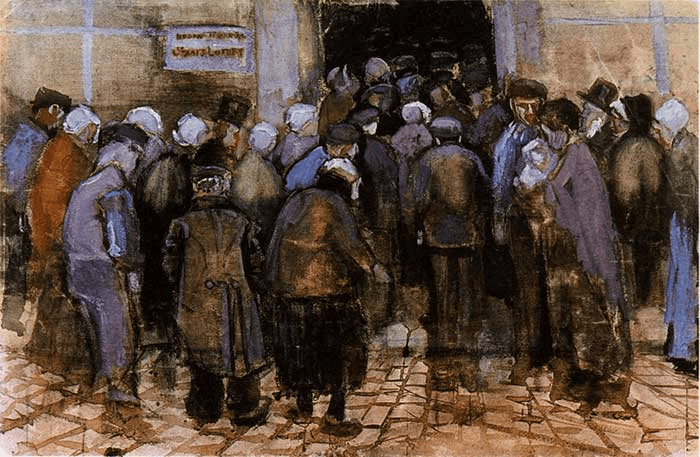
The Poor and Money by Vincent van Gogh, 1882

This is what the Lord says:

“For three sins of Judah,
    even for four, I will not relent.
Because they have rejected the law of the Lord
    and have not kept his decrees,
because they have been led astray by false gods,
    the gods their ancestors followed,
I will send fire on Judah
    that will consume the fortresses of Jerusalem.”

This is what the Lord says:

“For three sins of Israel,
    even for four, I will not relent.
They sell the innocent for silver,
    and the needy for a pair of sandals.
They trample on the heads of the poor
    as on the dust of the ground
    and deny justice to the oppressed.
Father and son use the same girl
    and so profane my holy name.
They lie down beside every altar
    on garments taken in pledge.
In the house of their god
    they drink wine taken as fines.

“Yet I destroyed the Amorites before them,
    though they were tall as the cedars
    and strong as the oaks.
I destroyed their fruit above
    and their roots below.
I brought you up out of Egypt
    and led you forty years in the wilderness
    to give you the land of the Amorites.

“I also raised up prophets from among your children
    and Nazirites from among your youths.
Is this not true, people of Israel?”
declares the Lord. (New International Version)

It’s not a sin to be poor. It is a sin to oppress, take advantage of, or exploit the poor.

Social justice isn’t something fabricated in the minds of progressive Christians. Social justice is biblical and at the heart of all sixteen prophetic books of Holy Scripture’s Old Testament.

The reason the prophets address poverty so often is that God hates injustice. God is not okay with an entire group of disadvantaged people having needed resources beyond arm’s reach – and the Lord’s ire is especially roused whenever the wealthy and powerful extort what little the poor have to begin with.

Even if there are some who tend to believe the poor are poor because of laziness or an unwillingness to work hard, you will not find that idea amongst the biblical prophets. You will, in fact, find just the opposite: fat cats who lie around with their privileged lives, not lifting a finger to help the underprivileged.

The Church does have a role in combating systemic oppression of the poor and needy, and the prophet Amos wants those who claim the name of the Lord to know it.

Amos not only harangued the nations who surrounded Israel and Judah of their sinful stances toward the poor, he leveled the very same message at God’s people who did the same things. Although the Israelites enjoyed a special status with God, that did not mean the Lord had a different set of values or expectations for them when it came to basic human justice.

Mistreating one another is a universal sin and all nations everywhere will be held accountable by God for how they treat the least persons among them. There is such a thing as universal human rights – and the godly person will care about this, at the least, because God cares.

Amos almost exclusively hones-in on the economic sins of the wealthy: taking away needed clothing from those who default on loans; assessing unnecessary and exorbitant fines; taking levies of grain; and living a lavish lifestyle on the backs of the less fortunate.

It was these continually repeated sins against one another which eventually led to both Israel and Judah being conquered by pagan nations and carried into exile.

Today, you will still easily find people being used by others, as if they were mere inhuman machines, here on this earth to make money for those who already have plenty of it. They’d sell their own grandmother if they could get a good price on her. Extortion and oppression are like eating and drinking to them.

Yet, such persons, groups, even entire governments are only stockpiling judgment upon themselves for the God whom they must eventually give an account in how they lived their lives on this earth.

Instead, intentionally paying attention to the poor and treating them with equity will involve the following:

  1. Donating to charitable causes, such as church denominational relief funds, and respected international organizations who can make your contributions count.
  2. Agitating politicians for better policies toward the poor. Writing letters, sending emails, and making phone calls are simple ways of letting your voice be heard in a democratic society.
  3. Learning about worldwide and local poverty. It’s hard not to be involved whenever there is pertinent information. Putting names and faces to struggling people is a must, as well as understanding some of the dynamics that go into poverty.
  4. Raising awareness of significant issues related to poverty and how it impacts the poor. Find others who care about this and share insights and understanding about how to educate others.
  5. Volunteering at a local organization who works with the poor.

There are many more ways to make a difference. As biblically informed people, care of the poor and being concerned for issues of poverty is a must, because the Lord is a Just God with a heart of justice for the disadvantaged, underprivileged, and needy among us.

Now if there are some poor persons among you, say one of your fellow Israelites in one of your cities in the land that the Lord your God is giving you, don’t be hard-hearted or tightfisted toward your poor fellow Israelites. To the contrary! Open your hand wide to them. You must generously lend them whatever they need. (Deuteronomy 15:7-8, CEB)

Just and merciful God, you give honor to the least, the forgotten, the overlooked, and the misjudged.

You give first place to the last, the left behind, the misunderstood, and the undervalued.

You give a warm welcome to the lost, the orphaned, the abandoned, and the destitute.

Help us, your people, to be your ears in listening to their cries.

Help us to be your voice speaking words of encouragement, affirmation, and acceptance.

Help us to be your feet walking beside those in need; and your hands to clothe, feed and shelter them.

You came for the least, the lost and last of this world. Lord, in your mercy, hear our prayer. Amen.

Psalm 59 – Victimization Needs a Voice

Oh, my God, deliver me from my enemies;
    put me out of reach from those who rise up against me.
Deliver me from evildoers;
    save me from the bloodthirsty.
Look at how they lie in ambush for my life!
    Powerful people are attacking me, Lord—
        but not because of any error or sin of mine.
    They run and take their stand—
        but not because of any fault of mine.

Get up when I cry out to you!
    Look at what’s happening!
You are the Lord God of heavenly forces,
    the God of Israel!
Wake up and punish all the nations!
    Grant no mercy to any wicked traitor!

They come back every evening,
    growling like dogs,
    prowling around the city.
See what they belch out with their mouths:
    swords are between their lips!
        Who can listen to them?
But you, Lord, laugh at them.
    You mock all the nations.
I keep looking for you, my strength,
    because God is my stronghold.
My loving God will come to meet me.
    God will allow me to look down on my enemies.

Don’t kill them, or my people might forget;
    instead, by your power
    shake them up and bring them down,
        you who are our shield and my Lord.
For the sin of their mouths,
    the words that they speak,
    let them be captured in their pride.
For the curses and lies they repeat,
        finish them off in anger;
        finish them off until they are gone!
Then let it be known to the ends of the earth
    that God rules over Jacob.

They come back every evening,
    growling like dogs,
    prowling around the city.
They roam about for food,
    and if they don’t get their fill,
    they stay all night.
But me? I will sing of your strength!
    In the morning I will shout out loud
    about your faithful love
        because you have been my stronghold,
        my shelter when I was distraught.
I will sing praises to you, my strength,
    because God is my stronghold,
    my loving God. (Common English Bible)

David was in a major pickle.

He was wildly successful as a member of King Saul’s court and a captain in his army. David fought Saul’s battles and won major victories. And this put him in the position of being the object of jealousy from Saul. So much so, that the king was ready to snuff out David’s life. David had done everything Saul had asked of him, and he was now about to be repaid by becoming a hunted man.

Today’s psalm was crafted by David in this awkward space between being at home but about to be on the run. It was a time of high anxiety and hypervigilance, of trying to come to grips with what was happening and about to happen.

Honestly, I really don’t like it when people poo-poo and invalidate other people’s emotions.

Every feeling which comes up for us is meant to be acknowledged and paid attention to.

Otherwise, if every feeling is tossed into some internal trash bin, those emotions eventually come out sideways,  looking like the stereotypical uptight and inflexible person who chronically complains and irritates others with their stone-faced tight-lipped sanctimonious policing of another’s feelings.

Such persons are aghast that psalms like today’s are even in the Bible. Biblical scholars identify these psalms as “imprecatory” psalms because they are curses, giving vent to the bitter anger and painful wonderings of the inner person.

A few years back, I was a chaplain in a large care facility. One of the residents was a retired Episcopal priest. He developed a brain tumor and had surgery to remove it. However, getting rid of the tumor damaged his ability to speak.

So, when I came to see him after his return to the nursing home, he labored intensely just to get a simple sentence out. And after each struggle to speak he would swear and utter some expletive, then apologize to me.

Finally, I said to him, “There’s no need to apologize. You have spent your life using words to bless and help others and now that has been robbed of you. You are angry. I am angry. Let’s just sit here and swear together about it.”

We raged together about disease. We swore like sailors about injustice. We cried out to God for vengeance on evil (and I was secretly praying that no one would walk into the room while we were doing this).

Whereas psalms of lament express deep sadness, imprecatory psalms rage with deep-seated anger.

With no cursing of disease, sickness, and death, it comes out sideways in this unkind sort of “snarky-ness” toward each other. In fact, one day I was speaking with someone at work, and she said to me, “Everyone was so mean to each other yesterday that I went home and cried.”

What I am proposing here is that our anger, our rage, even our vengeance needs recognition, just like our sadness does. Our bitterness must have an outlet, not directed toward one another, but toward the evil itself – and even toward God because God is big enough to handle our rage, whereas other humans are not.

Victimization needs a voice, and a bit of raging and cursing is the means to do it.

Giving voice to our deep anger is cathartic and therapeutic. Our speech needs to be congruent with the intensity of our pain because wherever there are no valued words of assault for victims, the risk of hurting each other is much higher.

Despair with no voice and no one to hear will eventually transition to harming others.

Holy One, you do not distance yourself from the pain of your people, but in Jesus bear that pain with us and bless all who suffer at another’s hands. Make our hurting holy! With your cleansing love, bring healing and strength; and by your justice, lift us up so that we may again rejoice in you, through Christ, my Lord. Amen.

Leviticus 19:9-18 – Be a Good Neighbor

When you reap the harvest of your land, do not reap to the very edges of your field or gather the gleanings of your harvest. Do not go over your vineyard a second time or pick up the grapes that have fallen. Leave them for the poor and the foreigner. I am the Lord your God.

Do not steal.

Do not lie.

Do not deceive one another.

Do not swear falsely by my name and so profane the name of your God. I am the Lord.

Do not defraud or rob your neighbor.

Do not hold back the wages of a hired worker overnight.

Do not curse the deaf or put a stumbling block in front of the blind but fear your God. I am the Lord.

Do not pervert justice; do not show partiality to the poor or favoritism to the great but judge your neighbor fairly.

Do not go about spreading slander among your people.

Do not do anything that endangers your neighbor’s life. I am the Lord.

Do not hate a fellow Israelite in your heart. Rebuke your neighbor frankly so you will not share in their guilt.

Do not seek revenge or bear a grudge against anyone among your people but love your neighbor as yourself. I am the Lord. (New International Version)

All of these Old Testaments commands to the ancient Israelites are a development and expansion upon the basic core Ten Commands or Words given by God to Moses.

Those core commands are based in the character of God. That same character is to be the normal daily lived experience of God’s people.

The Levitical instructions are a fleshing-out of God’s basic commands for a specific people in their particular social, economic, and historical situation.

Although we need not, as modern folk, strictly observe the commands, as they are culturally constructed, we very much need to fulfill the ethics and morality which are behind the specific instructions.

Today’s Old Testament lesson has to do with being a good neighbor – a person who conscientiously lives in community with others and pays attention to the collective needs and wants of everyone. It is to live into God’s overarching ethic for the common good of all persons.

A commitment to community life needs good neighbors. They are characterized by the following virtues:

Sacrifice

Israel was chiefly an agrarian society. So, when the season of harvest came, the workers gleaning the fields were to only go over it once. That way, the poor and less fortunate could come behind and pick up what the workers missed or dropped.

Any landowner who instructed the workers to keep working until they got every scrap of grain or fruit was being cruel to the poor. Merciful and generous owners would, conversely, instruct the workers to leave a bit behind and not get everything.

Since God sacrifices on behalf of humanity, so we, too, are to make sacrifices which benefit the common good of all persons in the community.

Live a life filled with love, following the example of Christ. He loved us and offered himself as a sacrifice for us, a pleasing aroma to God. (Ephesians 5:2, NLT)

A sacrificial spirit, not a self-indulgent one, is what God is looking for in a good neighbor.

Honesty

Cheating, lying, stealing, and deceit have absolutely no place in the kingdom of God. Instead, honest dealings with others, always being above board in all matters, is of upmost importance to God.

Witnesses in court are expected to speak the truth without falsehood. Business dealings are to have accurate weights and measures. Integrity and trustworthiness are the building blocks of any good society.

Since God is truth, so we, too, are to live into truth through being honest in all we say and do.

Have nothing to do with a false charge and do not put an innocent or honest person to death, for I will not acquit the guilty. Do not accept a bribe, for a bribe blinds those who see and twists the words of the innocent. (Exodus 23:7-8, NIV)

An honest spirit, not a thieving one, is what God is looking for in a good neighbor.

Fairness

In the ancient world, and still in many parts of the world today, workers were paid at the end of the day for their day’s work. Bosses who withheld expected wages till the next day were quite literally depriving a family of their supper.

For those who are not able to do a solid day’s work, such as the blind and the handicapped, it’s bad enough to simply ignore them, because God is attentive to their plight. That situation is exacerbated exponentially, whenever someone or a group of people, decide to make such persons’ lives even harder than they already are.

Since God is fair in all dealings, so we, too, are to extend fairness to all without any prejudice or favoritism.

The Lord watches to see if we are fair or if we cheat others. (Proverbs 16:11, CEV)

A fair spirit, not an exploitive one, is what God is looking for in a good neighbor.

Justice

Unequal treatment is about as far from God as one can get. Being concerned only about those with similar political views, economic interests, or spiritual inclinations is a gross practice of injustice. It denies the ethic of the common good of all in favor of the common good of some.

Since God is just in all things, so we, too, are to uphold biblical justice for our fellow humanity, no matter who they are or where they come from.

Never deprive foreigners and orphans of justice. And never take widows’ clothes to guarantee a loan. (Deuteronomy 24:17, GW)

A spirit of justice, not injustice, is what God is looking for in a good neighbor.

Love

Hate is the inevitable result of holding onto anger through nursing a grudge and holding onto bitterness. It fails to speak up and speak out.

Love, however, assertively addresses anger and seeks to make things right in a calm and concerned way. Love attacks problems, not people.

Since God is love, so we, too are to love one another.

Dear friends, let us love one another, for love comes from God. (1 John 4:7, NIV)

Don’t let evil get the best of you; get the best of evil by doing good. (Romans 12:21, MSG)

A spirit of love, not a hateful vengeful one, is what God is looking for in a good neighbor.

A good neighbor is one who seeks the common good of all persons because God is good, all the time, and always does what is right, just, and fair.

Gracious God and Father, in a world of fear and suspicion, teach us that love is the only means to conquer fear.

Loving Lord Jesus, Son of God, in a world full of anger and frustration, teach to overturn the tables and tear down the fences which turn away the hungry and homeless; and to practice hospitality without prejudice.

Blessed Holy Spirit of God, in a world of indifference and ignorance, teach us wisdom, to be caring of one another, and to protect one another.

Blessed Holy Trinity, the God whom we serve, help us to know the peace that steals gently in through quiet acts of kindness, just as peace is always within you as one God, now and forever. Amen.

Revelation 7:9-17 – Enduring Love

Look He’s Coming with the Clouds by Anthony Falbo, 2014

After this I looked, and there before me was a great multitude that no one could count, from every nation, tribe, people and language, standing before the throne and before the Lamb. They were wearing white robes and were holding palm branches in their hands. And they cried out in a loud voice:

“Salvation belongs to our God,
who sits on the throne,
and to the Lamb.”

All the angels were standing around the throne and around the elders and the four living creatures. They fell down on their faces before the throne and worshiped God, saying:

“Amen!
Praise and glory
and wisdom and thanks and honor
and power and strength
be to our God for ever and ever.
Amen!”

Then one of the elders asked me, “These in white robes—who are they, and where did they come from?”

I answered, “Sir, you know.”

And he said, “These are they who have come out of the great tribulation; they have washed their robes and made them white in the blood of the Lamb. Therefore,

“they are before the throne of God
    and serve him day and night in his temple;
and he who sits on the throne
    will shelter them with his presence.
‘Never again will they hunger;
    never again will they thirst.
The sun will not beat down on them,’
    nor any scorching heat.
For the Lamb at the center of the throne
    will be their shepherd;
‘he will lead them to springs of living water.’
    ‘And God will wipe away every tear from their eyes.’” (New International Version)

A simple observation of today’s text: There can only be a great multitude of people if there are a great multitude of mothers. The great multitude in the Apostle John’s vision of the end of time, had just come out of the great tribulation. And God does for them what any good mother would do: Never lets any of their children go hungry or thirsty; gets them out of harm’s way and protects them; and bends down to wipe their tears away and let them know that everything is going to be okay.

There is a day coming when followers of Jesus will see him face to face. Believers will serve the Lord continually. God’s very presence will be their permanent shelter. It will be a glorious time of unending peace, harmony, and rest.

There shall be no more worrying about how to make ends meet, no more wondering where we are going to get our needs met, and no more anxiety about the future. Injustice will be a thing of the past. Unending love and light will replace it.

First, however, before this permanent Sabbath, there will be trouble, hardship, trial, and even martyrdom. There is presently pain and suffering. Like a woman in labor, this must take place before there is the glory of new life. 

Sometimes the difficult circumstances of life seem to have no end. Yet, they will eventually pass, and we must continually keep this in mind. Christians have the hope of God’s pastoral presence forever guarding and keeping our lives if we endure to the end.

Perseverance, endurance, and pushing through hard situations are necessary to realize new and eternal life. We are not meant to just sit here on earth in some sort of holding pattern, waiting for the end to occur. Just as a pregnant woman changes her lifestyle to carry the child within, so we as Christians need to carry our souls, utilizing all kinds of spiritual practices that will help us do that well, until Jesus returns.

The Apostle John’s vision was given to believers in hardship who needed to persevere when things were tough. Giving them a glimpse of the glorious ending was one way of helping them in the present to live for Jesus Christ, despite the pain.

There’s nothing quite like a mother’s love. With the security of that love, we can live in healthy ways, enduring and persevering through difficulty and adversity. God’s love enables us to live securely in five ways:

  1. Not being afraid to fail.

That’s because, for the believer, we know the ending. We may, at times, feel like colossal failures, yet because the Lord is with us, we have nothing to fear. Being secure in our identity as God’s people enables us to step out and engage the world.

“It is not the critic who counts; not the man who points out how the strong man stumbles, or where the doer of deeds could have done them better. The credit belongs to the man who is actually in the arena, whose face is marred by dust and sweat and blood; who strives valiantly; who errs, who comes up short again and again, because there is no effort without error and shortcoming; but who does actually strive to do the deeds; who knows great enthusiasms, the great devotions; who spends himself in a worthy cause; who at the best knows in the end the triumph of high achievement, and who at the worst, if he fails, at least fails while daring greatly, so that his place shall never be with those cold and timid souls who neither know victory nor defeat.”

Theodore Roosevelt

When I am afraid,
    I put my trust in you.
I trust God, so I am not afraid of what people can do to me!
    I praise God for his promise to me. (Psalm 56:3-4, ERV)

2. Taking small steps of faith.

We can incrementally improve ourselves daily through our growth in grace. We don’t need to always do big things for God. We can do small acts of kindness with big love. That is likely what your own mother modeled for you. All big things come from small beginnings. The seed of every habit is a single, tiny decision. As that decision is repeated, over and over, a habit sprouts and grows stronger.

Continue to grow in the grace and knowledge of our Lord and Savior Jesus Christ. To him be the glory, now and forever! Amen. (2 Peter 3:18, GNT)

Love the Lord your God with all your heart, all your soul, all your mind, and all your strength. ’The second most important command is this: ‘Love your neighbor the same as you love yourself.’ These two commands are the most important. (Mark 12:30-31, ERV)

3. Being able to identify resistance.

With an awareness of God with us, we are able to name the obstacles, impediments, and challenges to perseverance. Acknowledging what hinders us, gives us the power to choose how to handle it. Our very survival depends on our ability to stay awake, to adjust to new ideas, to remain vigilant and to face the challenge of change.

We should remove from our lives anything that would slow us down and the sin that so often makes us fall. We must never stop looking to Jesus. He is the leader of our faith, and he is the one who makes our faith complete. (Hebrews 12:1-2, ERV)

4. Practicing good self-care.

The body, mind, emotions, and spirit are our vehicles to doing the will of God. So, it is imperative we steward these precious gifts of humanity with care. The only way we will make it over the long haul of our lives is through paying attention to how we carry stress in our bodies, learn to listen to it’s message, and following what we hear. Nearly everything works again if we unplug it for a few minutes… including us!

God has made us what we are. In Christ Jesus, God made us new people so that we would spend our lives doing the good things he had already planned for us to do. (Ephesians 2:10, ERV)

Surely you know that you are God’s temple and that God’s Spirit lives in you! (1 Corinthians 3:16, GNT)

5. Connecting with why you are persevering.

Losing connection with why we do what we do leads to dropping out and giving up. Yet, when we can remain vigilant to what is most important to us, it helps us push through all the sticky points of our lives. We all get stuck. And love is always the answer to getting unstuck. People don’t care what we believe; they care about why we believe it.

So, if you eat, or if you drink, or if you do anything, do it for the glory of God. (1 Corinthians 10:31, ERV)

Whatever you do, whether in speech or action, do it all in the name of the Lord Jesus and give thanks to God the Father through him. (Colossians 3:17, CEB)

Persevering and enduring throughout our lives can only be done with a great deal of encouragement – which means generous rhythms of giving love and receiving love. It’s what God does. It’s what our mothers taught and modeled for us. It’s enduring love.

Patient God, you tediously work until your plans and purposes are accomplished. As you are slowly bringing your kingdom to the world, strengthen me so that I do not give up. Help me to persevere, living and loving like Jesus, to his glory. Amen.