On the Importance of Hospitality (3 John 9-12)

A mosaic of the Apostle John, at the Monastery of St. John the Theologian, in Patmos, Greece

I have written something to the church, but Diotrephes, who likes to put himself first, does not welcome us. So if I come, I will call attention to what he is doing in spreading false charges against us. And not content with those charges, he refuses to welcome the brothers and sisters and even prevents those who want to do so and expels them from the church.

Beloved, do not imitate what is evil, but imitate what is good. Whoever does good is from God; whoever does evil has not seen God. Everyone has testified favorably about Demetrius, and so has the truth itself. We also testify for him, and you know that our testimony is true. (New Revised Standard Version)

I believe in an egalitarian world. Ideally, humanity is meant to live in equity with one another. Humility, meekness, and gentleness are to be the inner dispositions of a person’s life.

These virtues work themselves out in being concerned for the common good of all, laboring toward just and righteous ways of living for everyone and sharing our lives, as well as our resources, with each other. Viewing one another as equals inevitably leads to gracious hospitality.

However, in a world of power disparities, and privileged inequities, are attitudes of seeking attention, a perceived need to always win and be first, and tight-fisted control of authority and money. The common good of all persons is scaled back to be the concern for the common good of some. There is a failure to regard the weak, poor, and vulnerable as legitimate members of the community.

The Apostle John wrote his short succinct letter in a concern that the church may be following a leader who was taking them down a bad path – a road leading to injustice where power and privilege remain with a few, and perhaps even one. John’s plainspoken exhortation was to judge rightly between what is good and bad, and then imitate the good while forsaking the bad.

Hospitality is the true litmus test between the good and the bad.

An openness to the stranger, the immigrant, the migrant, the alien, the foreigner, the newcomer, and the outsider characterizes authentic fellowship.

Being closed to such persons and having a xenophobic bent to others who are different is the mark of unwelcoming and inhospitable people.

Hospitality serves others, whereas being inhospitable cajoles others to serve our needs.

Jesus, the Lord of all, did not come to this earth for people to serve him. Christ came to serve others, and to give his life to save many people (Matthew 20:28; Mark 10:45; John 13:1-17). We are to imitate the loving service and radical hospitality of the Lord Jesus. He is our example. We are to imitate Christ.

We must have both orthodoxy (right belief) and orthopraxy (right practice). Both go together like a hand in a glove. Good actions are the result of good and proper beliefs. The following are some thoughts about this nexus between belief and practice:

  • Hospitality (literally “love of the stranger”) is a way of life fundamental to orthodox Christianity, based in the person and work of Jesus
  • God is hospitable and loves the outsider, welcoming them into the dance of the Trinity, and provides for them; our human hospitality is to reflect this divine welcome
  • Hospitality means extending to another a kindness typically reserved for family or friends
  • The teaching of the New Testament emphasizes the practice of hospitality (Luke 14:12-14; Matthew 25:31-46)
  • The consistent witness of church history is to lift up and hold Christian hospitality.

“Whatever person you meet who needs your aid, you have no reason to refuse to help them.”

John Calvin

This was no mere theoretical advice for Calvin, whose ministry center of Geneva, Switzerland swelled with French Huguenot refugees fleeing persecution. Calvin, always the theologian, grounded his understanding of hospitality in the divine:

“We should not regard what a person is and what they deserve but we should go higher – that it is God who has placed us in the world for such a purpose that we be united and joined together. God has impressed the divine image in us and has given us a common nature, which should incite us to provide one for the other.”

John Calvin
  • Hospitality is a practice which integrates both respect and care. St. John Chrysostom warned his congregation to show “excessive joy” when offering hospitality to avoid shaming the recipient of care.
  • Biblical hospitality does not need to know all the details of someone’s life before extending care. If Christ forgave and healed those who injured him, how could we neglect even a starving murderer? 
  • True hospitality involves a face-to-face relationship of encouragement and respect – not just a distant giving of alms. Hospitable persons pay attention to others and share life with them.
  • The great twin concerns of hospitality are universalizing the neighbor and personalizing the stranger. One reason why many of the rich have little sympathy for the poor is because they seldom visit them. Hospitality depends on us recognizing our commonalities with strangers rather than our differences.
  • This is how we evaluate our hospitality: Did we see Christ in them? Did they see Christ in me?

Hospitable God:

Give us eyes to see the deepest needs of people.

Give us hearts full of love for our neighbors as well as for the strangers we meet.

Help us understand what it means to love others as we love ourselves.

Teach us to care in a way that strengthens those who are sick.

Fill us with generosity so we feed the hungry, clothe the naked, and give drink to the thirsty.

Let us be a healing balm to those who are weak and lonely and weary by offering our kindness to them.

May we remember to listen, smile, and offer a helping hand each time the opportunity presents itself. And may we conspire to create opportunities to do so.

Give us hearts of courage to risk loving our enemy.

Inspire us to go out of our way to include outsiders.

Help us to be welcoming and include all whom you send our way.

Let us be God’s hospitality in the world. Amen.

Hospitality Is a Matter of Life and Death (Jeremiah 49:7-11)

Concerning Edom, the Lord of heavenly forces proclaims:
Is wisdom no longer in Teman?
    Has good sense vanished from the perceptive?
        Are they no longer wise?
Turn, flee, and run for cover,
    you inhabitants of Dedan.
I’m bringing disaster on Esau:
    its day of reckoning.
If workers would come to you to pick grapes,
    they would at least leave a few on the vine.
If thieves would come in the night,
    they would take only what they needed.
But me? I will strip Esau bare.
    I will expose his hiding places,
        and he will find no place to take cover.
His offspring, family, and acquaintances will perish,
    and there will be no one left to say,
“Leave me your orphans,
    and I’ll look after them;
        trust your widows into my care.” (Common English Bible)

You might be saying to yourself, “What in tarnation is this crazy fool doing, having a Bible lesson on this here piece of Scripture that means nothing to you nor me?” Oh, really? To which I say, “What darned fool never gets into the backwoods of the prophets?”

Esau was the twin brother of Jacob, a real mountain man sort of guy. Being outdoors and hunting game was his thing. His descendants were the Edomites. They inhabited the southwest portion of what is now the country of Jordan, and the southeastern portion of Israel and Palestine in the middle east. It’s a territory made up of a network of clefts and caves in the rocks.

Edom tended to think of themselves as being invulnerable, the man’s man. They always had the high ground and knew how to handle themselves in the wilderness. For anyone interested in taking the Edomites down, it would be very difficult to dislodge them from their rocky fortress home. Yet, there is no place that is not vulnerable to the eye and purpose of Yahweh.

Site of an ancient Edomite stronghold in present day Jordan

Just as there was bad blood between Jacob and Esau, so also the Israelites and Edomites did not like each other throughout their history. Edom had no intention of helping their ancestral brother, and even participated with the Babylonians in the conquest of Jerusalem. What’s more, they rejoiced over the fall of the city – all of which raised the eyebrow of God.

Lord, remember what the Edomites did
        on Jerusalem’s dark day:
    “Rip it down, rip it down!
    All the way to its foundations!” they yelled. (Psalm 137:7, CEB)

Turns out that the Lord listened to the psalmist and remembered. The destruction of Edom came about because of two overlapping sins: the profound lack of hospitality; and the overt participation of doing harm. To refuse hospitality is to put someone or a group of people in harm’s way. It also betrays an attitude that works out in eventually becoming an agent of harm to those they could have helped.

In this vein, Edom is much more akin to Sodom and Gomorrah than to its brother Israel.

“Now this was the sin of your sister Sodom: She and her daughters were arrogant, overfed and unconcerned; they did not help the poor and needy.” (Ezekiel 16:49, NIV)

When the ancient Israelites, after having been delivered by God from Egyptian bondage, and traveling in the wilderness, came upon Edom, they made a request of their brother:

“Please let us cross through your land. We won’t pass through any field or vineyard, or drink water from any well. We will walk on the King’s Highway and not turn to the right or to the left until we have crossed your border.”

Edom said to him, “You won’t cross through, or I will come out against you with a sword.” (Numbers 20:17-18, CEB)

It does no one any good to refuse offering hospitality to others. Both the one in need, and the one being inhospitable, find themselves in dire straits. The reason the Lord cares so much about this is that God, at the core, is hospitable – loving the stranger and granting aid to the alien.

Jesus, upholding this long tradition of divine caring and prophetic utterance, had this to say to those who were indifferent:

“Depart from me, you who are cursed, into the eternal fire prepared for the devil and his angels. For I was hungry and you gave me nothing to eat, I was thirsty and you gave me nothing to drink, I was a stranger and you did not invite me in, I needed clothes and you did not clothe me, I was sick and in prison and you did not look after me.”

They also will answer, “Lord, when did we see you hungry or thirsty or a stranger or needing clothes or sick or in prison, and did not help you?”

He will reply, “Truly I tell you, whatever you did not do for one of the least of these, you did not do for me.”

Then they will go away to eternal punishment, but the righteous to eternal life. (Matthew 25:41-46, NIV)

It is high time that we, as a contemporary people, take the Old Testament prophets seriously, and adopt the divine heart for the alien, the stranger, the fatherless, the widow, and all who find themselves unable to meet their own basic needs.

And when a refusal of hospitality happens on a national scale, the people of that nation will discover themselves a bygone country – much like Edom and the Edomites of old.

Whenever the national zeitgeist translates into draconian tactics for keeping “those other people” at a distance and say to them, “get out of our country,” without any hospitality, that nation has come under the eye of a holy God who has a zero tolerance policy toward base unkindness and purposeful callousness.

So, we ought to have the fear of God when we believe we have a moral right to exclude immigrants because they may potentially harm citizens by taking away jobs, reducing wages, and draining social services. This line of reasoning is not consistent with the way of Christ.

I, for one, believe we have failed to live up to the moral universalism we pretend lies at the heart of the United States’ theories and political philosophies; and we have not been willing to accept the radical changes needed to accommodate even a modest notion of hospitality for those who have been the targets for hate crimes based upon their race, ethnicity, ancestry, religion, and gender.

The age old sin of this world is that the wealthy and the privileged, although giving out of their largess, have no intention of sharing power and would never think of following the example of the poor widow who gave everything she had.

So, God said of the Edomites, “I will ‘Edom’ up!” And like the wild game their ancestor Esau killed and ate, they were gone. Turns out that hospitality is really a matter of life and death.

Lord Jesus, you welcomed all who came into your presence. May we reflect that same spirit through the value of hospitality. May your light shine in our hearts this day and dispel the darkness of hate and bigotry. Remove from us anything that stands in the way of radiating your presence. Amen.

Matthew 25:31-46 – Meeting Jesus

On a bright Sunday morning, Lefty and his wife Goatrude were sitting at home enjoying a leisurely cup of coffee together. Lefty was slowly going through some of his emails.

And then, it happened.

“Oh, my goodness, look at this!” said Lefty to Goatrude. “I got an e-mail from Jesus! It says he will be here at 10am on Sunday. Egad! That’s any minute now!”

“The house is a mess! Hurry! Let’s get this all picked up.” said Goatrude. “And, for God’s sake, where is that big Bible? It needs to be here on the coffee table when Jesus gets here!”

“I think I know where that Bible is….” said Lefty. After rummaging around a junk closet, Lefty found the Bible dusted it off, and placed it prominently on the coffee table as the centerpiece of the living room.

As Goatrude and Lefty were hurriedly trying to make everything just right for Jesus, there was a knock at the door.

“That must be Jesus!” said Goatrude. “Answer it, Lefty. And, for goodness sake, stand up straight and be polite. We want Jesus to see us at our best.”

Lefty answered the door, surprised to see a ragged looking young man on the step.

“I’m sorry to bother you on a Sunday morning, but I haven’t had anything to eat all weekend. Might you have some food to spare?”

Perturbed with this interruption, Lefty answered the young man harshly. “No, I don’t. You need to go, right away. I have an important guest coming, and he’ll be here anytime now.” And he slammed the door shut.

Lefty had barely began getting back to tidying the living room when another knock came at the door.

“He’s here!” said Goatrude, moving quickly toward the door. But when she opened it, there stood a harried looking woman.

“Hello. My car broke down and I can’t get it started. And my cell phone died. Might I come in for just a few minutes so that I can get a bit warmed up and make a phone call?” said the woman.

Goatrude rudely responded, “We all have problems lady. I’ve got my own right now. You try and get ready for a visit from Jesus at the last minute. Try someone else.” And with that, Goatrude shut the door.

Lefty and Goatrude continued their hasty preparations for a visit from Jesus, when yet a third knock came at their door. This time, they answered it together, believing this to be Jesus for sure.

But when they opened the door, a frantic husband immediately said, “My wife just fell on the sidewalk. Please help me!”

“For God’s sake, man, we’re about to have Jesus here! We can’t be seen with a woman lying in front of our house! Get her up and go next door. And make it quick!”

Together, Goatrude and Lefty shut the door. Then, they sat down and anticipated Jesus to show.

Minutes pass… It’s now 10:15 and no Jesus. So, Goatrude, looking at Lefty, says, “I never figured Jesus to be somebody who is late. Maybe he got held up.”

“Hey, how about if I open this Bible and read something. When Jesus gets here, we’ll impress him with some knowledge. We’ll be the talk of the town, hosting Jesus.”

So, Lefty opened the big book, randomly turned to a page, and began reading….

“When the Son of Man comes in his glory, and all the angels with him, he will sit on his glorious throne. All the nations will be gathered before him, and he will separate the people one from another as a shepherd separates the sheep from the goats. He will put the sheep on his right and the goats on his left.

“Then the King will say to those on his right, ‘Come, you who are blessed by my Father; take your inheritance, the kingdom prepared for you since the creation of the world. For I was hungry, and you gave me something to eat, I was thirsty, and you gave me something to drink, I was a stranger and you invited me in, I needed clothes and you clothed me, I was sick, and you looked after me, I was in prison, and you came to visit me.’

“Then the righteous will answer him, ‘Lord, when did we see you hungry and feed you, or thirsty and give you something to drink? When did we see you a stranger and invite you in, or needing clothes and clothe you? When did we see you sick or in prison and go to visit you?’

“The King will reply, ‘Truly I tell you, whatever you did for one of the least of these brothers and sisters of mine, you did for me.’

“Then he will say to those on his left, ‘Depart from me, you who are cursed, into the eternal fire prepared for the devil and his angels. For I was hungry, and you gave me nothing to eat, I was thirsty, and you gave me nothing to drink, I was a stranger, and you did not invite me in, I needed clothes and you did not clothe me, I was sick and in prison and you did not look after me.’

“They also will answer, ‘Lord, when did we see you hungry or thirsty or a stranger or needing clothes or sick or in prison, and did not help you?’

“He will reply, ‘Truly I tell you, whatever you did not do for one of the least of these, you did not do for me.’

“Then they will go away to eternal punishment, but the righteous to eternal life.” (New International Version)

3 John 9-12 – On Hospitality and Against Being Inhospitable

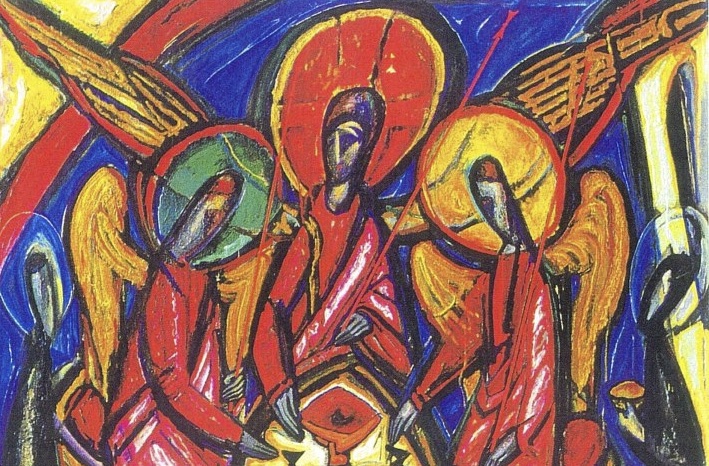
Trinity by Russian artist Alek Rapoport (1933-1997)

I wrote to the church, but Diotrephes, who loves to be first, will not welcome us. So, when I come, I will call attention to what he is doing, spreading malicious nonsense about us. Not satisfied with that, he even refuses to welcome other believers. He also stops those who want to do so and puts them out of the church.

Dear friends, do not imitate what is evil but what is good. Anyone who does what is good is from God. Anyone who does what is evil has not seen God. Demetrius is well spoken of by everyone—and even by the truth itself. We also speak well of him, and you know that our testimony is true. (NIV)

I believe in an egalitarian world. That is, humanity is meant to live, ideally, in equity with one another. Humility, meekness, and gentleness are to be the inner dispositions of a person’s life. These virtues work themselves out in being concerned for the common good of all, laboring toward just and righteous ways of living for everyone and sharing our lives as well as our resources with each other. In short, viewing one another as equals inevitably leads to gracious hospitality.

However, in a world of power disparities and privileged inequities are attitudes of seeking attention, a perceived need to always win and be first, and tight-fisted control of authority and money. The common good of all persons is scaled back to be the concern for the common good of some. There is a failure to regard the weak, poor, and vulnerable as legitimate members of the community.

The Apostle John wrote his short succinct letter in a concern that the church may be following a leader who was taking them down a bad path – a road leading to injustice where power and privilege remain with a few, and perhaps even one. John’s plainspoken exhortation was to judge rightly between what is good and bad, and then imitate the good while forsaking the bad.

Hospitality is the true litmus test between the good and the bad. An openness to the stranger, the immigrant, the migrant, the alien, the foreigner, the newcomer, and the outsider characterizes authentic fellowship. Being closed to such persons and having a xenophobic bent to others who are different is the mark of unwelcoming and inhospitable people. Hospitality serves others, whereas being inhospitable cajoles others to serve our needs.

Even Jesus, the Lord of all, did not come to this earth for people to serve him. He came to serve others and to give his life to save many people (Matthew 20:28; Mark 10:45; John 13:1-17). We are to imitate the loving service and radical hospitality of the Lord Jesus. He is our example. We are to imitate Christ.

We are to have both orthodoxy (right belief) and orthopraxy (right practice). Both go together like a hand in a glove. Good actions are to be the result of good and proper beliefs. The following are some thoughts about this nexus between belief and practice:

  • Hospitality (which literally means “love of the stranger”) is a way of life fundamental to orthodox Christianity, based in the person and work of Jesus.
  • God is hospitable and loves the outsider, welcoming them into the dance of the Trinity, and provides for them. Our human hospitality is to reflect this divine welcome.
  • Hospitality means extending to another a kindness typically reserved for family or friends.
  • The teaching of the New Testament emphasizes the practice of hospitality, i.e. Luke 14:12-14; Matthew 25:31-46.
  • The consistent witness of the Church in history is to lift and uphold Christian hospitality. For example, the Reformer John Calvin said, “Whatever person you meet who needs your aid, you have no reason to refuse to help them.” This was no mere theoretical advice for Calvin, whose ministry center of Geneva, Switzerland swelled with French Huguenot refugees fleeing persecution. Calvin, always the theologian, grounded his understanding of hospitality in the divine: “We should not regard what a person is and what they deserve but we should go higher – that it is God who has placed us in the world for such a purpose that we be united and joined together. God has impressed the divine image in us and has given us a common nature, which should incite us to provide one for the other.”
  • Hospitality is a practice which integrates both respect and care. St. John Chrysostom warned his congregation to show “excessive joy” when offering hospitality to avoid shaming the recipient of care.
  • Biblical hospitality does not need to know all the details of someone’s life before extending care. If Christ forgave and healed those who injured him, how could we neglect even a starving murderer? 
  • True hospitality involves a face-to-face relationship of encouragement and respect – not just a distant giving of alms. Hospitable persons pay attention to others and share life with them.
  • The great twin concerns of hospitality are universalizing the neighbor and personalizing the stranger. One reason why many of the rich have little sympathy for the poor is because they seldom visit them. Hospitality depends on us recognizing our commonalities with strangers rather than our differences.
  • This is how we evaluate our hospitality: Did we see Christ in them? Did they see Christ in me?

Hospitable God:

Give us eyes to see the deepest needs of people.

Give us hearts full of love for our neighbors as well as for the strangers we meet.

Help us understand what it means to love others as we love ourselves.

Teach us to care in a way that strengthens those who are sick.

Fill us with generosity so we feed the hungry, clothe the naked, and give drink to the thirsty.

Let us be a healing balm to those who are weak and lonely and weary by offering our kindness to them.

May we remember to listen, smile, and offer a helping hand each time the opportunity presents itself. And may we conspire to create opportunities to do so.

Give us hearts of courage to risk loving our enemy.

Inspire us to go out of our way to include outsiders.

Help us to be welcoming and include all whom you send our way.

Let us be God’s hospitality in the world.

Amen.