From Adversaries to Allies (Isaiah 19:18-25)

In that day five cities in Egypt will speak the language of Canaan and swear allegiance to the Lord Almighty. One of them will be called the City of the Sun.

In that day there will be an altar to the Lord in the heart of Egypt, and a monument to the Lord at its border. It will be a sign and witness to the Lord Almighty in the land of Egypt. When they cry out to the Lord because of their oppressors, he will send them a savior and defender, and he will rescue them. 

So the Lord will make himself known to the Egyptians, and in that day they will acknowledge the Lord. They will worship with sacrifices and grain offerings; they will make vows to the Lord and keep them. The Lord will strike Egypt with a plague; he will strike them and heal them. They will turn to the Lord, and he will respond to their pleas and heal them.

In that day there will be a highway from Egypt to Assyria. The Assyrians will go to Egypt and the Egyptians to Assyria. The Egyptians and Assyrians will worship together. In that day Israel will be the third, along with Egypt and Assyria, a blessing on the earth. The Lord Almighty will bless them, saying, “Blessed be Egypt my people, Assyria my handiwork, and Israel my inheritance.” (New International Version)

Yahweh is so much more than an ancient local Israelite deity. This is the Lord God almighty, creator of heaven and earth. God is the Lord of the universe, and Israel is not just a sliver of land in the Middle East.

As such, all peoples belong to God. And God is concerned for all the nations. In the ancient world, the Lord was even concerned for places like Egypt and Assyria – two nations which historically treated Israel with contempt and oppression.

The Lord God, Yahweh, as the prophet Isaiah stated, will be revealed to the Egyptians, so that they, too, will worship the Lord with sacrifices and offerings. They will revere God with a monument to Yahweh’s saving power.

The Egyptians will make religious vows and fulfill them. And there will also be relations with Assyria. Israel will exist alongside – and literally geographically in the middle – the powers of Egypt and Assyria. And Israel will serve as a blessing between them.

In other words, God will choose to bless, bringing both religious and political balance and peace. It is rather extraordinary that the Lord speaks of Egypt as “my people” and Assyria as “my handiwork.” God’s vision is always much larger than our own puny human sight or imagination.

In a biblical book filled with sad visions of judgment and God’s wrath, today’s Old Testament lesson is a beautiful vision of hope and peace. This, my friends, is what can be! It doesn’t have to be a pipe dream that various peoples who are historical enemies of one another can walk together in the peace and wholeness of God’s blessing. This is no impossible, although it appears highly improbable.

It takes little effort to hold onto hate and enmity; but it takes a great deal of energy to work on peacemaking, and loving those who have harmed others so terribly.

The fact of the matter is that Yahweh responds to every people who cry out in their oppression – even those who were once oppressors themselves.

That is called “grace,” and it is why grace is so scandalous, because a lot of folks don’t want to see grace extended to those they dislike, hate, and even want dead.

God will do for other nations what God did for Israel, in delivering them from their harsh slavery. The Lord’s ears hear everyone on the earth, and not just some people.

All of the hard-hearted resistance of the past, personified so stubbornly in the Pharaoh who would not let go of Israel, is remarkably overcome and reversed.

This is how it always seems to operate throughout history, including today. People cry out and are delivered, then worship the God who granted them grace and freedom. We very often come to believe because we were in some sort of awful trouble, which caused us to cry out and acknowledge the God who saves.

God both strikes and heals, attacks and helps. God moves people from rancorous relationships to robust reconciliation.

People, however, are not passive in any of this process. Those who are already blessed and enjoy God must relinquish any sort of exclusive thoughts or practices and be willing to share their identity and privilege with others who were once enemies.

Unity, harmony, wholeness, and a true ecumenical spirit and vision will bring people together. The benefits are wonderful, yet let it also be acknowledged that reconciliation and relationships require giving up any sense of being better than the other, or holding on to primacy of positions and power.

Stated positively, it means that we embrace a diversity of people, including them in every way possible, because we discern them as being equals, and not so different from me.

God has other chosen people besides me and you. Can you accept that?

“Egypt comes home to its true self only as Israel opens its sense of privilege to its adversaries.”

Walter Brueggemann

The Lord opposes the arrogant and proud, but gives grace to the humble. God will gladly deliver and welcome all peoples.

If we have the spiritual eyes to see, we will notice and observe that the world is God’s chosen people.

O God, hear our humble prayer, so that we may serve you in holiness and faith, giving voice to your divine presence among us until the coming of your Son, Jesus Christ, who lives and reigns forever and ever. Amen.          

Accept One Another (Romans 15:7-13)

Christian Unity, by Gisele Bauche

Accept one another, then, just as Christ accepted you, in order to bring praise to God. For I tell you that Christ has become a servant of the Jews on behalf of God’s truth, so that the promises made to the patriarchs might be confirmed and, moreover, that the Gentiles might glorify God for his mercy. As it is written:

“Therefore I will praise you among the Gentiles;
    I will sing the praises of your name.”

Again, it says,

“Rejoice, you Gentiles, with his people.”

And again,

“Praise the Lord, all you Gentiles;
    let all the peoples extol him.”

And again, Isaiah says,

“The Root of Jesse will spring up,
    one who will arise to rule over the nations;
    in him the Gentiles will hope.”

May the God of hope fill you with all joy and peace as you trust in him, so that you may overflow with hope by the power of the Holy Spirit. (New International Version)

Anyone who desires to follow the pattern of Christ, actively seeks and promotes the acceptance of one another.

Jesus is the Christian’s model: Christ did not seek to be served, but to serve, and give himself for the benefit of others. The ministry of Christ was meant for the whole world, and not just for some persons. Christ’s mission and ministry included non-Jews, and not only his own Jewish people.

The person and work of Jesus Christ confirmed the promises made to the original Jewish patriarchs of Abraham, Isaac, and Jacob. Jesus did nothing brand new; he was simply upholding and actively seeking to accept Gentiles and bring them to God. This has always been true of God’s plan and purpose – which is why the Apostle Paul cited four different Old Testament passages.

All four references are to the Gentiles, to non-Jewish persons. And this is why Paul himself had a ministry to Gentiles. The biblical verses mentioned by the Apostle include Gentiles who offer praise to God; Gentiles engrafted alongside Jews as God’s people; and Gentiles who put their hope in the root of Jesse, the Messiah.

The good news of Jesus Christ is an inclusive – not exclusive – message. Thus, Christian ministry is designed to include others, to bring them into the fold of those who are redeemed by God.

Christian community is made up of all kinds of people from every race and ethnicity – without exception, and without favoritism.

The Apostle Paul made it clear to the Roman Church of both Jew and Gentile that his bedrock Christian ethic was one of inclusion and care for others. He supported his ethical understanding from Holy Scripture.

Paul was concerned that the Church include all sorts of Christ followers who may have some differing understandings and practices in living out their own Christian faith.

The Body of Christ is designed and meant to be big enough, strong enough, and resilient enough to handle all sorts of people who together want to follow Christ and serve others, like Jesus did.

The Apostle’s prayer is one of hope, having everyone in the church be accepting of one another. Paul wanted all Christians to work and worship together as the one people of God who live according to the pattern of Christ.

The Christian model of living is based not upon dietary laws or special days; it instead has it’s foundation in the example of Christ’s earthly ministry. All Christians are to:

  • glorify God together for the divine mercy shown to them
  • rejoice together as a unified voice expressing faith, hope, and love
  • share together in the hope that God’s promises are and will be fulfilled completely in Christ

God fills us with joy and peace, and causes us to overflow with hope by the power of the Holy Spirit – made possible because of the person and work of Jesus Christ.

Since God grants faith to whomever God wants to grant faith; and since the Holy Spirit fills whomever the Spirit wants to fill, we are, therefore, to accept those whom God has already accepted – without exception, and without prejudice.

For the Apostle Paul, the church’s identity was at stake. Paul was concerned for two questions:

  1. Will the church be, at its core, a community of redeemed persons by the grace of God who center all their lives around the person and work of Jesus?
  2. Or will the church be a community of opinionated individuals and groups all jockeying for position to have their way on how they believe things should go?

You can tell what a person’s identity is by their “identity markers.”

For the Jewish Christians, Sabbath-keeping, circumcision, food laws, and holding to certain days on the calendar marked their identity as God’s people. Those issues were so important that if you took them away, there would be an identity crisis; the people felt totally lost without their traditions.

For Gentile Christians, their identity was built around being more free-thinking. So, if you take away their freedom and ability to choose, the Gentiles will go nuts and have an identity meltdown. 

Paul’s answer was for both Jew and Gentile to accept one another and build their unity around Jesus, period. They needed to be sensitive to each other and focus on their shared identity of Jesus as the center of the Christian life.

It is very difficult to have hope, peace, and spiritual power, whenever there is disunity. The lack of acceptance is typically like a cancer which invades the Body and destroys it, unless there is a spiritual intervention.

Acceptance of others is more than a nice idea; and it doesn’t mean that we overlook differences of convictions or dogma. It just means that we choose to focus on what is most important. And for the Apostle Paul, that meant having a unity around the pattern of Christ.

Loving Lord, you came not to be served but to serve. Empower us to bless one another and our neighbors, so that your spirit of generosity, compassion, and selfless action transform us and the people in our midst. We pray together, as the one people of God, that you will guide us in your way; through Jesus Christ our Savior, in the strength of the Holy Spirit. Amen.

God Has No Favorites (Acts 10:1-34)

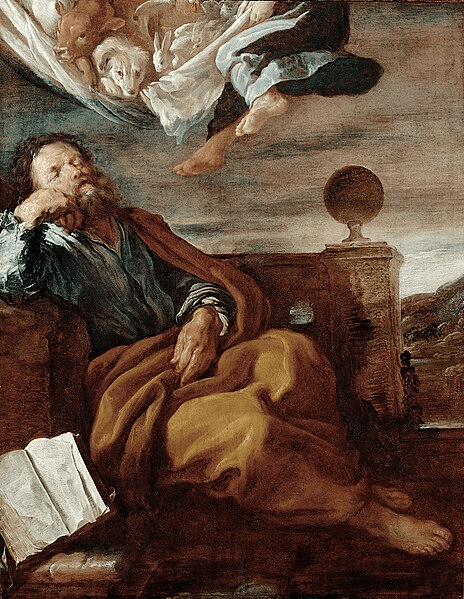
Peter’s Vision, by Domenico Fetti, c.1619

At Caesarea there was a man named Cornelius, a centurion in what was known as the Italian Regiment. He and all his family were devout and God-fearing; he gave generously to those in need and prayed to God regularly. One day at about three in the afternoon he had a vision. He distinctly saw an angel of God, who came to him and said, “Cornelius!”

Cornelius stared at him in fear. “What is it, Lord?” he asked.

The angel answered, “Your prayers and gifts to the poor have come up as a memorial offering before God. Now send men to Joppa to bring back a man named Simon who is called Peter. He is staying with Simon the tanner, whose house is by the sea.”

When the angel who spoke to him had gone, Cornelius called two of his servants and a devout soldier who was one of his attendants. He told them everything that had happened and sent them to Joppa.

About noon the following day as they were on their journey and approaching the city, Peter went up on the roof to pray. He became hungry and wanted something to eat, and while the meal was being prepared, he fell into a trance. He saw heaven opened and something like a large sheet being let down to earth by its four corners. It contained all kinds of four-footed animals, as well as reptiles and birds. Then a voice told him, “Get up, Peter. Kill and eat.”

“Surely not, Lord!” Peter replied. “I have never eaten anything impure or unclean.”

The voice spoke to him a second time, “Do not call anything impure that God has made clean.”

This happened three times, and immediately the sheet was taken back to heaven.

While Peter was wondering about the meaning of the vision, the men sent by Cornelius found out where Simon’s house was and stopped at the gate. They called out, asking if Simon, who was known as Peter, was staying there.

While Peter was still thinking about the vision, the Spirit said to him, “Simon, three men are looking for you. So get up and go downstairs. Do not hesitate to go with them, for I have sent them.”

Peter went down and said to the men, “I’m the one you’re looking for. Why have you come?”

The men replied, “We have come from Cornelius the centurion. He is a righteous and God-fearing man, who is respected by all the Jewish people. A holy angel told him to ask you to come to his house so that he could hear what you have to say.” Then Peter invited the men into the house to be his guests.

The next day Peter started out with them, and some of the believers from Joppa went along. The following day he arrived in Caesarea. Cornelius was expecting them and had called together his relatives and close friends. As Peter entered the house, Cornelius met him and fell at his feet in reverence. But Peter made him get up. “Stand up,” he said, “I am only a man myself.”

While talking with him, Peter went inside and found a large gathering of people. He said to them: “You are well aware that it is against our law for a Jew to associate with or visit a Gentile. But God has shown me that I should not call anyone impure or unclean. So when I was sent for, I came without raising any objection. May I ask why you sent for me?”

Cornelius answered: “Three days ago I was in my house praying at this hour, at three in the afternoon. Suddenly a man in shining clothes stood before me and said, ‘Cornelius, God has heard your prayer and remembered your gifts to the poor. Send to Joppa for Simon who is called Peter. He is a guest in the home of Simon the tanner, who lives by the sea.’ So I sent for you immediately, and it was good of you to come. Now we are all here in the presence of God to listen to everything the Lord has commanded you to tell us.”

Then Peter began to speak: “I now realize how true it is that God does not show favoritism…”

Peter’s Vision, by Doug Jaques

In this binary world of either/or, there are either good guys or bad guys, protagonists or antagonists, nice folk or jerks, Christians or non-Christians, etc.

Because this story is tied to its own cultural context, its punchline may not have the intended effect. Perhaps the story needs to be heard in a contemporary setting…

There was a man named “Dem.” He lived in New York, and was head of a labor union there. Dem did right by the people he represented. He always found ways to help those in need; led his family to worship God; and prayed faithfully every day.

One day, at about 3:00pm, during his time of prayer, he had a vision. An angelic messenger of God, as real as his next-door neighbor, came in and said, “Dem.”

Dem stared hard, wondering if he was seeing things. Then he said, “What do you want?” The angelic messenger said, “Your prayers and good works at your workplace and in your neighborhood have gotten God’s attention. So, here’s what you are to do: Send some people to Washington to get the one everyone calls ‘Pastor Pub.’ He’s staying with Perry the Politician whose house is down by the ocean.”

As soon as the angelic messenger was gone, Dem called two employees and one devout worker from the union. He went over with them in great detail everything he just experienced, and sent them off to Washington.

The next day, as the three travelers were approaching the city, Pastor Pub went out on the patio to pray. It was about noon. He got hungry and started thinking about lunch. While his food was being prepared, Pastor Pub fell into a trance.

He saw the skies open up. Something that looked like a huge blanket lowered by ropes at its four corners settled on the ground. Every kind of person – ethnicity, race, and gender – was on it. Then a voice came: “Go, Pastor Pub – baptize, marry, and bury.”

Pastor Pub exclaimed, “Oh, no, Lord. I’ve never so much as gotten close to non-Christians, let alone baptize, marry, or bury just anyone! It’s not holy!”

The voice came a second time: “If God says it’s okay, it’s okay.”

This happened three times, and then the blanket was pulled back up into the skies.

Peter’s Vision, by Edward Knippers

As Pastor Pub sat there puzzled, trying to figure out what it all meant, the people sent by Dem showed up at Perry’s front door. When the butler answered the door bell, they asked if there was a person known as Pastor Pub there.

Pastor Pub, on the back patio, didn’t hear them. So, the Spirit whispered to him, “Three people are at the door looking for you. Get up and go with them. Don’t ask any questions. I sent them to get you.”

Pastor Pub went to the front door and said, “I think I’m the guy you’re looking for. What in the world is going on?”

They said, “Dem is a God-fearing person, well-known for his just and right ways. Ask any politician in this city! He was commanded by an angelic messenger to get you and bring you to his house, so he could hear what you have to say.” Pastor Pub invited them in and was hospitable.

The next morning he got up and went with them. Some of his friends from Washington went along. Arriving in New York, Dem was expecting them; his close friends and relatives, and some workers, were waiting with him.

The minute Pastor Pub came through the door, Dem was up on his feet greeting him – and then down on his knees thanking him profusely. But Pastor Pub pulled him up saying, “There’s no need for that. I’m just a person no different than you.”

Talking things over, they went into the house, where Dem introduced Pastor Pub to everyone. Pastor Pub addressed them, “I’m sure that this is a highly irregular meeting. After all, Republicans, straight people, and anti-abortionists don’t do this sort of thing – visit and relax with Democrats, LGBTQ+ folk, and abortionists.

But God has shown me that no political party, gender, or issue is better than any other. So, the minute I was sent for, I came, no questions asked. But now I’d like to know why you sent for me.”

Dem said, “A few days ago at about this time, midafternoon, I was home praying. Suddenly there was a man right in front of me, flooding the room with light. He said, ‘Dem, your daily prayers and benevolent work have brought you to God’s attention. I want you to send to Washington to get the one they call Pastor Pub. He’s staying with Perry the Politician down by the ocean.’ So, I did it – I sent for you. And you have been good enough to come. Now we are all here in God’s presence, ready to listen to whatever the Lord put in your heart to tell us.”

At that point, the good news came exploding out of Pastor Pub: “It’s God’s own truth, and nothing could be plainer than this: God has no favorites!”

My friends, it is high time we set aside our sinful prejudice toward others. Far too many of us believe and claim that our positions on issues and ideas about how things ought to go are gospel truth – not to mention our ungodly discrimination against another race, ethnicity, and gender.

If it is judgment you want, then that judgment must begin with your own house, and specifically with you yourself…

A Spiritual Check-Up (2 Corinthians 13:5-10)

Examine yourselves to see if your faith is genuine. Test yourselves. Surely you know that Jesus Christ is among you; if not, you have failed the test of genuine faith. As you test yourselves, I hope you will recognize that we have not failed the test of apostolic authority.

We pray to God that you will not do what is wrong by refusing our correction. I hope we won’t need to demonstrate our authority when we arrive. Do the right thing before we come—even if that makes it look like we have failed to demonstrate our authority. For we cannot oppose the truth, but must always stand for the truth. We are glad to seem weak if it helps show that you are actually strong. We pray that you will become mature.

I am writing this to you before I come, hoping that I won’t need to deal severely with you when I do come. For I want to use the authority the Lord has given me to strengthen you, not to tear you down. (New Living Translation)

God is concerned about our spiritual health and vitality. And so, it’s important that we have regular spiritual check-ups and tests to evaluate the vitality of our faith. If we are spiritually sick or debilitated, the Lord seeks to restore us back to health.

In the Gospels, whenever Jesus miraculously healed a person, it was for far more than taking away a disease or correcting a disability. The Lord sought to make them well in order to restore a person’s life by including them in the community. For example:

  • Leprosy put a person on the outside, both literally and relationally. Ceasing to be a leper meant that a person now had no obstacles to full participation in communal life.
  • Blindness reduced a person to being a beggar in order to survive. Having sight restored meant that the person can now work with others, make a living, and contribute to the needs of others.
  • Incarceration was (and still is) a complete removal of a person from society. Being in prison severs many human connections. Release from jail opens the way to reconnection and an opportunity to have a different way of being with others.
  • Poverty encumbers a person and weighs them down so heavily that it limits their ability to function socially and relationally. Without poverty, a person is able to establish healthy patterns of giving and receiving within the community.

Those who are physically whole, mentally sharp, emotionally satisfied, and spiritually redeemed are free of obstacles and impediments to communal life.

So, it is a travesty whenever the people who enjoy full inclusion in the community, turn around and separate themselves, keeping relational distance from certain persons, and do not participate in the common good of all. They makes themselves sick and weaken their faith because of their lifestyle.

The type of spiritual examination of faith the Apostle Paul was talking about was not to obsess over whether one is a true believer, or not. He was referring to the person who claims faith yet maintains separation from others. In other words, to exclude others is the kind of behavior that unbelievers do, not Christians.

Yet, there are many sections of Christianity and entire Protestant denominations who pride themselves on such separation. They believe they’re being holy and keeping themselves from impurity. However, far too many of them are really putting a sanctified spin on their own sinful predilections to avoid people they don’t like.

Paul has no tolerance for calling exclusion of others “holiness” and naming the maintenance of an insider/outsider status as “sanctification.” The Apostle knew this was all poppycock and wanted nothing to do with it.

Christ didn’t die on a cruel cross, take away the obstacles to faith, open the way to know God, and create peace through his blood for a pack of so-called “Christians” to then erect imaginary concrete border walls to keep others out of Christian community and fellowship.

In God’s upside-down kingdom, the privileged insiders are really the outsiders; and the underprivileged outsiders are actually the insiders.

The privileged believers are just as sick as the leper, the blind, the poor, and the prisoner; and just as much in need of restoration. The path to their inclusion is solidarity with the entire community of the redeemed – rather than picking and choosing who is in and who is out.

All this, of course, is another way of stating that Christianity is as beset with cliques as anywhere else – with individual believers, local churches, and particular traditions following their pet theologians and pastors and not associating with others who follow a different set of folks.

The ancient Corinthian church was a train wreck of opposing groups and cliques. The Apostle Paul had had enough of it and called the people to do some serious self-examination. And he was careful not to degrade or discourage them but to try and encourage the church to tap into the Christ which dwells within them.

Spiritual health and restoration, for Paul, meant specific behaviors which intentionally include people. To be inclusive means we actively work toward grafting people into community, as well as discourage behaviors that create division, and thus, spiritual illness. Here are three ways of including others:

  • Practice hospitality. The word hospitality literally means, “love of stranger.” A hospitable believer goes out of their way to invite another into their life, to give them the gift of relationship and fellowship.

Take care of God’s needy people and welcome strangers into your home. (Romans 12:13, CEV)

Above all, show sincere love to each other, because love brings about the forgiveness of many sins. Open your homes to each other without complaining. And serve each other according to the gift each person has received, as good managers of God’s diverse gifts. (1 Peter 4:8-10, CEB)

  • Nip bitterness in the bud. In an ideal world, everyone holds hands and sings kumbaya together. We live, however, in a fallen world. Harmony, unity, and peace take copious amounts of energy. Like an attentive gardener, we must do the work of identifying weeds and uprooting them, so they don’t take over the garden.

Make every effort to live in peace with everyone and to be holy; without holiness no one will see the Lord. See to it that no one falls short of the grace of God and that no bitter root grows up to cause trouble and defile many. (Hebrews 12:14-15, NIV)

  • Seek to encourage others, and learn how to do it. Encouragement is both a gift and a skill to be developed. To encourage another is to come alongside and help someone with both affirming words and willing hands. It’s what Jesus did (and does) for us.

Christ died for us so that, whether we are dead or alive when he returns, we can live with him forever. So, encourage each other and build each other up, just as you are already doing. (1 Thessalonians 5:10-11, NLT)

Hospitality, harmony, and help are all forms of love. And love is to be the guiding principle and practice of church and community. Love is always the prescription for a healthy spiritual life and a restored community of faith. It prevents truth decay.

Lord, make me an instrument of your peace:
where there is hatred, let me sow love;
where there is injury, pardon;
where there is doubt, faith;
where there is despair, hope;
where there is darkness, light;
where there is sadness, joy.

O divine Master, grant that I may not so much seek
to be consoled as to console,
to be understood as to understand,
to be loved as to love.
For it is in giving that we receive,
it is in pardoning that we are pardoned,
and it is in dying that we are born to eternal life.
Amen.