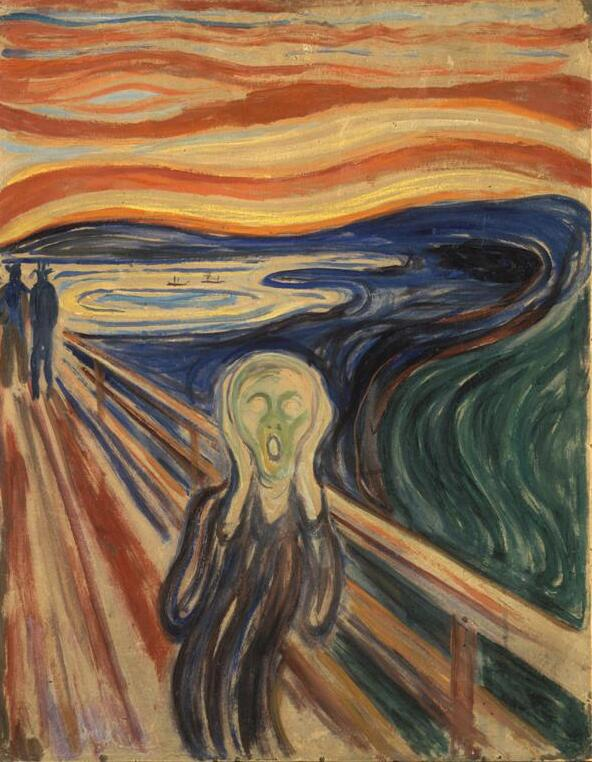
Confronting Spiritual and Emotional Pain (Psalm 79)

The Scream, by Edvard Munch, (1863-1944)

God! Barbarians have broken into your home,
    violated your holy temple,
    left Jerusalem a pile of rubble!
They’ve served up the corpses of your servants
    as carrion food for birds of prey,
Threw the bones of your holy people
    out to the wild animals to gnaw on.
They dumped out their blood
    like buckets of water.
All around Jerusalem, their bodies
    were left to rot, unburied.
We’re nothing but a joke to our neighbors,
    graffiti scrawled on the city walls.

How long do we have to put up with this, God?
    Do you have it in for us for good?
    Will your smoldering rage never cool down?
If you’re going to be angry, be angry
    with the pagans who care nothing about you,
    or your rival kingdoms who ignore you.
They’re the ones who ruined Jacob,
    who wrecked and looted the place where he lived.

Don’t blame us for the sins of our parents.
    Hurry up and help us; we’re at the end of our rope.
You’re famous for helping; God, give us a break.
    Your reputation is on the line.
Pull us out of this mess, forgive us our sins—
    do what you’re famous for doing!
Don’t let the heathen get by with their sneers:
    “Where’s your God? Is he out to lunch?”
Go public and show the godless world
    that they can’t kill your servants and get by with it.

Give groaning prisoners a hearing;
    pardon those on death row from their doom—you can do it!
Give our jeering neighbors what they’ve got coming to them;
    let their God-taunts boomerang and knock them flat.
Then we, your people, the ones you love and care for,
    will thank you over and over and over.
We’ll tell everyone we meet
    how wonderful you are, how praiseworthy you are! (The Message)

The temple was destroyed. The conquering army gloats over their victory. That’s the context of today’s psalm. It’s a prayer, an angry cry for God to step in and act on behalf of the humiliated people. The prayer is more than a simple plea for help; it’s a deeply passionate appeal, that says in 1960’s terms, “God, stick it to the man!”

In the face of evil, when there is destruction all around and violence everywhere, prayer does not become some sort of polite knock at the side door of God’s house. Instead, prayer is a pounding on the front door with a demand for God to do something about this terrible trouble.

For the psalmist, the incongruence between who God is and what has happened to God’s people is inconceivable and unacceptable. To profane God’s temple is to profane God; and to kill and maim God’s people is to flip the middle finger at God. The psalmist is beside himself and overwhelmed with emotion.

There is something very instructive here that we ought not miss. When we have been brutalized, victimized, and/or demoralized, we just want someone, especially the Lord we serve, to take notice and feel what we are feeling. Never underestimate the power of empathy and solidarity. To feel alone and bereft of help is an awful feeling.

Perhaps the psalmist’s prayer offends some sensibilities. I wonder, for those who find the language difficult, have ever had a daughter raped, or a house destroyed by fire, or seen a person killed without mercy in front of their own eyes. Methinks they have not. The feelings of helpless despair and sheer anger defy human words. These are not casual affronts; they are malicious destructions of property and people.

We need someone to affirm the raw ruthlessness of it all, to have some understanding of the impossible place we are in, with having to deal with such wanton cruelty. When our very support is ripped from our lives, the madness within is too much to bear. Who will rescue us from this body of death?

God is big enough to handle our rage and our hurt. The Lord is available and hears our desperate voice of prayer. Yet, God is not always going to directly and immediately answer on the terms we stipulate. God acts out of God’s own providence and justice, and not from our expectations. And that is a good thing, not a bad thing.

God sees. The Lord knows. And the Sovereign of the universe feels it all with us. The realization of this divine empathy enables us to recenter and reorient ourselves around faith, hope, and love. New life is never a gift in a vacuum; it comes out of agonizing struggle in having to reckon with the existence of evil.

So, when someone goes through a hellish experience, let us exercise our capacity to listen and witness the horrible spiritual pain of the person. Healing hurts: it is not a pleasant affair. So, hang in there and walk alongside another in their hour of need, even when their vitriol seems over the top to us. For only in telling our story to another will any of us find relief and renewed hope.

The biblical psalms permit us to use language appropriate to what has happened. They also allow us to move beyond the venom to the God who restores broken lives.

Lord Jesus Christ, by your patience in suffering you hallowed earthly pain and gave us the example of obedience to your Father’ will: Be near me in my time of weakness and pain; sustain me by your grace, that my strength and courage may not fail; heal me according to you will; and help me always to believe that what happens to me here is of little account if you hold me in eternal life.

My Lord and my God, as Jesus cried out on the cross, I cry out to you in pain, O God my Creator and Sustainer. Do not forsake me. Grant me relief from this suffering and preserve me in peace, through Jesus Christ my Savior, in the power of the Holy Spirit. Amen.


Naming and Forsaking Evil (Psalm 83:1-4, 13-18)

Deliver Us From Evil, by John Flaxman (1755-1826)

God, don’t shut me out;
    don’t give me the silent treatment, O God.
Your enemies are out there whooping it up,
    the God-haters are living it up;
They’re plotting to do your people in,
    conspiring to rob you of your precious ones.
“Let’s wipe this nation from the face of the earth,”
    they say; “scratch Israel’s name off the books.”
And now they’re putting their heads together,
    making plans to get rid of you….

My God! I’ve had it with them!
    Blow them away!
Tumbleweeds in the desert waste,
    charred sticks in the burned-over ground.
Knock the breath right out of them, so they’re gasping
    for breath, gasping, “God.”
Bring them to the end of their rope,
    and leave them there dangling, helpless.
Then they’ll learn your name: “God,”
    the one and only High God on earth. (The Message)

The psalms are the church’s prayer book. Many of the psalms are laments; and many of them are worshipful songs of praise. And there are also the “imprecatory” (pronounced im-PRECK-a-tory) psalms. To “imprecate” means to invoke evil upon someone; it is to pronounce a curse. 

The reason for the imprecatory psalm is that it is not any person’s place to engage in revenge or retaliation. Instead, for people who are genuinely caught in the crosshairs of evil and have sinful persons dogging them, prayer is their most effective recourse; an appeal to God is their best chance at survival and hope.

Sometimes you have to tell it like it is. There’s a time to do your best in putting up a good face and dealing with people who never stop gossiping, slandering, and trying to get their way. But there is also a time to call such behavior “evil” and cry out to God for help.

There are a lot of folks who consider imprecatory psalms a problem because of their detailed expressions of imprecation, of cursing. Yet, such psalms refuse to put a positive spin on malevolent motives, wicked words, and destructive actions.

Desperate people utter desperate prayers. Their unflinching sense of injustice will not allow them to sugarcoat the villainous plans of corrupt people.

Evil is never toppled with tepid prayers from wimpy worshipers. Rather, nefarious agendas are thwarted in the teeth of specific, focused, and intense prayers directed with spiritual precision and passion to the very core of diabolical forces.

We need not be shy about being real with God, even with praying imprecatory prayers. There really are people in this world, maybe even in your own life, that have malicious intent against you or others. Our job is not personal revenge, but to entrust ourselves to the God who fights for the poor, the oppressed, and the needy against the arrogant and the powerful. Let your prayers, then, reflect your life.

Along with psalms of praise lifted during times of celebration, so imprecatory psalms are not to be ignored but need to be uttered equally loud as prayers to almighty God in seasons of desperate evil.

If you have a gut feeling deep down that wicked people are running amok, then use this psalm as a prayer against the darkness which seeks to envelop the earth.

Jesus Christ will build his church and the gates of hell shall not overcome it (Matthew 16:18). The picture Jesus portrayed is one of faithful believers equipped with righteousness and justice storming the gates of hell, not shying away from it. Baked within the Lord’s words were the promise that evil atrocities will not have the day – that God’s people will not be destroyed or overwhelmed because of demonic and satanic power.

There is a time to flee and then there is a time to engage. I am suggesting that the chief way of mitigating evil is to punch it in the mouth with imprecatory psalms prayed with righteous flavor and focused directly against the powers of this present darkness. Why pray, out of all the things we could do, in order to deal with the evil of this world?…

For we do not wrestle against flesh and blood, but against principalities, against powers, against the rulers of the darkness of this age, against spiritual hosts of wickedness in the heavenly places. (Ephesians 6:12, NKJV)

Spiritual problems require spiritual implements to solve. And the tool of imprecatory psalms is a major way of pushing back the dark forces of this world, as well as the means of spiritual assertiveness against all forms of heinous acts and acerbic words from depraved people and evil systems.

God’s wrath is an expression of God’s love – because God is not okay with evil taking root in the lives and institutions of humanity. Prayer is our privilege of coming to the God who upholds justice and righteousness. For if God is for us, who can be against us?

Almighty God, hear me in the day of my trouble and send help from your holy sanctuary and strengthen my faith. Do not let me amble down the path of temptation, but deliver me from the evil one.

Holy Spirit, breathe your enablement into me and inspire me with a passion for goodness, truth, justice, and righteousness.

Lord Jesus be present with me in your risen power and protect me from harm and from everything that hinders your healing presence in this world. You overcame the forces of Satan, redeemed the world, then ascended to the Father.

Blessed Holy Trinity – Father, Son, and Sprit – the God whom I serve: May you be with me and within me; before me and behind me; on my right and on my left; above me and beneath me; and around me always, for the sake of your glory. Amen.

Coming to Grips with Grinding Adversity (Psalm 137)

“By the Waters of Babylon, They Sat Down and Wept” by Kate Gardiner Hastings

Alongside Babylon’s streams,
    there we sat down,
    crying because we remembered Zion.
We hung our lyres up
    in the trees there
    because that’s where our captors asked us to sing;
    our tormentors requested songs of joy:
    “Sing us a song about Zion!” they said.
But how could we possibly sing
    the Lord’s song on foreign soil?

Jerusalem! If I forget you,
    let my strong hand wither!
Let my tongue stick to the roof of my mouth
    if I don’t remember you,
    if I don’t make Jerusalem my greatest joy.

Lord, remember what the Edomites did
        on Jerusalem’s dark day:
    “Rip it down, rip it down!
    All the way to its foundations!” they yelled.
Daughter Babylon, you destroyer,
    a blessing on the one who pays you back
    the very deed you did to us!
    A blessing on the one who seizes your children
    and smashes them against the rock! (Common English Bible)

This side of heaven is full of both love and heartbreak, celebration and lament, encouragement and insult. It is a spiritually schizophrenic existence of heaven’s kiss and hell’s bite. 

We live in a fundamentally broken world. Yet, it is a world that is presently being reclaimed by God’s kingdom. Therefore, our emotions run the gamut from joyful happiness to sheer sorrow. Either way, especially through the difficult stretches of our lives, Christians are to tether themselves to their true home of heaven.

The psalmist was speaking of Jerusalem, the city that represented the very presence of God. Yet, the Babylonians came and destroyed the temple, their homes, and carried thousands of her citizens into exile.

Although experiencing the Babylonian Exile, the people of Jerusalem were not to forget their real home. 

For the believer in Jesus, this present abode is like camping in a tent – it is a temporary home, and not our permanent residence.

It is easy to forget our true home, which is why we need the constant perspective of eternity. We ought not get too familiar with our current living conditions. 

Simple acts like looking up at the stars at night or gazing into the vast expanse of the day’s sky can be tangible reminders that we are meant for larger things, for the embrace of heaven.

None of this, however, means that we are to ignore what is happening in the here and now. Trauma is real and needs to be dealt with. Having an expansive perspective doesn’t mean we stuff the details and emotions of traumatic events.

The psalmist names the difficult experience, the agonizing emotions, and the bitter thoughts. None of it is hidden or buried under a layer of positivity.

“Lamenting Jews in Exile” by Eduard Bendemann, 1832

We need the combination of faith that my experienced is acknowledged, of hope that a better future is coming, and of love that good still presently exists in the world. Faith, hope, and love are all vital in coming to grips with terrible adversity.

Hiding large swaths of our lives and stories from others is not the path to spiritual wellness, emotional healing, and personal peace. Spiritual and emotional health comes from owning our internal struggles. The virtues of weakness, humility, vulnerability, and faith opens us to the way of grace.

We too often struggle because we don’t struggle. 

I’m the expert on stuffing feelings and turning them into thoughts. I learned it well early in my life. Yet, feelings never evaporate just because we ignore them. Just the opposite, like a forgotten half-carton of cottage cheese in the back of the fridge, our feelings only gather moldy bacteria and crust over with nastiness. 

We need to understand that feelings really do have an expiration date to them. If not openly acknowledged and dealt with, they’ll fester into bitterness. It’s much better to deal with our present struggles instead of living with the wishful thinking that they’ll just go away.

There are 52 references to “one another” in the New Testament, including: 

  • Love one another (John 13:34-35)
  • Be kind to one another (Ephesians 4:32)
  • Show hospitality to one another (1 Peter 4:9)
  • Forgive one another (Colossians 3:13)
  • Encourage one another (Hebrews 3:13)
  • Bear the burdens of one another (Galatians 6:2)
  • Spur one another on toward spiritual well-being and healthy community relationships (Hebrews 10:24)

Nowhere in Holy Scripture will you find references to hide from one another, pester one another, or put up a false front toward one another.

God desires for us to take a risk on betting the farm on Jesus. Embracing Christ involves owning our struggles, both to God and to one another. 

You may argue that it isn’t helpful to wear your feelings on your sleeve. But I’m not talking about emotional diarrhea; I’m referring to something far worse: emotional prostitution, where we sell ourselves to others in a cheap façade of who we really are and how we are really doing. 

We want to be liked, loved, and longed for. And we very much desire to avoid heartrending pain. So, many mistakenly believe that keeping up false appearances will get them what they long for.

What matters most is faith expressing itself through love (Galatians 5:6). It takes personal risk to have faith. And it takes two to have love.

Own your struggle. Face it squarely in all of its foulness, degradation, and ugliness. Face it with both God and others. 

If you’re mad as hell at God, then say it; the Lord is big enough to take it. If you need prayer or help, ask for it. Don’t just expect someone to read your mind or your emotions. If someone asks you to pray, stop what you’re doing, get on your knees with that person, and pray like there’s no tomorrow.

Life is too short to sleepwalk through it with a constellation of unacknowledged emotions. It takes no relational effort to ask a pat question like, “How are you?” It takes even less relational energy to give a pat answer such as, “Fine,” or “Busy.” Instead, let’s get down to why you feel a constant need to say how busy you are, even when you’re not really all that busy.

Holy Scripture doesn’t call us to hide, but to love one another enough to both give and receive God’s grace. 

Daily reading and praying of the psalms is a good place to begin in learning to be authentic with God and the people in our lives. It’s the only way of dealing with the overwhelming circumstances and emotions we face.

Loving God, please grant me peace of mind and calm my troubled heart. My soul is like a turbulent sea. I can’t seem to find my balance, so I stumble and worry constantly. Give me spiritual strength, mental clarity, and emotional calm to find my purpose and walk the path you’ve laid out for me. Just as the sun rises each day against the dark of night, may the light of your divine countenance shine on the shadowy places of my life, through Jesus Christ my Lord, in the illumination of the Holy Spirit. Amen.

Psalm 58 – Curse the Wicked

Do you rulers indeed speak justly?
    Do you judge people with equity?
No, in your heart you devise injustice,
    and your hands mete out violence on the earth.

Even from birth the wicked go astray;
    from the womb they are wayward, spreading lies.
Their venom is like the venom of a snake,
    like that of a cobra that has stopped its ears,
that will not heed the tune of the charmer,
    however skillful the enchanter may be.

Break the teeth in their mouths, O God;
    Lord, tear out the fangs of those lions!
Let them vanish like water that flows away;
    when they draw the bow, let their arrows fall short.
May they be like a slug that melts away as it moves along,
    like a stillborn child that never sees the sun.

Before your pots can feel the heat of the thorns—
    whether they be green or dry—the wicked will be swept away.
The righteous will be glad when they are avenged,
    when they dip their feet in the blood of the wicked.
Then people will say,
    “Surely the righteous still are rewarded;
    surely there is a God who judges the earth.” (New International Version)

The term “imprecatory” means to call down a curse on a person or group of people. There are eighteen imprecatory psalms within the Old Testament psalter, all of which make a clear petition for God to turn the evil back on the people who inflict it (or try to) on others. Maybe this surprises you that there is such language in the Bible.

There is nothing sanitized about imprecatory psalms. They are as raw and real as it gets, expressing deep anger. Whatever you might think about how a proper pious person ought to pray, imprecatory curses are likely not your first thought. But here they are, contained in Holy Scripture for our use.

One reason for the imprecatory psalms is that it is not any person’s place for revenge or retaliation. Instead, for people who are genuinely caught in the crosshairs of evil, for those who have awful trouble dogging them, prayer is their most effective recourse.

Sometimes you just have to tell it like it is. There is a time to do your best in putting up a good face so that you can deal with people who keep gossiping, slandering, and trying to get their way. Yet, there is also a time to call such behavior “evil” and cry out to God for help.

There are many folks who consider imprecatory psalms a problem because of their detailed expressions of cursing. Yet, such psalms refuse to put a positive spin on malevolent motives, wicked words, and destructive actions.

Desperate people utter desperate prayers. Their unflinching sense of injustice will not allow them to sugarcoat the villainous plans of corrupt people.

Evil is never toppled with tepid prayers from wimpy worshipers. Rather, nefarious agendas are thwarted in the teeth of specific, focused, and intense prayers directed with spiritual precision to the very core of diabolical forces.

We need not be shy about being real with God, even with praying imprecatory prayers. There really are people in this world, maybe even in your own life, that have malicious intent against you or others. Our job is not personal revenge, but to entrust ourselves to the God who fights for the poor, the oppressed, and the needy against the arrogant and the powerful. Let your prayers reflect your life.

With no cursing of evil, our emotional pain and spiritual anger come out sideways in an unkind sort of “snarky-ness” toward each other. What I am proposing is that our terrible hurt and our rage needs to be acknowledged and voiced.

Our bitterness must have an outlet, not directed toward one another, but toward the evil itself – and even toward God because God is big enough to handle our rage, whereas other humans are not.

Victimization needs a voice, and a bit of raging and cursing is the means to do it. Giving voice to our deep anger is cathartic and therapeutic. Our speech needs to be congruent with the intensity of our pain because where there are no valued words of assault for victims, the risk of hurting each other becomes much higher.

Despair with no voice and no one to hear will eventually transition to harming others.

Spiritual problems require spiritual implements to solve. And the imprecatory psalms are a major tool for pushing back the dark forces of this world. They are a significant means of spiritual assertiveness against heinous acts, acerbic words, systemic evil, depraved people, and horrible circumstances.

God’s wrath is an expression of God’s love because God is not okay with evil taking root in the lives and institutions of humanity.

Prayer is our privilege of coming to the God who upholds justice and righteousness. For if God is for us, who can be against us?