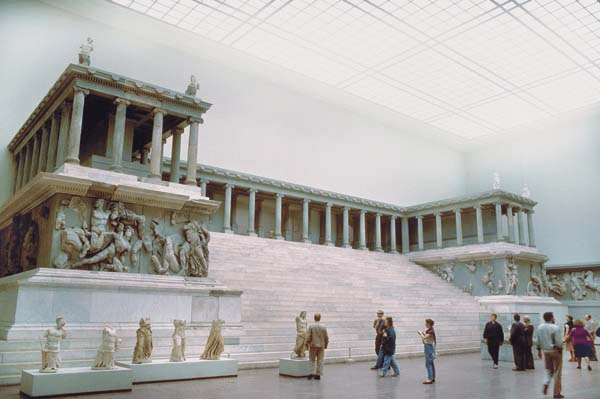
Christ and Culture (Revelation 2:12-17)

The Altar of Pergamum is considered one of the greatest surviving monuments from antiquity, now located in the Pergamum Museum, Berlin, Germany

“To the angel of the church in Pergamum write:

These are the words of him who has the sharp, double-edged sword. I know where you live—where Satan has his throne. Yet you remain true to my name. You did not renounce your faith in me, not even in the days of Antipas, my faithful witness, who was put to death in your city—where Satan lives.

Nevertheless, I have a few things against you: There are some among you who hold to the teaching of Balaam, who taught Balak to entice the Israelites to sin so that they ate food sacrificed to idols and committed sexual immorality. Likewise, you also have those who hold to the teaching of the Nicolaitans. Repent therefore! Otherwise, I will soon come to you and will fight against them with the sword of my mouth.

Whoever has ears, let them hear what the Spirit says to the churches. To the one who is victorious, I will give some of the hidden manna. I will also give that person a white stone with a new name written on it, known only to the one who receives it. (New International Version)

I’ve lived in one or two places in my life that I might have secretly described as the city where Satan lives. Jesus, however, in words to an ancient church, put it out there that they were living in such a place.

We aren’t told why Jesus described the city of Pergamum that way. Many ancient and important places typically had a prominent temple to some Greek god or goddess. In Pergamum, there existed a temple to Asclepius, the god of healing, symbolized by a snake – which isn’t exactly a positive icon in the worship of God.

The bad names didn’t stop there. Balaam is mentioned. He was a foreigner to Israel who is associated with false prophecy and leading worshipers of God astray. Balaam was blamed for the people’s idolatry and immorality before entering the Promised Land. (Numbers 31:16)

“Probably the greatest tragedy of the church throughout its long and checkered history has been its constant tendency to conform to the prevailing culture instead of developing a Christian counter-culture.”

John R.W. Stott

The name “Nicolaitans” is likely a Greek form of saying “Balaamites.” Thus, they are one in the same thing. It seems that Jesus was pointing a finger directly at particular religious practices consistent with the tradition of Balaam, namely, eating food sacrificed to idols and committing sexual immorality.

Idols and temples and eating were a hot button issue in the earliest church. All the places that churches were established, there were a significant number of Gentile converts from Greek religion to following Christ and worshiping God. And it was anything but a nice easy clean break from the old to the new.

I would surmise that the Balaamites and Nicolaitans are a group of Christian converts from paganism who were embracing a more syncretistic religion, and urging others to do the same – to maintain and engraft some of the Roman values and Greek religious practices so that the church would become more socially accepted and economically viable. Perhaps, they may have reasoned, there would be less persecution and things would generally go better for everyone.

“Some Christians want enough of Christ to be identified with him but not enough to be seriously inconvenienced.”

D.A. Carson

Whereas the Apostle Paul had a more nuanced understanding of the relationship between the church and the culture, the communication to the church at Pergamum was a definitive statement that Nicolaitans are immoral idolaters and the only thing to do in such a case is for them (not the entire congregation as a whole) to repent, stop the syncretism, and start devoting themselves completely to the worship of God alone.

Jesus himself was advocating for a firm refusal in trying to achieve respectability, to make compromises in religious practice. It certainly appears that, at least in the case of Pergamum’s converts, there was to be absolutely no connection with the old religion – not even with eating any meat or anything else that came from the pagan temple.

The Greek god Asclepius was connected with medicine and healing. So, why would this be such a problem for the fledgling church? Why would the city of Pergamum be labeled as the place where Satan lives?

Pergamum was a prominent city. It’s Greek culture, cultural and social traditions, and religious center represented the pinnacle of pagan society. This perhaps explains in part why early Christians viewed the place as a bastion of the devil.

Antipas, the Christian Bishop of Pergamum, is said to have been martyred there at the end of the first century, C.E. – which is around the time when many scholars believe the Book of Revelation was composed.

Whatever was actually going on at the time, there were most certainly significant tensions between the Christian and pagan communities which existed in the ancient city of Pergamum. Avoiding persecution, even death, may have been foremost in the minds of the Nicolaitans – who wanted accommodations with paganism that went too far, even for Jesus.

“Christ claims no man purely as a natural being, but always as one who has become human in a culture; who is not only in culture, but into whom culture has penetrated.”

H. Richard Niebuhr

It’s always been a difficult thing for Christians of every historical age to know how to deal with being in a society that is of a different culture and religion. And every generation of believers need to struggle through and reaffirm what Christian faith looks like wherever they live in this world, and in whatever cultural context they find themselves within.

In the letter to the church at ancient Pergamum, we perhaps find some guidance in Christ’s affirmation of holding onto Christian faith and keeping up a public profession of fidelity to him; and in Christ’s denunciation of diluting that Christian faith with too much accommodation to pagan culture.

Not every believer is going to agree in how to practically proceed with such matters. Yet these are issues worth having constructive conversations about, rather than simply digging into an established personal trench and, from there, lobbing unhelpful volleys of words at those who disagree.

Almighty God and Father of our Lord Jesus Christ, you are a jealous God who will not accept any attachment to other gods. I affirm you as the Most High God, and you will not give your honor or acclaim to idols. Please help us your people to avoid putting anything or anybody above or below you. Amen.

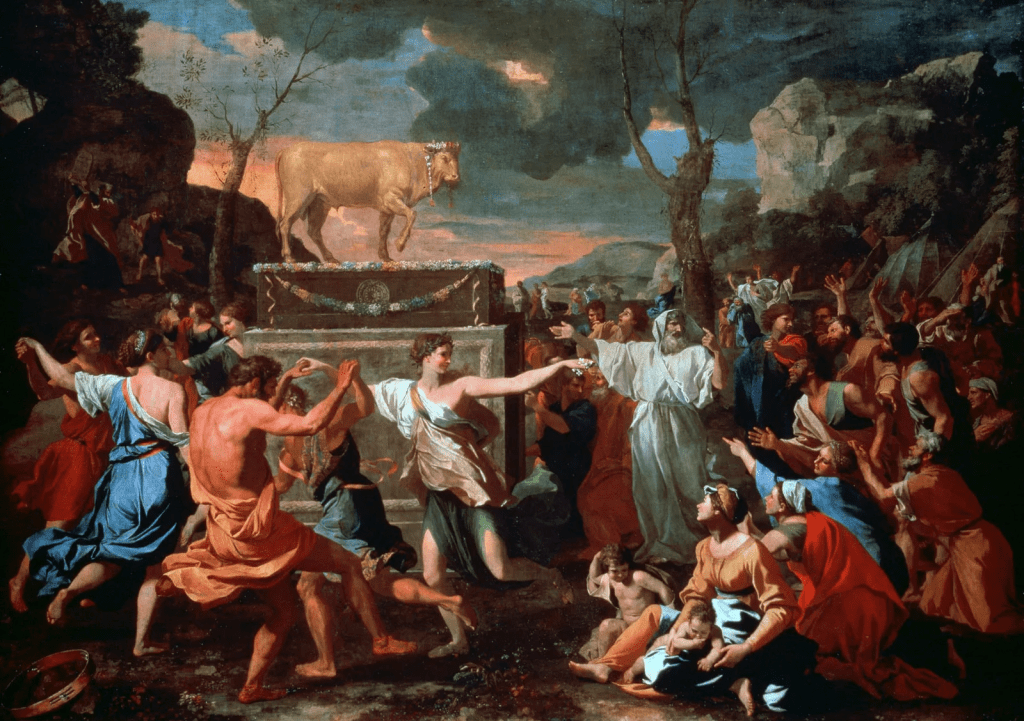
The Golden Calf (Exodus 32:1-14)

Adoration of the Golden Calf, by Nicolas Poussin (1594-1665)

When the people saw that Moses was so long in coming down from the mountain, they gathered around Aaron and said, “Come, make us gods who will go before us. As for this fellow Moses who brought us up out of Egypt, we don’t know what has happened to him.”

Aaron answered them, “Take off the gold earrings that your wives, your sons and your daughters are wearing, and bring them to me.” So all the people took off their earrings and brought them to Aaron. He took what they handed him and made it into an idol cast in the shape of a calf, fashioning it with a tool. Then they said, “These are your gods, Israel, who brought you up out of Egypt.”

When Aaron saw this, he built an altar in front of the calf and announced, “Tomorrow there will be a festival to the Lord.” So the next day the people rose early and sacrificed burnt offerings and presented fellowship offerings. Afterward they sat down to eat and drink and got up to indulge in revelry.

Then the Lord said to Moses, “Go down, because your people, whom you brought up out of Egypt, have become corrupt. They have been quick to turn away from what I commanded them and have made themselves an idol cast in the shape of a calf. They have bowed down to it and sacrificed to it and have said, ‘These are your gods, Israel, who brought you up out of Egypt.’

“I have seen these people,” the Lord said to Moses, “and they are a stiff-necked people. Now leave me alone so that my anger may burn against them and that I may destroy them. Then I will make you into a great nation.”

But Moses sought the favor of the Lord his God. “Lord,” he said, “why should your anger burn against your people, whom you brought out of Egypt with great power and a mighty hand? Why should the Egyptians say, ‘It was with evil intent that he brought them out, to kill them in the mountains and to wipe them off the face of the earth’? Turn from your fierce anger; relent and do not bring disaster on your people. Remember your servants Abraham, Isaac and Israel, to whom you swore by your own self: ‘I will make your descendants as numerous as the stars in the sky and I will give your descendants all this land I promised them, and it will be their inheritance forever.’” Then the Lord relented and did not bring on his people the disaster he had threatened. (New International Version)

The Golden Calf, by Sefira Lightstone

The ancient Israelites were dramatically delivered from slavery through a series of plagues on Egypt. Then, their lives were saved when God parted the Red Sea and the people fled from the advancing Egyptian army; collapsing the water on the soldiers when they tried to pursue the people.

The Israelites were led to Mount Sinai where God graciously entered into covenant with them; and gave them the law and the commandments. Yet, between receiving the covenant, and waiting for Moses to return from the mountain, the Israelites fell into chaos and a failure of faith. So, how did the relationship between God and Israel go so awfully sideways?

Moses spent a great amount of time with God on Mount Sinai. Apparently, the people believed that the forty days and forty nights on the mountain was too long and assumed that Moses would not return. So, what followed was idolatry, near annihilation, and intercession.

A failure of leadership

Aaron was left to lead the people during Moses’ absence. It didn’t take long for the people to get unruly and start working on Aaron. They asked him to make gods who will go before them, just as Yahweh and Moses had done in the pillar of cloud by day and fire by night.

For whatever reason, Aaron complied with their request. Maybe the people pestered him to death with constant bickering and asking, and he eventually gave-in to their coercion. Perhaps Aaron thought they had a point, and went with it as a willing participant. We aren’t told why. We are told that Aaron ordered the people to remove all the gold earrings they were wearing and bring them to him.

Aaron took all the gold he received and fashioned it into the form of a calf. Again, we aren’t told why Aaron chose to make a golden calf, in particular. Maybe he was forging a false god altogether in the shape of one of the Egyptian gods. After all, there had been a significant “back to Egypt” movement earlier, when circumstances got tough without food or water in the desert. Or perhaps Aaron was making a false image of the one true God. Either way you look at it, it’s not good.

The golden calf was handed to the people and proclaimed as the gods who brought them out of Egypt. If that weren’t bad enough, Aaron made the situation even worse by building an altar for the calf and declaring a feast for the next day. So, it’s no surprise to us as readers when we see poor leadership decision-making that leads to the people getting way out-of-hand in their festivities through drunkenness and sexual immorality.

The consequences of poor leadership

All of the revelry got God’s attention. The Lord saw the people’s depravity and commanded Moses to get back down the mountain, at once. God’s tone of voice and choice of pronouns took a turn. The Lord said to Moses, “Your people have acted perversely,” effectively distancing the divine from the mass of humanity at the foot of the mountain.

God was so upset that he started planning to destroy the whole lot of them and completely start over through the descendants of Moses. Yet, even though the Lord was very angry, and rightly so, Moses stepped in and interceded on the people’s behalf. Moses appealed to God’s reputation rather than God’s compassion. In an interesting twist, Moses turned the responsibility for the Israelites back onto God by saying they are your people, the ones whom you brought out of the land of Egypt.

What’s more, Moses pointed out to God that the Egyptians would question God’s motives for bringing the Israelites into the desert. And then Moses appealed to God’s covenant with Abraham, Isaac, and Jacob (Israel) to make a great nation of their descendants to dwell forever in the land God promised them. Moses actually persuaded the God of the universe to set aside divine anger and let the people live.

The people forgot who rescued them from slavery in Egypt. Regardless whether or not they had good intentions, the people failed in keeping their covenant obligations to God and sought to substitute God’s physical absence with a false image of God.

The implications of leadership for us

Today’s Old Testament story raises many questions for us. Here are just a few to ponder:

  • Which golden calves in our culture today draw our loyalty and love away from God when we get impatient with waiting for God’s timetable? Maybe our grumbling and complaining is a telltale sign that we are not content with God and what God is doing among us – and that we are fashioning (or have already fashioned) a god of our own making in the form of financial budgets, church buildings, or dogmatic theologies.
  • How have we made the God whom we worship into an idol that we try to control and manipulate for our own purposes? Perhaps we have substituted the one true God who is free, untamed, mysterious, and surprising, for a puny humanly constructed image, ideology, institution, or idol.
  • How do we maintain the balance between divine judgment with its consequences for disobedience, alongside God’s mercy, forgiveness, and faithfulness to the people? It could be, we are being led to grace, no matter how we go about answering the question.

Faithful God, you preside over an unfaithful people. Just as the people of Israel doubted your power and turned to other gods to fulfill their needs, we too, turn to other gods, seeking acceptance, power, and independence. Show us how to live humbly and walk in your ways, through the One who offered true power to all humanity, Jesus Christ our Savior and Lord. Amen.

Walk in the Way of Love (Ephesians 5:1-6)

Follow God’s example, therefore, as dearly loved children and walk in the way of love, just as Christ loved us and gave himself up for us as a fragrant offering and sacrifice to God.

But among you there must not be even a hint of sexual immorality, or of any kind of impurity, or of greed, because these are improper for God’s holy people. Nor should there be obscenity, foolish talk or coarse joking, which are out of place, but rather thanksgiving. For of this you can be sure: No immoral, impure or greedy person—such a person is an idolater—has any inheritance in the kingdom of Christ and of God. Let no one deceive you with empty words, for because of such things God’s wrath comes on those who are disobedient. (New International Version)

You are loved. There may not be a lot of things I know, and much of life might be a mystery with few answers, yet the one unshakable truth I have absolutely no doubt about is that you and I are loved by a good and loving God.

Humanity is loved and is therefore meant to love one another as the ultimate rule and guide of life.

Just as God loves, so we are to do the same. We are to mimic divine love in our daily lives. The healthiest of relationships are characterized by a continual dynamic of giving love and receiving love.

Whenever love fails to be the basic rule of life, people are exposed to the gravity of God’s wrath – which exists as the extension of God’s love, in order to put a stop to unloving words and actions in the world.

Unfortunately, as a hospital chaplain and church pastor, I daily see the sad effects of individuals who have experienced a paucity of love and, so, have taken on a false self to try and find love in all the wrong places – with damaging consequences.

Three inappropriate unloving ways of acting are mentioned in today’s New Testament lesson:

  • Sexual immorality is the illegitimate attempt to get the legitimate need for erotic love met without any strings attached. It is a misguided belief that one-night stands and clandestine trysts will protect against being too committed to another and getting hurt.
  • Impurity is any other illicit, illegal, or improper kind of behavior toward others which tries to do the same thing as immorality: Seeking to meet legitimate needs in an illegitimate way – to turn a trick for love, trying to avoid emotional, spiritual, or even physical pain.
  • Greed is an insatiable pursuit of addictive behavior meant to numb or stuff all the unwanted emotions which reside deep in the soul because of engaging in the immoral or impure actions.

Three inappropriate unloving words of speaking are mentioned:

  • Obscenity is filthy speech which is a cover for the agonizing unmet needs of love deep within the human heart. Obscene words are nothing more than verbal sexual immorality. They are a twisted attempt at trying to give and get loving words in an illicit manner.
  • Foolish talk, much like impurity, is any other illicit or improper words crafted to manipulate or cajole another. It is the hustle for love. The original Greek word means literally “to talk like a moron,” that is, a person who lacks sound judgment.
  • Coarse joking is crude and addictive speech, much like greed, envy, and coveting, which verbally trolls for love without unveiling any real feelings.

The antidote to all these baseless actions and distasteful words is to realize the true self, created by God, through receiving the love of God and of others with thanksgiving. Within genuine loving relationships, people can express their legitimate needs to each other and satisfy one another. Yet, with the false self, there is secrecy, hiding, and massive amounts of shame.

Love opens us to all that is good and beautiful. Love also opens us to the possibility of devastating hurt and loss. It is when we try to obtain the good and beautiful, while trying to build walls of protection against potential pain, that we get in trouble. The sinister tools we must use to try and get that impossible job done are manipulation and control with both verbal and physical immorality.

There is no true and authentic love apart from openness and vulnerability. Cheap imitations of love will only lead to hopeless despair.

“To love at all is to be vulnerable. Love anything and your heart will be wrung and possibly broken. If you want to make sure of keeping it intact you must give it to no one, not even an animal. Wrap it carefully round with hobbies and little luxuries; avoid all entanglements. Lock it up safe in the casket or coffin of your selfishness. But in that casket, safe, dark, motionless, airless, it will change. It will not be broken; it will become unbreakable, impenetrable, irredeemable. To love is to be vulnerable.”

C.S. Lewis

The way of love is the way of Christ. Imitating his example of a holy life, compassionate service, helpful speech, and healing actions – with a humble heart of gratitude – is to be our guide, rule, and direction in life. It is to realize our true selves and nudge the world just a bit closer back to Eden.

O Lord, in the name of Jesus Christ your Son our God, give us the love which never ceases so that our hearts will be enlightened and always burning with holy passion for the common good of all.

O Christ, our loving Savior, set our souls aflame so that they may shine brightly with the warmth and glow of unquenchable divine love, and lessen the darkness of the world. Lord Jesus, we pray, give us the light of your love so that we might always see you, desire you, look on you in love, and long after you.

Blessed Holy Spirit, send the fire of your love and empower us for loving service so that we may emulate and follow the example of our loving Lord, for the sake of Jesus Christ. Amen.

2 Peter 2:1-10a – Beware of Spiritual Predators

But there were also lying prophets among the people then, just as there will be lying religious teachers among you. They’ll smuggle in destructive divisions, pitting you against each other—biting the hand of the One who gave them a chance to have their lives back! They’ve put themselves on a fast downhill slide to destruction, but not before they recruit a crowd of mixed-up followers who can’t tell right from wrong.

They give the way of truth a bad name. They’re only out for themselves. They’ll say anything, anything, that sounds good to exploit you. They won’t, of course, get by with it. They’ll come to a bad end, for God has never just stood by and let that kind of thing go on.

God didn’t let the rebel angels off the hook but jailed them in hell till Judgment Day. Neither did he let the ancient ungodly world off. He wiped it out with a flood, rescuing only eight people—Noah, the sole voice of righteousness, was one of them.

God decreed destruction for the cities of Sodom and Gomorrah. A mound of ashes was all that was left—grim warning to anyone bent on an ungodly life. But that good man Lot, driven nearly out of his mind by the sexual filth and perversity, was rescued. Surrounded by moral rot day after day after day, that righteous man was in constant torment.

So, God knows how to rescue the godly from evil trials. And he knows how to hold the feet of the wicked to the fire until Judgment Day.

God is especially incensed against these “teachers” who live by lust, addicted to a filthy existence. They despise interference from true authority, preferring to indulge in self-rule. (The Message)

I wish everyone who claims the name of Christ was safe to talk to, interact with, and share life together. However, not everyone is. *Sigh*

Unfortunately, there exists spiritual predators who create chaos, keep others off-balance, and speak and act in ways that benefit their own consolidation of authority. They are like Sith Lords who come-off as well-meaning but always have a secret agenda for more power and control. *Sigh*

So-called teachers and leaders are not all trustworthy. Like mosquitoes drawn to warm blood, they seek to feast on the godly, taking advantage of their good nature – slowly, carefully, and insidiously draining the life out of them. All the while, the true believer doesn’t know what’s going on until it is too late. *Sigh*

Some are even more sinister. Like tarantulas, they immobilize their victims and slowly suck out their insides with the prey’s full awareness. Unable to scream or seek help, they lie in silent pain wishing for a miracle. *Sigh*

Yet, at the same time, none of those false teachers, emotional manipulators, and spiritual charlatans are putting anything over God. The Lord sees it all – and is incensed about it. The ungodly, masking as benevolent authorities, will not be able to carry-on with their hidden agenda of evil forever. Their time will run out. Judgment Day is coming.

The Lord knows how to deliver victims from their victimization. It rarely comes fast enough for us. Nevertheless, the destruction of all injustice is just around the corner. But how do we deal with all the unethical and immoral behavior now!?

We stay the course. Do not give-in to the temptation to play another’s Machiavellian game. The Christian life begins with humility, is sustained by a gentle spirit, embraces right ways of being with others, and typically results in trouble, even persecution. (Matthew 5:1-12)

We strive to always live into personal peace and be peacemakers. We understand that he who is within us is greater than he who is in the world. (1 John 4:4)

We choose to love and pray for our enemies, all the while being wise as serpents and gentle as doves. (Matthew 5:44, 10:16)

We embrace patience and persevere through each frustratingly mad situation, knowing that the Lord has promised to be with us, even until the very end of the age. (James 5:7-12; Matthew 28:20)

We give no one a reason to speak ill of us, blessing others and not cursing them. (Titus 3:2; James 4:11; Romans 12:14)

We trust God in all things, while being careful not to put a pearl necklace around a pig. (Proverbs 3:5-6; Matthew 7:6)

We keep encouraging and affirming others, even when we don’t get encouragement and affirmation ourselves. (Ephesians 4:29; 1 Thessalonians 5:11; Hebrews 3:13)

We stick to a community of people with like-minded values and refuse to withdraw into isolation. (Galatians 6:2; Philippians 1:27-30)

We follow Christ, our true Teacher and Lord, one day at a time, one step at a time – focusing continually on his words and ways as our polestar through the morass of confusion and iniquity. (Matthew 16:24; John 8:12, 10:27, 12:26; 1 Peter 2:21)

Jesus knew the sobering truth of spiritual predators acting as godly when he said:

Not everyone who calls me their Lord will get into the kingdom of heaven. Only the ones who obey my Father in heaven will get in. On the day of judgment many will call me their Lord. They will say, “We preached in your name, and in your name we forced out demons and worked many miracles.” But I will tell them, “I will have nothing to do with you! Get out of my sight, you evil people!” (Matthew 7:21-23, CEV)

May you remain encouraged in faith, steadfast in hope, and forever in love with the Savior who has loved you and given himself to you.

Christ, light of light, brightness indescribable, the wisdom, power and glory of God, the Word made flesh: you overcame the forces of Satan, redeemed the world, then ascended again to the Father. Grant me, I pray, in this tarnished world, the shining of your splendor. Send your holy angels to defend me, to guard my going out and coming in, and to bring me safely to your presence, where you reign in the one holy and undivided Trinity, now and forever. Amen.