The Example To Follow (1 Peter 2:19-25)

The Crucifixion, by John Kohan

For it is commendable if someone bears up under the pain of unjust suffering because they are conscious of God. But how is it to your credit if you receive a beating for doing wrong and endure it? But if you suffer for doing good and you endure it, this is commendable before God. To this you were called, because Christ suffered for you, leaving you an example, that you should follow in his steps.

“He committed no sin,
    and no deceit was found in his mouth.”

When they hurled their insults at him, he did not retaliate; when he suffered, he made no threats. Instead, he entrusted himself to him who judges justly. “He himself bore our sins” in his body on the cross, so that we might die to sins and live for righteousness; “by his wounds you have been healed.” For “you were like sheep going astray,” but now you have returned to the Shepherd and Overseer of your souls. (New International Version)

The reality of this life, for every one of us, is that we will suffer in some way. It’s not a matter of if we will suffer, but when and why. What’s more, my suffering is really not about me; it’s about him.

Therefore, let’s ensure that when the suffering comes, we know why – that it isn’t because of our own stupidity and poor choices, but because we are in solidarity with the One who suffered on our behalf and are living for him.

And in the midst of such suffering, let’s make sure that we face it and deal with it according to the example of Christ. Let’s imitate him.

Let’s also be honest from the start: We don’t like pain and suffering, and we often spend an inordinate amount of time and energy trying to avoid pain. 

Yet, in reality, our own suffering weans us away from the temporal things we tend to find consolation in, and drives us to the permanent source of comfort, strength, help, and encouragement. Our consolation is ultimately found solely in him.

When the athlete goes into the weight-room, they purposely go there to suffer. There is grunting and straining and difficulty. There is a tearing-down of muscle fibers. There is pain. 

That’s because strength-training needs commitment which suffers, and the pain that comes with growth. One cannot simply go into a weight-room, sit and watch other people lift weights, and believe they will then get in shape by only observing. 

God will put us in unwanted circumstances we did not ask for, and would not choose for ourselves, in order to position us to know him, to know Jesus. 

Crucifixion, by John Kohan

There are things in our lives that need to experience the suffering of death, in order for new life and growth to occur. For example, fire is an important part of Yellowstone National Park, because it brings environmental growth. According to ecology experts:

“Fire promotes habitat diversity by removing the forest overstory, allowing different plant communities to become established, and preventing trees from becoming established in grassland. Fire increases the rate that nutrients become available to plants by rapidly releasing them from wood and forest litter and by hastening the weathering of soil minerals.”

Concerning Christianity: Suffering is a necessary part of the Christian life because it creates the conditions for new life and growth and releases fresh sources of God’s grace into the church and world. 

We are to put to death anger, rage, malice, slander, lying, and useless language. They are to be replaced with compassion, kindness, humility, gentleness and patience, forgiveness, and love. (Colossians 3:7-14) 

More pointedly: Quit fighting against your suffering. Stop kicking and screaming long enough to look your suffering square in the face and learn from it.

Your suffering is trying to tell you something. But if you keep taking the stance of a pugilist trying to punch the pain away, suffering will just keep moving forward at you and never topple. 

You and I cannot beat suffering. We can only learn from it. In order to learn from it, we must embrace it.

So, here’s the counter-intuitive, counter-cultural practice that you might not like, and might think I’m off my rocker for suggesting: Submit to suffering. Yes, because in doing so you are submitting to him.

Don’t hear what I’m not saying. I am, in no way, trying to sanitize troubles, adverse circumstances, or even terrible trauma. Evil is evil, bad is bad, and no amount of saying otherwise will change the leopard’s spots. 

However, only through submitting to the process of what suffering teaches us will we ever have power over it.

Fighting against suffering is about as useful as taking on a bear. Bears, like suffering, can be dangerous. We don’t blame bears if they act like bears. Likewise, we ought not to be surprised when suffering hurts.

I suggest we treat suffering like facing a bear in the wilderness of trouble: 

  1. Calmly talk in low tones to your suffering. Speak to it. Remember who you are. You belong to God. Treat suffering as if it is curious about you. Stay calm. Doing the big freak-out only encourages suffering to do damage.
  2. Walk with others through suffering. Both yours and theirs. Christian community is one of the best practices of the Christian life. Suffering becomes connection within a community of persons who discern its purpose. 
  3. Keep your eye on suffering.  Don’t ignore it, or pretend it isn’t there. Don’t run. Face suffering. Keep it in front of you. It will pass, but you must be patient and calm. Once it is gone, then you can reflect on what happened and debrief with others about the experience.

For anything to change, we must stop something, and start something else. When it comes to suffering:

  • Stop fighting. Start accepting. 
  • Stop going it alone. Start living in vital and vulnerable community. 
  • Stop being a martyr. Start letting the martyrdom of Christ be your center of life. 
  • Stop talking. Start listening. 
  • Stop treating your suffering as an adversary. Start relating to suffering as a companion to learn from.

Lord Jesus Christ, by your patience in suffering you hallowed earthly pain, and gave us the example of obedience to your Father’s will. Be near me in my time of weakness and pain. Sustain me by your grace, so that my strength and courage may not fail. Heal me according to you will. And help me always to believe that what happens to me here in this life is of little account, if you hold me in eternal life, my Lord and my God. Amen.

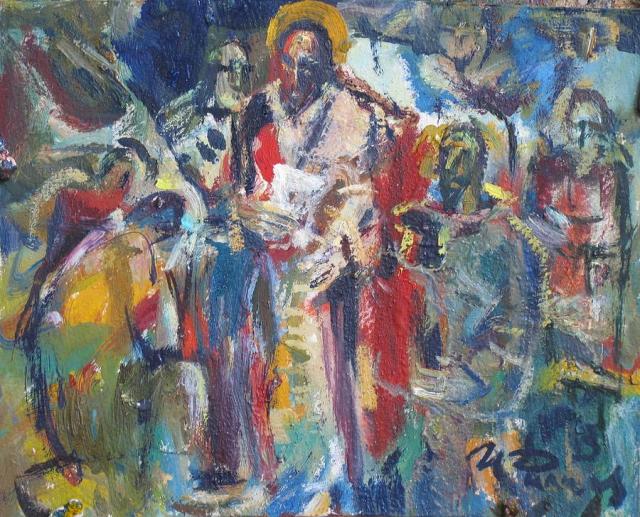
Grateful to God (1 Thessalonians 2:13-20)

Apostle Paul, by Ivan Filichev

And we also thank God continually because, when you received the word of God, which you heard from us, you accepted it not as a human word, but as it actually is, the word of God, which is indeed at work in you who believe. For you, brothers and sisters, became imitators of God’s churches in Judea, which are in Christ Jesus: You suffered from your own people the same things those churches suffered from the Jews who killed the Lord Jesus and the prophets and also drove us out. They displease God and are hostile to everyone in their effort to keep us from speaking to the Gentiles so that they may be saved. In this way they always heap up their sins to the limit. The wrath of God has come upon them at last.

But, brothers and sisters, when we were orphaned by being separated from you for a short time (in person, not in thought), out of our intense longing we made every effort to see you. For we wanted to come to you—certainly I, Paul, did, again and again—but Satan blocked our way.For what is our hope, our joy, or the crown in which we will glory in the presence of our Lord Jesus when he comes? Is it not you? Indeed, you are our glory and joy. (New International Version)

Reception and Acceptance of God’s Word

The Apostle Paul, in all of his letters to the churches, was attentive to affirming those things which are good amongst the believers; and not only the aspects of church life that needed change and/or repentance.

For the Thessalonians, Paul was profoundly grateful to God for the people’s receiving of the Word and their accepting it as from God. Perhaps there is no greater affirmation than this for the Christian.

In order to receive and accept God’s Word, people must know it. And people cannot know God’s Word unless they take the time and effort to read it and discover it for themselves.

Scripture reading is a foundational spiritual practice for Christians everywhere, and for all of Christ’s Church throughout the earth. Church worship liturgies, as well as individual Christians’ daily disciplines of faith, ought to be thoroughly saturated with Holy Scripture. Yet, many churches are believers, sadly, are not.

I am specifically calling out the conservative evangelical church on this. Although they claim to be Bible-centered, with an extended time for the sermon, there is a paucity of actual Scripture contained within those gathered times.

Too much of the preaching fails to truly explain Scripture, and there are virtually no Scripture readings or references outside the sermon and in the worship service. This is a travesty, and also a testament to the biblical ignorance of so many evangelicals.

What’s more, the evangelical impulse for a “personal quiet time with the Lord” is, in reality, practiced by precious few believers – and usually consists of little more than a daily crumb of the Bible.

I perhaps sound cranky and crotchety. Yet in a previous life, I was an evangelical Pastor for many years, and know the frustrations and challenges of attempting to bring biblical literacy to such churches and Christians. There’s a better way, but alas, that is a topic for another time and another post.

Imitators and Sufferers with God’s Churches

The true muster of a Christian and any Christian Church is the desire, speech, and action of actually following the words and ways of Jesus. It was the Lord Jesus himself who said:

“Remember what I told you: ‘A servant is not greater than his master.’ If they persecuted me, they will persecute you also.” (John 15:20, NIV)

“In this world you will have trouble. But take heart! I have overcome the world.”

Jesus (John 16:33, NIV)

Paul was thankful for the Thessalonians because of their solidarity with the other churches; and their willingness to suffer as Jesus did. What’s more, they did not try to reinvent the wheel, but affirmed the sound practices they saw in the original churches of Judea and imitated those good things.

This was not a matter of pragmatism, that is, just doing something that worked somewhere else and adopting it for yourself. Instead, Paul was talking about following the example of the first and earliest of churches. Those churches were made up of Jewish Christians who received a lot of persecution from their fellow Jews.

The Thessalonians, too, received grief and belligerence from the same sort of people, trying to bully them around and tell them what to do. But the believers held fast to the pattern of teaching and living they observed from both Paul and the churches who endured suffering in Judea.

It’s one thing to express belief. It’s quite another thing to suffer for those beliefs and experience persecution for them. God will handle the persecutors on Judgment Day, not us. It’s our job to remain faithful and persevere in the Christian life until that Day comes.

Glory and Joy in God’s Presence

For the Apostle Paul, glory and joy was not found in his great intellect and persuading many people, or his many accomplishments of planting churches and defending the faith. Paul’s highest joy was found in people coming to know Christ and living for Jesus.

His glory was in the hundreds of relationships established with people, and all the believers he mentored. In other words, Paul’s glory and joy was the real names and faces of people he encountered and gathered into the one Church, for whom Christ died and sacrificed himself.

It wasn’t even a thought in the Apostle’s big old head to gain glory for himself, or to pursue joy for it’s own sake. Rather, Paul discovered that real joy and glory comes in fulfilling the mission give to him by Christ:

To make disciples of all nations, baptizing them in the name of the Father, and of the Son, and of the Holy Spirit; teaching them to receive and accept God’s Word, to become imitators and sufferers with God, and to glory and joy in God’s presence.

Almighty God, Father of all mercies, we your unworthy servants give you humble thanks for all your goodness and loving-kindness to us and to all whom you have made.

We bless you for our creation, preservation, and all the blessings of this life; but above all for your immeasurable love in the redemption of the world by our Lord Jesus Christ; for the means of grace, and for the hope of glory.

And, we pray, give us such an awareness of your mercies, that with truly thankful hearts we may show forth your praise, not only with our lips, but in our lives, by giving up ourselves to your service, and by walking before you in holiness and righteousness all our days, through Jesus Christ our Lord, to whom, with you and the Holy Spirit, be honor and glory throughout all ages. Amen.

Philippians 3:17-20 – Follow a Good Example

Join together in following my example, brothers and sisters, and just as you have us as a model, keep your eyes on those who live as we do. For, as I have often told you before and now tell you again even with tears, many live as enemies of the cross of Christ. Their destiny is destruction, their god is their stomach, and their glory is in their shame. Their mind is set on earthly things. But our citizenship is in heaven. And we eagerly await a Savior from there, the Lord Jesus Christ. (New International Version)

Who do you imitate? What examples do you follow? How are you influenced by others?

Good Examples Are Virtuous

Because we are social creatures, we mimic and then pass on things we learn from others. So, it’s imperative we learn from people who demonstrate the values and ideals we aspire to possess ourselves.

In the people we listen to, either virtually or in person, as well as the authors we read, we are to live according to an example of virtue, sacrifice, and commitment.

We must imitate those Christian leaders who have a proven character in persevering in faith in the face of pain and suffering and have done it with great humility.

This does not necessarily mean we emulate those who eruditely speak the Word of God, have superior gifts and abilities, and enjoy success in ministry. It does mean, however, we ought to imitate, and have as mentors, those persons who imitate Christ.

We can leave behind and ignore those who are self-promoting peacocks, concerned with pursuing admiration and praise. Let’s, instead, mimic those who have proved themselves in hardship.

A Christian leader who has not undergone fiery trials and been purged of sinful pride are more easily seduced by their own importance. However, leaders who have seen their share of hard circumstances, pain, and suffering, and have come through it loving God and serving others out of grace and humility, are leaders worth imitating. They will likely serve well as good models of faith and ministry.

Good Examples Are In Community

Please notice there is more in today’s New Testament lesson than individually following a good example; we are to join with others in doing so. Community is needed for proper spiritual mimicking to take place.

Watch what God does, and then you do it, like children who learn proper behavior from their parents. Mostly what God does is love you. Keep company with him and learn a life of love. Observe how Christ loved us. His love was not cautious but extravagant. He didn’t love in order to get something from us but to give everything of himself to us. Love like that.

Ephesians 5:1-2, MSG

This is why the Apostle Paul wrote a letter telling Titus to ensure that he was being an example within the church community – and why he gave detailed instructions on virtue to make sure the older saints of God were teaching and mentoring the younger generations with a good example to show them. (Titus 1:5, 2:1-4, 3:1-2)

Following an example doesn’t take place in isolation. Like a duckling, we need to be with other ducklings following Mama Duck. Otherwise, we are at risk of getting lost and losing our faith, maybe even our lives.

Be a Good Example

It is also good to consider the kind of example we ourselves are displaying for others. In all our words and behaviors, whether we recognize it or not, we are modeling what is genuinely important to us. And sometimes what we do not say, or choose not to do, says as much or more about our character, beliefs, and ethics.

Our character is revealed in the way we treat people. How we treat those who cannot give something back to us tells more about our character than how we treat people we think are important.

People who are honest, kind, and fair – only when there’s something to gain – shouldn’t be confused with people of real character who demonstrate virtuous qualities habitually, under every circumstance. Individuals and groups of people are never to be handled as things or mechanisms to get what we want and achieve our goals.

Character is also revealed in the way we deal with the pressures and temptations which come our way. If we are one way whenever situations are going well, and then another way when things go sideways, it reveals something of our inner self.

Doing the right thing, whether someone is watching, or not, is always a hallmark of a good example.

It takes a lot of confidence in our way of life to say to another, like the Apostle Paul did, “follow my example.” If we have learned with humility and curiosity the words and ways of Jesus, and lovingly put them into practice, then we can be emboldened to mentor others in the faith and demonstrate for them what laboring for justice, righteousness, holiness, and godliness looks like in this fallen world.

Good Examples Together

More than ever, we need a cadre of solidly committed folks who have been mentored well in the ways of grace to serve as a beacon of light in the darkness of this world’s besetting sins of structural racism, hedonistic consumerism, discriminatory ageism, oppressive patriarchalism, biased hierarchism, disparity classism, religious anarchism, and a hundred other “isms” which keep people from flourishing in this life as God intended.

It is vital we learn from and emulate others who have a proven track record of promoting the common good of all persons. And it is equally important we become part of the ranks of those who are good examples of citizens in God’s benevolent and ethical kingdom.

Lord God, help me as your disciple to follow you in every thought, word, and deed. Give me a heart of faith and obedience so that I will live with confidence in the example and in the way of Jesus. Enable me to recognize your good and perfect will, even when it may seem nonsensical to me. I want to follow you all the days of my life. Please give me the strength to do so in the strength of your Holy Spirit. Amen.

Philippians 3:13-4:1 – Follow My Example

Brothers and sisters, I do not consider myself yet to have taken hold of it. But one thing I do: Forgetting what is behind and straining toward what is ahead, I press on toward the goal to win the prize for which God has called me heavenward in Christ Jesus.

All of us, then, who are mature should take such a view of things. And if on some point you think differently that too God will make clear to you. Only let us live up to what we have already attained.

Join in following my example, brothers and sisters, and just as you have us as a model, keep your eyes on those who live as we do. For, as I have often told you before and now tell you again even with tears, many live as enemies of the cross of Christ. Their destiny is destruction, their god is their stomach, and their glory is in their shame. Their mind is set on earthly things. But our citizenship is in heaven. And we eagerly await a Savior from there, the Lord Jesus Christ, who, by the power that enables him to bring everything under his control, will transform our lowly bodies so that they will be like his glorious body.

Therefore, my brothers and sisters, you whom I love and long for, my joy and crown, stand firm in the Lord in this way, dear friends! (NIV)

Many years ago, while driving through an intersection, a car turned in front of me and caused me to slam my brakes. After getting on my way (and proud of myself for not saying a word) my daughter, who was five years old at the time, leaned forward from the back seat and asked me, “Dad, is that guy an idiot?” 

Kids often imitate their parents in everything, whether good or bad. This is no less true for adults. When it comes to Christianity, faith is passed on not just from individuals reading their bibles in seclusion; it is handed down from person to person. Christians learn from leaders and respected persons how faith is lived out and practiced – and this comes primarily through imitating what they see. 

Therefore, it is good for us to ask the question: “Who do I imitate?” because we mimic and pass on things we learn from others. So, it is imperative we learn from people who demonstrate the values and ideals we aspire to possess ourselves. In the people we listen to either virtually or in person, as well as the authors we read, we are to walk according to the example of virtue, sacrifice, and commitment.

We must imitate those Christian leaders who have a proven character in persevering in faith in the face of pain and suffering and have done it with great humility. This does not necessarily mean we emulate those who eruditely speak the Word of God, have superior gifts and abilities, and enjoy success in ministry. It does mean, however, we ought to imitate, and have as mentors, those persons who imitate Christ. We can leave behind those who are self-promoting peacocks and pursue admiration and praise. 

We are to mimic those who have proved themselves in hardship. A Christian leader who has not undergone fiery trials and been purged of sinful pride are more easily seduced by their own importance. However, leaders who have seen their share of hard circumstances, pain, and suffering, and have come through it loving God and serving others out of grace and humility, are leaders worth imitating. They will likely serve well as good models of faith and ministry.

It is also good to consider the kind of example we ourselves are displaying for others. In all our words and behaviors, whether we recognize it or not, we are modeling what is genuinely important to us. And sometimes what we do not say, or choose not to do, says as much or more about our character, beliefs, and ethics.

It takes a lot of confidence in our way of life to say to another, like the Apostle Paul did, “follow my example.” If we have learned with humility and curiosity the words and ways of Jesus, and lovingly put them into practice, then we can be emboldened to mentor others in the faith and demonstrate for them what laboring for justice, righteousness, holiness, and godliness looks like in this fallen world.

More than ever we need a cadre of solidly committed folks who have been mentored well in the ways of grace to serve as a beacon of light in the darkness of this world’s besetting sins of structural racism, hedonistic consumerism, discriminatory ageism, oppressive patriarchalism, biased hierarchism, disparity classism, religious anarchism, and a hundred other “isms” which keep people from flourishing in this life as God intended.

It is vital we learn from and emulate others who have a proven track record of promoting the common good of all persons. And it is equally important we become part of the ranks of those who are good examples of citizens in God’s benevolent and ethical kingdom.

Almighty God, may I stand firm in faith through all the challenges and travails of this life. Enable me to incorporate the love of Christ in my life to such a degree that it proves to be an example of grace and peace. Give me a heart willing to sacrifice and serve the common good of all. Give me a broader and deeper understanding of the lessons I need to discover from others wiser than myself. Allow me to learn all I must from this painful, yet blissful life, through Jesus Christ my Lord, in the power of your Holy Spirit. Amen.