Mark 8:14-21 – Adventures in Missing the Point

The disciples had forgotten to bring bread, except for one loaf they had with them in the boat.“Be careful,” Jesus warned them. “Watch out for the yeast of the Pharisees and that of Herod.”

They discussed this with one another and said, “It is because we have no bread.”

Aware of their discussion, Jesus asked them: “Why are you talking about having no bread? Do you still not see or understand? Are your hearts hardened? Do you have eyes but fail to see, and ears but fail to hear? And don’t you remember? When I broke the five loaves for the five thousand, how many basketfuls of pieces did you pick up?”

“Twelve,” they replied.

“And when I broke the seven loaves for the four thousand, how many basketfuls of pieces did you pick up?”

They answered, “Seven.”

He said to them, “Do you still not understand?” (New International Version)

In today’s Gospel lesson, Jesus uses yeast as a metaphor for corrupting influences. It only takes a little bit of yeast to work through the whole batch of dough. Christ, upholding the teachings of Old Testament law, didn’t just want people to avoid eating actual unleavened bread. He desired his disciples to be unleavened themselves, a holy people, free of all crookedness and malevolent motives.

Christ’s disciples, bless their pea-pickin’ literal interpreting hearts, were too dense to pick up on the metaphor. They began anxiously chattering about how Jesus might be disappointed with them in having no actual bread to eat. Although they had just witnessed an amazing miracle of literally feeding thousands of people, the disciples did not discern what that miracle meant beyond just filling bodily stomachs.

Had Christ’s disciples been able to see beyond the literal to the metaphorical, they would have likely understood several lessons Rabbi Jesus was teaching them:

  • The provision of bread pointed to who Jesus truly is: Living Bread from heaven. Just like the miraculous provision of manna in the desert to the ancient Israelites, so God was graciously meeting the total needs of people through Jesus. Conversely, the yeast of corruption saps the life out of people.
  • The presence of bread doesn’t necessarily mean it’s all good. There’s leavened bread and unleavened bread. That is, there is the healthy bread of God’s Word to eat, and there are other words to eat which is unhealthy bread. A life set apart for goodness and mercy in the world brings life to others. A person with mixed motives and personal agendas of power and privilege brings no nourishment to others – only inedible bread.
  • The puny amount of bread became a huge feast. A little bit of Jesus is enough to feed thousands and satisfy empty stomachs. A little bit of false teaching and hypocrisy is enough to corrupt thousands of people and make them sick.
  • The prosperity of bread multiplied by Jesus was so much that there were leftovers. In the kingdom of God, there is abundance. The disciples served the bread to the throng of people, and they received bread for themselves with twelve basketfuls of bread pieces – enough bread to feed their families, as well. The leavened bread of corruption doesn’t satisfy; it only decreases health.

But the disciples didn’t get it. So, Jesus chided them for their profound lack of spiritual awareness. By this time, the disciples had been following Jesus for a while – watching him do miraculous works of healing and meeting people’s needs, as well as being on the inside track of receiving his gracious teaching. If anyone ought to get what’s going on, it was them.

If we continually possess only a one-dimensional interpretation of Holy Scripture, a literal one, we are most certainly going to miss most of what’s really happening with Jesus. Rigid and narrow hermeneutical approaches aren’t just inadequate; they’re a corrupting influence. It is an adventure in missing the point because there is only a dim awareness of self, others, God, and God’s Word. It doesn’t nourish anybody. In fact, it makes people sick.

That sad situation makes such people, along with disciples at the time, no better than those on the outside of God’s kingdom.

“You will listen and listen,
    but never understand.
You will look and look,
    but never see.” (Isaiah 6:9, CEV)

Spiritual blindness and deafness are the symptoms of an unexamined and unaware life. And the lack of awareness is a malady from the bread of corruption.

Jesus Christ has a mission, along with the authority to make it happen. He was hoping for a more adequate understanding of this from his disciples, instead of getting the obtuse deer-in-the-headlights response.

Although, in some ways, today’s Gospel story is downer, it is also hopeful. The disciples ultimately do not remain stuck. They illustrate for us the nature of faith. Faith is not a one and done event of praying a sinner’s prayer or accepting Jesus. Rather, faith is an unfolding drama of redemption.

We grow in and into faith. Faith is much more a gradual awareness of God’s character and working in the world, with maybe a few dramatic epiphanies along the way. It is piecemeal, rather than wholesale. It’s more like taking small bites of delicious bread and savoring it with friends, instead of ravenously devouring an entire loaf alone.

“I am the living bread which came down from heaven. If anyone eats of this bread, he will live forever; and the bread that I shall give is My flesh, which I shall give for the life of the world.” (John 6:51, NKJV)

Lord Jesus, as you came to serve us living bread, fill us with the compassion and insight to respond to human need by loving service. Let the fire of your goodness and justice burn into us and through us, that we may seek to transform the unjust structures of society. As you come into our lives to redeem all that is good, guide to renew and sustain the life of your creation. Let your glory fill our lives. Let your glory fill this world. Amen.

2 Corinthians 7:2-16 – Genuine Sorrow Changes Us

Make room for us in your hearts. We have wronged no one, we have corrupted no one, we have exploited no one. I do not say this to condemn you; I have said before that you have such a place in our hearts that we would live or die with you. I have spoken to you with great frankness; I take great pride in you. I am greatly encouraged; in all our troubles my joy knows no bounds.

For when we came into Macedonia, we had no rest, but we were harassed at every turn—conflicts on the outside, fears within. But God, who comforts the downcast, comforted us by the coming of Titus, and not only by his coming but also by the comfort you had given him. He told us about your longing for me, your deep sorrow, your ardent concern for me, so that my joy was greater than ever.

Even if I caused you sorrow by my letter, I do not regret it. Though I did regret it—I see that my letter hurt you, but only for a little while— yet now I am happy, not because you were made sorry, but because your sorrow led you to repentance. For you became sorrowful as God intended and so were not harmed in any way by us. Godly sorrow brings repentance that leads to salvation and leaves no regret, but worldly sorrow brings death. See what this godly sorrow has produced in you: what earnestness, what eagerness to clear yourselves, what indignation, what alarm, what longing, what concern, what readiness to see justice done. At every point you have proved yourselves to be innocent in this matter. So even though I wrote to you, it was neither on account of the one who did the wrong nor on account of the injured party, but rather that before God you could see for yourselves how devoted to us you are. By all this we are encouraged.

In addition to our own encouragement, we were especially delighted to see how happy Titus was, because his spirit has been refreshed by all of you. I had boasted to him about you, and you have not embarrassed me. But just as everything we said to you was true, so our boasting about you to Titus has proved to be true as well. And his affection for you is all the greater when he remembers that you were all obedient, receiving him with fear and trembling. I am glad I can have complete confidence in you. (New International Version)

“The only vice that cannot be forgiven is hypocrisy because the repentance of a hypocrite is itself hypocrisy.”

William Hazlitt (1778-1830)

I’m in the soul business. Not in the Detroit Mo-town Aretha Franklin kind of soul business (although that would be very cool) but in the sense of leading human souls to God and building them up in Christ. Key to the Christian life’s soul is the term “repentance.”  To repent means to turn around, to stop going in one direction and start going in another one. It is repentance which makes all the difference in the direction of our souls.

Certainly, no one can really judge the heart of another. Yet, today’s New Testament lesson lets us in on how to truly measure the sincerity of a person’s repentance. 

Worldly sorrow or grief does not lead to repentance, but disconnection and death. People with worldly sorrow beat themselves up but never really change direction. Like Judas Iscariot of old, they just hang themselves instead of admitting guilt to Jesus. 

Godly sorrow, however, leads to repentance, a change of direction. And here is the evidence of the genuine change: 

  • Owning the problem.
  • Eagerness to make things right.
  • Indignation over what has been done or said.
  • Discernment that there is more pain in avoiding the problem than there is confronting it.
  • Desire and energy to do what is best for the person who was wronged.
  • Willingness to accept whatever consequences which might result from the offense.

Crying and weeping might be necessary. Yet the tears can also be a cheap form of avoiding true repentance. 

Whether there are tears, or not, there must be solid action that changes direction and seeks to rectify offenses, as much as it is within our control to do so. 

Deliverance from the power of guilt and shame comes through repentance. There are no shortcuts or easy routes to the soul’s orientation to practical godliness. 

There is nothing romantic about repentance. It is typically messy, usually ugly, and often painful. Yet, there must be suffering before there is glory. Attempting to remove true repentance from personal transformation only eviscerates the Christian life and leaves our souls vacuous and empty.

Instead, we carefully, tediously, and patiently go about the important work of repentance, with all its deep sorrow, regret, vulnerability, challenge, awkwardness, and courage.

Holy God, I confess to you the things which I have said and done, as well as those things I have left unsaid and undone. And, yet your mercy is from everlasting to everlasting. Open my eyes to the ways I have offended others and failed to build them up. Help me to step boldly into repentance and faith in Jesus Christ, through the power of the Holy Spirit.  Amen.

Matthew 23:13-28 – Whoa, Here Comes the Woes!

Pharisees by German painter Karl Schmidt-Rottluff, 1912

“Woe to you, teachers of the law and Pharisees, you hypocrites! You shut the door of the kingdom of heaven in people’s faces. You yourselves do not enter, nor will you let those enter who are trying to.

“Woe to you, teachers of the law and Pharisees, you hypocrites! You travel over land and sea to win a single convert, and when you have succeeded, you make them twice as much a child of hell as you are.

“Woe to you, blind guides! You say, ‘If anyone swears by the temple, it means nothing; but anyone who swears by the gold of the temple is bound by that oath.’ You blind fools! Which is greater: the gold, or the temple that makes the gold sacred? You also say, ‘If anyone swears by the altar, it means nothing; but anyone who swears by the gift on the altar is bound by that oath.’ You blind men! Which is greater: the gift, or the altar that makes the gift sacred? Therefore, anyone who swears by the altar swears by it and by everything on it. And anyone who swears by the temple swears by it and by the one who dwells in it. And anyone who swears by heaven swears by God’s throne and by the one who sits on it.

“Woe to you, teachers of the law and Pharisees, you hypocrites! You give a tenth of your spices—mint, dill, and cumin. But you have neglected the more important matters of the law—justice, mercy, and faithfulness. You should have practiced the latter, without neglecting the former. You blind guides! You strain out a gnat but swallow a camel.

“Woe to you, teachers of the law and Pharisees, you hypocrites! You clean the outside of the cup and dish, but inside they are full of greed and self-indulgence. Blind Pharisee! First clean the inside of the cup and dish, and then the outside also will be clean.

“Woe to you, teachers of the law and Pharisees, you hypocrites! You are like whitewashed tombs, which look beautiful on the outside but on the inside are full of the bones of the dead and everything unclean. In the same way, on the outside you appear to people as righteous but, on the inside, you are full of hypocrisy and wickedness. (NIV)

I am not sure if today’s Gospel lesson was purposefully designed to fall on Halloween, or not. If it was, I guess the compilers of the Daily Lectionary wanted to scare the bejabbers out of us with Christ’s chilling pronouncement of woes upon hypocritical religious folk.

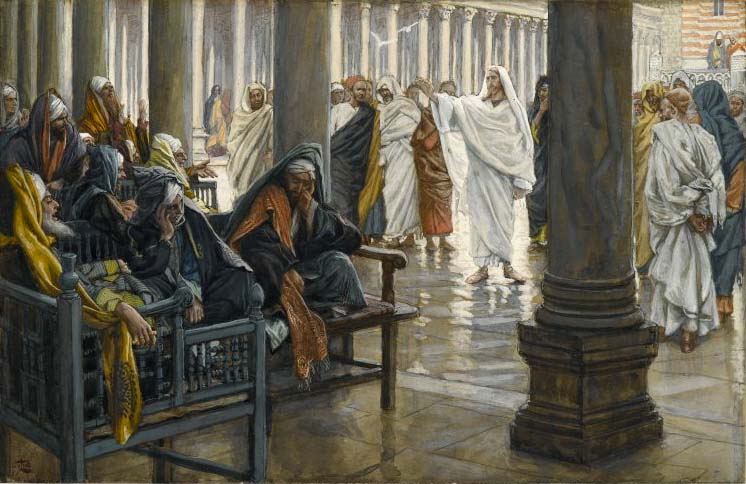
Christ’s scathing critique was directed against a distorted spirituality, a false Christianity, and a controlling religious leadership that stifled the true worship of God. The word “woe” literally means “disaster” “calamity” or “misery.” Jesus leveled seven of them squarely at the religiously committed who had an incongruent faith in which the outside did not match the inside.

“Woe unto You, Scribes and Pharisees” by French painter James Tissot (1836-1902)

Woe to the Door Slammers

Jesus wanted no slamming the door of God’s kingdom in the faces of ordinary people. The Lord has a zero-tolerance policy for keeping others on the margins and out of the reach of resources and people who could help them.

Several years ago, while working on my graduate thesis in American religious history, I read hundreds of sermons from antebellum southern preachers. Most of them had a uniform biblical defense of the institution of black chattel slavery. Many of the clergymen pastored large churches and led many white people to Christ. Yet, they slammed the door of God’s kingdom smack in the faces of African American slaves, and taught others to do the same.

We might unwittingly door-slam people when we say God’s grace is for all, and then turn around and use policies and procedures to exclude certain people. Typically, behind it all, is a commitment to old-fogy-ism instead of Holy Scripture. 

Woe to the Exporters of Hell

The religious insiders were mission-oriented and wanted to make disciples just like themselves, which unfortunately meant loading others down with a heavy burden of legalistic mumbo-jumbo. In doing so, they were exporting their brand of religion which weighed people down instead of uplifting them.

In contrast to this, Jesus was concerned to form followers in and around the biblical virtues of humility, sensitivity to sin, meekness, purity, mercy, and peace-making. 

Woe to the Misguided Oath-Takers

Oath-taking was an art form with the religious authorities. There was so much complexity with their rules regarding oaths that it was common to make lots of promises to God which were never kept. Chiefly because there was no real intention of keeping them from the get-go. So, Jesus called them on it and railed about their blindness of truth. 

The leaders had lost sight of what is important to God. They either could not or would not distinguish between important and unimportant matters. In Christ’s Sermon on the Mount, Jesus addressed the issue of truth and oath-taking by saying, in essence, that if you’re going to play these games about promise-making and promise-keeping, then don’t swear or make promises at all. Just say “yes” or “no.” This was Christ’s way of saying that lies and liars come from Satan, not God. (Matthew 5:33-37)

Woe to Those Who Give to Get

It is good to give – not so good to give from selfish motives and as a means of avoiding other matters. The religious leaders neglected weightier issues of the law while focusing on their superb 10% giving skills. 

The way it worked was this: “Well, I do my part and give 10%, then I get to do whatever the heck I want with the other 90%.” Meanwhile, the things which God passionately cares about, like justice, mercy, and faith, took a back seat. Focusing on frivolous pennies instead of precious life is going to raise the ire of Jesus every time.

Life is supremely important to God. The Lord sees the single mom who struggles to make it; the lonely person who wonders if there is any worth to her existence; and the poor worker who is stuck in a job without a living wage. God cares about the needy persons around us:

This is what the Lord of Armies says: “Administer real justice and be compassionate and kind to each other. Do not oppress widows, orphans, foreigners, and poor people. And do not even think of doing evil to each other.” (Zechariah 7:9-10, GW)

He has shown you, O mortal, what is good. And what does the Lord require of you? To act justly and to love mercy and to walk humbly with your God. (Micah 6:8, NIV)

Speak out for those who cannot speak, for the rights of all the destitute. (Proverbs 31:8, NRSV)

Justice, mercy, and faithfulness all have to do with neighbor love. It is easy to love those who love us back. Yet, the one who loves another, the outsider, the person for whom no one else cares or loves is the one whom Jesus is looking for. We are to have a spiritual vision of living in the world for the sake of the world, without being of the world. Apart from this vision, there is blindness.

Woe to the Squeaky Clean

The teachers of the law had a compulsion for ritual cleanliness. For Jesus, it was an inner issue of the heart, and not about outward washings. For example, having a polished and immaculately clean church building means little if the parishioners within are full of greed and self-indulgence. Christian ministry ought to be centered in cleaning up the human heart, and not just making sure the outside looks good. 

The ancient leaders were obsessed with not making a mistake and becoming impure. In a strict legalistic system, making a mistake equals the unpardonable sin. However, in a system of grace, people are encouraged to freely pursue God, and if they fail, are allowed the grace to try something different or try again.

Woe to Perfect Hair

Okay, that is not quite what the text says, but it is darned close. At Passover, when multiple thousands of people came to Jerusalem, the Pharisees whitewashed all the tombstones to make sure no one would inadvertently step on a grave. Because if someone did, they became unclean and unable to celebrate Passover. 

Jesus said the perfect hair people were like those tombstones – all nice, clean, spiffy, and looking good on the outside, but on the inside full of death. 

Inordinate focus on the outside only prevents one from hearing the cries of people all around us and responding with justice. On the farm, we would say, if there is no manure in the barn, there is no life.

Conclusion

Jesus gave us some telltale signs of the hypocrite:

  • Fails to practice what they preach.
  • Keeps other people out of God’s kingdom.
  • Focuses on externals.
  • Majors on the minors.

The final word, however, is not hypocrisy but grace. At the end of his tirade, Jesus broke into a tear-filled, heart-rending love song for his wayward people. The set of woes from Jesus, then, are not just blast-the-bad-guys. Jesus has a very deep concern for all people to know the true worship of God.

Matthew 23:29-36 – “Woe Is Me!”

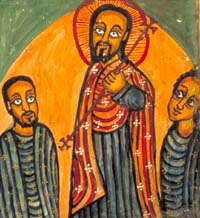
Ethiopian Jesus
Jesus, from an Ethiopian Orthodox Church, c.1750 C.E.

“Woe to you, teachers of the law and Pharisees, you hypocrites! You build tombs for the prophets and decorate the graves of the righteous. And you say, ‘If we had lived in the days of our ancestors, we would not have taken part with them in shedding the blood of the prophets.’ So, you testify against yourselves that you are the descendants of those who murdered the prophets. Go ahead, then, and complete what your ancestors started! 

“You snakes! You brood of vipers! How will you escape being condemned to hell? Therefore, I am sending you prophets and sages and teachers. Some of them you will kill and crucify; others you will flog in your synagogues and pursue from town to town. And so upon you will come all the righteous blood that has been shed on earth, from the blood of righteous Abel to the blood of Zechariah son of Berekiah, whom you murdered between the temple and the altar. Truly I tell you; all this will come on this generation. (NIV) 

I almost feel the need to place a warning label on this blog post: “The writer has determined that a careful reading of this Scripture is dangerous to those who think their current state of Christianity is just fine.”  Jesus stands in a long line of Old Testament prophets as the ultimate prophesier calling the people to see things as they really are and come back to the God of all, not the God of their own making. 

I feel yet another warning is warranted, knowing from years of experience that there is an Enemy of our souls: The dark forces of this world will try every which way to get us to believe these words of Jesus are for other people, not me or you – that you and I are okay and that this is for “those” people [probably ones we don’t like] who are clearly deluded. We, however, are simply fine.   

We all need these words from Jesus and to let them speak to us. Christ’s scathing and damning critique was leveled against a distorted spirituality, a false Christianity, a controlling leadership that stifled and snuffed-out the true worship of God. Jesus pronounced seven woes on the religiously pious spiritual brokers of his day. Today’s Gospel lectionary contains only the seventh woe. This woe, along with the rest, are not directed toward the irreligious or the spiritually lackadaisical folks among us – the woes are aimed squarely at the religiously committed. 

Ethiopian Orthodox Jesus
Ethiopian Orthodox Church depiction of Jesus

The word “woe” literally means “disaster” “calamity” and “misery.” Jesus pronounced a woe against ultra-religious persons who were obsessed with respecting the tombs and the graves of the ancient prophets. It was considered a terrible travesty to walk on such a grave, even accidentally. The concern about it would be something like today’s respect given to the American flag by many people. 

Here is what Jesus is getting at with his woe on those being so concerned with the tombs of the prophets: Honoring dead people and inanimate objects like graves while ignoring live people is not good. Respecting dead people of the past means nothing if we simultaneously ignore the live people right in front of us. For Jesus, one of the surest ways to hell is to give credence to Christian leaders long dead while flippantly disregarding the prophet or pastor presently in our lives who is taking pains to communicate God’s will and care for God’s people right now. 

Jesus knew quite well the telltale signs of hypocrisy: 1) hypocrites don’t practice what they preach; 2) hypocrites keep other people out of God’s kingdom; 3) hypocrites focus on externals; and, 4) hypocrites major on the minors. Hypocrisy, however, never has the last word – grace does. The final word to everything is God’s grace.  

For all of Christ’s severe words, his heart was filled with a love and a longing for his wayward people. Jesus died for the ungodly with deep concern, intention, and hope that everyone would come to know the true worship of God – filled with an abundance of mercy for the penitent sinner. 

When the prophet Isaiah experienced a vision of God his response was “woe is me!” (Isaiah 6:1-5). The appropriate response to today’s Gospel lesson is repentance – to see and turn from our own propensity toward spiritual and/or religious pride and the tendency to view the “other” as needing to repent, but not me.  

Let us, then, come to the cross of Jesus Christ and there find the grace which absolves us from such sin. Let us approach the empty tomb and find Christ’s resurrecting power of transformation. Let us approach the ascended Christ on the throne with both humility and confidence. Let us intercede for a world which desperately needs the peace of Christ. 

Lord Jesus Christ, you prayed that we would be one as you and your Father are one. We confess our resistance to your prayer. We have failed to maintain the unity of the Spirit. We have broken the bond of peace. For the times we have not listened to each other, when we have spoken in anger, haste, or fear, we are sorry. For the times we have not loved each other, when we have competed, or insulted or judged each other, we are sorry. For the harm that our disunity has done to our witness to the Gospel, we are sorry. Have mercy on us, we pray. Restore us to friendship with you and with one another, through the power of your Spirit. Lord, grant your grace for repentance to spiritual charlatans and victimizers; and, give your power to those distressed and victimized for forgiveness of their abusers, so that all of us together may strive to break the chains of oppression and show the peace of Christ in the world. Amen.