Be Merciful (Jonah 4:1-11)

Jonah was really upset and angry. So he prayed:

Our Lord, I knew from the very beginning that you wouldn’t destroy Nineveh. That’s why I left my own country and headed for Spain. You are a kind and merciful God, and you are very patient. You always show love, and you don’t like to punish anyone.

Now let me die! I’d be better off dead.

The Lord replied, “What right do you have to be angry?”

Jonah then left through the east gate of the city and made a shelter to protect himself from the sun. He sat under the shelter, waiting to see what would happen to Nineveh.

The Lord made a vine grow up to shade Jonah’s head and protect him from the sun. Jonah was very happy to have the vine, but early the next morning the Lord sent a worm to chew on the vine, and the vine dried up. During the day the Lord sent a scorching wind, and the sun beat down on Jonah’s head, making him feel faint. Jonah was ready to die, and he shouted, “I wish I were dead!”

But the Lord asked, “Jonah, do you have the right to be angry about the vine?”

“Yes, I do,” he answered, “and I’m angry enough to die.”

But the Lord said:

You are concerned about a vine that you did not plant or take care of, a vine that grew up in one night and died the next. In that city of Nineveh there are more than 120,000 people who cannot tell right from wrong, and many cattle are also there. Don’t you think I should be concerned about that big city? (Contemporary English Version)

Fear and anger go hand in hand. The fear of what sort of evil might happen often leads a person toward angry vitriol, even violence.

I once dealt with a woman who was so upset with her husband that she was literally shaking with anger. There was a time when her husband had been abusive, but thankfully, he gave his life to God, changed, and became a loving person. 

The thing that was so upsetting for the wife is that God saved her husband without punishing him for all the abuse he had dished out. She wanted some divine payback! The woman was actually furious about God showing grace and compassion.

This is not a novel or new experience. In the ancient world, the Assyrians were notorious for their brutality toward conquered peoples. They thought up forms of torture as a creative past-time. It was a violent culture, full of inhumane practices, and soldiers who were the scourge of the Middle East.

The violent ways of the Assyrians caught the notice of God. Divine judgment was hanging over the capital of the Assyrian Empire, Nineveh. So, God told the prophet Jonah to go and give the powerful empire a message of impending doom. (Jonah 1:2)

Jonah did not immediately obey God. However, he eventually went to Nineveh (after the infamous being in the belly of a great fish for three days and nights). The result was a great repentance of sin from the Assyrian people. 

The entire city turned from their evil ways. God saw this mass repentance and relented from sending disaster. Instead of destroying the city, with all its inhabitants and animals, the Lord was merciful and spared them. After all, God delights in seeing humility and the courage to admit evil and turn from it.

But Jonah had a serious problem with God’s grace toward the Assyrians. He was so upset and angry about the whole affair, that he wanted to die. Jonah was actually annoyed and greatly displeased by God’s goodness. Jonah wanted justice; he was looking for judgment. The last thing he wanted was divine mercy toward the very people who were experts at killing Jews. 

Yet, we must come to grips with the reality that God’s grace is so massive that it even extends to some of the most evil people in history. And Jonah wanted no part of that sort of theology.

God asked Jonah twice, “Do you have a right to be angry?” Jonah wanted destruction and pay-back for all the sin of the Assyrians. But God searches our hearts and exposes our expectations. Often, when those expectations do not happen, we are disappointed and become angry, even livid over the lack of retribution from God.

God wanted Jonah to share the same heart of mercy. And God still desires God’s people to have a heart that has grace and compassion, even in the face of terrible evil. Sometimes, God calls us to do what we least want to do in order to reveal what is really in our own hearts.  

Hating people to the point of wanting nothing but destruction upon them does nothing to bring about the righteous life that God desires. In Christian understandings, the blood of Jesus Christ has the power to bring healing and hope, even to the worst of sinners.

Whenever our fears turn to anger and we believe that God should bomb evil people off the face of the earth… or if we think our neighbors might be harboring ill-intent just because they are of a different race, ethnicity, or religion… or if we harbor bitterness because of real evil present in this world and want at least a little payback; then, we are no better than Jonah.

We end up looking just as ridiculous as Jonah, sitting at the edge of the city, pouting like a little kid.

Let’s grow up and rise above the current rancor that exists in so many places. Be concerned for the billions of people on this earth who need a merciful divine intervention and the grace of repentance that leads to new life. 

Pray for your enemies. Do good works for those who oppose you. Gain a bigger for the nations of the world. Remember what is really important in life. 

Any fool can rant and rave with anger against another; but the wise and gracious follower of God patiently and carefully prays and acts in ways that brings mercy and grace to others.

Merciful God, your presence of love in this world is truly amazing. Despite the real existence of evil on this earth, your grace cuts through it all and has the last word. Work in my life in such a way that fear is done away with and sinful anger vanishes, to be replaced with the love of Jesus Christ. Amen.

Seek the Least and the Lost (Matthew 18:1-14)

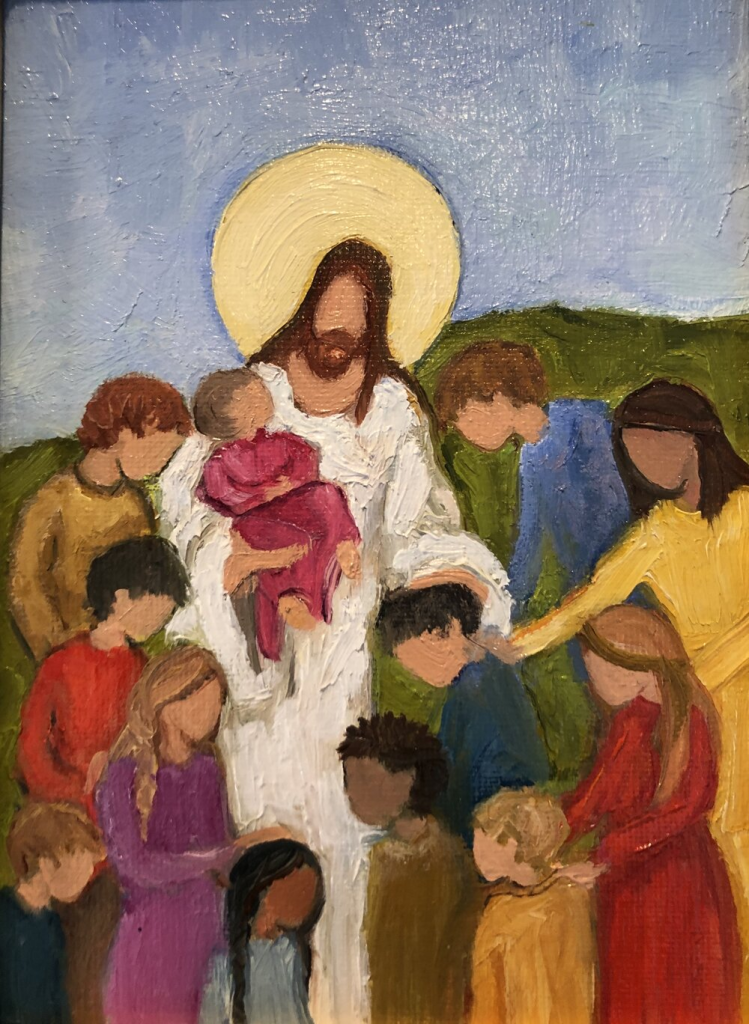
Child of God by Suzi Olson

At that time the disciples came to Jesus and asked, “Who, then, is the greatest in the kingdom of heaven?”

He called a little child to him and placed the child among them. And he said: “Truly I tell you, unless you change and become like little children, you will never enter the kingdom of heaven. Therefore, whoever takes the lowly position of this child is the greatest in the kingdom of heaven. And whoever welcomes one such child in my name welcomes me.

“If anyone causes one of these little ones—those who believe in me—to stumble, it would be better for them to have a large millstone hung around their neck and to be drowned in the depths of the sea. Woe to the world because of the things that cause people to stumble! Such things must come, but woe to the person through whom they come! If your hand or your foot causes you to stumble, cut it off and throw it away. It is better for you to enter life maimed or crippled than to have two hands or two feet and be thrown into eternal fire. And if your eye causes you to stumble, gouge it out and throw it away. It is better for you to enter life with one eye than to have two eyes and be thrown into the fire of hell.

“See that you do not despise one of these little ones. For I tell you that their angels in heaven always see the face of my Father in heaven.

“What do you think? If a man owns a hundred sheep, and one of them wanders away, will he not leave the ninety-nine on the hills and go to look for the one that wandered off? And if he finds it, truly I tell you, he is happier about that one sheep than about the ninety-nine that did not wander off. In the same way your Father in heaven is not willing that any of these little ones should perish. (New International Version)

“A person’s a person no matter how small.”

Horton Hears a Who! By Dr. Seuss

Jesus sees, honors, and protects little people. 

Horton the elephant spoke to people completely unconcerned for all the residents of Who Ville that lived on a clover. Dr. Seuss chose to make Horton an elephant, a large creature able to hear with big ears and be attentive to the small. Bigness can only come from becoming small.

Little people, the ones others fail to notice, matter to Jesus. And so, they ought to matter to us, too. Since Jesus sees and hears them, we should, too. 

Jesus often mingled with little people – children, women who had no rights, social misfits like lepers, the chronically ill, religious outsiders, tax collectors, and prostitutes. 

Our world is filled with similar people – angry adolescents, unwanted babies, forgotten old people, the mentally ill, moral failures, immigrants and refugees. If we have eyes to see and big ears to hear, we will notice the poor whom no one else hears. They are around us, even if they are invisible to us.

We’re all just little people before God. So, let’s be humble enough to see the little people around us. 

Who’s the greatest in the kingdom of heaven?

That question drips with a desire to position and posture oneself in a place of prominence and power. In other words, the questions really is, “How do I climb the ladder in God’s kingdom to be the most important person?”

In response, Jesus graciously and calmly called a child to him and answered that unless we become like a little child, we have no future with God. There’s only one way to have what you want, and it’s through humility.

Children had no status or rights in the ancient world. Ancient culture was not remotely youth or kid oriented. Kids were generally viewed as just potential adults. They were seen as weak, small, and unable to contribute much of anything until they grew up. 

Disciples of Jesus are to become like children, that is, lowly. Followers of Christ must give up their status and desire to be important. They can only be big if they become small.

Only by getting on the same level as little people can we ever welcome Jesus.

Why become like a little child?

Because a person who is attentive to the lowly is actually attentive to Jesus himself. 

We are not to welcome people because they are great, wise, rich, powerful, good-looking, and just like you and me – but because they are noticed by Jesus.

The proud person who seeks prominence is always looking for greener pastures and things to do that will impress people who will help advance them up the ladder of success. They do not care who gets stepped on along the way. 

The Christian, however, is to give all people, including the little ones and the marginal ones, the time of day and treat them as important.

How does one become humble and avoid sin?

Those who receive these little ones receive Jesus; those who reject these little ones reject Jesus, and by their lack of loving them cause them to sin. This, according to Jesus, is damnable behavior, and, so, must be dealt with in a radical manner because hell is worth avoiding at any cost. 

So then, the proud person must hack off part of themselves because it is better to be maimed for the rest of your life than enter hell. This is just one reason why a lot of folks stopped following Jesus.

Yet, Jesus insists that if, for example, your pursuit of money consumes you and you hold onto it and avoid the poor, give it away! If you hold onto your time like a clock miser and let it become your “precious” then you must get rid of it, you must give it away! It is better for you to have nothing than to have plenty of time and money and be thrown into hell fire!

In short, we should seek the lost.  

Instead of waiting for them to show up, or to seek us out, we must go get them.

The lost matter to God.

Those who are on the fence and are half-hearted in their devotion to Jesus and the mission of the church, matter to God. So are the spiritually indifferent and the not very committed. 

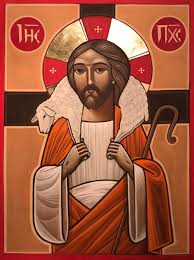
Coptic Church icon of Jesus the Good Shepherd

The temptation for spiritually serious persons is to look down on these lukewarm people. Jesus knew how easy it is to berate and despise such persons in our hearts:

To some who were confident of their own righteousness and looked down on everyone else, Jesus told this parable: “Two men went up to the temple to pray, one a Pharisee and the other a tax collector. The Pharisee stood by himself and prayed: ‘God, I thank you that I am not like other people—robbers, evildoers, adulterers—or even like this tax collector. I fast twice a week and give a tenth of all I get.’

“But the tax collector stood at a distance. He would not even look up to heaven, but beat his breast and said, ‘God, have mercy on me, a sinner.’

“I tell you that this man, rather than the other, went home justified before God. For all those who exalt themselves will be humbled, and those who humble themselves will be exalted.” (Luke 18:9-14, NIV)

If we are willing to humble ourselves, we can learn the hard practice of not hating others for what we hate in ourselves. 

We hate it when we are lax in our devotion to Christ; fail to accomplish what we want; miss opportunities to do good; and neglect to pray, give, or serve. So, when we see this as a pattern in someone else’s life, we may easily despise them in our hearts.

Turns out that many serious Christians must be converted as well – to seeing God’s heart for these despised little people.

What should be done about lost people?

Human reasoning might say, “Ah, let that one go; we have 99.” But God’s reasoning is, “I really care for that one.” Jesus wants to convert us to the statistically unimportant. 

If a person does not contribute to the life of the flock, do we care?

The parable contained within today’s Gospel lesson has become so familiar that it no longer shocks us. What kind of shepherd would be so stupid to abandon the entire flock and expose them to the dangers of wild animals and the harsh environment in order to search, maybe even unsuccessfully for one stinky, messed up, knurly, ugly, eats-too-much, sheep? 

And then, what’s more, when finding such a sheep, that shepherd rejoices more about this one sheep found than over the more dependable and attractive members of the flock? 

Only such a “foolish” shepherd can represent God’s concern for each one straying child.

Our Father in heaven is not willing that any of these little people should be lost. Therefore, we are to seek the lost.

Conclusion

Antonio Stradivarius (1644-1737) was an Italian violin maker. His violins are now the most prized violins ever made because of the rich and resonating sound they produce. The unique sound of a Stradivarius violin cannot be duplicated.

Surprisingly, these prized violins were not made from treasured pieces of wood, but instead were carved from discarded lumber. Stradivarius, who was very poor and could not afford fine materials like his contemporaries, got much of his wood from the dirty harbors where he lived. He would take those waterlogged pieces of wood to his shop, clean them up, and from those pieces of trashed lumber, he created instruments of rare beauty.

It has since been discovered that while the wood floated in those dirty harbors, microbes went into the wood and ate out the center of those cells. This left just the fibrous infrastructure of the wood that created resonating chambers for the music. From wood that nobody wanted, Stradivarius produced violins that everybody wants.

God has a plan. It is a plan to build a benevolent realm using not just the big and important, but the lowly and despised. 

May we all participate with the Lord and humble ourselves for kingdom purposes.

Your People Will Be My People (Ruth 1:6-18)

Naomi and Ruth by Chana Helen Rosenberg, 2017

When Naomi heard in Moab that the Lord had come to the aid of his people by providing food for them, she and her daughters-in-law prepared to return home from there. With her two daughters-in-law she left the place where she had been living and set out on the road that would take them back to the land of Judah.

Then Naomi said to her two daughters-in-law, “Go back, each of you, to your mother’s home. May the Lord show you kindness, as you have shown kindness to your dead husbands and to me. May the Lord grant that each of you will find rest in the home of another husband.”

Then she kissed them goodbye, and they wept aloud and said to her, “We will go back with you to your people.”

But Naomi said, “Return home, my daughters. Why would you come with me? Am I going to have any more sons, who could become your husbands? Return home, my daughters; I am too old to have another husband. Even if I thought there was still hope for me—even if I had a husband tonight and then gave birth to sons—would you wait until they grew up? Would you remain unmarried for them? No, my daughters. It is more bitter for me than for you, because the Lord’s hand has turned against me!”

At this they wept aloud again. Then Orpah kissed her mother-in-law goodbye, but Ruth clung to her.

“Look,” said Naomi, “your sister-in-law is going back to her people and her gods. Go back with her.”

But Ruth replied, “Don’t urge me to leave you or to turn back from you. Where you go I will go, and where you stay I will stay. Your people will be my people and your God my God. Where you die I will die, and there I will be buried. May the Lord deal with me, be it ever so severely, if even death separates you and me.” When Naomi realized that Ruth was determined to go with her, she stopped urging her. (New International Version)

Every time I read this account of Naomi and her daughters-in-law I’m reminded of my Dad because this was his favorite Old Testament story.

Dad was a lifelong farmer, and so, always related to the agrarian society of ancient Israel. But what really resonated for him in Scripture was Ruth’s response to her mother-in-law: “Your people are my people and your God my God. Where you die I will die, and there I will be buried.”

My father did not want to be a farmer. He wanted to go to college and become an engineer. In fact, without my grandfather’s knowledge, he was accepted to a university and secured an on-campus job. Yet, when Grandpa found out, he was less than pleased because Dad was needed on the farm during the depression era.

So, Dad, although he could have went to college, decided to stay on the farm. And the reason he decided to do so was not because he got his arm twisted, but because of the story of Ruth. He made the decision to stick with farming and never looked back. My Dad died ten years ago and is buried in the same cemetery as his father.

Ruth and Naomi by He Qi, 2001

The biblical character of Ruth is a solid example of one who was cognizant that she was part of a larger whole – that, although she was indeed an individual with personal choices, the decisions she made impact a much wider community. I believe Ruth discerned that the Israelite community understood this truth, and she wanted to be a part of it.

It is rare, in this age of extreme individualism, that people willingly give themselves to do what is best for the group, the family, the neighborhood, the faith community, the nation, and the world. There is a tendency to view things very narrowly in terms of what’s in it for me and ignore the rest.

So, I invite you to consider becoming ever more aware and connected to the communities around you. Discover the issues, problems, joys, sorrows, celebrations, and challenges they hold. And give yourself to the great struggles of that place. Jesus said:

If any of you want to be my followers, you must forget about yourself. You must take up your cross and follow me. If you want to save your life, you will destroy it. But if you give up your life for me, you will find it. (Matthew 16:24-25, CEV)

The One who is concerned to save the entire world only tolerates disciples who share his care for the entire human family.

Therefore, we ought neither to participate in nor support causes, activities, or speech that is harmful to others. Instead, we should find ways of using our particular gifts and abilities to serve the common good of all persons. We need more commitment and love, and a lot less anger, divisiveness, and hatred.

Grace and humility will always serve us, and others, very well. Judgment and pride, not so much.

Tell them to do good, to be rich in the good things they do, to be generous, and to share with others. (1 Timothy 6:18, CEB)

How, then, shall we live?

Your people will be my people.

Can you imagine a world in which all persons ascribe to this?

May it be so, to the glory of God.

We pray to you, Lord God, for all people everywhere:

For all people in their daily life and work;
For our families, friends, and neighbors, and for those who are alone.

For our community, the nation, and the world;
For all who work for justice, freedom, and peace.

For the just and proper use of your creation;
For the victims of hunger, fear, injustice, and oppression.

For all who are in danger, sorrow, or any kind of trouble;
For those who minister to the sick, the friendless, and the needy.

For the peace and unity of the Church;
For all who proclaim and seek the Truth.

Hear us, Lord; For your mercy is great. Amen.

Let the Little Children Come (Luke 18:15-17)

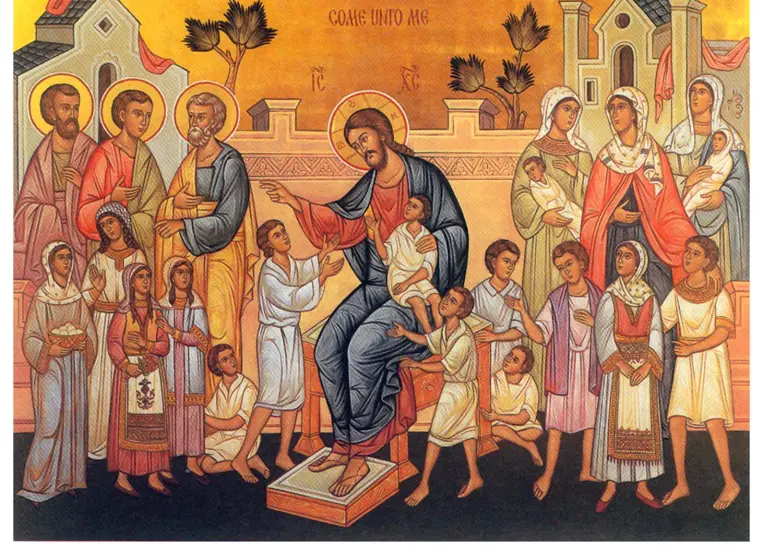
People were also bringing babies to Jesus for him to place his hands on them. When the disciples saw this, they rebuked them. But Jesus called the children to him and said, “Let the little children come to me, and do not hinder them, for the kingdom of God belongs to such as these. Truly I tell you, anyone who will not receive the kingdom of God like a little child will never enter it.” (New International Version)

I happen to believe that kids are closer to the kingdom of God than most adults.

Us big people have developed a lot of baggage over the years. And all that stuff tends to obscure God’s kingdom and the light of Christ within us.

Kids, however, especially small children, still haven’t discerned any veil between the seen and unseen worlds. They freely move between them both without any problem.

So, of course, Jesus wanted to be around children. If he had any homesickness at all, I’m sure the presence of kids made him feel at home more than anywhere else on this earth.

Jesus is our Immanuel, God with us.

The kingdom of God is here within us.

The disciples of Jesus had some difficulty with Christ’s branding of the message because it was not exclusive enough for them. They wanted limits on the us part.

Kids are part of that mass of people that God is with. Children deserve as much or more attention than adults. More than simply saying that we care about kids, we need to be like Jesus. He let the children come to him and was intolerant of anyone preventing kids from doing so.

Since the disciples were, ironically, still living in a small world, they rebuked those who brought little children to Jesus.

We aren’t specifically told why the disciples rebuked the adults bringing children to Jesus. Maybe the children were making a lot of noise and were being a nuisance in the middle of Jesus’ teaching. Perhaps the disciples had Jesus on a tight time schedule and this bringing kids to Christ thing was causing a delay. It could be that the disciples simply saw children as an interruption to the “important” work of ministry. 

I tend to think that the disciples simply failed to appreciate the children. The dominate view of kids in the ancient world was to see them as potential adults. Kids were pretty low on the ladder of society. The disciples likely saw no reason for children to be involved in what was happening.

The babies and toddlers and small children were brought so that Jesus might place his hands on them and pray for them. That still seems to me to be the best reason to bring kids to Jesus. 

“This story teaches us that Christ does not receive only those who voluntarily come to Him of a holy desire and moved by faith, but also those who might not yet be old enough to realize how much they need His grace….  From this we gather that His grace reaches to this age of life also….  It would be cruel to exclude that age from the grace of redemption.”

John Calvin

“Jesus does not only save repentant adults; he also saves dependent children and all those whom we think are incompetent to respond to Jesus.”

Frederick Dale Bruner

Jesus flat out rebuked his disciples for hindering the little children from coming to him. He wanted just the opposite of what was taking place. Why? Because the kingdom of heaven belongs to such little people as these. 

As mentioned, children were at the bottom of the societal pecking order in the ancient world. Their place in that society was to be respectful and quiet, to speak only when spoken to, and to never interrupt an adult.

Yet, Jesus took the time to touch them and pray for them. He invited this interruption to his schedule. Christ bluntly told his disciples that they were the ones being the hindrance, not the kids.

I baptize all sorts of people, including kids and babies. Why? Because in baptism, I recognize that the smallest ones among us can come to this holy sacrament. I understand that in baptism the Holy Spirit begins and initiates the process of salvation that will take that little one from infancy to adulthood and eventual death. I discern that, ideally, the child grows to live into their baptism by recognizing by faith that Jesus died and rose from the dead and grants grace and forgiveness to all who come to him. 

In that process of salvation, of coming to know Jesus, we have the sacrament of the Lord’s Table to strengthen our faith and demonstrate to us that the saving work of Jesus that has been accomplished. It is a Table of grace for all the members of Christ’s Church. 

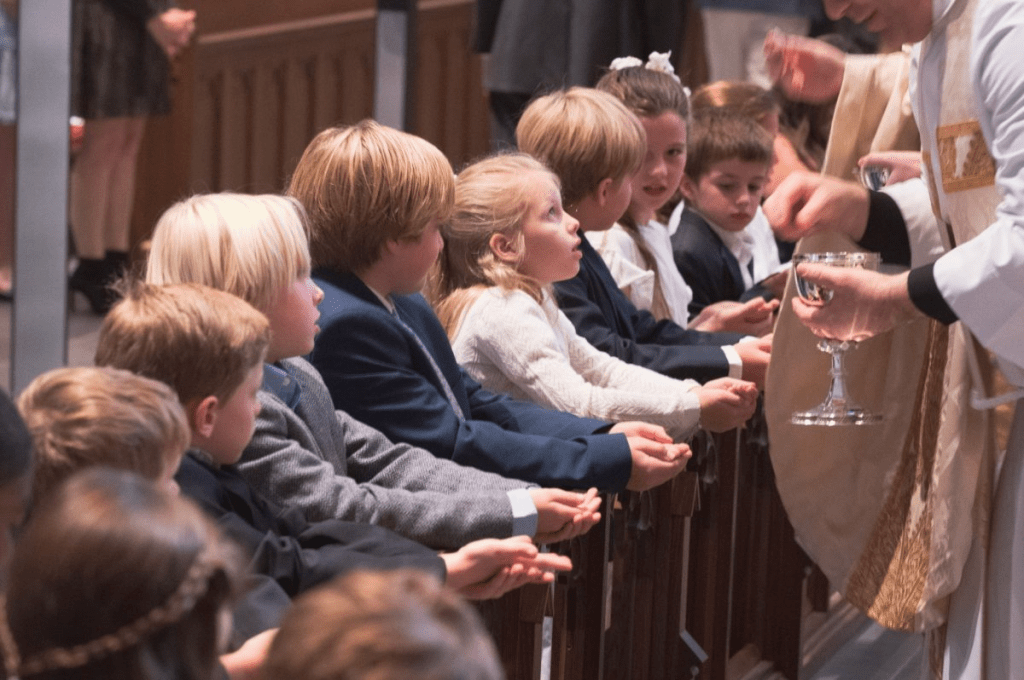
In my Reformed Christian tradition, we believe that Jesus is not physically, but spiritually present at the Table.  Because Jesus is present, we are able to receive the grace available to us as Christ’s members. So why, in light of this reality, and the words and practice of Jesus toward children, would we ever hinder and prevent the smallest members among us from participating at the Table?

Here’s a thought: If Jesus himself were serving communion in a church, and a group of 2-year-old children came toddling up to the Table to see Jesus, would you stop them from doing so? Or much like the disciples, would you rebuke those bringing children to Jesus?

As for me, I’d rather not be rebuked by my Lord.

Jesus gave children the three gifts they most need: time, touch, and prayer. Parenting and teaching are holy vocations, and we have the wonderful privilege of bestowing these same gifts on our children, grandchildren, and students.

Time, touch, and prayer are ways we bless children. And, what’s more, as God’s children, we are all to approach Jesus and spend time with him, allow him to touch us, and interact with him through prayer. 

May we all have the humility to bend down at eye level to the littlest among us so that we and others will know that the kingdom of God is among us.