God, the Jilted Lover (James 4:4-10)

You’re cheating on God. If all you want is your own way, flirting with the world every chance you get, you end up enemies of God and his way. And do you suppose God doesn’t care? The proverb has it that “he’s a fiercely jealous lover.” And what he gives in love is far better than anything else you’ll find. It’s common knowledge that “God goes against the willful proud; God gives grace to the willing humble.”

So let God work his will in you. Yell a loud no to the Devil and watch him make himself scarce. Say a quiet yes to God and he’ll be there in no time. Quit dabbling in sin. Purify your inner life. Quit playing the field. Hit bottom, and cry your eyes out. The fun and games are over. Get serious, really serious. Get down on your knees before the Master; it’s the only way you’ll get on your feet. (The Message)

Quite apparent is the fact that the Apostle James was not trying to win friends in the world. However, he was trying to influence the people within the churches in his care. Specifically, he was confronting the proud and arrogant.

So, please understand, up front, that James was going after the haughty persons because it takes a hammer to break a hard heart. And so, his approach ought only to be emulated in the unique context of handling persons stuck in their own destructive hubris. Nevertheless, there is much instruction in these verses to help us all.

Throughout Holy Scripture, we find a marriage metaphor, likening the relationship of God to the people, much like a lover. God’s covenant relationship is at the heart of understanding the whole of Scripture. Whenever people stray from divine promises, God is offended and hurt. 

Yes, God feels pain. God is an emotional Being, which is why we have emotions as God’s image-bearers. One way to view the Bible is that it is a book about God, the jilted lover. The Lord set affection and love upon people, yet many people have spurned their Lover’s advance. And this situation pains God. 

When Adam and Eve, decided to find satisfaction outside of God, the Lord was hurt. After them, when people had children and raised them, they did so largely apart from the God who loved them:

The Lord saw that the human beings on the earth were very wicked and that everything they thought about was evil. He was sorry he had made human beings on the earth, and his heart was filled with pain. (Genesis 6:5-6, NCV)

Yet, God was gracious. The Lord took a group of Noah’s descendants, Abraham’s family, and set a covenant of affection on them. God hoped to restore the world to right relationship through the Israelites. However, they too, came to set their affections on others. So, nearly half of the Old Testament is devoted to communicating the Lord’s hurt and disappointment. 

Like a jilted lover, God longed for Israel to remain faithful. For example, the prophet Hosea had an unfaithful wife, Gomer, and their relationship mirrored the relationship between God and Israel. Just as Hosea did not give up on his wife, even though she was brazenly unfaithful, so God looked at Israel as a spouse and could not bear to give her up.

Israel spurned their lover’s grace and kindness and actively sought other lovers, causing God anger and agony. God recounted the history of unfaithfulness:

“At every crossroad you built your platform and degraded your beauty by spreading your legs to all comers. And so, you encouraged even more promiscuity. You prostituted yourself with the Egyptians, your neighbors with the large sexual organs, and as you added to your seductions, you provoked me to anger…. 

Still not satisfied, you prostituted yourself to the Assyrians, but they were not enough for you either. So, you prostituted yourself with the Babylonians, the land of traders, but again you were not satisfied. How sick was your heart that you could do all these things, the deeds of a hardened prostitute?…

You are like an adulterous wife: you take in strangers instead of your husband. Ordinary prostitutes are given gifts, but you gave your gifts to all your lovers. From every direction you even bribed them to come to you for your sexual favors. As a prostitute, you were more perverse than other women. No one approached you for sexual favors, but you yourself gave gifts instead of receiving them.” (Ezekiel 16:25-34, CEB)

Despite Israel’s unfaithfulness, God extended grace to the beloved spouse:

“I am taking you back!
I rejected you for a while,
but with love and tenderness
    I will embrace you again.
For a while, I turned away
    in furious anger.
Now I will have mercy
    and love you forever!
I, your protector and Lord,
    make this promise.” (Isaiah 54:6-8, CEV)

The Old Testament ends with God still longing for return:

The Lord proclaims: “I care passionately about Zion; I burn with passion for her.” (Zechariah 8:2, CEB)

All of this theological awareness was in the heart of the Apostle James when he wrote his letter to the hard-hearted. He knew they were flirting with the world. He wanted them to stop and return to the God who longed to show them grace, if only they would humble themselves.

God yearns, passionately, for us to find our needs met, and enjoyment found, in the loving divine embrace. Spiritual adultery hurts God deeply, like it would any jilted lover. God awaits with loving patience to show grace and compassion to wayward people. 

Only the stance and attitude of humility can receive grace. Sinful pride prevents people from receiving God’s good gift. So, James rattled-off ten quick staccato commands to remain connected in a love relationship with God. They are resolutions to live by. 

Submit to God

Humble folk willingly place themselves under God’s authority because they are convinced God has their best interests at mind. One temptation when facing adversity is to entertain the belief that no one is going to look out for you except yourself. So, to avoid getting hurt too badly, we might become cynical, arrogant, and callous – self-protective strategies designed to keep the hurt away. This only creates hardness of heart. The alternative is faithful submission to God – knowing that God’s Spirit will protect and living with the conviction that nothing can separate us from the love of God in Christ.

Resist the devil

Satan is a bully. The way to deal with bullies is to stand up to them. We face down the temptation by submitting to God and resisting the devil. Don’t be deceived into flipping it around by listening to Satan and avoiding submission to God.

Come near to God

Like a loving parent, the Lord longingly looks out the window waiting for prodigals to return. Coming to God is the first thing we ought to do. When my daughter was young her bike was stolen. So, we sat down together in the backyard and came to God in prayer. I barely finished praying when a police cruiser pulled up in the alley behind our house. The policeman rolled down his window and said, “Hey, are you missing a bike?”  We hopped in and he took us to where someone had ditched the bike. It was a tremendous lesson that when we come to God, God comes to us. I realize life does not always work that way, yet we can be assured that God listens, hears, and will respond.

Wash your hands

We cannot approach God with blood on our hands, but must come squarely facing our sin and disobedience.  We must deal with the wrong we have done without sweeping it under the rug. God wants us to admit our sin, receive grace, and deal with matters of restitution and reconciliation, without trying to save face when found out in a concern for “optics.”

Purify your heart

Whereas the previous resolution is mostly external, this one addresses the inner person, the heart. Not only do our actions need to be cleaned up through washing our hands, but our attitudes must also be purged of pollution. Our hearts cannot handle two masters; we are to be single-minded without mixed motives.

“The man who tries to walk two roads will split his pants.”

African proverb

The next four resolutions describe important emotional responses to sin:

“The Crying Giant,” Wilmington, Delaware

Grieve

Trying to move on without grieving and lamenting is called denial. Grief is not only an event; it is a process which takes time. Grieving is biblical. Sharing our stories with each other, giving testimony to God’s grace, and expressing ourselves is important. A loving God knows there cannot be healing apart from grief and lament.

Mourn

Blessed are those who mourn with an emotional response to the devastation of sin. Mourning sees sin in all its foulness and degradation. People who do not mourn become hard-hearted and need deep spiritual transformation. Jesus offers the remedy: By his wounds we are healed.

Wail

We are to more than cry – we need to wail.  Whereas mourning might be more personal, wailing has a much more public dimension to it. I believe the great tragedy in many modern churches is an inordinate focus on victory and triumphalism. The result: Far too many Christians cry alone. No one should ever have to cry by themselves. We must weep with those who weep. If there ever was an appropriate place for crying, it should be amongst fellow brothers and sisters in Christ.

Change

We cannot turn the clock back to some bygone idyllic era. We are to grasp the type of change which occurs in living for Jesus Christ and above sin – with no casual cavalier attitudes toward sin. I once had a conversation with a young woman about heaven and hell. When we began the discussion, she expressed a desire to be wherever the better party was going on. By the time we finished our conversation she was grieving and crying. I never knew what became of her. But once she got just a glimpse of the gravity of sin, it undid her.

Be humble

Humility sums up all these resolutions. The paradox is that through grieving, mourning, and wailing we become joyful and satisfied; through suffering there is glory; becoming last is to become first; entering the narrow gate leads to the broad open space of God’s eternal life.

Gracious God, our sins are too heavy to carry, too real to hide, and too deep to undo. Forgive what our lips tremble to name, what our hearts can no longer bear, and what has become for us a consuming fire of judgment. Set us free from a past that we cannot change; open to us a future in which we can be changed; and grant us grace to grow more and more in your likeness and image, through Jesus Christ, the light of the world. Amen

Put To Death (Acts 7:55-60)

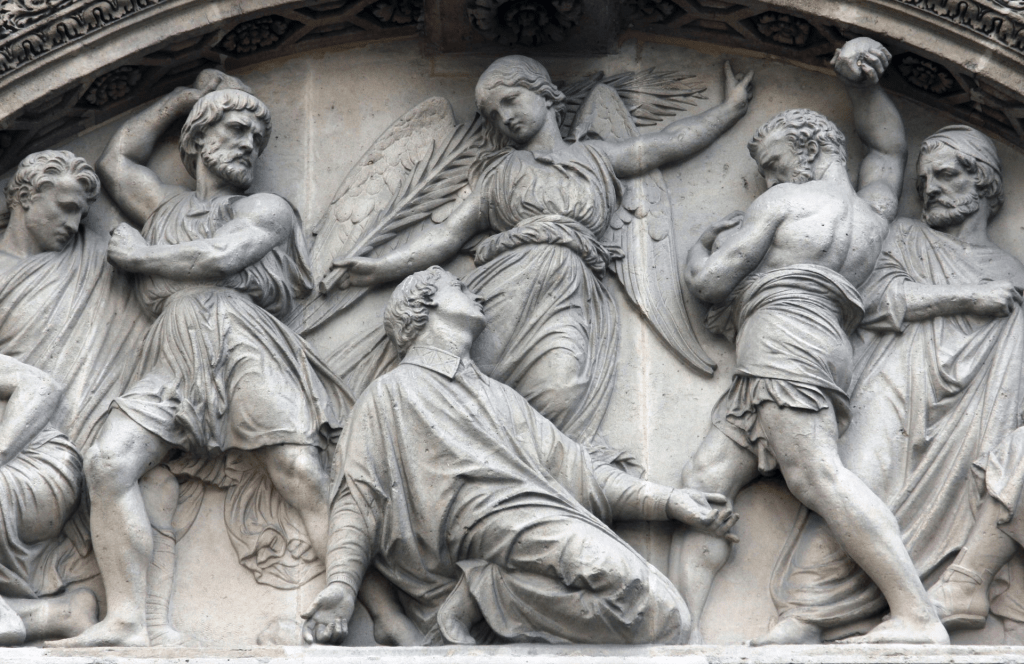
The Martyrdom of Stephen, by sculptor Gabriel-Jules Thomas (1824-1905)

But Stephen, full of the Holy Spirit, looked up to heaven and saw the glory of God, and Jesus standing at the right hand of God. “Look,” he said, “I see heaven open and the Son of Man standing at the right hand of God.”

At this they covered their ears and, yelling at the top of their voices, they all rushed at him, dragged him out of the city and began to stone him. Meanwhile, the witnesses laid their coats at the feet of a young man named Saul.

While they were stoning him, Stephen prayed, “Lord Jesus, receive my spirit.” Then he fell on his knees and cried out, “Lord, do not hold this sin against them.” When he had said this, he fell asleep. (New International Version)

Although I am a trained in biblical exegesis and hermeneutics (interpreting Scripture) I believe that most insights come from making simple observations about the text. So, I want to point out: Stephen was not martyred by the Romans, a religiously pagan group, nor Gentile people; he was martyred by those of his own ethnicity, by “God’s people.”

The religious authorities were more than just unhappy with Stephen. The Sanhedrin (the Jewish ruling council) were incensed with him, so mad that they were grinding their teeth at him. The council sincerely believed Stephen was a blasphemer of God, that what he was saying was so subversive and religiously radical, they could stone him to death with a clear conscience, as if this act were upholding God’s honor and God’s Law.

The result was not only the death of a humble man; it also sparked an intense persecution against the church which caused a new Christian diaspora (Acts 8:1-3). Many believers in Jesus found themselves as Christian refugees trying to eke out a living and worshiping Christ in foreign places.

I wish I could say the greatest opposition I’ve ever experienced as a Christian came from non-Christians who simply misunderstood and misinterpreted me. However, my most hurtful wounds have come from the hands of church folk, believing they were acting on God’s behalf by exacting an emotional martyrdom upon me with the stones of gossip, slander, backbiting, blame-shifting, and outright lying (and a few threats of violence).

Whenever I encounter persons who no longer attend church and have no intention of ever returning to any local congregation, I get it. I understand. Yet, although the church is sometimes like a woman of disrepute, I still love her, and will do whatever I can to edify her and not repay evil with evil.

Stoning a believer, either actually with physical rocks or virtually with verbal stones, is akin to persecuting Jesus himself. That’s because Christ so closely identifies with his people that it is as if he is a head, and his followers are a body – joined together in a vital union.

So, when Christ’s Body is subjected to what I call, “hermeneutical hubris,” in which one group of people insists there is only one way to interpret Scripture, and then uses their authority and structures of power to force compliance on another group, the result is persecution.

And that is precisely why Christians can abuse other Christians.

Rather than discerning that all Christians belong to God, one narrow-minded and small-hearted group excludes all other groups who disagree with them as blaspheming the name of Christ.

For example, insisting that a literal interpretation in the only means of understanding the Bible’s authority is to ignore and abuse the actual and real authority which exists with the Bible. I am in no way encouraging an “anything goes” type of approach to Holy Scripture that lets it say whatever you want it to say. 

What I am saying is that the biblical writers themselves employed different methods of interpretation, as well as the early church fathers (which is one reason I hold to the interpretive guides of the ancient Christian creeds, i.e. The Apostles’ Creed and Nicene Creed).

Far too often, churches stick to a particular interpretation because they believe they are keeping biblical fidelity. This is many times born of a fear that Christendom will be lost, and society will sink into an abyss of egregious sin. The irony is that many churches are sinking into forms of abusive and ungracious behavior by fighting battles that Scripture does not call them to fight.

The binary thinking of “I’m right and you’re wrong” is not an approach you’ll find in God’s Holy Word.

Even if the Sanhedrin in Stephen’s day intended on upholding the holiness of their God and the rightness of their cause, the impact it had on the church was martyrdom, death, and diaspora.

Unfortunately, throughout Christian history, the tables have too often turned with Christians persecuting Jews. I myself would like to avoid being the persecutor. If I kill anything, may it be putting to death my own sin – because that is what the Bible calls me to do.

Dear brothers and sisters, you have no obligation to do what your sinful nature urges you to do. For if you live by its dictates, you will die. But if through the power of the Spirit you put to death the deeds of your sinful nature, you will live.

The Apostle Paul (Romans 8:12-13, NLT)

Since, then, you have been raised with Christ, set your hearts on things above, where Christ is, seated at the right hand of God. Set your minds on things above, not on earthly things. For you died, and your life is now hidden with Christ in God. When Christ, who is your life, appears, then you also will appear with him in glory.

Put to death, therefore, whatever belongs to your earthly nature: sexual immorality, impurity, lust, evil desires and greed, which is idolatry. Because of these, the wrath of God is coming.You used to walk in these ways, in the life you once lived. But now you must also rid yourselves of all such things as these: anger, rage, malice, slander, and filthy language from your lips. 

Do not lie to each other, since you have taken off your old self with its practices and have put on the new self, which is being renewed in knowledge in the image of its Creator. Here there is no Gentile or Jew, circumcised or uncircumcised, barbarian, Scythian, slave or free, but Christ is all, and is in all.

Therefore, as God’s chosen people, holy and dearly loved, clothe yourselves with compassion, kindness, humility, gentleness and patience. Bear with each other and forgive one another if any of you has a grievance against someone. Forgive as the Lord forgave you. And over all these virtues put on love, which binds them all together in perfect unity.

Let the peace of Christ rule in your hearts, since as members of one body you were called to peace. And be thankful. Let the message of Christ dwell among you richly as you teach and admonish one another with all wisdom through psalms, hymns, and songs from the Spirit, singing to God with gratitude in your hearts. And whatever you do, whether in word or deed, do it all in the name of the Lord Jesus, giving thanks to God the Father through him. (Colossians 3:1-17, NIV)

Gracious God, as your Son humbled himself on this earth, so may your church walk continually in such humility that believers everywhere work together in unity for the sake of gospel of grace as a blessing to the world in the power of your Holy Spirit. Amen.

Psalm 75 – Don’t Talk Out the Side of Your Neck

We give thanks to you, O God;
    we give thanks; your name is near.
People tell of your wondrous deeds.

At the set time that I appoint,
    I will judge with equity.
When the earth totters, with all its inhabitants,
    it is I who keep its pillars steady.
I say to the boastful, “Do not boast,”
    and to the wicked, “Do not lift up your horn;
do not lift up your horn on high
    or speak with insolent neck.”

For not from the east or from the west
    and not from the wilderness comes lifting up,
but it is God who executes judgment,
    putting down one and lifting up another.
For in the hand of the Lord there is a cup
    with foaming wine, well mixed;
he will pour a draught from it,
    and all the wicked of the earth
    shall drain it down to the dregs.
But I will rejoice forever;
    I will sing praises to the God of Jacob.

All the horns of the wicked I will cut off,
    but the horns of the righteous shall be exalted. (New Revised Standard Version)

Way back in my college days, there were some lively characters within my group of friends and acquaintances. One of those friends had a phrase he called people out on, whenever he discerned there was some sort of insincerity or disingenuous talk… 

“Quit talkin’ out the side o’ ya’ neck!” he would say with a great deal of flavor. My friend’s phrase perfectly captures the psalmist when he exhorts the boastful person not to speak with an insolent or haughty neck.

Indeed, God will judge everyone on earth with equity, without favoritism. The Lord has no tolerance for evil speech. 

A telltale sign of the wicked is that they show ingratitude; they aren’t thankful. An ungracious boss will always point out mistakes and missteps; and rarely or never seeks to affirm someone for a job well-done. In those rare times when a “thanks” is given, its so mechanical that the person receiving feels the abject insincerity of it.

The parent who sparingly expresses gratitude tends to liberally correct and discipline, leaving the child in a pool of guilt and shame. Folks who enjoy airing their own opinions are usually bereft of thanksgiving; they leave in their wake of harsh words a group of angry or discouraged people.

You will likely not hear any of the aforementioned persons forthrightly declare the mighty acts of God. Rather, they highlight their own actions, even stealing the deserved attention of another onto themselves. Yet, the arrogant and insolent person will meet their match with the sovereign God who humbles and exalts according to divine standards of justice, mercy, and love.

Instead of talking out the side of our necks, the godly use their tongues in a different manner: They give thanks and practice gratitude for God’s wondrous deeds. 

The way to avoid the hubris of the proud person is to use our speech for thanksgiving. Humble, encouraging, and generous words cannot co-exist in the same sentence as insincere proud boasting. 

Freedom from useless, selfish, and harmful gibberish requires more than a decision to stop talking that way; it also includes a determination to speak words of encouragement, gratitude, and kindness. The following can be helpful advice when facing our own pride:

  1. Confess when you’re wrong. Acknowledge and admit the sinful speech without trying to put a spin on it to make it sound less offensive. Ask what you can do to make it right. Ask for forgiveness.
  2. Lighten up, man. Don’t take things so seriously. Learn to laugh at yourself. We all have our quirks, and we all make mistakes. Most stuff isn’t worth getting upset over. And some people are definitely not worth giving the satisfaction of making you get in a huff. Let it go, dude.
  3. Be good to yourself. Treat yourself with greater kindness. Arrogance is often a byproduct of failing to practice healthy self-care. Whenever we are obsessed with looking good and being good, we place unrealistic expectations not only on ourselves, but others, as well. It comes out in a “I-know-what-is-best-so-do-what-I-say” sort of attitude.
  4. Wake up and realize you are not always right. Arrogant people tend to think they are right most of the time, that their truth is the only truth that really matters. You’ve probably been wrong more than you realize, but arrogance tends to blind us to our own shortcomings. Not every battle is worth fighting. Sometimes you just have to smile and let things go.
  5. Learn to delegate. Let other people take the lead. Humility allows us to serve under another person or as a less dominant member of a team. Other people are not nincompoops. You aren’t the only one who can do the job.
  6. Ask for help. It takes humility to ask for help.Arrogant people wrongly believe they can do it themselves, especially thinking they are the best person for everything. Old Satan still believes he can do a better job of running the world than God. Don’t be like Satan.
  7. Offer meaningful encouragement and thanks. Go out of your way to build up others and thank them for their efforts and the job they did.
  8. Treat everyone with respect. No matter their position or station in life, acknowledge each human being as worthy of kindness and respect.

Remembering God’s gracious works in the world, and using our tongues to recount them, has the effect of putting us in our proper place and shooing away the arrogance.

One way of expressing gratitude to God is to take a few minutes each day, pause, and give thanks for the things you notice. 

If you take a walk, be intentional about noticing God’s creation. Then, give thanks for the specific things you see. At your workplace, take note of the blessings around you, and express gratitude for each of them. At home, notice the simple pleasures of being with family and be sure to offer God praise for them. 

For, if we do not observe the Lord in the common and the mundane, we will likely miss God when he shows up in the dramatic and the awesome.

Almighty God, you are the rightful Judge of all the earth. Today I forsake all proud and haughty speech, and, instead, give thanks to you for your mighty acts of salvation and deliverance in Jesus’ name. Amen.

Psalm 138 – Humility and Hubris

I give you thanks, O Lord, with all my heart;
    I will sing your praises before the gods.
I bow before your holy Temple as I worship.
    I praise your name for your unfailing love and faithfulness;
for your promises are backed
    by all the honor of your name.
As soon as I pray, you answer me;
    you encourage me by giving me strength.

Every king in all the earth will thank you, Lord,
    for all of them will hear your words.
Yes, they will sing about the Lord’s ways,
    for the glory of the Lord is very great.
Though the Lord is great, he cares for the humble,
    but he keeps his distance from the proud.

Though I am surrounded by troubles,
    you will protect me from the anger of my enemies.
You reach out your hand,
    and the power of your right hand saves me.
The Lord will work out his plans for my life—
    for your faithful love, O Lord, endures forever.
    Don’t abandon me, for you made me. (New Living Translation)

The God of Holy Scripture is no uppity highfalutin Being. However, amongst humanity, those with established pedigree, high position, and influential power tend not to hobnob with the common person. In their hubris, they believe themselves to be above the common person.

Not so with the Lord of the universe. God consistently cares for humble folk. The Lord intentionally seeks the average commoner and draws near to them. The Creator bends down to meet lowly creatures at their level.

Conversely, the Lord stays out on the margins of proud and arrogant people. God stands straight up and looks down from afar on the haughty who believe they are above others. The privileged and powerful in the world will experience divine distance, mostly because their attitudes and actions put the stiff arm toward God.

One of the most frustrating experiences in life is to have someone in power arrogantly misjudge you. Rather than carefully listening and offering gracious attention, the proud already assume they know what’s going on and what is best for others.

So, like a bull about to enter a China shop, or a timebomb ready to explode, human hubris of the heart violates and blows up another’s life based upon misinformation and faulty egotistical assumptions.

Yet, God sees. From a lofty place, clearly observing all creaturely activity, the Lord knows what is truly happening. And God is not okay with injustice perpetrated by cocky roosters and pretentious autocrats. Everyone will experience God’s power. It’s just a matter of what type of power one receives.

The Lord’s saving and sustaining power will uphold the humble of heart. However, the power of God’s wrath is the lot of puffed up peacocks who only care about getting their way. Their own puny power will be eventually stripped away and given to those who will wield it with grace.

The difference between the proud and the lowly is evidenced by their prayers. Megalomaniacs are concerned for material acquisitions, high positions, and fame. And their prayers reflect those ambitions. The meek, however, pray for increased spiritual strength to withstand trouble; enlarged hearts to hold more of God; and acceptance of whatever the Lord wants, whether it is for personal good or ill.

The arrogant may accomplish many good things. It’s possible for them to achieve greatness through outstanding work and incredible feats. Yet, God knows the real score. Jesus said:

“Not everyone who calls me Lord will enter God’s kingdom. The only people who will enter are those who do what my Father in heaven wants.On that last Day many will call me Lord. They will say, ‘Lord, Lord, by the power of your name we spoke for God. And by your name we forced out demons and did many miracles.’ Then I will tell those people clearly, ‘Get away from me, you people who do wrong. I never knew you.’” (Matthew 7:21-23, ERV)

Self-absorbed people enjoy their own presence and narcissistically believe everyone else should, too. Yet, ordinary people, being attentive to the common good of all persons, rely on the presence and protection of God for everyone and everything.

Whereas the vainglorious person trusts in their own ability to achieve and hold power so that they can smugly boast about their superiority, on the contrary, the meek are content to labor for the Lord in relative obscurity, to try and use their skills and aptitude for the benefit of their fellow humanity. God holds them tightly and securely. But not so with the egotistical. They will fall because they were never in God’s hand to begin with.

If the humble are weak, that’s okay. Because God is strong. If they are in trouble, no problem. The Lord has their back. They can let go, knowing there is a God who doesn’t. And that is the irony to the spiritual life – that in releasing and relinquishing we gain and acquire.

The truly humble of heart shall be vindicated by God from the wicked. For the Lord’s steadfast love will have the day.

Most merciful God, we confess that we have sinned against you in thought, word, and deed, by what we have done, and by what we have left undone. We have not loved you with our whole heart; we have not loved our neighbors as ourselves. We are terribly sorry, and we humbly repent. For the sake of your Son, Jesus Christ, have mercy on us and forgive us so that we may delight in your will, and walk in your ways, to the glory of your Name. Amen.