Welcome, friends! Advent is upon us. May this season spark faith, increase hope, stir up love, and surprise the world with joy. Click the video below and let us acknowledge the coming of the Christ child…
Isaiah 11:1-10
For the Scripture set to song…
And for a traditional Advent hymn…
Come, Thou Long-Expected Jesus by Shannon Wexelberg
May the light of Christ lead us to the joy of his kingdom, now and for ever.Amen.
A shoot will come up from the stump of Jesse; from his roots a Branch will bear fruit. The Spirit of the Lord will rest on him— the Spirit of wisdom and of understanding, the Spirit of counsel and of might, the Spirit of the knowledge and fear of the Lord— and he will delight in the fear of the Lord.
He will not judge by what he sees with his eyes, or decide by what he hears with his ears; but with righteousness he will judge the needy, with justice he will give decisions for the poor of the earth. He will strike the earth with the rod of his mouth; with the breath of his lips he will slay the wicked. Righteousness will be his belt and faithfulness the sash around his waist.
The wolf will live with the lamb, the leopard will lie down with the goat, the calf and the lion and the yearling together; and a little child will lead them. The cow will feed with the bear, their young will lie down together, and the lion will eat straw like the ox. The infant will play near the cobra’s den, and the young child will put its hand into the viper’s nest. They will neither harm nor destroy on all my holy mountain, for the earth will be filled with the knowledge of the Lord as the waters cover the sea.
In that day, the Root of Jesse will stand as a banner for the peoples; the nations will rally to him, and his resting place will be glorious. (Isaiah 11:1-10, NIV)
Christians believe Isaiah’s prophecy to speak of Jesus in whom all these virtues exist in wonderful perfection and practice. Jesus Christ has so clearly identified with us that we are in a vital union with him. He still exists here on earth in the person of the Holy Spirit. Jesus was sent by the Father. With the Father and the Son, the Spirit was sent to press the redemptive events of Jesus into the believer’s heart. This is basic Trinitarian theology. Yet these are not abstract ideas. Prayer, discernment, and listening are the pathways forward to discovering the wisdom, counsel, and knowledge we need to live and serve well as Christians.
In some quarters of Christianity, the church exists as a mere stump of its former existence. For many Christians, daily experience of the Spirit has been supplanted by individual ingenuity, hard work, and getting ahead through accumulation of more and more. Basic Christian spirituality then becomes a mere shadow of its former influence. If we desire the Spirit of the Lord to rest upon us, we will seek Christ as our foremost importance.
Indeed, it is when we are worn down to a stump and have no ability to grow or sustain life anymore that God enters, specializing in giving hope to the hopeless, justice for the poor, wisdom to the confused, and peace to all who desire a harmonious world.
In the awful feelings of helplessness and hopelessness, there is a faint sign of life. A fresh shoot becomes discernible. Could there be possibility amidst such impossible circumstances? Can there be life again? Do I dare hope again? Will things really change, and do so for the better?
The answer is “yes.” For where the Spirit of the Lord blows there is the force of resurrection power, spiritual energy, and fresh courage. Where others see only three-dimensional impossibilities, the believer has the capacity of faith to see multi-dimensional possibilities. The Spirit’s force generates possibility where none existed before. When the breath of God whispers to the sprout in the stump, pessimistic despair turns to optimistic hope, even joy.
Jesus Christ is the Christian’s hope. In Christ, there is security, well-being, and life. With Jesus, there is a vision of justice in which all persons receive what they need to live, thrive, and flourish in God’s world. Christ operates to our advantage and on our behalf without the personal greed and indifference of so many earthly rulers. The weak and vulnerable have a champion in Jesus. Renewal and restoration become very real possibilities.
I have lately taken a liking to a show called “The Repair Shop,” a British television series in which family heirlooms which have sentimental value for their owners are carefully restored by experts. What captivates me about the show is how one person can take an old broken-down item (and by all appearances now a piece of junk) and restore it to its once glorious newness.
There is more to my captivation of the show. I am struck by the sheer pleasure the restorers take in handling the old object, enjoying the process. Just by the looks on their faces, I can tell they consider it a privilege to be restoring such a precious object of the past.
Artisan Steve Fletcher restoring an 18th century French clock
I am sure this is precisely how God feels with us. Rather than envisioning the Lord as some reluctant deity who feels put out with having to rescue a bunch of dumb and wayward people, God is One who has delight in taking this old stump of fallen damaged humanity and restoring us to our original luster and beauty. Transformation is God’s specialty, and the Lord goes about the process of restoration with great care and delight.
The impossible possibility of God’s new creation is poetically described in the peaceful co-existence of animals and creatures who are inconceivably together without fear or violence. There is a time coming when death will be no more, and so, the necessity in this life of hunter and prey shall be forever negated. No more snakes terrorizing women and children. No more big fishes eating little ones. No more human fat cats preying upon and striking poison on the smaller and vulnerable.
The presence of the godly Ruler means the world will be governed rightly, detoxified of its sinful impurities; a place where the poor, the weak, and the little lambs will indeed be safe and secure forever. There will be peace because of the Prince of Peace. All creation will be full of God, and thus, free of all malice.
This beautiful prophecy from Isaiah envisions a deep, radical, limitless transformation in which there will be no more appetite to injure another; no more desire to devour another; no more lust for selfish control of another; and no more destructive passion for domination over others.
It is a thorough renovation of the human heart, human institutions, the animal kingdom, and even every blade of grass in creation. The Apostle Paul had this grand vision of God in mind when he wrote to the Church at Rome:
The creation waits in eager expectation for the children of God to be revealed. For the creation was subjected to frustration, not by its own choice, but by the will of the one who subjected it, in hope thatthe creation itself will be liberated from its bondage to decay and brought into the freedom and glory of the children of God. We know that the whole creation has been groaning as in the pains of childbirth right up to the present time. Not only so, but we ourselves, who have the first fruits of the Spirit, groan inwardly as we wait eagerly for our adoption to sonship, the redemption of our bodies. (Romans 8:19-23, NIV)
The implication for us as humanity was voiced by Paul to the Colossian Church:
Now you must rid yourselves of all such things as these: anger, rage, malice, slander, and filthy language from your lips. Do not lie to each other, since you have taken off your old self with its practices and have put on the new self, which is being renewed in knowledge in the image of its Creator. Here there is no Gentile or Jew, circumcised or uncircumcised, barbarian, Scythian, slave or free, but Christ is all, and is in all. (Colossians 3:8-11, NIV)
The transformation is all-pervasive, impacting everything public while also being intimately personal. It is a gift from God; it is the impossible made possible. And it is this precise thing which we acknowledge, celebrate, and long for in the season of Advent. When the angel came to Mary and communicated that Isaiah’s vision was coming to reality through her womb, Mary astonishingly retorted:
“How will this be, since I am a virgin?”
The angel, with supreme confidence, answered Mary as a matter of fact:
“The Holy Spirit will come on you, and the power of the Most High will overshadow you. So, the holy one to be born will be called the Son of God…. For no word from God will ever fail.”
Mary’s response gives voice to our own desires and longings for the new order of things:
“I am the Lord’s servant. May your word to me be fulfilled.” (Luke 1:34-38, NIV)
This is our confession, too. I am the Lord’s servant. You are the Lord’s servant. May God’s word to us about the coming of Christ be fulfilled, just as Isaiah has said. The hopes and fears of all the years are met in Jesus on a bright starry night.
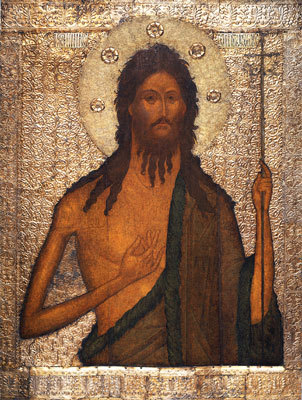
16th century Russian Orthodox icon of John the Baptist
At that time Herod the tetrarch heard the reports about Jesus, and he said to his attendants, “This is John the Baptist; he has risen from the dead! That is why miraculous powers are at work in him.”
Now Herod had arrested John and bound him and put him in prison because of Herodias, his brother Philip’s wife, for John had been saying to him: “It is not lawful for you to have her.” Herod wanted to kill John, but he was afraid of the people, because they considered John a prophet.
On Herod’s birthday the daughter of Herodias danced for the guests and pleased Herod so much that he promised with an oath to give her whatever she asked. Prompted by her mother, she said, “Give me here on a platter the head of John the Baptist.” The king was distressed, but because of his oaths and his dinner guests, he ordered that her request be granted and had John beheaded in the prison. His head was brought in on a platter and given to the girl, who carried it to her mother. John’s disciples came and took his body and buried it. Then they went and told Jesus. (NIV)
John’s murder is a story about our world – a world of power, sex, and intrigue. Times may change, but people across the ages do not change. Humanity is fundamentally the same in every century. And the world is still the world, no matter the historical time.
The contrast between Herod and John supply us with two types of people who exist throughout every age of humankind, offering us the choice of which way we will go with our lives. The story illustrates for us the reality of living in a fallen world as a devout person.
The Herod in today’s Gospel lesson was a son of Herod the Great, the one who killed all the male babies when Jesus was born in order to try and get rid of any rival king (Matthew 2:1-18). King Herod is displayed in the narrative as a tragic and pathetic figure who is ruled by his own lusts. He seems too proud and wimpy to admit he made a rash promise and killed a man just to save face with his guests at a party.
Talk about a Jerry Springer worthy family drama, here it is: The Herod family was rich, proud, and downright violent. They tended to marry within their own clan to hold their power and possessions for themselves. Herodias married her uncle Herod Philip; Salome was their daughter. Later, Salome married Philip the tetrarch, half-brother to Herod Philip. Through marriage, Salome became both aunt and sister-in-law to her mother. Then the Herod in our story married Herodias, who had been married to Herod’s half-brother, Herod Philip. Having fallen in love with Herod Antipas, Herodias divorced Herod Philip to marry Herod Antipas. Sheesh, nothing like complicated family drama.
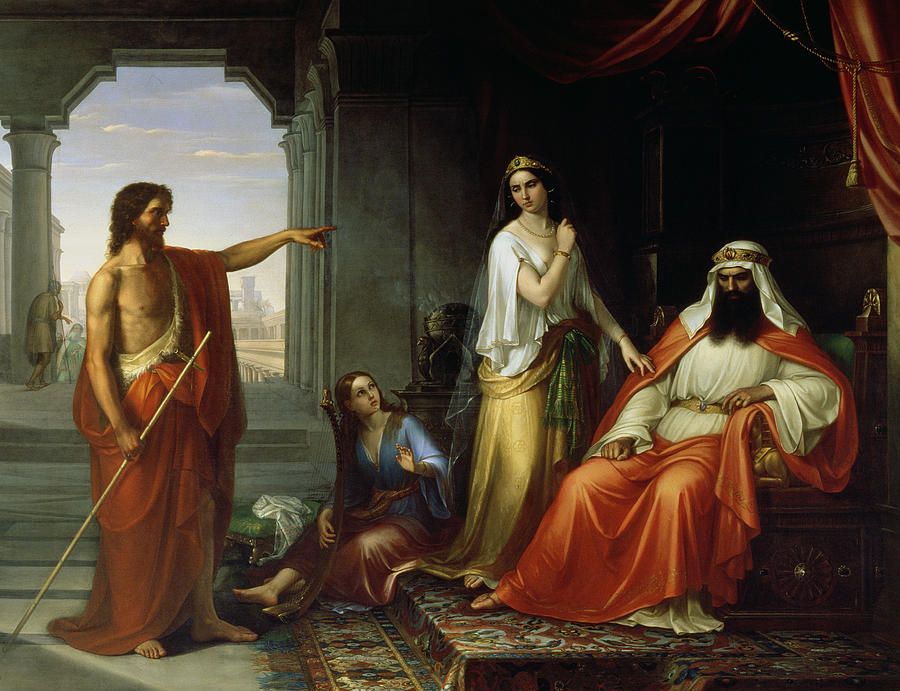
St. John the Baptist Rebuking Herod by Italian artist Giovanni Fattori (1825-1908)
Into this violation of Old Testament marriage laws (the Herod’s were Jewish) came John who made no bones about the fact this was not right (Leviticus 18:16, 20:21). Herodias nursed a grudge against John for speaking out against her and Herod’s choices. Hell, hath no fury like a woman’s scorn, and when Herodias found an opportunity to get rid of John, she coached her daughter into asking for John the Baptist’s head on a platter. Herod, too insecure to take back his ridiculous promise and look like a fool, consented to the execution of John.
In contrast to all this tragic theater is John the Baptist. John was a messenger of God and a preacher of repentance. As one who was preparing the way for Jesus, his message was simple and to the point: Repent, for the kingdom of God is near. John got into trouble and lost his life because he spoke truth to power by meddling in the life of King Herod and his family. The Herod’s were the political establishment of the day, and John did not temper his words when dealing with them.
There is a refreshing integrity about John. He was always the same no matter where he was, and no matter who the people were around him. In contrast to Herod, John was bold, courageous, confident, unafraid, and secure enough in his relationship with God to engage in ministry without thought to the consequences. He was unconcerned for what others might think of him if he proclaimed truth in the public square, and it did end up costing him his life.
The story of John the Baptist’s death speaks about the hostility of this world. And it prefigured and foreshadowed the death of Jesus. Like John, Jesus was executed by the civil authorities. Herod, like Pilate after him, hesitated to execute and was swayed by the crowd. Herodias, like the chief priests toward Jesus, finally got her way through scheming and manipulation. John’s disciples came and took his body and buried it, just like Joseph of Arimathea and Nicodemus did for Jesus.
These stories, on the surface of things, appear to be only gloom and doom. Yet, there is a message of hope and joy. The absurd is working out itself in deliverance from sin, death, and hell. Through death, Jesus conquered death. We now have no fear of death; its sting has been taken away. Without fear of death, we have no reason to fear life with its troubles and tribulations.
The fork in the road is between the way of John or Herod. It is a values-based decision. If worth is derived from what we do, what we have, and/or other’s opinion of us, we will likely identify more with Herod and his choices. If there is a preoccupation with hoarding power and control, this is the path of Herod.
Conversely, if the ultimate value is in knowing Christ crucified and the power of his resurrection, then we identify with John as our spiritual ancestor. If security and worth is derived from being in Christ, then there is boldness to speak truth to power and give grace to the powerless.
Herod saw no further than his immediate needs and safety; he failed to discern his own heart. Because of his spiritual blindness, Herod did not look away from himself and look to God. Faith in Jesus comes when persons look away from themselves and look to Christ who holds the power to free all from spiritual bondage.
Let us look to the example of John the Baptist who consistently sought to do the will of God as best as he understood it. Together with all God’s people past and present, we declare that God is with us, the kingdom of God is near, and the love of Christ brings faith and hope.
Almighty God, through your providence John the Baptist was wonderfully born and was sent to prepare the way of your Son, our Savior by the preaching of repentance. Lead us to repent according to his preaching and, after his example, constantly to speak the truth, boldly to rebuke vice, and patiently to suffer for truth’s sake; through Jesus Christ your Son, our Lord, who is alive and reigns with you, in the unity of the Holy Spirit, one God, now and forever. Amen.
As a deer gets thirsty for streams of water, I truly am thirsty for you, my God. In my heart, I am thirsty for you, the living God. When will I see your face? Day and night my tears are my only food, as everyone keeps asking, “Where is your God?”
Sorrow floods my heart, when I remember leading the worshipers to your house. I can still hear them shout their joyful praises. Why am I discouraged? Why am I restless? I trust you! And I will praise you again because you help me, and you are my God.
I am deeply discouraged as I think about you from where the Jordan begins at Mount Hermon and from Mount Mizar. Your vicious waves have swept over me like an angry ocean or a roaring waterfall.
Every day, you are kind, and at night you give me a song as my prayer to you, the living Lord God.
You are my mighty rock. Why have you forgotten me? Why must enemies mistreat me and make me sad? Even my bones are in pain, while all day long my enemies sneer and ask, “Where is your God?”
Why am I discouraged? Why am I restless? I trust you! And I will praise you again because you help me, and you are my God. (CEV)
Sadness. Every human on planet earth knows the feeling. Since we are emotional creatures, profound sadness even to the point of depression and/or despondency will happen. Yet, despite the universal nature of discouragement and tears, many Christians buck the sadness.
Far too many believers focus so exclusively on victory in Jesus through his resurrection, ascension, and glorification that they use religion as their denial when unwanted emotions like sadness come banging at the doorstep of their soul.
So, I most emphatically say: Depression is not sin. To be discouraged is not the Enemy. Experiencing sadness is neither wrong nor selfish. Quite the opposite, in fact. It is necessary to sit with our emotions and feel the breadth and depth of them. Both our spiritual and emotional health come through an awareness and robust engagement with our feelings. To refuse to feel is to put the stiff arm to God.
The psalmist does anything but deny his feelings. He brings them before the Lord and spreads them out before the Divine. Why am I discouraged? Why am I restless? Why the sadness? Could it be that God has forgotten me? Where is the Lord? Is God angry with me? Are my troubles the result of divine wrath?
To blandly say we have never uttered or thought such questions is a telltale sign of denial. The bottom line for many folks is that they do not want to feel because such emotions complicate their lives. Besides, discouragement and sadness hurt. “Why feel,” we reason, “when it only brings pain?”
Ah, yes, the avoidance of pain. And there is no pain quite like emotional and spiritual pain. Much like an open wound which needs a liberal application of painful peroxide, so our spiritual wounds must sting with the salve of emotional feeling. Healing is neither cheap, easy, nor painless. It typically hurts like hell.
The psalmist’s own pain revolved around feelings of alienation from God, being cut off from fellow worshipers, and harassed by others around him. Understandably, he experienced despondency and loneliness. The psalmist wondered if anyone, including God, even cared what he was going through. In other words, he is desperate for God to show up.
I am going to make a simple observation about this psalm: The psalmist did not get any answers to the several questions he posed. He even repeated them, to no avail. The only form of comfort the psalmist received was to remember what God had done in the past. Somehow, someway, this will help with the difficulties of the present.
There are times in life when we must recall what we know about God, ourselves, and others. If the Lord has delivered in the past, God can do it again. If others helped before, perhaps they will be present in the here and now. And just maybe, even likely, you and I will discover a resilient spirit within. We already possess everything we need to not only survive but to grow and thrive in life.
Hope arises from holding the big picture of the past, present, and future together at the same time. When present circumstances are difficult, and it appears we are about to swallowed up into the now, we must hold the past and future along with it, in careful tension. Then, we shall find the ennoblement to keep going.
Trust in the future, a confident expectation of hope, is born from the trustworthiness of the past. A prayerful song in our heart will carry us through till our hope is realized.







 Rev. Tim Ehrhardt