
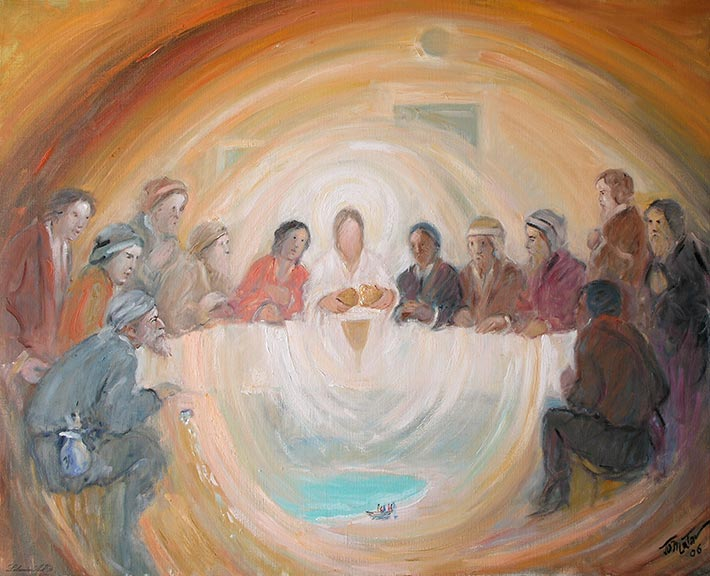
John 6:41-51 – The Bread of Life

“I Am the Bread of Life” by Lebanese painter Joseph Matar

The Jews there began to grumble about him because he said, “I am the bread that came down from heaven.” They said, “Is this not Jesus, the son of Joseph, whose father and mother we know? How can he now say, ‘I came down from heaven’?”

“Stop grumbling among yourselves,” Jesus answered. “No one can come to me unless the Father who sent me draws them, and I will raise them up at the last day.It is written in the Prophets: ‘They will all be taught by God.’ Everyone who has heard the Father and learned from him comes to me. No one has seen the Father except the one who is from God; only he has seen the Father. Very truly I tell you, the one who believes has eternal life.

I am the bread of life. Your ancestors ate the manna in the wilderness, yet they died. But here is the bread that comes down from heaven, which anyone may eat and not die. I am the living bread that came down from heaven. Whoever eats this bread will live forever. This bread is my flesh, which I will give for the life of the world.” (New International Version)

Christians everywhere hold to Jesus as the Son of God, Lord of the universe, and Savior of all.

However, for most people who were following Jesus around in the first century, this was not their understanding of Christ. In his earthly ministry, Jesus spoke in ways that introduced people to who he really was and sought to bring them to a point of following him based on his identity. 

Jesus wanted the crowds to see him for who he really is – themselves for what they really needed – and follow him based on the deepest needs of their lives.

I believe Jesus is the hope of all nations and all people, and in him humanity’s most basic and profound needs are met for forgiveness, love, and purpose in life. To address this, I ask three basic philosophical and theological questions of life:

What should human beings seek in life?

The responses in history are legion. The ancient Greek philosopher Aristotle thought a proper appreciation for an ethical and virtuous life found in practical wisdom was where people’s most concerted efforts should be. 

Karl Marx, the father of communism and socialism believed the proletariat should use their heads and their hands to rise above their economic conditions and oppression.

In the late 1960’s, Bobby Kennedy said we ought to be working the hardest to achieve justice and not advance ourselves on the misfortunes of others.

In more recent times, the Harvard Business Review is continually on the lookout for the best ways of being efficient, productive, and making the most of time because work itself is paramount.

Jesus insisted that people are not to work for food that spoils, but for food that endures to eternal life. Christ positioned himself as the bread of life – the one who is able to sustain humanity and enable to thrive and flourish in life.

By literally feeding thousands of people, Jesus wanted the people to understand the source of life itself comes from him. Jesus aspired beyond providing a supper for folks – he desired the people to feast on himself – to ingest him, to take him into their lives in a deep and profound way as the fulfillment of all the hope and promises of the Old Testament. 
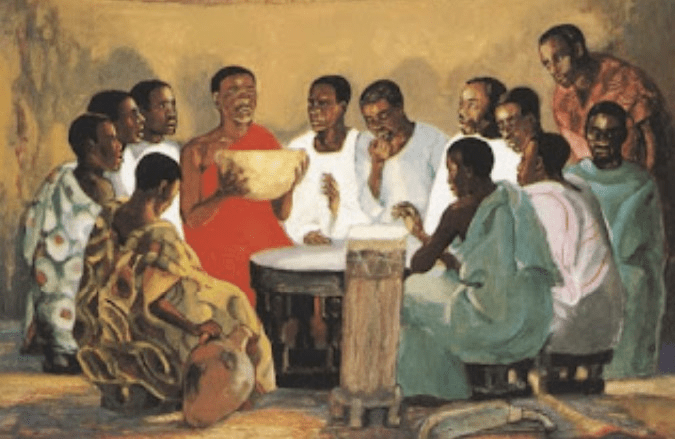
“The Lord’s Supper” by Cameroon artist Jesus Mafa, 1973

Jesus is the bread, the basic staple of life, that meets the cravings and needs of all people everywhere. Starving people, in both body and soul, find in Jesus a meal which keeps on giving, a feast of grace that is both delectable and unending.

The answer to my own question is that, for me, one’s highest pursuit and greatest quest is Jesus. Apart from Christ, I will starve. Furthermore, Jesus is not some cheap fast food off a value menu; he is real soul food to be ingested and enjoyed with others.

I believe people need Jesus. A passionate seeking of Jesus, to follow him, live for him, center life around him, is my most ardent desire. I do not simply desire Jesus for what he can do for me; I vigorously chase after him because if I do not have Jesus, I will die, I will starve to death. 

For me, Jesus is so much more than a nice addition to my life, like a new puppy; Jesus is Lord and Savior. I must consume him, or I will be completely undone, and I will not survive! Jesus is my bread, my food, my life!  I cannot survive on a daily crumb, but I feast on every word that comes from the mouth of Jesus because in Christ there is the life that is truly life.

What should human beings do in life?

Believe. To have and keep faith in the One God has sent, Jesus, is the primary “work” that pleases God.

Jesus communicated to the crowd that they can do so much more than follow him for another earthly meal – they can place their faith and hope in him for food that will last, food that will transcend the three-dimensional world.

Faith is more than an intellectual recognition to some facts about Christianity.

Belief is not about always having clarity and certainty to every facet and loci of Christian doctrine. Rather, Christian faith is a complete trust in Jesus as our hope and our life.

Education, economic uplift, political stability, and institutional peace and justice are important activities for this world. For the Christian, the accomplishment of these and so much more comes from the grace of God in Christ. As people come to the end of themselves with their homebrewed and half-baked attempts at being satisfied, Jesus stands at the door and knocks, the Living Bread who offers himself for humanity’s deepest needs.
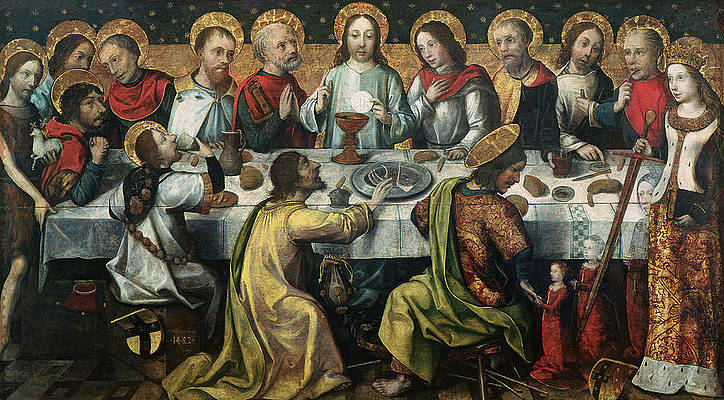
“The Last Supper” by Godefroy, 1482, C.E.

Giving kudos to Jesus might be nice, yet Christ himself cares about folks placing their trust in him for grace, forgiveness, and hope in their world. Jesus longs to reconnect people with God through giving himself as the means of making that happen.

All the works we do in this life, every good deed we accomplish, and each positive action we do are all helpful and necessary… and they all pale in comparison to the greatest work of all, to believe in Jesus Christ as the hope of this world, the hope of your family, the hope of the church, and the hope of your life. It’s all accessed by faith in the Son of God who loved me and gave himself for me.

Church buildings and furniture, stained-glass windows, pews, and even the Bible are not Jesus – they are simply and hopefully signs which point to him. They are all designed to lead us to Christ so that we may come to him. And coming to Christ is what the Lord’s Supper, Holy Communion, the Eucharist, and any other description you want to give about ingesting Jesus is about. The elements of bread and cup bring us to Christ so that we can experience Jesus and be joined to him by faith in a mystical union of human and divine in the unseen heaven.

Conclusion

Where will you find true satisfaction and hope? Probably not in the clearance aisle at Wal-Mart. Likely not in conforming to cultural Christianity or embracing generic forms of Jesus as merely a good teacher and moral example.

Furthermore, life’s ultimate satisfaction and hope are not to be found in a spotless house and perfect kids; in working more hours and making more money. Nor will we find contentment and peace in the radical independence of doing things my way.

Jesus is the Bread of Life. Through ingesting him, passionately pursuing him, believing in him, and coming to him in everything, we find the life that is truly life. Do not settle for any substitutes to Jesus. Come to the real person.

Lord God, you said that when we seek you with all our hearts, you will be found.  As the deer pants for streams of water, so we, your people, long for you in a dry and weary land.  We hunger and thirst for your righteousness.  We deeply desire your presence in all things. So, we die to ourselves and surrender to your will and way for us, by faith trusting you will come into our lives and completely take over. May your blessing rest upon us as we seek Jesus. Amen.

2 Kings 4:32-37 – But That Is Not the End of the Story

Elisha and the Shunammite woman by Dutch painter Gerbrand van den Eeckhout (1621-1674)

Elisha entered the house and found the boy stretched out on the bed dead. He went into the room and locked the door—just the two of them in the room—and prayed to God. He then got into bed with the boy and covered him with his body, mouth on mouth, eyes on eyes, hands on hands. As he was stretched out over him like that, the boy’s body became warm. Elisha got up and paced back and forth in the room. Then he went back and stretched himself upon the boy again. The boy started sneezing—seven times he sneezed!—and opened his eyes.

He called Gehazi and said, “Get the Shunammite woman in here!” He called her and she came in.

Elisha said, “Embrace your son!”

She fell at Elisha’s feet, face to the ground in reverent awe. Then she embraced her son and went out with him. (The Message)

Life sometimes feels like a roller coaster. Our emotions go up and down alongside the circumstances which bring them forth.

Elisha was one of the all-time great prophets in ancient Israel. He developed an ongoing friendship with a woman from the town of Shunem. It was her simple hospitality to a stranger that brought about the enduring relationship.

Whenever Elisha passed through on his prophetic business, he would stop in and have a meal or spend the night in a special room set aside just for him.

But that is not the end of the story….

The woman was about to have a big change of life, a life she could not have ever seen coming and only dreamed of.

The Shunammite woman had no children and was not able to conceive. Yet, on one of his visits, Elisha promised her she would hold her very own infant child… which she eventually did. A year after Elisha’s pronouncement, the woman and her husband had a son.

The woman went from discouraged to elated. The child grew. The Shunammite and her family were content and living well.

But that is not the end of the story….

In today’s Old Testament lesson, we pick up the narrative as the child is a small boy, the family happy and healthy… until they weren’t.

One day the boy was playing, as he did every day. Whatever happened, he developed such a terrible headache that his dear mother rocked him for hours, trying to comfort him. The worst case scenario happened. The boy died.

The woman went from joy to despair in a matter of hours.

But that is not the end of the story….

The grieving mother refused to let death have the last word on her son. She saddled her donkey and went directly to Elisha. The Shunammite lamented to him about her son, and in her grief, cried out how Elisha had gotten her hopes up, only to be dashed by that dark enemy of death.

The prophet responded to the woman’s plea and set off  post haste to her home, which had now become a sort of funeral parlor. Elisha went into the room by himself with the dead boy. In an odd process similar to what Jesus would do centuries later, Elisha did some physical actions in bringing about a miraculous resurrection.

The boy sneezed, got up, and was given back to his mother. Her lowest of the low grinding sadness of distress and despair now turned to the highest of the high elation of joy and gratitude.

But that is not the end of the story….

The story continues because the larger overarching story of God’s gracious intervention into this world to bring about the redemption of all creation.

Along the way, across the millennia, the Lord continues to use faithful people to bring about renewal, restoration, and redemption. In the Christian tradition, the apex of this merciful work is fulfilled in the person of Jesus Christ.

God himself was pleased
    to live fully in his Son.
And God was pleased
    for him to make peace
by sacrificing his blood
    on the cross,
so that all beings in heaven
    and on earth
would be brought back to God. (Colossians 1:19-20, CEV)

The resurrection of the boy, and all risings from death before Jesus, prefigured and foretold the ultimate resurrection of Christ. And because Christ is risen, we too, shall rise from death – both spiritually and bodily.

Therefore, we have been buried with him through baptism into death, in order that just as Christ was raised from the dead through the glory of the Father, so we too may live a new life. For if we have become united with him in the likeness of his death, we will certainly also be united in the likeness of his resurrection. (Romans 6:4-5, NET)

The end of the grand narrative story is moving to a climax. Jesus is coming again to judge the living and the dead. All things shall be restored. All will be made right. We may sorrow in the night, but joy comes in the morning.

Then I saw a new heaven and a new earth, for the first heaven and the first earth had passed away, and the sea was no more. And I saw the holy city, the new Jerusalem, coming down out of heaven from God, prepared as a bride adorned for her husband. And I heard a loud voice from the throne saying,

“See, the home of God is among mortals.
He will dwell with them;
they will be his peoples,
and God himself will be with them and be their God;
he will wipe every tear from their eyes.
Death will be no more;
mourning and crying and pain will be no more,
for the first things have passed away.”

And the one who was seated on the throne said, “See, I am making all things new.” Also, he said, “Write this, for these words are trustworthy and true.” Then he said to me, “It is done! I am the Alpha and the Omega, the Beginning and the End. To the thirsty I will give water as a gift from the spring of the water of life. (Revelation 21:1-6, NRSV)

Our past grief and our present troubles will give way to a future hope – an ending to the story we can barely imagine, a glorious existence with our God which will have no end.

May the Lord come soon.

I pray the Lord Jesus will be kind to you.

May faith, hope, and love surround everyone who belongs to Christ Jesus. Amen.

Romans 5:1-5 – Maybe There Can Be Peace…

Therefore, since we have been justified through faith, we have peace with God through our Lord Jesus Christ, through whom we have gained access by faith into this grace in which we now stand. And we boast in the hope of the glory of God. Not only so, but we also glory in our sufferings, because we know that suffering produces perseverance; perseverance, character; and character, hope. And hope does not put us to shame, because God’s love has been poured out into our hearts through the Holy Spirit, who has been given to us. (New International Version)

Today, there are millions, perhaps billions, of people without peace in this world.

Maybe…

Maybe there isn’t much peace in your life. Because of that unsettled icky sense of agitation, your mind is somewhere else. It could be that you are upset about something that has happened or are worried about something that is going to happen. 

Maybe the lack of peace has to do with another person. They did or said something, and it’s been grinding on you. So, you are having conversations with that person in your head for which you will probably never say aloud. 

Maybe you have to deal with someone else who doesn’t have peace, and it’s creating stress for you. And you are wondering when things will settle down.

Maybe the lack of peace runs much deeper than your immediate circumstances and plans. 

Maybe every day, day-in-and-day-out, you are not quite sure about where you stand with a person or a group of people.

Maybe you aren’t sure about how you stand with God. You wonder whether God is really pleased with you, or not. 

Maybe you aren’t even in touch with your lack of peace because you are an expert at pushing whatever feelings you have so far down that you think you’re fine. But you really aren’t.

Maybe you are a perfectionist…

Perfectionists are never at peace. The specter of perfectionism always hangs in the air. There’s a steady stream of “should have’s,” and “could have’s” making noise in your head. Your work, no matter how good, is never good enough. “I should have done better.”  “I ought to do better.”  “I must be better.” 

Instead of viewing life’s opportunities as challenges to be welcomed, the perfectionist sees life as one unending mountain to climb, never quite reaching the top. 

The constant companions of perfectionistic people are disappointment, condemnation, frustration, and perceived failure. There is, for them, an internal world of self-loathing based on the lie that I am not enough – I have to be perfect. Peace, for the perfectionist, is a pipe dream.

Maybe we could focus a bit on God…

The Christian God is a triune God, existing in three persons – Father, Son, and Spirit – the great Three-in-One. The Trinity is the basis for all we are and all we do.

All of life is grounded in the triune God. God exists in perfect unity and harmony. God is God’s own community of glorious love. God’s glory is primarily seen on this earth through creation, through us, God’s creatures.

Glory is revealed as we reflect the image of God stamped on us in creation. Since God is love, God’s people are to be characterized by love – loving God, loving one another, and loving neighbor. God’s people are meant to exist together in unity and harmony, reflecting the very nature of the Holy Trinity. 

Yet, after the creation of the world and humanity, man and woman fell into guilt and shame through bucking God’s design for people. Ever since, God has been on a mission to reclaim the lost glory.

Maybe we need to focus on the Son… 

The ultimate expression of God’s mission was the sending of the Son to this earth. It is through Christ’s life, death, resurrection, and ascension that the way has been opened to a renewed relationship with our triune God.

The way is now clear for us to experience real practical peace. It has been achieved through the cross of Jesus Christ.

Therefore, since God has initiated a rescue mission for us by sending the Son, since we have been justified through faith, we have peace with God. 

To be justified means God made us righteous – has made things right between us. God has also provided access for us to be right with each other and the rest of creation. To put this in a contemporary vernacular, we ask God, “Are we good?” and God responds, “We’re good.”

Since then, we’re good with God, we have peace with God. 

Since then, that is true, we cannot try and get peace by another way.

Peace does not come through doing the right things, and by being a good person. 

Peace does not come through trying to obtain feelings of peace.

Peace is not merely the absence of conflict – of just keeping people from strangling each other and harming one another. 

Peace cannot be achieved by trying to relieve anxiety through better effort. 

Maybe grace is the answer…

The antidote to perfectionism, the resolution to feeling a lack of peace is unconditional approval from God. 

Grace is the elixir of life. 

Grace is the thing a perfectionist cannot work to obtain, and the thing that truly helps. 

Grace is freely given; it is a gift.   

Grace (God’s loving unconditional acceptance of us) is the true way of peace.

Some folks have so tied themselves to impossible performances and conditional love that the gift of grace is hard to accept. 

Change won’t happen overnight, and that’s okay – because God deals with us according to grace, not by earning spiritual merit badges. 

The renewal that brings transformation is a process, not an event. In Scripture it’s called “sanctification.” So, it’s important to enjoy the process. 

When you’ve caught yourself going back to the pigsty of perfectionism, instead of beating yourself up, go ahead and laugh at yourself and your own fallibility. Perfectionists take themselves way too serious. Anytime they can lighten up, it lights up the face of God (in a non-performance sort of way!).

Maybe peace is possible…

Peace delivers us from our brokenness.  Again, let’s return to the triune God. There is perfect peace within Father, Son, and Spirit. God is perfect unity, harmony, and love.

Peace means living, working, and playing together. 

Peace means experiencing wholeness, integrity, and contentment, even in the midst of hard circumstances. 

Peace means being a peacemaker.

The late Fred Rogers, from Mister Rogers’ Neighborhood, got into television because he didn’t like TV. During spring break of his senior year in seminary he encountered television for the first time. What he saw repulsed him because he saw people demeaning each other and not having peace.  

Fred Rogers worried that TV programming would create a generation of emotionally-bankrupt children. Faced with the decision to either sour on television itself or work to restore the medium, he chose the latter. He dropped out of seminary and began pursuing a career in broadcasting. Fourteen years later, he created a television show that shaped entire generations of children, running on PBS from 1968-2001.

Mr. Rogers was a devout Christian who rarely talked about his faith on the air. Yet, his show infused our society with beauty and grace. “You’ve made this day a special day by just your being you,” he’d famously sign off. “There is no person in the whole world like you, and I like you just the way you are.” 

In many ways, the lasting legacy of Mr. Rogers will not only be the greater emotional stability of generations of children, but also his wonderful example of peace and how to restore the world through basic human kindness.

Maybe the path of peace is different than I believed…

Having all our circumstances like we want them is not the basis of experiencing peace. That’s being delusional. Peace doesn’t happen whenever everything goes our way.

Instead, we are to rejoice in all our circumstances, even the ones which cause suffering – because they the Holy Spirit’s means of teaching us to experience the peace we long for.

Suffering is our triune God’s way of weaning us off all that divides and antagonizes so that we can attach ourselves to God’s peace. 

One of the most read Christian books of all time was written in the 1500’s by a French woman known as Madame Guyon. She saw the disunity of the world and the lack of peace in our individual lives as stemming from our lack of practicing God’s ways. 

Much of the world doesn’t know what to do with suffering, and does not accept it, because people want their own way with everything.

War and Peace by U.S. Air Force Staff Sgt. Jamal D. Sutter

To know God’s peace, we must practice just the opposite – by refusing all personal desires we have, whether good or bad. Why? Because the practice of refusing our own will breaks it free so it can attach to God’s will.  

We need our brains to be rewired in saying “no” to ourselves.

The other part of Madame Guyon’s practice is to accept every circumstance, even difficulty and suffering, with joy and thanksgiving. 

We can learn to say “yes, thank you” for each hard circumstance, whether good or bad. As in the case of Mr. Rogers, the evil we observe can spur us toward making peace in this world. We detach from personal desires so we can attach to what God wants to do.

Peace, on the practical level, comes from persevering under suffering and rejoicing in it. Why rejoice? Because suffering produces character and character hope. There cannot be hope without suffering. 

God the Father called God the Son to suffer; and God the Spirit leads us into suffering so that we might know peace and hope on a daily basis.

Conclusion

Abandon everything to God. Let it go – every dream, every personal desire, everything you have so that you are free to know God’s will for your life. 

Accept each circumstance you face with joy and thanksgiving. The Trinitarian love of God is poured into our hearts through every circumstance of life, even if it is difficult and hard. 

When we practice abandonment of our wills and acceptance of our circumstances, the result gives us hope, the confident expectation that nothing in our lives happens in vain. 

Every situation can lead us to know God and experience peace. This is very different from simply believing in the Trinity; it is to daily experience the Trinity. 

Glorious God, make your presence known through our worship, our prayer, and our reading of your Word. Father, Son, and Holy Spirit, within you lies unity, love, justice, peace, and power.

Fill our outstretched hearts with your Spirit and encircle us with your love. Make yourself known to us in new and challenging ways. Empower us to forsake every will but your own.  Inspire us toward your peace. Do with us what you will, through Christ our Lord in the power of the Holy Spirit. Amen.

Revelation 21:1-6 – Making Everything New

Make All Things New by James Janknegt, 2005

Then I saw “a new heaven and a new earth,” for the first heaven and the first earth had passed away, and there was no longer any sea. I saw the Holy City, the new Jerusalem, coming down out of heaven from God, prepared as a bride beautifully dressed for her husband. And I heard a loud voice from the throne saying, “Look! God’s dwelling place is now among the people, and he will dwell with them. They will be his people, and God himself will be with them and be their God. ‘He will wipe every tear from their eyes. There will be no more death’ or mourning or crying or pain, for the old order of things has passed away.”

He who was seated on the throne said, “I am making everything new!” Then he said, “Write this down, for these words are trustworthy and true.”

He said to me: “It is done. I am the Alpha and the Omega, the Beginning and the End. To the thirsty I will give water without cost from the spring of the water of life. (New International Version)

The world as we now know it will someday pass away. For the Christian, there is a future hope – there is a time coming when it will literally be heaven on earth, a renewed earth. God will descend to dwell with us.

This will bring us full circle to the original design God had in the garden with Adam and Eve –an unhindered relationship between God and humanity in which we are no longer dogged by our sinful nature, a sinful world system, and all the sinful temptations that the devil uses to exploit for his own purposes. 

Tears, death, sorrow and pain will be a thing of the past. Eventually, our struggle with sin, guilt, and shame will be completely over.

The message of the Apostle John to the early Church was a very encouraging vision for them. The Church was facing all kinds of trouble and persecution due to their commitment to Christ. To know that contemporary problems would not last, but that Jesus would change everything, was a great comfort and help to the believers in their very real and present troubles.

One of the problems we experience in this present evil age is that we are an impatient people. We want good things to happen, now!  All of God’s people throughout history have been looking ahead for the ultimate fulfillment of God’s promises. The Apostle John was not so much giving a brand new revelation to the Church but upholding and anticipating for Christians what had also been true for Israel: 

“See, I will create
    new heavens and a new earth.
The former things will not be remembered,
    nor will they come to mind.
But be glad and rejoice forever
    in what I will create,
for I will create Jerusalem to be a delight
    and its people a joy.
I will rejoice over Jerusalem
    and take delight in my people;
the sound of weeping and of crying
    will be heard in it no more. (Isaiah 65:17-19, NIV)

When Jesus came in his first Advent, God’s people thought for sure all these promises would be fully realized. But, like a young couple in their engagement period, the promises of God had been initiated and promised, but not yet realized or consummated. Some folks might wonder if those good promises are nothing more than a politician’s word.

Above all, you must understand that in the last days scoffers will come, scoffing and following their own evil desires. They will say, “Where is this ‘coming’ he promised? Ever since our ancestors died, everything goes on as it has since the beginning of creation.” 

But they deliberately forget that long ago by God’s word the heavens came into being and the earth was formed out of water and by water. By these waters also the world of that time was deluged and destroyed. By the same word the present heavens and earth are reserved for fire, being kept for the day of judgment and destruction of the ungodly.

But do not forget this one thing, dear friends: With the Lord a day is like a thousand years, and a thousand years are like a day. The Lord is not slow in keeping his promise, as some understand slowness. Instead, he is patient with you, not wanting anyone to perish, but everyone to come to repentance.

But the day of the Lord will come like a thief. The heavens will disappear with a roar; the elements will be destroyed by fire, and the earth and everything done in it will be laid bare. (2 Peter 3:3-10, NIV)

Jesus had John write this statement down: “I am making everything new.” God is now in the process of moving history to its final stage. Can we be patient, as God is, in letting divine purposes do their work until that final day comes, or will we be impatient? 

“No step taken in faith is wasted, not by a God who makes all things new.”

Rachel Held Evans

We live in an amazing time in which we have instant communications and can travel anywhere in the world in a relatively short amount of time. The earth is a big place, but we can traverse it by plane in less than two days. It used to be that a ship going across the Atlantic Ocean took about three months from Europe to America. Now, we fly across the ocean in a matter of hours. Yet, we freak out that we have to be to the airport two hours before a flight and grump and complain about standing in a twenty minute line to board a plane.

It used to be that communication moved at the same pace as a ship. Knowing about a significant event that happened in Europe would take three months to reach America. Now we can know about what kind of bread some Frenchman ate for breakfast almost instantly after he eats it because he posted it on social media. And we complain if we have to wait a few extra seconds for something to load on our computers and phones, as if the world were about to end.

Well, actually, it is about to end.

Until that happens, we are not to twiddle our thumbs and simply wait for the end to come, spending our remaining time figuring out exactly the day and hour of Christ’s return. Instead, all things are being transformed. And it will culminate and climax in his Second Coming and the final passing away of the old order of things.

We properly anticipate Jesus coming again when we let God change our hearts and lives, our neighborhoods and workplaces, our families and churches, to be just like Jesus. God is now in the business of preparing for Christ’s return by doing away with the old order to make room for the new. 

Therefore, if anyone is in Christ, the new creation has come: The old has gone, the new is here! All this is from God, who reconciled us to himself through Christ and gave us the ministry of reconciliation: that God was reconciling the world to himself in Christ, not counting people’s sins against them. And he has committed to us the message of reconciliation. 

We are therefore Christ’s ambassadors, as though God were making his appeal through us. We implore you on Christ’s behalf: Be reconciled to God. God made him who had no sin to be sin for us, so that in him we might become the righteousness of God. (2 Corinthians 5:17-21, NIV)

The book of Revelation helps us to break our fixation with the past and holding onto the ways we have always done things. It reminds us of God’s capacity and action for renewal.  We can walk now in newness of life. 

We were therefore buried with him through baptism into death in order that, just as Christ was raised from the dead through the glory of the Father, we too may live a new life. (Romans 6:4, NIV)

The work of God will ultimately destroy the old and bring in the new. God is now in the process of renewal, changing lives so that Christ can dwell in our hearts through faith as the Alpha and Omega, the Beginning and the End, as the One who has no room for any other god.

God knows the whole story. The Lord knows your story. The sovereign ruler of the universe knows how everything is going to turn out. When everything passes away, when all is stripped from our lives, when the world as we know it is done away with, what are we left with? 

We are left with God’s purposes, not ours. Then, our own hearts can beat in sync with God’s heart for all creation. Whenever we seek to do away with the evils and troubles of this world; to eradicate global poverty; to end the world of sex-trafficking; to help others come to grips with the evil of this world through changing old satanic ways of operating; to come alongside others in their trouble; then, God is using us to make everything new.

The end is coming, but it is not yet here. Meanwhile, God is presently working to make everything new by bringing salvation of both body and soul to all kinds of people.

Blessed God, the world seems to be spinning out of control. Keep me alert and disciplined in my prayers. More than anything, help me live in constant, redeeming love for everybody. Let my hospitality be endless, generous, and without complaint. Make my tongue, my hands, and my heart a conduit for the light of Jesus Christ, the source of all goodness. Amen.