To the Family of God (2 John 1:1-16)

St. John the Apostle, by sculptor Thomas Ball (1819-1911)

From the Elder—

To the dear Lady and to her children, whom I truly love. And I am not the only one, but all who know the truth love you, because the truth remains in us and will be with us forever.

May God the Father and Jesus Christ, the Father’s Son, give us grace, mercy, and peace; may they be ours in truth and love.

How happy I was to find that some of your children live in the truth, just as the Father commanded us. And so I ask you, dear Lady: let us all love one another. This is no new command I am writing you; it is the command which we have had from the beginning. This love I speak of means that we must live in obedience to God’s commands. The command, as you have all heard from the beginning, is that you must all live in love.

Many deceivers have gone out over the world, people who do not acknowledge that Jesus Christ came as a human being. Such a person is a deceiver and the Enemy of Christ. Be on your guard, then, so that you will not lose what we have worked for but will receive your reward in full.

Anyone who does not stay with the teaching of Christ, but goes beyond it, does not have God. Whoever does stay with the teaching has both the Father and the Son. So then, if some come to you who do not bring this teaching, do not welcome them in your homes; do not even say, “Peace be with you.” For anyone who wishes them peace becomes their partner in the evil things they do.

I have so much to tell you, but I would rather not do it with paper and ink; instead, I hope to visit you and talk with you personally, so that we shall be completely happy.

The children of your dear Sister send you their greetings. (Good News Translation)

The Pastor

Tucked away near the back of the Bible is a short little letter from the Apostle John, identifying himself as “The Elder.” This is meant to convey both his venerable leadership and his affectionate relation as the grandfatherly old man who has something important to say. In other words, John was, in our terms, a Pastor responsible for shepherding the church with care.

The Church and Christians

“The dear Lady” is a metaphor for the church. Through personifying the church, John was assigning worth, respect, and dignity to the mother with spiritual progeny.

“Her children” are the believers within the church, spiritual offspring with the church as their mother. This has been an important motif for most of Christian history – an understanding that has gotten lost over the centuries in much of the Protestant world. Yet, one of the magisterial reformers, John Calvin, retained this view of the church and its members:

“The Church is the bosom which God is pleased to gather his children… who are guided by her motherly care until they mature and at last reach the goal of faith…. How useful, indeed how necessary, it is that we should know her. For there is no other way to enter into life unless this mother conceive us in her womb, give us birth, nourish us at her breast, and keep us under her care and guidance… Our weakness does not allow us to be dismissed from her school until we have been pupils all our lives.”

(Institutes of the Christian Religion, 4.1, 4)

Indeed, Calvin was merely upholding the words of St. Cyprian, Bishop of Carthage (c.200-258, C.E.)  who stated 1,300 years earlier than the reformer:

“No one can have God as Father who does not have the church as Mother.”

St. Cyprian (On the Unity of the Catholic Church, ch.vi)

Love and Truth

The relationship between the mother and her children is to be always characterized by familial love. Everything within Christianity rises and falls with love because God is love.

God extends loving words and actions because love is the stuff that God is made up of. The very character of God is love, through and through. There is never a time when God is not loving.

In fact, God’s anger and wrath are expressions of love – for God is opposed to all which is unloving. Therefore, God extends justice and confronts sin so that love will freely flow once again amongst humanity and all creation.

God is not okay with deceit, not at all alright with errant understandings of his Son, Jesus Christ, being made out as a mere phantom without a real flesh-and-blood body. He had to be made like us in every way. Otherwise, there is no deliverance from the deceitfulness of sin, the sting of death, and the agony of hell.

John, as the Apostle of love, consistently espoused the primacy and permanence of love whenever he had the chance. Truth and love go together, always, insisted John. Love is only really possible when there is truth in the heart.

The true muster of mother church and of individual believing children is their love. No matter what is done – whether outreach, fellowship, or worship – it is all to be done in love and in truth. It’s not enough to be right; the rightness must be applied with the generosity, grace, and liberality of love.

The telltale sign of the deceiver, the false teacher, is that he proclaims only one without the other, either truth or love, but never both together.  

A profound lack of love is the litmus test that belies a faulty and heretical doctrine of Jesus. The absence of love is a red flag that impure teaching is happening. The real enemy of Christ is the one who claims Christianity but does not love, neither in word nor deed. If we really want to love God, we will love one another, and vice-versa.

Love and truth always go together. A mother is a mother because of her children; and a child is a child because of the mother. You cannot have one without the other.

To embrace truth is to love a group of people wherever they are. It is to see them, listen to them, then act on their behalf. Far too often Christians are known for their hubris in superimposing on others what those others need – believing they already know the truth of both Bible and them.

Love abides with the truth of a people. Genuine love seeks the truth and responds accordingly. Love is willing to find out what the issues are of a people. Assuming others need our money, our plans, our service, or our solutions, assumes we already understand their situation without hearing from them.

Love is longsuffering. It is willing to sit with folks for as long as it takes. Love finds itself by carefully applying biblical truth to the truth of a people. And that takes a great deal of time and effort. There are no shortcuts to love.

Love must have its way, or it isn’t love.

Since God is love, God must have his way in us first.

Hope and Happiness

Hope is a confident expectation that promises will be kept and realized.

Happiness is the result.

Hope and happiness go together like bacon and eggs, Tom and Jerry, the moonwalk and Michael Jackson, Friday and fish fry, Harry Potter and Hogwarts, salt and pepper, Adam and Eve, Jesus and the Spirit, and well, I think you get the picture.

Unhappiness is the inevitable result of feeling hopeless. Hope and happiness are both relational terms. They come from having good relations based in love and truth.

Love and truth are very much relational terms, being realized because of mother church’s nurturing.

And the chosen mother came into being because of the Father’s gracious will.

So, tell me, what is your takeaway from this quite brief reflection on John’s little letter?…

Persevere Through Adversity (Psalm 129)

Painting of Jerusalem by Alex Levin

From my earliest youth my enemies have persecuted me.
    Let all Israel repeat this:
From my earliest youth my enemies have persecuted me,
    but they have never defeated me.
My back is covered with cuts,
    as if a farmer had plowed long furrows.
But the Lord is good;
    he has cut me free from the ropes of the ungodly.

May all who hate Jerusalem
    be turned back in shameful defeat.
May they be as useless as grass on a rooftop,
    turning yellow when only half grown,
ignored by the harvester,
    despised by the binder.
And may those who pass by
    refuse to give them this blessing:
“The Lord bless you;
    we bless you in the Lord’s name.” (New Living Translation)

The Jewish people know a thing or two about perseverance through suffering; they’ve been enduring it for millennia. If we let them, they can show us a better way of facing adversity.

It seems to me that we modern Gentiles could learn from our Jewish brothers and sisters. We Westerners tend toward burying the past, putting things behind us, and forgetting all the bad things which occurred back there. But the Psalms, a wonderful depository of Jewish thought and practice, will have none of that approach.

Today’s Psalm comes from a group known as the “Psalms of Ascent.” (Psalms 120-134) These were sung by ancient Jewish worshipers as they made the journey up to Jerusalem for the Feast of Tabernacles.

As the pilgrims walked together on their ascent to the great city, the experience of collectively singing and worshiping made the people feel united in joy, purpose, and sorrow. Remembering was central to that sense of solidarity.

The Jewish people have been attacked by countless enemies, not only throughout the Old Testament, but also throughout their long history. Empires tend to not like Jews because Jews hold to their own set of laws and worship practices – which seem to always come into conflict with what some Emperor, Dictator, or Tyrant wants. So, they try to be rid of Jews, like plowing a field to break up the stubborn hard ground of Yahweh worship. The Jewish people end up being treated, literally, like dirt.

“The attempt to eliminate the people of God was an attempt to eradicate the presence of God from the human situation. The fact that after Auschwitz the Jewish people still lives and can still affirm its faith is the most powerful testimony that God still lives.”

Rabbi Jonathan Sacks, Crisis and Covenant

God will deliver… eventually. Whether Jew or Christian, there will always be enemies to the faith. And sadly, the history of Christianity includes their own brand of persecuting Jews. *Sigh*

Haters, the Psalm hopes, will be like grass in shallow soil: They may sprout quickly, but will also wither quickly and blow away to be gone forever.

The evil of this fallen world is terrible and ugly; but it isn’t permanent. Therefore, we need patience and perseverance through the suffering and adversity to realize the deliverance.

And as much as aggressive bullies try to wipe out those not conforming to their ways, the Lord simply brings in a harvest of righteousness, despite it all.

Even though the Psalms of Ascent were written long ago by people living in a time and place very different from ours, yet they express the emotions we all feel, which makes them helpful for our journey through life, as well.

Although none of us delights in persecution, pain, and struggle, we can take the stance of embracing our hard circumstances because suffering produces perseverance; perseverance, character; and character, hope. And hope does not put us to shame, since love is the force that binds the world together. (Romans 5:3-8)

“When two friends climb a hill, the hill seems less steep than if they climbed it alone.”

Sherri Mandell

Oftentimes, it is inside the pain that we begin to become one with our own vulnerable humanity. And that humble humanity is where great courage, great creativity, and great work germinates within our spirits and cultivates the ground of this world, growing to produce faith, hope, and love.

Everyone facing adversity knows how hard it is to keep going without seeing the goal. Like the farmer, we must expectantly wait till the harvest. There is nothing we can do to speed up the process and go straight from planting to harvest. It takes time and plenty of patience. Grumbling and complaining about how long it is taking will not make it go any faster.

Perseverance in the face of hardship is a major pathway to realizing a holy life. Consider the ancient prophets:

  • Jeremiah was faithful to proclaim God’s message yet was thrown into a cistern and left for dead. Yet, he was delivered from it. (Jeremiah 38:1-28)
  • Micaiah was faithful to declare truth to King Zedekiah, who then promptly imprisoned him, even though the king asked for God’s message. (1 Kings 22:24-27)
  • Daniel was faithful to pray consistently to the one true God and was thrown into the lion’s den to be killed. But the Lord saved him. (Daniel 6:1-28)

The prophets all suffered for doing the right thing and did not waver in their commitment to the Lord. Through their troubles they learned to trust God and draw near to the Lord. The adversity strengthened, not weakened, their faith.

What’s more, consider the Old Testament character of Job, who is Exhibit A of perseverance through grinding hardship. Job had it all; and he lost it all… except his faith. Job tenaciously held onto righteousness, despite his awful physical, mental, emotional, and spiritual pain. And he eventually came through it, restored and whole.

We are to keep going in our faith and not give up – and the Psalms of Ascent can help us in our endurance.

The soul would have no rainbow if the eyes had no tears. We live in a time when we will either sink or swim – there is no in-between. God’s celestial shore is within sight; don’t miss it by getting discouraged by all the fog. 

Hang in there, my friend. There is good reason to do so.

Coming to Grips with Grinding Adversity (Psalm 137)

“By the Waters of Babylon, They Sat Down and Wept” by Kate Gardiner Hastings

Alongside Babylon’s streams,
    there we sat down,
    crying because we remembered Zion.
We hung our lyres up
    in the trees there
    because that’s where our captors asked us to sing;
    our tormentors requested songs of joy:
    “Sing us a song about Zion!” they said.
But how could we possibly sing
    the Lord’s song on foreign soil?

Jerusalem! If I forget you,
    let my strong hand wither!
Let my tongue stick to the roof of my mouth
    if I don’t remember you,
    if I don’t make Jerusalem my greatest joy.

Lord, remember what the Edomites did
        on Jerusalem’s dark day:
    “Rip it down, rip it down!
    All the way to its foundations!” they yelled.
Daughter Babylon, you destroyer,
    a blessing on the one who pays you back
    the very deed you did to us!
    A blessing on the one who seizes your children
    and smashes them against the rock! (Common English Bible)

This side of heaven is full of both love and heartbreak, celebration and lament, encouragement and insult. It is a spiritually schizophrenic existence of heaven’s kiss and hell’s bite. 

We live in a fundamentally broken world. Yet, it is a world that is presently being reclaimed by God’s kingdom. Therefore, our emotions run the gamut from joyful happiness to sheer sorrow. Either way, especially through the difficult stretches of our lives, Christians are to tether themselves to their true home of heaven.

The psalmist was speaking of Jerusalem, the city that represented the very presence of God. Yet, the Babylonians came and destroyed the temple, their homes, and carried thousands of her citizens into exile.

Although experiencing the Babylonian Exile, the people of Jerusalem were not to forget their real home. 

For the believer in Jesus, this present abode is like camping in a tent – it is a temporary home, and not our permanent residence.

It is easy to forget our true home, which is why we need the constant perspective of eternity. We ought not get too familiar with our current living conditions. 

Simple acts like looking up at the stars at night or gazing into the vast expanse of the day’s sky can be tangible reminders that we are meant for larger things, for the embrace of heaven.

None of this, however, means that we are to ignore what is happening in the here and now. Trauma is real and needs to be dealt with. Having an expansive perspective doesn’t mean we stuff the details and emotions of traumatic events.

The psalmist names the difficult experience, the agonizing emotions, and the bitter thoughts. None of it is hidden or buried under a layer of positivity.

“Lamenting Jews in Exile” by Eduard Bendemann, 1832

We need the combination of faith that my experienced is acknowledged, of hope that a better future is coming, and of love that good still presently exists in the world. Faith, hope, and love are all vital in coming to grips with terrible adversity.

Hiding large swaths of our lives and stories from others is not the path to spiritual wellness, emotional healing, and personal peace. Spiritual and emotional health comes from owning our internal struggles. The virtues of weakness, humility, vulnerability, and faith opens us to the way of grace.

We too often struggle because we don’t struggle. 

I’m the expert on stuffing feelings and turning them into thoughts. I learned it well early in my life. Yet, feelings never evaporate just because we ignore them. Just the opposite, like a forgotten half-carton of cottage cheese in the back of the fridge, our feelings only gather moldy bacteria and crust over with nastiness. 

We need to understand that feelings really do have an expiration date to them. If not openly acknowledged and dealt with, they’ll fester into bitterness. It’s much better to deal with our present struggles instead of living with the wishful thinking that they’ll just go away.

There are 52 references to “one another” in the New Testament, including: 

  • Love one another (John 13:34-35)
  • Be kind to one another (Ephesians 4:32)
  • Show hospitality to one another (1 Peter 4:9)
  • Forgive one another (Colossians 3:13)
  • Encourage one another (Hebrews 3:13)
  • Bear the burdens of one another (Galatians 6:2)
  • Spur one another on toward spiritual well-being and healthy community relationships (Hebrews 10:24)

Nowhere in Holy Scripture will you find references to hide from one another, pester one another, or put up a false front toward one another.

God desires for us to take a risk on betting the farm on Jesus. Embracing Christ involves owning our struggles, both to God and to one another. 

You may argue that it isn’t helpful to wear your feelings on your sleeve. But I’m not talking about emotional diarrhea; I’m referring to something far worse: emotional prostitution, where we sell ourselves to others in a cheap façade of who we really are and how we are really doing. 

We want to be liked, loved, and longed for. And we very much desire to avoid heartrending pain. So, many mistakenly believe that keeping up false appearances will get them what they long for.

What matters most is faith expressing itself through love (Galatians 5:6). It takes personal risk to have faith. And it takes two to have love.

Own your struggle. Face it squarely in all of its foulness, degradation, and ugliness. Face it with both God and others. 

If you’re mad as hell at God, then say it; the Lord is big enough to take it. If you need prayer or help, ask for it. Don’t just expect someone to read your mind or your emotions. If someone asks you to pray, stop what you’re doing, get on your knees with that person, and pray like there’s no tomorrow.

Life is too short to sleepwalk through it with a constellation of unacknowledged emotions. It takes no relational effort to ask a pat question like, “How are you?” It takes even less relational energy to give a pat answer such as, “Fine,” or “Busy.” Instead, let’s get down to why you feel a constant need to say how busy you are, even when you’re not really all that busy.

Holy Scripture doesn’t call us to hide, but to love one another enough to both give and receive God’s grace. 

Daily reading and praying of the psalms is a good place to begin in learning to be authentic with God and the people in our lives. It’s the only way of dealing with the overwhelming circumstances and emotions we face.

Loving God, please grant me peace of mind and calm my troubled heart. My soul is like a turbulent sea. I can’t seem to find my balance, so I stumble and worry constantly. Give me spiritual strength, mental clarity, and emotional calm to find my purpose and walk the path you’ve laid out for me. Just as the sun rises each day against the dark of night, may the light of your divine countenance shine on the shadowy places of my life, through Jesus Christ my Lord, in the illumination of the Holy Spirit. Amen.

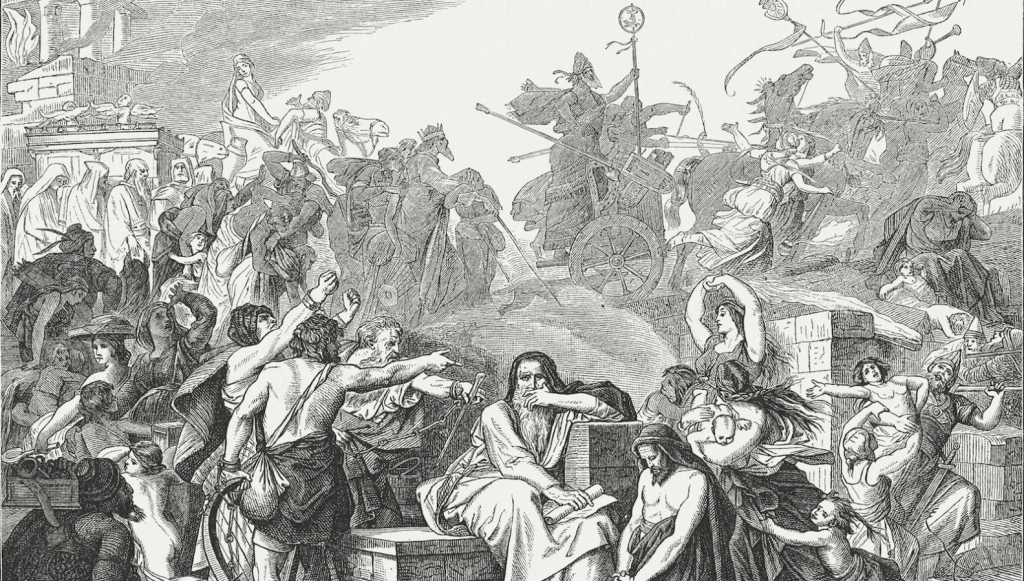
Exiled (Jeremiah 52:12-30)

The Babylonian Exile by Jewish-German painter Eduard Bendemann (1811-1889)

In the nineteenth year of Nebuchadnezzar king of Babylon on the seventh day of the fifth month, Nebuzaradan, the king of Babylon’s chief deputy, arrived in Jerusalem. He burned the Temple of God to the ground, went on to the royal palace, and then finished off the city. He burned the whole place down. He put the Babylonian troops he had with him to work knocking down the city walls. Finally, he rounded up everyone left in the city, including those who had earlier deserted to the king of Babylon, and took them off into exile. He left a few poor dirt farmers behind to tend the vineyards and what was left of the fields.

The Babylonians broke up the bronze pillars, the bronze washstands, and the huge bronze basin (the Sea) that were in the Temple of God and hauled the bronze off to Babylon. They also took the various bronze-crafted liturgical accessories, as well as the gold and silver censers and sprinkling bowls, used in the services of Temple worship. The king’s deputy didn’t miss a thing. He took every scrap of precious metal he could find.

The amount of bronze they got from the two pillars, the Sea, the twelve bronze bulls that supported the Sea, and the ten washstands that Solomon had made for the Temple of God was enormous. They couldn’t weigh it all! Each pillar stood twenty-seven feet high with a circumference of eighteen feet. The pillars were hollow, the bronze a little less than an inch thick. Each pillar was topped with an ornate capital of bronze pomegranates and filigree, which added another seven and a half feet to its height. There were ninety-six pomegranates evenly spaced—in all, a hundred pomegranates worked into the filigree.

The king’s deputy took a number of special prisoners: Seraiah the chief priest, Zephaniah the associate priest, three wardens, the chief remaining army officer, seven of the king’s counselors who happened to be in the city, the chief recruiting officer for the army, and sixty men of standing from among the people who were still there. Nebuzaradan the king’s deputy marched them all off to the king of Babylon at Riblah. And there at Riblah, in the land of Hamath, the king of Babylon killed the lot of them in cold blood.

Judah went into exile, orphaned from her land.

3,023 men of Judah were taken into exile by Nebuchadnezzar in the seventh year of his reign.

832 from Jerusalem were taken in the eighteenth year of his reign.

745 men from Judah were taken off by Nebuzaradan, the king’s chief deputy, in Nebuchadnezzar’s twenty-third year.

The total number of exiles was 4,600. (The Message)

The Babylonian Exile by Fahri Aldin, 2017

Eventually, God’s words and decrees happen. It may take minutes. It might take centuries. But it will happen.

God promised destruction. It happened. The temple, the city walls, and the houses of Jerusalem were destroyed.

God decreed deportation of the people. It happened. Thousands of Jews were uprooted and moved to Babylon.

God foretold depression. It happened. The social and economic system of Judah collapsed.

God said there would be an occupation of Gentiles. It happened. The occupying force seized and confiscated the holy temple articles. They violated that which was sacred to Judah.

God repeatedly told the people that there would be a reckoning for the years of social injustice and religious infidelity. It happened. There was not just a deportation of persons; there were waves of removal.

The long prophecy of Jeremiah began with a proclamation of exile. It moved toward that exile. And then, in the end, the exile became reality.

Surely, it must have seemed to the citizens of Jerusalem that the end of the world was at hand. Their very identity as God’s people, as they had understood it for centuries, was now obliterated. Who are they now?

The Jewish exile changed forever their understanding of themselves and of God because they needed to reimagine what being the people of God really means without a place and without a temple.

God is both subject and object of all Holy Scripture, including the book of Jeremiah. Perhaps neglected in all the talk of exile is that the Lord was also cast-off, put away, and exiled. And rather than this being bad news, it becomes the good news that divine presence was right alongside the exiles.

In our darkest times, in the worst of circumstances, when all seems hopeless – there is a God who shows such solidarity with us that he is crucified and put to death so that we might live.

The Lord does not stand afar off from us but is beside us, even within us.

The sheer violation and agony of Good Friday and the depressive silence of Holy Saturday are the means of demonstrating the power of resurrection and new life.

We may be deported, depressed, and destroyed – exiled to a place we do not know and do not want to be. Yet, that is not the end of the story.

Exile is temporary. Mercy is forever. There cannot be a resurrection without a death. There must be suffering before there is glory.

Love wins. Every time.

God is Love. Thus, there is always hope….