Called To a Way of Being – Fourth Sunday of Advent (Romans 1:1-7)

Paul, a servant of Christ Jesus, called to be an apostle, set apart for the gospel of God, which he promised beforehand through his prophets in the holy scriptures, the gospel concerning his Son, who was descended from David according to the flesh and was declared to be Son of God with power according to the spirit of holiness by resurrection from the dead, Jesus Christ our Lord, through whom we have received grace and apostleship to bring about the obedience of faith among all the gentiles for the sake of his name, including you who are called to belong to Jesus Christ,

To all God’s beloved in Rome, who are called to be saints:

Grace to you and peace from God our Father and the Lord Jesus Christ. (New Revised Standard Version)

To be a Christian is to be a servant of Jesus, called to a specific way of being in the world, and set apart for the gospel of God.

Concerning this gospel, this good news, it is all about God the Son, Jesus Christ, who is also fully human. Jesus is the singular person – both God and human at the same time, all the time. His human credentials are linked to the genealogy of the ancient King David, who was promised by God that one of his descendants would sit on throne forever. And as for Christ’s divinity, it was confirmed and established through his resurrection from death.

It is through Christ that we are called to belong to him; we have received the grace to be called children of God; and we are called to holiness for God. We all, therefore, have a calling. Every one of us is important. All of us receive the grace of God to fulfill that calling in this world.

In our contemporary society, we put a lot of stock into what we do, to the point of identifying ourselves primarily by our job titles and positions. But in God’s society, our primary identification is that we belong to God, and specifically to Jesus Christ.

Belonging to Christ means we are to have a certain way of being – not just doing – on this earth. We are first and foremost human beings, and not human doings. What we do is to flow from our being, and not the other way around. We do not gain identity through actions and accomplishments.

Our way of being has a lot to do with the Advent season. Christ’s coming into this world as a vulnerable baby was a deliberate way of being for Jesus in this world. He would go through all the human travails and trials that we do. He would know both joy and suffering, and would know them as coming together into one:

For the joy set before him he endured the cross, scorning its shame, and sat down at the right hand of the throne of God. (Hebrews 12:2, NIV)

It’s normal for us to wonder about the nature of our own personal sufferings. Its hard for us to make sense out of all the nonsensical things in this world, especially when it pertains to us personally.

Indeed, it is hard for us to accept the reality that humble suffering is not only a part of living in this world, but is also an important part of being a Christian who belongs to Jesus.

Whenever we lose something or someone important to us, we struggle with why. We may wonder where God was. We might think there is something wrong with us, as if God is punishing us for some unknown sin we’ve done in the past.

But we would be barking up the wrong tree. Methinks we wrestle so much with adversity and hardship because of our predilection for doing instead of being.

Perhaps our life situations are more about our way of being in this world, rather than what we do on this earth.

Maybe my life is meant primarily to be about being a person who is always loving, kind, compassionate, just, good, righteous, and holy – a saint, set apart as one who belongs to God.

Maybe it has a lot less to do with our vocations and only seeing things through what I’m able to do, or not do.

It could be that I am meant to see God’s grace operating through me by means of love, not hate; kindness, not meanness; compassion and comfort, not indifference and annoyance; justice, not injustice; goodness, not bad attitudes; and holiness, not unrighteousness.

It is quite possible that today (and every day) my Christian life has been about, is about, and will continue to be about my suffering for the sake of Jesus, who suffered for me.

“Why be disturbed of things that do not succeed according to your plans and desires? Who gets everything according to his likes? Neither I, nor you, nor anyone else on this earth. No one in this world is without some trial or illness or affliction, not even a king or a pope. Who, then, has it the best? The one who is willing to suffer for God’s sake.” Thomas à Kempis, The Imitation of Christ

The believers in the Roman Church, for whom the Apostle Paul wrote his letter, were focused primarily on what they had and what they did as Jews and as Gentiles. Because of their understanding of identity, they kept wrangling with each other and looking down on one another – namely, because they failed to each other as belonging equally to God as the one people of God. Jews were too hung up on how they kept the Law for centuries without any Gentiles. And Gentiles were too myopic to see that they were not replacing Jews out of some superior activity.

To love one another, and to simply love, is to suffer. Apart from love there is no suffering. Without love, there is no peace, no grace; and there is no belonging to God and having a way of being in the world which pleases God.

Furthermore, one can never have possessions or wealth without a great deal of anxiety and apprehension. Our happiness does not consist in temporal things, but in the permanence of relationships, because relationships are the only things we take with us in the end.

In the spirit and practice of the Lord Jesus whom the Christian serves, we must pass through the fire before we arrive at redemption and be at peace with God and humanity.

To reach the joy of Christmas, we must endure the weeks of Advent, of anticipating the hope to come, of waiting to see the Christ child who humbly comes into the world for us and for our salvation. And that means we may likely have to endure any current adverse and hard circumstances.

We are called – not for selfish gain, and not to look down on others who are different – but for a way of being in this world which emulates the Lord whom we serve, Jesus Christ our Savior.

Shepherd of Israel: May Jesus, Emmanuel and son of Mary, be more than just a dream in our hearts. With the apostles, prophets, and saints, save us, restore us, and lead us in the way of grace and peace, so that we may bear your promise into the world. Amen.

Be Patient – Third Sunday of Advent (James 5:7-10)

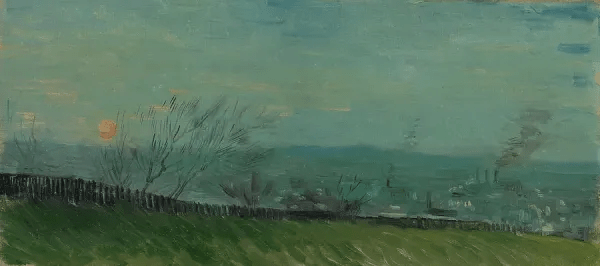
Sunset in Montmartre, by Vincent Van Gogh, 1887

Be patient, therefore, brothers and sisters, until the coming of the Lord.

The farmer waits for the precious crop from the earth, being patient with it until it receives the early and the late rains. You also must be patient.

Strengthen your hearts, for the coming of the Lord is near.

Brothers and sisters, do not grumble against one another, so that you may not be judged. See, the Judge is standing at the doors! 

As an example of suffering and patience, brothers and sisters, take the prophets who spoke in the name of the Lord. (New Revised Standard Version)

Patience is a wonderful virtue… unless you’re smack in the middle of circumstances you neither want nor asked for. Then, patience feels a whole lot more like a vice.

It’s easy to be impatient; it takes little to no effort at all. And praying for patience doesn’t help, because you’re prayer actually gets answered; God puts you in one of those unwanted situations.

The Jewish Christians for whom the Epistle of James was addressed were in that weird life-place of enduring hard circumstances. They were struggling with impatience, so much that the believers began cozying up to the rich and powerful to meet their ever-increasing needs. In their misery, they were looking to the very people who were using them and withholding wages from them. (James 2:1-7; 5:1-6)

It seemed as if God was shuffling his divine feet and not getting around to helping the Christians in their difficulty. They gave everything to Jesus and following him, to the point of being willing to suffer for the Name.

Their suffering led to outright persecution. The believers had to flee Judea for Gentile lands to the West (Acts 8:1-3). In their new homes they got double-trouble. Because they were Jews, they were looked at with suspicion. And because they were Christians, the Jewish community didn’t accept them. The believers were truly alone. All they had was Jesus.

It was enough, at least for a while. But it’s one thing to face difficulty, and quite another thing for the trouble to bleed into next week, next month, next year… When is this ever going to end?

Impatience doesn’t help. In fact, it only exacerbates an already agonizing situation. Grumbling and arguing and verbal fights begin to occur. The community starts to fracture. Blaming and shaming slowly replace the love and encouragement they once had together.

Every good thing in life takes time – lots of time! And the best things in life require a lifetime of endurance, perseverance, and patience. In order to keep going and hold onto our spiritual commitment, we need solid examples of patience, and reasonable ways to think about our situations.

I admit that it has been hard for me to be patient, as of late. I’m weary of American politics and the current administration. I’m tired of seeing my family members struggle with health issues day after day – many of them having to endure debilitating and heart-wrenching trials.

And there are some days when I’ve just had it with my own limitations. I can’t do many of the things I used to do, and it’s frustrating to tears to try and do some things that others do effortlessly.

Yet the Scripture reminds me of my days growing up on the farm. Planting and harvesting never happened in a week; it takes months to realize a return on all the hard work done through the Spring and Summer to get to Fall’s mature crop.

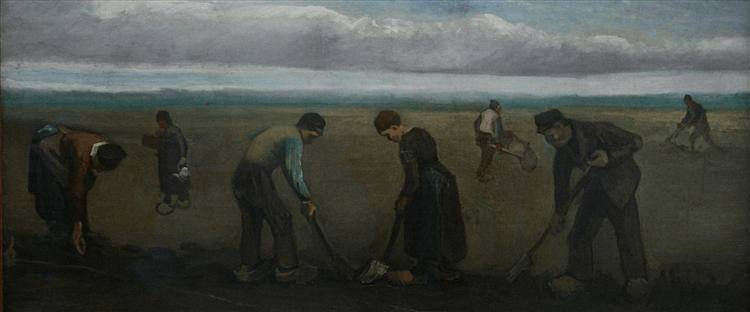
Peasants Planting Potatoes, by Vincent Van Gogh, 1884

I’m also reminded of the biblical prophets who suffered much for their message to the people. Lately, I’ve been reading the prophecy of Ezekiel in the Old Testament. If you have never read Ezekiel, or only read bits of it, you may not realize how incredibly difficult Ezekiel’s life was in serving Yahweh.

The prophet kept up a steady stream of very challenging situations to illustrate the message of judgment he was continually giving. Needless to say, Ezekiel was not always a popular guy. Proclaiming gloom, doom, and death all day every day tends to do that. In one encounter, for month after month, the prophet laid on his side and had to use excrement to light a fire and cook his food every day. God told him to, so that the people would see what was about to happen to them. (Ezekiel 4:1-17)

We have no record of Ezekiel grumbling or talking back to God. He faithfully did all that the Lord commanded him to say and do. He endured all the grumblers around him, and all the grieving people who had been displaced from their homes in Jerusalem.

In every generation, there are people in this world that undergo difficulties and troubles which others could never even imagine. And it’s been going on for millennia. Furthermore, terrible adversity will keep happening… until Christ returns.

Yes, there will be an end to all the suffering. But we may have to persevere to the end of our lives, remaining faithful to our spiritual commitment, and keeping up our love for one another. It won’t be easy to do.

I would be nothing but a hack preacher if I told you that everything will be bunnies and butterflies if you only look to Jesus and have faith. Although there can be joy, even in our mourning, there will always be the need for an agonizing form of patience that continually watches for help, healing, and hope in the return of Christ.

This is why it is so important not to let your own family, church, and faith community break down into fissures of impatience and grumbling.

We must keep our hearts strong. Ironically and paradoxically, that happens through our weakness.

In some ways, I’m weaker than I’ve ever been in my life. Yet, in other ways, I’ve never been stronger. The Trump administration can break me down and mess with my healthcare and my finances… my illness can keep me from ministry that I long to do… and the daily crud of life may redirect me in ways I don’t like… but I can truly say that God is good; God is the strength of my life.

I know that Christmas is coming. I’m looking for the birth of the Savior. I expect to see the angels rejoicing in the sky. I fully look forward to stepping in a few cow pies and horse apples in order to get a glimpse at the baby who changes the world.

Every good thing in life comes with a bit of manure on the shoes. And the best things in life are worth all the hardship one goes through in order to see the glory and majesty of the Divine.

I may not know you, my friend, but please know that I am praying for you. No matter what happens, I can always pray, always watch, always hope, always believe, and always love my neighbor, despite all the hate in this old fallen world.

Be safe. Be strong. Be spiritual. We are all in this life together.

God of joy and exultation, you strengthen what is weak; you enrich the poor and give hope to those who live in fear. Look upon our needs this day. Make us grateful for the good news of salvation and keep us faithful in your service until the coming of our Lord Jesus Christ, who lives forever and ever. Amen.

I Will Yet Again Praise God (Psalms 42 & 43)

Solitude, by Winslow Homer, 1889

As a deer longs for flowing streams,
    so my soul longs for you, O God.
My soul thirsts for God,
    for the living God.
When shall I come and behold
    the face of God?
My tears have been my food
    day and night,
while people say to me continually,
    “Where is your God?”

These things I remember,
    as I pour out my soul:
how I went with the throng
    and led them in procession to the house of God,
with glad shouts and songs of thanksgiving,
    a multitude keeping festival.
Why are you cast down, O my soul,
    and why are you disquieted within me?
Hope in God, for I shall again praise him,
my help and my God.

My soul is cast down within me;
    therefore I remember you
from the land of Jordan and of Hermon,
    from Mount Mizar.
Deep calls to deep
    at the thunder of your torrents;
all your waves and your billows
    have gone over me.
By day the Lord commands his steadfast love,
    and at night his song is with me,
    a prayer to the God of my life.

I say to God, my rock,
    “Why have you forgotten me?
Why must I walk about mournfully
    because the enemy oppresses me?”
As with a deadly wound in my body,
    my adversaries taunt me,
while they say to me continually,
    “Where is your God?”

Why are you cast down, O my soul,
    and why are you disquieted within me?
Hope in God, for I shall again praise him,
    my help and my God.

Vindicate me, O God, and defend my cause
    against an ungodly people;
from those who are deceitful and unjust,
    deliver me!
For you are the God in whom I take refuge;
    why have you cast me off?
Why must I walk about mournfully
    because of the oppression of the enemy?

O send out your light and your truth;
    let them lead me;
let them bring me to your holy hill
    and to your dwelling.
Then I will go to the altar of God,
    to God my exceeding joy,
and I will praise you with the harp,
    O God, my God.

Why are you cast down, O my soul,
    and why are you disquieted within me?
Hope in God, for I shall again praise him,
    my help and my God. (New Revised Standard Version)

I often get asked why God allows such hard things in our lives. There is likely no complete answer to that question; at least not on this side of heaven. Yet, I believe we can respond to the query in part: Facing hard circumstances, difficulty, and  adversity drives us to seek our help in God.

For those committed to knowing God, the desire for help through hardship becomes a deep longing not just to cope with and transcend troubles, but also to experience God like never before.

Every believer is familiar with becoming forlorn, even with crying themselves to sleep at night because of what is happening in their life. And the experience is further exacerbated by calloused others who mock us for our belief in a divine transcendent being.

Much like Christ on the cross, those who care nothing for us stroll by, see our agony, and respond with a “Humph! Let’s see your ‘God’ save you now!” (Matthew 27:42; Mark 15:31; Luke 23:35)

It’s in such times we remember back, when God felt very near to us, and seemed to answer every prayer. Yet now, the silence of God is palpable. This awkward quietness puts one in a position to hope. And when hope reawakens, a new resolve toward perseverance through the trouble comes.

For in hope we were saved. Now hope that is seen is not hope, for who hopes for what one already sees? But if we hope for what we do not see, we wait for it with patience. (Romans 8:24-25, NRSV)

Somehow, deep in our soul, we know that we will yet praise God again for a great deliverance. We remember that we were helped in the past; and now, in the present, that we will be helped again. Praise arises as an organic response to what we know will happen, even though it hasn’t yet happened.

Fresh prayers come to us, smack in the midst of our adverse situations. We pray, not only for our own help and deliverance, but also for the justice of God to have it’s way in the world.

We think of all the other believers who, like us, are facing hardship for no fault of their own. In a wonderful sense of solidarity in spirit, we lift up our sisters and brothers in the faith before the God for whom we are convinced will help them, as well as us.

All we want to do is somehow maintain our integrity of relationship with God and others, to remain in the cradle of truth – keeping our little light shining in the darkness that surrounds us.

It is not a sin to be troubled and to feel alone in the middle of a stressful and difficult circumstance. What we do with ourselves when we are in such a situation is what makes all the difference.

I suggest we flee to the Book of Psalms. In those times when tears become our food and drink, and we don’t know how to pray, let’s let the psalmist pray for us by adopting his prayers as our very own.

O God, our refuge and hope: When despondency and despair haunt and afflict us, comfort us with the stillness of your divine presence, so that we might confess all you have done, through Christ to whom we belong and in whom we are one. Amen.

Truth Stumbles In the Public Square

In these past few months, as an American citizen, I have often wondered what God thinks about the current political situation and climate of the United States.

I must say that with a serious reading of the biblical prophets, it’s rather easy to imagine what the Divine stance likely is:

Justice is far from us,
    and deliverance does not reach us;
we wait for light, but there is only darkness;
    and for brightness, but we walk in gloom.
We grope like the blind along a wall,
    groping like those who have no eyes;
we stumble at noon as in the twilight,
    among the vigorous as though we were dead.
We all growl like bears;
    like doves we moan mournfully.
We wait for justice, but there is none;
    for salvation, but it is far from us.
For our transgressions before you are many,
    and our sins testify against us.
Our transgressions indeed are with us,
    and we know our iniquities:
transgressing and denying the Lord
    and turning away from following our God,
talking oppression and revolt,
    conceiving lying words and uttering them from the heart.
Justice is turned back,
    and deliverance stands at a distance,
for truth stumbles in the public square,
    and uprightness cannot enter.
Truth is lacking,
    and whoever turns from evil is despoiled.

The Lord saw it, and it displeased him
    that there was no justice. (Isaiah 59:9-15, NRSV)

These days, many of my prayers echo the complaint of the ancient prophet Isaiah. I too, have an expectation that God will grant justice and righteousness; and that the Lord will take pity upon us for our ignorance of what is just, right, and good.

And like the prophet Isaiah, I grieve a situation of profuse lying, political malpractice, and socio-economic illiteracy. Many, if not most, Americans and the world community alike, lacks things it needs to live a viable and joyous life. So, I mourn, like a bear growling for a long-awaited meal.

It seems to me that we are failing one another. Our collective vice, and lack of virtue, have led us on a path of injustice. We are a flawed people; we need Divine help.

Perhaps you believe I am being something of a curmudgeon, being too negative – that I’m seeing the glass darkly as only half empty. But no, I’m actually seeing the glass as completely empty, for we are a bereft people.

But just maybe this emptiness can be filled with justice and righteousness, and not shallowness and lack of education, nor gaslighting and manipulative selfishness. Just maybe we can filled to the full in truth.

Our public life together depends upon ethics of accountability.

This insipid business of people stating that they are “being transparent” is nothing but a red flag letting us know that they are doing just the opposite.

We need a new community – a fresh vision of what life can be together. And we are getting anything but that. Instead, in the U.S., we get entrenched yelping from both Republicans and Democrats. And in the face of injustice, we receive an eerie silence from those who ought to know better.

This is not simply a struggle for a political party and its policies. What is happening now transcends each party’s vision of how to live together as a people.

Historically, the Democratic party has generally believed that government ought to raise money through a fair system of taxation. The funds then are to be used to provide basic services that serve the common good of all persons, i.e. ensuring a living wage, protection through laws, maintenance of infrastructure, equal access to healthcare and education, etc.

The Republican party has approached a more individualistic vision of government, believing that each person should manage their own money to make the best use of a market economy. Then, they can create economic growth without reliance upon government regulation of business. Private philanthropy and non-profit organizations are relied upon to provide social services. Private companies are called upon to handle infrastructure needs.

In essence, at the core, Democrats have a vision of community and caring for one another, whereas Republicans have a vision of each person living prosperously under their own fig tree without the interference of others.

This is why things like tax increases and tax cuts become such visceral issues, because they get at the practical outworkings of each party’s vision of how to live together.

But the stakes are even higher than an American two-party system. There is presently leadership in the United States that is openly antagonistic, belligerent, bullying, rude, and frankly, unbiblical and unvirtuous. There is nothing that comes out of the current president’s mouth that reflects the words of Jesus; and there is nothing he does which is consistent with the ways of Jesus.

Many, if not most, “Christian” Republicans are woefully out of touch with their own Bibles; and, at the very least, are complicit in retraumatizing the already traumatized people in the nation (and the world) through supporting unjust leadership.

In the time of the prophet Isaiah, not only was there injustice (common citizens not receiving what they need to build a good life and flourish) but there was no one willing and available, no one engaged and at work to turn around an unjust system so that the government would respect basic human rights for the poor and the needy, the least and the lost in society.

So, the prophet was on the scene to announce that Yahweh, the God of Judah, has noticed. Yahweh has seen that the leadership would not accept responsibility for implementing the Law of God (namely, a set of just, right, and good laws which were to frame all of Jewish society).

Nobody cared. No one bothered to help those without a voice and without hope. And Yahweh knew it. Therefore, a sorry state existed which eventually turned into the people losing their land through an active judgment of God.

Truth matters. And when it is suppressed in the public square, God’s eyebrow is raised.

Lips that speak lies, tongues that mutter wickedness, attitudes which are dishonest, hands that work only for self, and feet which run to violence are all anti-truth practices. (Isaiah 59:3-4)

There is no way on this earth and in this life to get along without government. And because of that, government’s legitimate duty to its people is to provide necessary order, safety, peace, and ensure justice – which means making sure that all citizens have what they need to grow, thrive, and prosper.

Both survival and prosperity must have the glue of truth holding society together – which means that a nation’s government needs to have the basic fundamentals of justice in mind and at heart.

A telltale sign that leaders do not have the best interests of their own people is how they speak to and treat others outside their own nation, people in differing circumstances in different places.

“They did not want to consider their duty. They have distorted their intelligence so as to not understand what ought to be done… They have distanced themselves so far from the truth that they openly combat those who turn away from perversity and choose the good.”

Theodoret (393-457 C.E.)

I cannot think of a better way to describe our current failure of leadership in this world.

Lord, have mercy upon us.

Instead of selfishness we need self-discipline. Rather than a personal concern for earthly wealth and profit, we need to seek first the kingdom of God and God’s righteousness.

Instead of simply loving those who love us, we can  love our enemies and seek to do good. We can actively walk alongside beleaguered people who have had quite enough of belligerent bullying and bogus bellicosity in their lives.

To God belongs the ability to save, deliver, redeem, and judge. To you and I belongs the responsibility for treating our fellow humanity with justice, equity, goodness, and humility with a gentle spirit, holding one another accountable for our attitudes and actions. In short, it means living the truth.

That includes every politician and political party.

“Truth is difficult to reach and endure, but it is always the doorway to new freedom and life.”

John O’Donohue

If you yet are looking for some sort of positive outlook, some kind of hope, it is this: Our present suffering of spirit can serve to burn away any illusions (and delusions) that a politician or political process will save us.

Any disillusionment we may have becomes an opportunity to discover both old and new ways living the truth. It often takes suffering to teach us what is truly most important to us.

Our current malaise, national anxiety, and world troubles can become the means of future possibility, if we will let it. Worrisome circumstances can open to us the light of undiscovered truth about ourselves and our world.

We may stumble, yet there is always the chance to catch ourselves and not fall. So, what does God think of this present national and world situation? The prophet Isaiah insisted:

Let the wicked forsake their way
    and the unrighteous their thoughts;
let them return to the Lord, that he may have mercy on them,
    and to our God, for he will abundantly pardon.
For my thoughts are not your thoughts,
    nor are your ways my ways, says the Lord.
For as the heavens are higher than the earth,
    so are my ways higher than your ways
    and my thoughts than your thoughts. (Isaiah 55:7-9, NRSV)

No matter what happens on this earth, Isaiah’s perspective insists upon the truth and reality of God’s ultimate authority. We shall not always understand divine authority, yet at its core, is full of justice and righteousness. And nothing can stop from it breaking out into the public square.

May it be so, to the glory of God.