How To Be Honest, Just, and Fair (Proverbs 1:1-7)

Solomon writing Proverbs by Gustave Doré (1832-1883)

The proverbs of Solomon, son of David and king of Israel.

Here are proverbs that will help you recognize wisdom and good advice, and understand sayings with deep meaning. 

They can teach you how to live intelligently and how to be honest, just, and fair. They can make an inexperienced person clever and teach young people how to be resourceful. 

These proverbs can even add to the knowledge of the wise and give guidance to the educated, so that they can understand the hidden meanings of proverbs and the problems that the wise raise.

To have knowledge, you must first have reverence for the Lord. Stupid people have no respect for wisdom and refuse to learn. (Good News Translation)

At the beginning of this year, if you like making new year’s resolutions, or are looking for a good practice to adopt, I have a suggestion: Consider committing yourself to the reading, reflection, and study of the biblical proverbs. At the least, read a chapter of Proverbs every day throughout this month. Since there are 31 chapters, and 31 days in the month of January, you have a guide in what to read every day.

The pursuit of wisdom is a noble aspiration for the New Year. One of the best places to go in that pursuit is the biblical book of Proverbs because it is all about living wisely and not foolishly. To acquire and live by wisdom means learning how to grow in being right, just, and fair in all our interactions and dealings with others.

Honest

“Honest” is “right” or “righteous.” For King Solomon of old, this is a relational term – to be righteous, to have honest and right relationships with God and other people. Righteousness involves experiencing peaceful, harmonious, and fruitful relations. 

For the Christian, right living is to know the wonderful freedom and joy of an unhindered relationship through Jesus Christ in dependence upon the Holy Spirit. When it comes to fellow human relations, a person characterized by righteousness does not, for example, let the sun go down on their anger. It is to know personal peace as well as to be a peacemaker, so that relationships do not remain strained, but enjoy harmony.

Just

“Just” is closely related to “right.” We might tend toward primarily understanding justice as a punitive act – and that is certainly a part of the term. God punishes the wicked with appropriate timing and wisdom; and deals with those who withhold righteousness and love through their uncaring, inattentive, or evil acts. 

Solomon understood justice as mostly concerned with providing a person with the necessities of life. So, for example, if someone is hungry and needs food, or does not have clean water to drink, it is a “just” act for us to provide those critical needs. God is deeply concerned for justice, and expects people to act in this same manner.

Fair

“Fair” is to be egalitarian. Fairness and equity binds righteousness and peace together by avoiding prejudice toward others and their needs. It means to not show favoritism because there is an unshakable belief in the equality of all people, no matter where they are from, what they do, or who they are.

Therefore, if we exercise righteousness and justice exclusively with individuals and groups we like, but ignore others in need, there is no fairness. To give our love and service to all persons without strings attached, or without being concerned to get paid back, is the practice of being fair in everything we do and say.

To live in the way of being honest, just, and fair in all our interactions is to be wise. Conversely, the classic fool is one who judges others, creates discord, and ranks persons according to their own personal standard of who deserves help, and who does not. Trying to have a useful and gracious conversation with a fool is like trying to reason with a toddler – you will get nowhere. 

A good way of pursuing the wise and biblical virtues of honest righteousness, restorative justice, and egalitarian fairness is to ask God to open our eyes to those within our sphere of influence who need both physical and relational needs met. Then, follow through by loving those persons for whom God brings into our lives.

Almighty God, the essence and source of wisdom, you are always right, just, and fair in all things. I praise you for your infinite and abundant wisdom.

Whereas you abound in wisdom, I am lacking. Please help me to grow in wisdom, as I increase in my knowledge and respect of your divine presence.

By means of your Spirit, please increase my depth of insight as I study your Holy Word. Hold me back from leaning on my own understanding and enable me to wholeheartedly embrace the wisdom from above.

Since you are a just God who shows no favoritism, lead me into being like you in my dealings with others through the example of Jesus Christ, in the strength of the Holy Spirit. Amen.

A Call to Truth and Justice (Exodus 23:1-9)

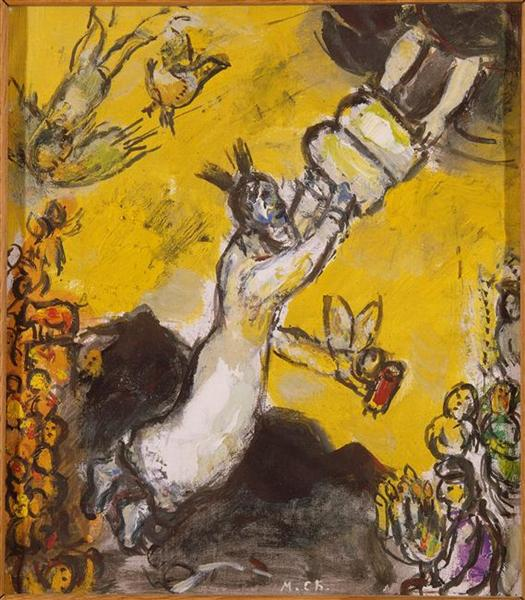
Moses Receives the Law, by Marc Chagall, 1963

“You must not pass along false rumors. You must not cooperate with evil people by lying on the witness stand.

“You must not follow the crowd in doing wrong. When you are called to testify in a dispute, do not be swayed by the crowd to twist justice. And do not slant your testimony in favor of a person just because that person is poor.

“If you come upon your enemy’s ox or donkey that has strayed away, take it back to its owner. If you see that the donkey of someone who hates you has collapsed under its load, do not walk by. Instead, stop and help.

“In a lawsuit, you must not deny justice to the poor.

“Be sure never to charge anyone falsely with evil. Never sentence an innocent or blameless person to death, for I never declare a guilty person to be innocent.

“Take no bribes, for a bribe makes you ignore something that you clearly see. A bribe makes even a righteous person twist the truth.

“You must not oppress foreigners. You know what it’s like to be a foreigner, for you yourselves were once foreigners in the land of Egypt. (New Living Translation)

On Mount Sinai, God gave Moses the Ten Commandments. These laws are basic ethical commands given to the people in their relationship to God and to one another. Following those Ten Words, the next several chapters of Exodus provide detailed instructions and commands for the Israelites in their own social, economic, and cultural context.

Today’s Old Testament lesson is part of this sequence of specific laws for the Israelites. These laws all have to do with being honest in legal matters. There is to be no perversion of justice through perjury, favoritism, bending to dishonest pressure, bribery, and false charges. What’s more, there must be no overlooking of the poor and powerless; and no disregard for the immigrant and foreigner.

All the sequences of commands – covering Exodus chapters 20-25 – are connected back to the basic Ten Commandments. The laws about justice and injustice are the fleshing-out of the ninth command to not testify falsely against your neighbor.

In other words, we are not to lie in public, especially when a person’s life or livelihood is at stake. We are to practice right relations with others; and do justice for all persons without prejudice or favoritism. We do this because God shows no favoritism and judges rightly with proper justice.

He will not judge by what he sees with his eyes,
    or decide by what he hears with his ears;
but with righteousness he will judge the needy,
    with justice he will give decisions for the poor of the earth. (Isaiah 11:3-4, NIV)

The Lord is a just God – it is inherent to the divine character. Therefore, our actions, as people created in the image of God, are to always be just, right, and truthful. There is a special place in God’s heart for the poor and powerless, and so, we ought also to consider their needs and treat them well and with respect – because true religion gives to those who we know cannot pay us back.

This, then, also is why immigrants and foreigners are mentioned. They need proper justice, and not negligence on our part to provide them with what they need. Throughout Holy Scripture we are admonished to not oppress the stranger from another place.

For through him [Christ] we both have access to the Father by one Spirit. Consequently, you are no longer foreigners and strangers, but fellow citizens with God’s people and also members of his household, built on the foundation of the apostles and prophets, with Christ Jesus himself as the chief cornerstone. (Ephesians 2:18-20, NIV)

The Lord watches over the foreigner
    and sustains the fatherless and the widow,
    but he frustrates the ways of the wicked. (Psalm 146:9, NIV)

Jesus picked up on the basic commands of God in his Sermon on the Mount – which, in many ways, is a restatement of the Ten Commandments by getting to the heart of them. Concerning the matter of giving false pledges, he said:

“Again you have heard that it was said to those who lived long ago: Don’t make a false solemn pledge, but you should follow through on what you have pledged to the Lord… Let your yes mean yes, and your no mean no. Anything more than this comes from the evil one. (Matthew 5:33, 37, CEB)

In court, we offer an oath, swearing that we will tell the truth and only the truth – and no lying. This is the only way that injustice can be avoided and justice can be established.

“I swear on a stack of Bibles I won’t…” “I will, if I get around to it….” These are a few of the caveats we give when making a promise or oath. Oaths communicate our truthful intentions of being above board with a high level of integrity.

It’s not okay when we bear false testimony concerning an event or incident that has taken place. There is no excuse for saying something is truthful when you know it isn’t quite true or all true. That makes us liars.

The Lord detests lying lips, but he delights in people who are trustworthy. (Proverbs 12:22, NIV)

Jesus wants us to clarify our values of right and wrong; make wise decisions; identify what we know is truth and error; and follow through on speaking the truth in love.

Any human society cannot stand unless it is committed to justice for all. People everywhere have a universal need for communities and nations which pursue truth, justice, benevolence, and integrity for everyone within their sphere of influence and responsibility.

Almighty God, who created us in your own image: Grant us grace to fearlessly contend against evil; and to make no peace with oppression, so that we may reverently use our freedom. Help us to employ that freedom in the maintenance of justice in our communities and among the nations, to the glory of your holy Name; through Jesus Christ our Lord, who lives and reigns with you and the Holy Spirit, one God, now and forever. Amen.

Obey with Integrity and Love (Psalm 15)

God, who gets invited
    to dinner at your place?
How do we get on your guest list?

 “Walk straight,
    act right,
        tell the truth.

“Don’t hurt your friend,
    don’t blame your neighbor;
        despise the despicable.

“Keep your word even when it costs you,
    make an honest living,
        never take a bribe.

“You’ll never get
blacklisted
if you live like this.” (The Message)

Nearly all of us had to work hard to get good grades in school. Each schoolyear began with a blank slate; then, what we did with learning the lessons determined the grade.

So, it’s unthinkable for many of us to consider that we all begin God’s school with A’s. We’re all 4.0 students. There’s only a lower grade if we neglect to do the things necessary as an A student. And, as it turns out, the most important things are a matter of basic human kindness and respect for others.

At the end-of-the-year banquet, awards are given. If we’ve done what’s expected, then the invitation to come to the front and receive the award is assured.

Yet, if anyone has gone out of their way to be deliberately stupid and ignore what’s right, then they aren’t going to show up at the banquet. They’ll dismiss it as a waste of their time and blabber about how they don’t be around a bunch do-gooder pricks and Abe Lincoln’s, blah-blah-blah.

Integrity, honesty, kindness, accountability, and commitment matter. Virtue shows itself through the practice of obedience.

We might get hung up on obedience for a few reasons:

  1. Many Westerners, especially Americans, have a strong anti-authoritarian strain; obedience smacks them as something negative. For some, they would rather stick-it-to-the-man than obey. Even Christians might sacralize their disobedience by linking obedience to law – as if gospel and obedience are antithetical.
  2. A lot of people have been personally hurt because they tried to do the right thing by obeying their authorities, but it ended badly. Now, they aren’t so sure about the whole obedience thing.
  3. We just plain don’t want anyone else telling us what to do and not do; and that includes not wanting to obey God. So, we focus on the freedom to do what we want, to the exclusion of obedience.

Yet, there’s no way to get around the pervasive reality of obedience to Torah, to Yahweh. Obedience is both the glue which holds a people together, as well as the major means of expressing love to God and others.

Jesus said, “If you love me, obey my commandments.” (John 14:15, NLT)

Love and obedience go together in Holy Scripture like a hand in a glove. Jesus insisted that upholding Torah and loving others is by obedience to divine commands.

When Jesus first began his teaching and healing ministry, he sat all the people down who were following him and gave them a summary of the Old Testament understanding of God’s righteousness. These are the things, Jesus explained, that characterize a person who loves God:

Blessed are the poor in spirit, for theirs is the kingdom of God. 

Blessed are those who mourn, for they shall be comforted. 

Blessed are the meek, for they will inherit the earth. 

Blessed are those who hunger and thirst for righteousness, for they will be filled. 

Blessed are the merciful, for they will be shown mercy. 

Blessed are the pure in heart, for they will see God.  Blessed are the peacemakers, for they will be called sons of God. 

Blessed are they who are persecuted for righteousness, for theirs is the kingdom of God (Matthew 5:12-17, NIV).

Obedient believers are characterized by their:

  • Authentic humility
  • Deep concern over sin, to the point of tears
  • Gentle and meek spirit toward others
  • Intense desire for personal righteousness and corporate justice
  • Daily life of mercy, purity, and peacemaking
  • Willingness to accept adversity as part of the spiritual life

“Love the Lord your God with all your heart and with all your soul and with all your mind. This is the first and greatest commandment. And the second is like it: Love your neighbor as yourself.”

Jesus (Matthew 22:36-40, NIV)

Humanity is meant for wholeness, integration, and alignment of head, heart, and gut – with the glue of obedient love. We are designed to have all of life in parity and balance – work, play, family, and faith – because God is Lord of it all, not just the spiritual parts.

Historic confessional Christianity acknowledges that obedience is both duty and delight – and they go together in perfect harmony.

Believers consider it a both a high charge and a wonderful privilege to love the Lord with a life devoted to obeying divine commands.

It’s just that sometimes we have our lives so planned and pre-determined that when God’s Spirit shows up to take us to a place of obedience, we struggle to realize what’s happening. And we miss what the Lord is doing in this world. 

At other times, we read scriptural commands and feel the gentle nudging of God’s Spirit, yet we either cannot or will not respond out of fear, busyness, or grief. 

Then there are times in which we are attentive to God’s Word and Spirit, seeking to obey – only to mess up and fail at it. It can leave us wondering if God could ever really do anything in or through us.

The truth is this: Love conquers all. Grace overcomes everything. Mercy never fails.

We are here on this earth because of how much the Lord is devoted to us. Even though we often walk the spiritual road in a three-steps-forward-two-steps-backward kind of way, God accommodates to our weakness. 

So, we keep learning the ways of the Lord under the tutelage of God’s Spirit – who patiently and powerfully works within us so that God’s kingdom breaks into this world and God’s will is done on earth as it is in heaven.

Blessed God, I seek not my own will but to fulfill your will in my everyday life. Enable me and strengthen me for this sacred duty and delight, in the power of your Spirit. Amen.

Lord, Have Mercy (Mark 10:46-52)

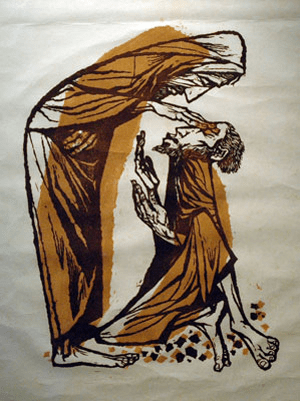
“Christ Healing the Blind Man” by Robert Hodgell

Then they came to Jericho. As Jesus, his disciples, and many people were leaving Jericho, a blind beggar named Bartimaeus, son of Timaeus, was sitting by the road. When he heard that Jesus from Nazareth was passing by, he began to shout, “Jesus, Son of David, have mercy on me!”

The people told him to be quiet. But he shouted even louder, “Son of David, have mercy on me!”

Jesus stopped and said, “Call him!” They called the blind man and told him, “Cheer up! Get up! He’s calling you.” The blind man threw off his coat, jumped up, and went to Jesus.

Jesus asked him, “What do you want me to do for you?”

The blind man said, “Teacher, I want to see again.”

Jesus told him, “Go, your faith has made you well.”

At once he could see again, and he followed Jesus on the road. (God’s Word Translation)

“I’d like to live my life so close to the bottom that when the system collapses I don’t have far to fall.” Dorothy Day

This is one of my very favorite stories in the entirety of Holy Scripture. And I will tell you why….

Because Jesus listens with ears of mercy

Jesus was headed to Jerusalem and had a lot on his mind and his heart. He knew what was coming, that his passion and death awaited him. No one would fault Jesus for not hearing a blind man shouting. But Jesus was listening so that he might hear someone just like the needy blind man. Rather than being distracted and lost in his head, Jesus was just the opposite – being attentive and aware of the humble folk right in front of him.

The Lord is always and continually listening for honesty and vulnerability. His ears of mercy are specially tuned, even today, for those who cry out to him from a place of genuine openness and humility.

Because Jesus speaks with words of mercy

Once Jesus listened, he responded by asking a question. I am impressed with Jesus throughout the Gospels. Christ gave people the gift of choice. He acknowledged people and respected them by not simply and indiscriminately healing, as if he were some fix-it guy. Jesus Christ bestowed on the lowliest of people the human dignity of choice by empowering them to answer a question.

Whereas everyone around Bartimaeus was looking down on him, both literally and figuratively, Jesus granted him the gift of dignity and basic human kindness – which are gifts we can all bestow on one another.

Because Jesus pays attention with a divine appointment of mercy

Our Lord took the time to heal blind Bartimaeus. Jesus could have simply healed him without even stopping his journey. He could have just waved his hand and the man would be healed. What’s more, Jesus could have even started a healing factory where everyone with a need got healed: bring ‘em in, move ‘em out, and keep the line moving!

Jesus was doing more than giving sight; he was giving a man the blessing of time and personal attention. The Gospel is never impersonal, which is why we ought to resist being non-relational in ministry to others. Christian ministry isn’t simply about meeting a need; it’s about blessing other people with the gift of relationship.

Coptic Church icon of Christ healing the blind man

Because Jesus reaches out with the touch of mercy

Jesus touched the man’s eyes (included in Matthew 20:29-34). He didn’t have to do that. The Lord of all most certainly could have healed without touching. In fact, it most likely may have been downright gross. A lot of people had eye diseases with runny pussy eyes in the ancient world.

Because the blind man didn’t listen to the crowd

I really love that! Maybe it’s the rebel in me. I just believe it is such a beautiful thing whenever someone refuses to be shamed by another and embraces their need. That is exactly what the blind man did. He not only refused to give-in to peer pressure, but he also responded to them by shouting all the louder. May his tribe increase!

Blind Bartimaeus teaches us that, when we know Love is there, we can freely acknowledge our needs, our wants, and our pain. With Jesus, who is Love incarnate, it doesn’t matter what anyone else thinks around us; there is no pretense, no propping up a false self to present for others to see. The true self is able to express what is really on the inside.

Because the blind man could actually see

In truth, Bartimaeus already had sight – not physical sight but spiritual eyes which could see better than anyone else in the crowd. One of the great ironies throughout the Gospels is that the sighted crowd seems to never see who Jesus really is, while blind folk see Christ clearly for who he is: the Son of David, the rightful king, the Savior of all.

It matters not how much faith one possesses; but it very much matters in whom that faith is placed. A thimble-full of faith is enough to move mountains, whereas a water tower full of misplaced faith in someone else cannot even provide a single glass of refreshment.

Because the blind man followed Jesus

Throughout the healing ministry of Jesus, there were plenty of persons who simply walked away and went about their lives after receiving what they desired. Yet, Bartimaeus, now given the gift of physical sight, immediately started following Jesus on the road.

This account feels a lot like my own testimony of experiencing the love of God in Christ and not ever wanting to leave it. So, I’ve been following Jesus for over forty years, still profoundly grateful in my heart for the One who loves and heals.

Because one lowly non-descript blind man made a difference

I don’t think Bartimaeus ever set out to change the world. And yet, he did. Here we are reading his testimony all these millennia later. One person, becoming a simple follower of Jesus and living a life of discipleship, changes a crowd from being a group of shushing church ladies to a robust throng of worshipers.

One individual makes a difference. Don’t let anyone tell you otherwise.

Lord Jesus Christ, Son of God, have mercy on me, a sinner.

Lord Jesus Christ, Son of David, heal me, a broken person.

Lord Jesus Christ, Son of Man, help me, a lost and lonely individual.

Lord have mercy, Christ have mercy, Lord have mercy on my love-starved soul and grant me your peace.

Amen.