
Romans 8:18-24 – Groaning Inwardly

depressed person

I consider that our present sufferings are not worth comparing with the glory that will be revealed in us. For the creation waits in eager expectation for the children of God to be revealed. For the creation was subjected to frustration, not by its own choice, but by the will of the one who subjected it, in hope that the creation itself will be liberated from its bondage to decay and brought into the freedom and glory of the children of God.

We know that the whole creation has been groaning as in the pains of childbirth right up to the present time. Not only so, but we ourselves, who have the first fruits of the Spirit, groan inwardly as we wait eagerly for our adoption to sonship, the redemption of our bodies. For in this hope we were saved. But hope that is seen is no hope at all. Who hopes for what they already have? (NIV)

In the wake of the Day of Pentecost, Christians are mindful of the Holy Spirit. The Spirit’s power certainly brings strength and courage for witness and ministry. That same power is also found in the travails and tribulations of this life. Spiritual power can be discovered in the dark places of our lives, in the times of loneliness and doubt, and in the constant need for prayerful intercession.

The Spirit is both a mighty wind and a gentle breeze.

Perhaps you, like me, grieve the loss of over 100,000 Americans to the deathly enemy of COVID-19. Our collective lament is an awful groaning expression of our pain. We need the Holy Spirit! The good news of Pentecost is that when we are not powerful, the Spirit helps us in our weakness – that is our hope and our quiet strength.

In today’s New Testament lesson, the Apostle Paul used the experience of childbirth to illustrate what the experience of the Christian life is often like. Growth, wonder, expectation, hope, patience, pain, and joy are all words to describe pregnancy and childbirth. When it comes to the Church and the Christian life, we are in the gestation period. Our salvation has not yet come to full term. Meanwhile, we must remain encouraged and healthy, keeping our future hope always in front of us so that we will not lose heart. When we are limited in what we can do and where we can go, we pray. And there are times when we are flat on our backs, overwhelmed with our circumstances, not able to utter any words in prayer.

As Christians, we are awaiting our complete redemption. If we lack patience and see little hope, we will find it difficult to persevere. In such times it does no good to be like Eeyore and feel sorry for ourselves. Yet, on the other hand, it also does no good to always be smiling, positive, and upbeat as if nothing is worth grieving over.  To take such a posture toward the awful effects of living in a fallen world with disease and death is, at best, to ignore the power of lament, and, at worst, to live in abject denial. We can neither fix nor control most of what is going on in the world around us. To lament is to acknowledge the reality that something terrible happened. Lament causes us to stare down a painful event and face it in all its ugliness.

In such feelings of helplessness and powerlessness, God comes to us in the person of the Holy Spirit.

The Spirit resides with us and strengthens us with Pentecostal power. We not only celebrate the Spirit’s mighty power to blow a violent wind and upturn history; we are also grateful for that same power in coming alongside us and providing the inner strength to face yet another day of hardship and difficulty as we seek to heal.

We live in an awkward time. Nothing is as it was. And, yet, it has always been this way – a time of spiritual pregnancy in which we possess salvation but do not yet possess it in all its fullness. There is so much groaning going on because we realize there is such a large gap between where we are and where we want to be. If women could have babies without nine months of struggle, limitation, and pain I think they would opt for that instead of the way it is now.

There is a time coming when every tear will be wiped away and unending joy will rule.

All of creation groans because where it is now and where it will be seems like such a long time in coming.  Every creature and every living thing will experience decay and death. The world is not yet redeemed from its cursed bondage. So, the earth produces disasters and diseases because we live in this fallen world that is not yet redeemed.

Pinocchio

Humanity groans because we fall victim to circumstances beyond our control. We also groan because of our own poor choices that give us grief. Although we have been delivered from sin, death, and hell and experience spiritual power… we still must wait eagerly for the redemption of our bodies. We are keenly aware of the terrible disconnect between where we are as people and where we want to be. It is something of feeling like Pinocchio, not yet a real boy who has to deal with strings and other puppeteers who do not care about him; and, who feels the need to lie because of his situation and pays the consequence of his nose growing.

Yet, a deeper thing is happening under the surface: Our frustrations, longings, lusts, jealousies, and escapist daydreams, things we might be ashamed of to take to prayer, are in fact already lifting our hearts and minds to God in more honest ways than we ever do consciously.

If carrying heavy burdens, it is spiritually appropriate to offload your worries onto the Holy Spirit who is waiting to intercede for you right now. And if there is no immediate relief, we are to persevere and keep engaging in prayer without giving up. Pentecostal power may be available, but it is not cheap; it requires a commitment of abiding prayer and waiting patiently for the Spirit to accomplish his purposes in his time.

Come, Holy Spirit, fill the hearts of your faithful. Kindle in me the fire of your love. Send me your gentle breeze, and I shall be renewed.  Spirit of the living God, I invite you to wring the death out of my heart and saturate my soul with your life-giving breath of faith, hope, and love through Jesus Christ, my Savior. Amen.

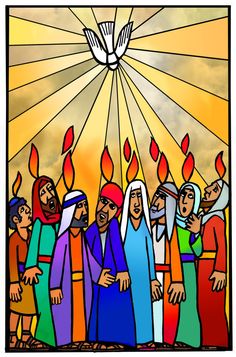
What Pentecost Means for Us

Pentecost

The Holy Spirit is the distinguishing mark of the believer in Jesus Christ. Christians are given the Spirit.  Therefore, our main responsibility as Christians is to receive. Christianity is distinctive in this sense – it is primarily a religion of receiving. The Christian life is lived by the power of the Holy Spirit, and not in our own strength. The function of faith is to receive what grace offers. We are saved and sanctified by grace alone through faith. God lives in and through us by means of the Spirit. The miraculous and the supernatural cannot be done by any human person. It can, however, be accomplished through the power of the Holy Spirit.

We may put a lot of pressure on ourselves to be a certain way and to do certain things. The result is that we are tired. Every time we catch our breath, someone else needs something else. Yet, what if Christianity is not chiefly about giving, but about receiving? What if the Christian life was about putting ourselves in a position to receive through prayer and humility? The opposite of receiving is not giving – it is pride.

Maybe this kind of talk causes some uncomfortable feelings with you. This is no adventure into passivity or laziness. This is about receiving grace from God by means of the Holy Spirit and allowing God the Spirit to work in and through us to the glory of Christ. Jesus said we would do greater works than even he himself with the advent of the Spirit! (John 14:12-14). The question then becomes: Will we let God be God? Will we participate with God, and allow the Spirit to work? Will we petition God and let him do whatever he wants to do in and through us?

The Spirit is elsewhere in Scripture described as a gentle and encouraging presence, a counselor and comforter. Yet, not at Pentecost – the Spirit is portrayed like wind and fire (Acts 2:1-21). Neither a gentle breeze, nor a warm campfire – instead, a violent presence! The Holy Spirit on the Day of Pentecost was not some gentleman caller entering politely when invited. Rather, the Spirit appears more like a drunken sailor who bursts into the room and causes and big ruckus. There is nothing subtle about the Spirit at Pentecost. The Spirit is electric and volcanic, causing a huge upheaval. This is a big God with a big Word looking to expand out into a big world.

Pentecost

Because of Pentecost, believers are marked by God’s Spirit. The life of God within them is the life of the Spirit. God wants to pour out the Spirit on all kinds of people. He wants to fill people to overflowing so that what comes out of them is “prophecy.” That is, inspired speech and words coming from a spiritual heart full of the Spirit. Just as an inebriated person says and does things he/she would not typically say or do because they are filled with alcohol, so the person filled with God’s Spirit says things and does things that they would not typically say or do because their inspiration and courage do not come from themselves but is a result of God within them.

God transformed the little band of Christ followers from learners, to practitioners sent out with a mission.  Being on a mission from God is not so much about ability; it is about being filled and sent.  First time parents may read and learn all they can about parenting before their child is born. Yet, when that little bundle comes into the world and the hospital puts this kid in your arms and sends you out, you feel inadequate for the task.  Parenting becomes a kind of supernatural affair where you pray and learn on the fly, finding out that you need something beyond yourself to get anywhere in raising this screaming, pooping, sleeping person who depends completely on you for everything.

God has sent us into the world to make disciples and we may feel largely inadequate for the task. However, this has more to do with receiving the Spirit. The Spirit comes looking to turn our lives upside-down with new life in Jesus Christ.

Pentecost means the Spirit has come to shake things up and accomplish among God’s people what they could never do on their own. The church in the New Testament was not a country club for people to simply enjoy the perks of membership. The church in Acts 2 is more like a place where the people seem drunk because they are all talking with inspired speech from the Holy Spirit.

Everyone who calls on the name of the Lord will be saved. Maybe we do not need to be saved in the sense that we have already called on the name of the Lord concerning forgiveness of sins in Christ. Yet, maybe we need to call on the name of the Lord to be delivered from our misguided attempts to see the Christian life as a pleasant affair. Perhaps we need deliverance from disordered priorities and misguided loves. We may need to be saved from ourselves so that we are open to the Holy Spirit with palms up receiving from him whatever it is he wants to do in and through us, rather than telling God what we think he needs to do. Prayer, then, is more about receiving the Spirit and God’s purposes for us rather than giving God an earful and expecting him to buy into our plans.

Pentecost is the launching pad of the church’s mission – it was explosive because the Spirit is a kind of wild man who fills people up to overflowing with himself so that what comes out of them is inspired speech and missional actions.  If a language barrier cannot stop the Spirit from operating, then how much more can God transform us and use us in the lives of those around us?

0bab4-pentecost

How we interpret events is important. Peter interpreted the believers of Jesus speaking different languages as the outpouring of the Spirit. This outpouring of the Spirit is a sign that the end is near. This giving of the Spirit will be inclusive – there is room for all kinds of people. And, through the Spirit, God will save all who call on his name.  The way we interpret events is based upon what kind of relationships we have. Peter had a relationship with God that caused him to go constantly to prayer so that when the Spirit showed up, he interpreted that God was up to something.

Next week my wife and I will celebrate 35 years of marriage. How I interpret my anniversary is based upon what kind of relationship I have with my wife. A good relationship means that it will be a day of celebration and joy with the anticipation of more years together. A bad relationship would bring an interpretation of the day with anger or regret. If there is a bland relationship in which two people are married but just live under the same roof, then it is just another anniversary and there is no regret, but also no celebration or any anticipation of the future – it just is another day.

This is not just another day. It is Pentecost! Just as marriages occasionally need a spark and a fire and a fresh wind, so we need the Holy Spirit to breathe on us because God wants to do something within us that results in the church becoming afire with mission! How we interpret this day of Pentecost says a lot about our relationship to Jesus Christ. How we spend our day today says a lot about how we interpret the Holy Spirit in our lives. Let us be filled with the Spirit and with joy as we anticipate what our God will do now, and in the years to come.

Exodus 19:16-25 – An Awesome God

Mount Sinai

On the morning of the third day, thunder roared, and lightning flashed, and a dense cloud came down on the mountain. There was a long, loud blast from a ram’s horn, and all the people trembled. Moses led them out from the camp to meet with God, and they stood at the foot of the mountain.  All of Mount Sinai was covered with smoke because the Lord had descended on it in the form of fire. The smoke billowed into the sky like smoke from a brick kiln, and the whole mountain shook violently. As the blast of the ram’s horn grew louder and louder, Moses spoke, and God thundered his reply. The Lord came down on the top of Mount Sinai and called Moses to the top of the mountain. So, Moses climbed the mountain.

Then the Lord told Moses, “Go back down and warn the people not to break through the boundaries to see the Lord, or they will die. Even the priests who regularly come near to the Lord must purify themselves so that the Lord does not break out and destroy them.”

“But Lord,” Moses protested, “the people cannot come up to Mount Sinai. You already warned us. You told me, ‘Mark off a boundary all around the mountain to set it apart as holy.’”

But the Lord said, “Go down and bring Aaron back up with you. In the meantime, do not let the priests or the people break through to approach the Lord, or he will break out and destroy them.”

So, Moses went down to the people and told them what the Lord had said. (NLT)

As Christians await the Day of Pentecost and the giving of the Spirit, the Revised Common Lectionary reminds us of another great anticipation from the Old Testament. The ancient Israelites were amazingly delivered from Egyptian slavery, miraculously walked through the Red Sea, and traveled with wondrous anticipation to Mount Sinai. Now, in today’s reading, they are about to meet with God!

The scene of this meeting is not exactly the romantic highland encounter of the Man from Snowy River (my wife’s all-time favorite movie). The landscape is much more akin to the dark and volcanic Mount Doom from The Lord of the Rings. The picture appears more foreboding than loving. The thing about mountain top experiences is that they are not all monolithic one-size-fits-all encounters with bright rainbows and happy skipping unicorns.

Holy Scripture is replete with mountain experiences. Mountains serve as symbols for significant encounters with a mighty God. Whether it is Christ’s transfiguration on a mountain; or, the giving of the law on a mountain; the awesome mountain serves as a tangible symbol of divine majesty, strength, and sovereignty. And, I might add, conversely, valleys in Scripture are symbolic of difficulty and suffering.  Our God is a God of both mountain and valley. That is, the God of the Bible is both transcendent and immanent; he rules with power and might high above us on his holy mountain; yet, he also comes near to us in the valley of the shadow of death.

Leading up to the giving of the Ten Words (Commandments) in Exodus 20, Exodus 19 portrays an awesome scene of God in his transcendent holiness and power. In fact, the experience was so otherworldly that the people were afraid to even come near the mountain. The Israelites needed limits placed on themselves because of God’s holy presence. Just like coming too near the immense power of the sun will destroy us, so getting near God can ruin us if we do not respect his holiness.

Respecting God’s power and transcendence brings the reality of his immanence into greater appreciation. God has gone to extreme lengths to reveal himself to his people. For the Christian, it all culminates through the incarnation of Christ, the sending of the Son. In Jesus, the transcendence and immanence of God meet perfectly to bridge the chasm between humanity and the divine.  Because of Jesus, the awesome sounds of thunder and trumpet do not lead to fear; they announce grace to those who approach God by faith.

You have not come to a mountain that can be touched and that is burning with fire; to darkness, gloom and storm; to a trumpet blast or to such a voice speaking words that those who heard it begged that no further word be spoken to them, because they could not bear what was commanded: “If even an animal touches the mountain, it must be stoned to death.” The sight was so terrifying that Moses said, “I am trembling with fear.” But you have come to Mount Zion, to the city of the living God, the heavenly Jerusalem. You have come to thousands upon thousands of angels in joyful assembly, to the church of the firstborn, whose names are written in heaven. You have come to God, the Judge of all, to the spirits of the righteous made perfect, to Jesus the mediator of a new covenant….

See to it that you do not refuse him who speaks. If they did not escape when they refused him who warned them on earth, how much less will we, if we turn away from him who warns us from heaven? At that time, his voice shook the earth, but now he has promised, “Once more I will shake not only the earth but also the heavens.” The words “once more” indicate the removing of what can be shaken—that is, created things—so that what cannot be shaken may remain.

Therefore, since we are receiving a kingdom that cannot be shaken, let us be thankful, and so worship God acceptably with reverence and awe, for our “God is a consuming fire.” (Hebrews 12:18-29, NIV)

Our God is an awesome God. As Christians anticipate Pentecost, we connect the consuming fire of Mount Sinai with the fire of the Spirit. The divine drama of both experiences has provided God’s people with spiritual power. Both the deliverance of the Israelites from Egyptian slavery by God and the deliverance secured on Mount Zion from spiritual slavery by Jesus are meant to free us to do the will of God. With God’s Word and God’s Spirit given to us, we are emancipated from an empty way of life to experience the fullness of Christ.

May the Spirit who hovered over the waters at creation breathe life into your spirit.

May the Spirit whose presence on the mountain was a consuming fire grant you a revived spirit.

May the Spirit who overshadowed the virgin Mary at the conception of our Lord overwhelm your spirit with joy.

May the Spirit who set the Church afire on Pentecost aflame every spirit on earth with the love of Christ.

And, may the Spirit who exhorts, encourages, helps, and comforts be your blessing and your life today and always. Amen.

John 14:15-21 – On Loving God

Welcome, friends! Simply click the video below and let us enjoy our virtual presence with one another.

You can also view this video on TimEhrhardtYouTube

To reflect on God’s love for us, click You Are My King (Amazing Love) written by Billy James Foote and originally sung by Philips, Craig, and Dean.

To reflect on our love for God, click I Love You Lord written and sung by Laurie Klein.

May your week be filled with love and obedience in the power of the Spirit.