Psalm 1 – Two Different Ways

Oh, the joys of those who do not
    follow the advice of the wicked,
    or stand around with sinners,
    or join in with mockers.
But they delight in the law of the Lord,
    meditating on it day and night.
They are like trees planted along the riverbank,
    bearing fruit each season.
Their leaves never wither,
    and they prosper in all they do.

But not the wicked!
    They are like worthless chaff, scattered by the wind.
They will be condemned at the time of judgment.
    Sinners will have no place among the godly.
For the Lord watches over the path of the godly,
    but the path of the wicked leads to destruction. (New Living Translation)

Today’s psalm presents us with two differing ways we can choose to shape our lives: The way of the upright and virtuous, or the way of the unethical and depraved. 

The way of the right and just person leads to human flourishing and life – whereas the way of the wicked and unjust person leads to human degradation and death. 

Distinguishing between the righteous and the wicked is not always as easy as it looks.

Only at the end of the age, when the Day of Judgment comes, will we know for certain the righteous and the wicked.

The magisterial Reformer, Martin Luther, contrasted these two ways with his Heidelberg Disputation of 1518. Luther called the way of the wicked a theology of glory – and described the way of the righteous as the theology of the cross.

The cross of Christ, as expressed by Luther, is God’s attack on human sin. Christ’s death is central to Christianity, and one must embrace the cross and rely completely and totally upon Christ’s finished work on the cross to handle human sin. Through being crucified with Christ, we find the way to human flourishing and life. In other words, righteousness is gained by grace through faith in Christ.

Conversely, the theology of glory is the opposing way of the cross. For Luther, the wicked person, and the vilest offender of God, is not the person who has done all kinds of outward sinning and heinous acts. The worst of sinners do good works.

Specifically, the wicked person is the one who does all kinds of nice things – yet does them disconnected from God by wanting others to see their good actions. Another way of putting this: The wicked person is one who seeks to gain glory for self, rather than giving glory to God.

Our good works can be the greatest hindrance to righteousness.

It is far too easy to place faith in our good works done apart from God, rather than having a naked trust in Christ alone. And it is far too easy to do good things for the primary purpose of having others observe our goodness, rather than do them out of the good soil of being planted in God’s Word. 

The remedy for sin is the cross, and the sinner is one who lives apart from that cross, trusting in self so that people can recognize and give them their perceived due respect and accolades.

“It is impossible for a person not to be puffed by his good works unless he has first been deflated and destroyed by suffering and evil until he knows that he is worthless and that his works are not his but God’s.”

Martin Luther

We are not to avoid good works but do them from the good soil of being planted in the law of God and connected to the vine of Christ. When the psalmist uses the term “law” he is referring to Scripture as a whole, to all the acquired wisdom about how life is supposed to be lived in God’s big world.

The righteous are those who immerse themselves in the law; secretly rise early to meditate on God’s Word; privately pour over Scripture’s message and pray to put it into practice because they want to delight in God. Their fruit will be abundant and sweet.  

The wicked, however, are simply too busy to take note what the law says; only serve to be seen; and publicly desire to be recognized for their charity and works. Such works will not stand when Judgment Day comes.

You’re nothing but show-offs. You’re like tombs that have been whitewashed. On the outside they are beautiful, but inside they are full of bones and filth. (Matthew 23:27, CEV)

Truly righteous people have a humble sense that they could easily drift from God, if not staying connected and rooted in Jesus and the way of the cross. 

The wicked, in contrast, are like chaff – worthless, and not adding value to anything. They are arrogant and annoying – wanting all the attention that God rightly deserves. The wicked have nothing to contribute to God’s kingdom. They hinder the harvest of souls God is working toward with their irritating attitudes.

Generosity marks the righteous because God is generous. Grace defines the righteous because God is gracious.  Gentleness is the way of the righteous because Christ is gentle. Spiritual prosperity is the result of a righteous relationship cultivated with Jesus Christ. The Lord watches over the way of such persons.

The way of the wicked will perish.

We have sixteen prophetic books in the Old Testament, all given to a single message: Judgment is coming because of wickedness.  And the wicked turn out to be God’s covenant people, because they selectively did their good works to gain glory for themselves. They withheld the good they could have done because it did not add any value to their reputation or their personal goals.

God desires genuine spiritual growth for us. That will only happen if we avoid the theology of glory and embrace a theology of the cross – delighting in God and the law.

Every day, we have a choice to make: The way of connection and life, or the way of disconnection and death. 

Look here! Today I’ve set before you, life and what’s good versus death and what’s wrong. If you obey the Lord your God’s commandments that I’m commanding you right now by loving the Lord your God, by walking in his ways, and by keeping his commandments, his regulations, and his case laws, then you will live and thrive, and the Lord your God will bless you…. But if your heart turns away and you refuse to listen, and so are misled, worshipping other gods and serving them,I’m telling you right now that you will definitely die…. I have set life and death, blessing and curse before you. Now choose life—so that you and your descendants will live—by loving the Lord your God, by obeying his voice, and by clinging to him. That’s how you will survive and live long…. (Deuteronomy 30:15-20, CEB)

The idols of our hearts can so easily draw us away from God so that our own good works are done for an audience who will recognize and affirm. Instead, our daily choice must be to love God supremely and give God glory for everything good in our lives. 

What will you choose this day?

Acts 7:54-8:1 – Humility and Hubris

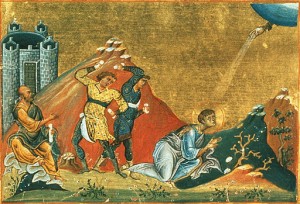
A 10th century depiction of Stephen’s martyrdom

When the members of the Sanhedrin heard this, they were furious and gnashed their teeth at him. But Stephen, full of the Holy Spirit, looked up to heaven and saw the glory of God, and Jesus standing at the right hand of God. “Look,” he said, “I see heaven open and the Son of Man standing at the right hand of God.”

At this they covered their ears and, yelling at the top of their voices, they all rushed at him, dragged him out of the city and began to stone him. Meanwhile, the witnesses laid their coats at the feet of a young man named Saul.

While they were stoning him, Stephen prayed, “Lord Jesus, receive my spirit.” Then he fell on his knees and cried out, “Lord, do not hold this sin against them.” When he had said this, he fell asleep.

And Saul approved of their killing him.

On that day a great persecution broke out against the church in Jerusalem, and all except the apostles were scattered throughout Judea and Samaria. (New International Version)

Although I am a trained in biblical exegesis and hermeneutics (interpreting Scripture) I believe that most insights come from making simple observations about the text. So, I want to point out: Stephen was not martyred by the Romans, a religiously pagan group, or Gentile people; he was martyred by those of his own ethnicity, by the people of God.

They weren’t simply unhappy with Stephen. The Sanhedrin (the Jewish ruling council) were incensed with him, so mad that they were grinding their teeth at him. The council truly believed Stephen was a blasphemer of God, that what he was saying was so subversive and religiously radical, they could stone him to death with a clear conscience, as if it were upholding God and God’s Law.

The result was not only the death of a humble man; it also sparked an intense persecution against the church which caused a new Christian diaspora. Many believers in Jesus now found themselves as Christian refugees trying to eke out a living and worshiping Christ in foreign places.

I wish I could say the greatest opposition I’ve ever experienced as a Christian came from non-Christians who simply misunderstood and misinterpreted me. However, my most hurtful wounds have come from the hands of church folk, believing they were acting on God’s behalf by exacting an emotional martyrdom upon me with the stones of gossip, slander, backbiting, blame-shifting, and outright lying.

Never look down on anybody unless you’re helping them up.

Whenever I encounter persons who no longer attend church and have no intention of ever returning to any local congregation, I get it. I understand. I’ve been there. Yet, although the church is sometimes like a woman of disrepute, I still love her, and will do whatever I can to edify her and not repay evil with evil.

Stoning a believer, either actually with physical rocks or virtually with metaphorical stones, is akin to persecuting Jesus himself. That’s because Christ so closely identifies with his people that it is as if he is a head, and his followers are a body – joined together in a vital union.

So, when Christ’s Body is subjected to hermeneutical hubris in which one group of people insists there is only one way to interpret Scripture, and then uses it’s authority and structures of power to force compliance on another group, the result is persecution.

And that is precisely why Christians can abuse other Christians.

Rather than discerning that all Christians belong to God, one narrow-minded and small-hearted group excludes all other groups who disagree with them as blaspheming the name of Christ.

Insisting, for example, that a literal interpretation in the only means of understanding the Bible’s authority is to ignore and abuse the actual and real authority which exists with the Bible. I am in no way encouraging an “anything goes” type of approach to Holy Scripture that lets it say whatever you want it to say. 

What I am stating is that the biblical writers themselves employed different methods of interpretation, as well as the early church fathers (which is one reason I hold to the interpretive guides of the ancient Christian creeds, i.e. The Apostles’ Creed and Nicene Creed).

Far too often churches stick to a particular interpretation because they believe they are keeping biblical fidelity. This is many times born of a fear that Christendom will be lost, and society will sink into an abyss of egregious sin. The irony is that many churches are sinking into forms of abusive and ungracious behavior by fighting battles that Scripture itself never calls them to fight.

The binary thinking of “I’m right and you’re wrong” is not an approach you’ll find in God’s Holy Word.

Even if the Sanhedrin in Stephen’s day intended on upholding the holiness of their God and the rightness of their cause, the impact it had on the church was death and diaspora.

Unfortunately, throughout Christian history, the tables have too often turned with Christians persecuting Jews. I myself would like to avoid being the persecutor. If I kill anything, may it be putting to death my own sin.

Gracious God, as your Son humbled himself on this earth, so may your church walk continually in such humility that believers everywhere work together in unity for the sake of gospel of grace as a blessing to the world in the power of your Holy Spirit. Amen.

Luke 16:19-31 – Does God Know Your Name?

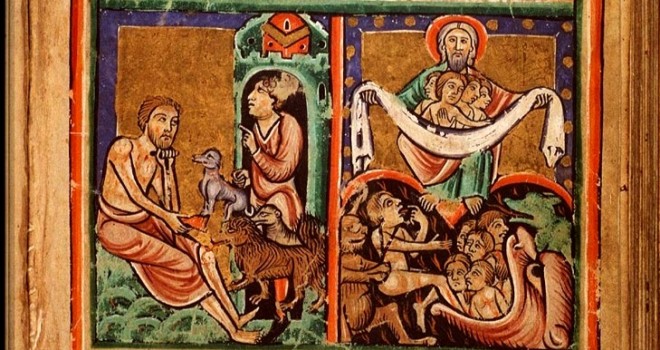
The Rich Man and Lazarus, from a French pictorial Bible, c.1200 C.E.

“There was a rich man who was dressed in purple and fine linen and lived in luxury every day. At his gate was laid a beggar named Lazarus, covered with sores and longing to eat what fell from the rich man’s table. Even the dogs came and licked his sores.

“The time came when the beggar died, and the angels carried him to Abraham’s side. The rich man also died and was buried. In Hades, where he was in torment, he looked up and saw Abraham far away, with Lazarus by his side. So, he called to him, ‘Father Abraham, have pity on me and send Lazarus to dip the tip of his finger in water and cool my tongue, because I am in agony in this fire.’

“But Abraham replied, ‘Son, remember that in your lifetime you received your good things, while Lazarus received bad things, but now he is comforted here, and you are in agony. And besides all this, between us and you a great chasm has been set in place, so that those who want to go from here to you cannot, nor can anyone cross over from there to us.’

“He answered, ‘Then I beg you, father, send Lazarus to my family, or I have five brothers. Let him warn them, so that they will not also come to this place of torment.’

“Abraham replied, ‘They have Moses and the Prophets; let them listen to them.’

“‘No, Father Abraham,’ he said, ‘but if someone from the dead goes to them, they will repent.’

“He said to him, ‘If they do not listen to Moses and the Prophets, they will not be convinced even if someone rises from the dead.’”  (New International Version)

Everyone looks for a miracle at some point in life, especially for family. Whenever we see relatives walking far from God or siblings living without much thought to the words and ways of Jesus, it can be disconcerting. We may reason that if they could just experience or see some great miracle, then they will surely believe and embrace Christ. 

Yet, Jesus’ parable to us of the rich man and Lazarus graphically depicts an important message: God has already revealed divinity to humanity through Moses and the Prophets (the Old Testament). If people are not convinced by what already exists and is, they will not respond when the miraculous slaps them in the face.

Maybe we too often look for the dramatic because the mundane typically rules the day. Perhaps what we are looking for is already present in God’s revelation to us. It could be that the greatest task we have is not to beg for a miracle (even though there is nothing wrong with that!) but first to be quiet and listen to the Spirit of God speak through the Word of God so that our prayers to God arise in God’s way and God’s time.

Today’s Gospel story gets at the heart of where we immediately and reflexively turn when in dire straits. There is nothing wrong with turning to others, consulting trusted resources, or even Google. Yet, Holy Scripture is timeless. It contains everything we need for life and godliness in this present age. And I believe it has the answers to life’s most pressing questions.

Everyone has their trusted sources, as well as sources we don’t trust. If a person has had a pattern of not consulting or trusting the source material of Scripture, then it doesn’t matter who encourages them, even if it is a trusted person who shows up from the grave, to look into the Bible’s contents and believe it’s message.

If we look closely at the story, we are told the poor man’s name: Lazarus. And we are not told the rich man’s name. You see, the poor man, Lazarus, had his name written in the Book of Life. The rich man’s name cannot be spoken because it is not found there.

There are two opposite choices in life. One is to choose pleasure and overlook the great needs of the earth. Like old Jacob Marley in the Christmas Carol, it is to forge a chain, link by link, day after day, which will eventually leave one in bondage and regret.

The other choice is hope. To look ahead by faith and see the eternal things which are coming, then shaping our existence to act in sync with permanent values, is to choose life. Although this may bring deprivation, even suffering, in this present existence, the decision to forego temporary pleasure for eternal glory shall be rewarded. It is to live for future prosperity through present affliction.

So, how shall we then live?

Will we anchor our souls in the good bosom of bettering our fellow humanity?

Is there an acknowledgment that the measure we give to others shall eventually be given to us?

Do we seek to hold faith with a neighbor in his poverty?

Are we trusting so much in our five senses – sight, smell, taste, hearing, touch – that we either cannot or will not trust in the sixth sense of the spirit which tells us to believe Moses and the prophets?

Christ has risen. Christ is coming again. If we align our lives with spiritual truth, we shall find our names written in the Book of Life. Let us actively look for Lazarus in our lives, so that we don’t carelessly step over him day after day while selfishly indulging in the good things of this life.

Mighty God, you have done miraculous things. Help me see what you have already done and teach me to listen so that your revelation becomes alive to me. Holy Spirit, impress the redemptive event of Christ’s resurrection on the hearts of all who do not know you so that they might know your amazing grace. Amen.

1 Timothy 4:6-16 – Build Your Faith Muscle

If you point these things out to the brothers and sisters, you will be a good minister of Christ Jesus, nourished on the truths of the faith and of the good teaching that you have followed. Have nothing to do with godless myths and old wives’ tales; rather, train yourself to be godly. For physical training is of some value, but godliness has value for all things, holding promise for both the present life and the life to come. This is a trustworthy saying that deserves full acceptance. That is why we labor and strive, because we have put our hope in the living God, who is the Savior of all people, and especially of those who believe.

Command and teach these things. Don’t let anyone look down on you because you are young, but set an example for the believers in speech, in conduct, in love, in faith and in purity. Until I come, devote yourself to the public reading of Scripture, to preaching and to teaching. Do not neglect your gift, which was given you through prophecy when the body of elders laid their hands on you.

Be diligent in these matters; give yourself wholly to them, so that everyone may see your progress. Watch your life and doctrine closely. Persevere in them, because if you do, you will save both yourself and your hearers. (New International Version)

There are several metaphors throughout the New Testament illustrating the nature of the Christian life and Christian community.

God’s people are the temple of the Holy Spirit, the house where the Lord dwells; the Body of Christ, a group working together and strengthening one another in faith; the army of the Lord, advancing with the shared purpose of proclaiming good news and extending God’s benevolent rule – just to name a few.

All the metaphors are embedded with the need for training, for spiritual disciplines and practices which strengthen faith and promote spiritual health.

Just as an army of recruits needs intense basic training and ongoing discipline; and just as the body needs hourly movement and daily exercise of its muscles; so, Christian communities require spiritual development with a variety of forms and functions to elicit and establish a solid godly life.

The curriculum in the school of faith, the liturgy within the spiritual temple, the boot camp for the Lord’s soldier, and the sets and repetitions for Christ’s Body are reading and listening to Scripture with a life rhythm of personal and corporate integrity, confident faith, steadfast love, encouraging words, and virtuous behavior.

If we dedicate ourselves to these things, there will be no room for entertaining wacky stories which have no basis in truth. Instead, there will be lush spiritual growth, teachable spirits, humble service, supportive beliefs, compassionate ministry, and open fellowship.

The high values of our faith need to be both used and guarded. Our treasured possessions, whatever they may be, are handled appropriately and carefully – being kept in a secure place when not used – and being used with care when out.

Our faith, our life and doctrine, is both a precious possession, as well as a necessary muscle to do the will of God. Like our own physical muscles, faith needs to be stretched, exercised, rested, and supplied with plenty of protein and necessary nutrients. Overtaxed muscles will fatigue and can be damaged through too much exertion. And underused muscles will wither and atrophy, unable to handle even the smallest of strain when we need them.

So, it is best to have proper spiritual hygiene and exercise through a regimen of tried and true practices designed to improve and maintain healthy faith. If you want to build your faith, consider the following 10 ways:

  1. Increase your amount of reading. There is no substitute for daily repetitions of reading the Bible. Supporting a growing faith will require more voluminous reading.
  2. Focus on listening to the biblical text. Reading is only as good as our listening skills. For the Christian, paying attention to the Holy Spirit’s gentle whispers is a must.
  3. Decrease your media time. For all the good stuff out there, a lot of media information is based in myth, half-truths, and opinions masked as facts – not to mention all the hack and huckster preachers.
  4. Pray more. In fact, pray continually.
  5. Practice gratitude – not complaining. Need I say more?
  6. Snack on good spiritual reading. Consuming a good book before bed keeps the faith muscle fed longer.
  7. Rest! When God created and instituted seven days, the first day was a day of rest; the workdays came after. Don’t flip-flop the divine order.
  8. Supplement with good spiritual conversation. Half-baked theological ideas come from remaining in one’s own cave-like head. Consultation, collaboration, and fellowship help create a rich and full faith.
  9. Don’t overtrain. Good idea: Read the Bible in a year. Bad idea: Read the Bible in a month. Good idea: Digest the contents of ecumenical Creeds and church Confessions. Bad idea: Stuff a bunch of knowledge down your gullet without any love to wash it down. Savor the meal. Don’t be a pig.
  10. Don’t lift too heavy for your faith muscle. The ancient desert fathers spent years developing their faith and could do incredible feats of spiritual strength. Christianity isn’t a competition of keeping up with the Francis of Assisi’s and Martin Luther’s of history. Use the measure of faith given to you and focus on those small daily decisions of trust.

Christianity is a marathon, not a 100-meter sprint. We persevere to the end, not flame out after taxing ourselves with expectations and responsibilities God never gave us.

Be safe. Be strong. Be smart. Be spiritual. We are all in this together.

Gracious God, fill your Church with truth, the truth with peace, and the peace with love. Where our faith is weak, make it strong; where it is misguided and in error, correct and direct it; where it is amiss, reform it; where it is in want, provide for it; where it is divided, reunite it, for the sake of Jesus Christ your Son our Savior. Amen.