The Necessity of Mentoring Relationships: Paul, Tom, and Timothy (2 Timothy 3:10-15)

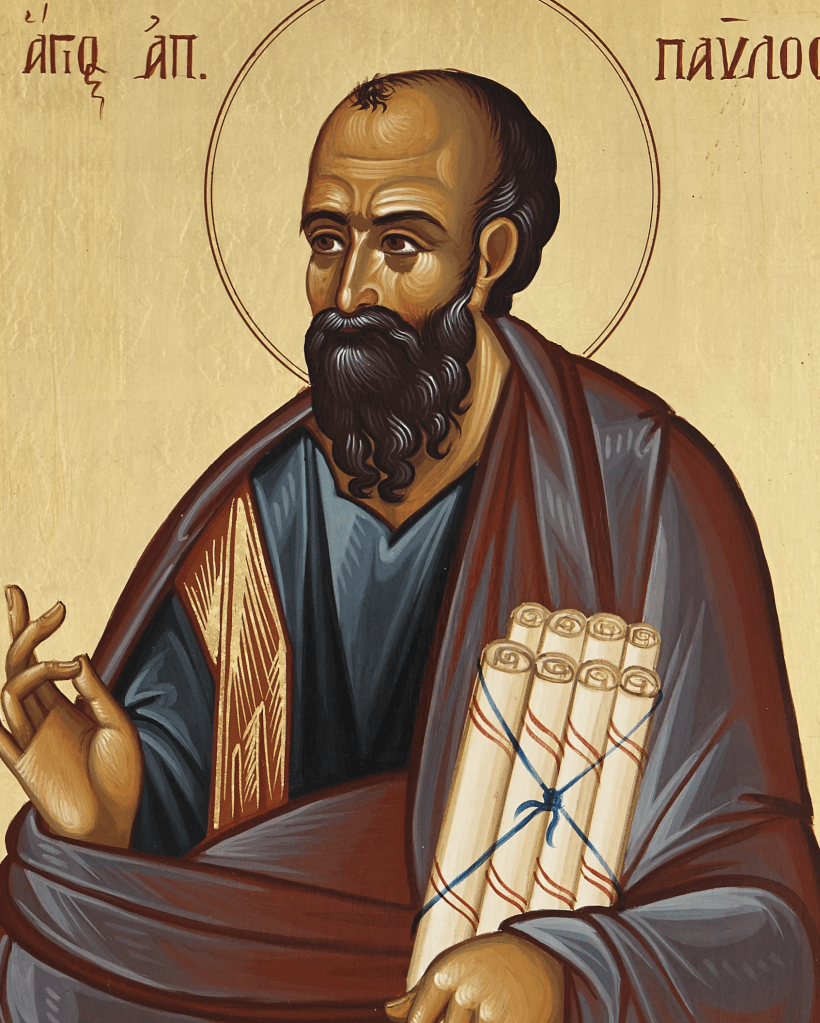
Orthodox icon of St. Paul
Orthodox icon of St. Timothy

You’ve been a good apprentice to me, a part of my teaching, my manner of life, direction, faith, steadiness, love, patience, troubles, sufferings—suffering along with me in all the grief I had to put up with in Antioch, Iconium, and Lystra. And you also well know that God rescued me! Anyone who wants to live all out for Christ is in for a lot of trouble; there’s no getting around it. Unscrupulous con men will continue to exploit the faith. They’re as deceived as the people they lead astray. As long as they are out there, things can only get worse.

But don’t let it faze you. Stick with what you learned and believed, sure of the integrity of your teachers—why, you took in the sacred Scriptures with your mother’s milk! There’s nothing like the written Word of God for showing you the way to salvation through faith in Christ Jesus. (The Message)

Paul and Timothy had a special relationship. Paul, the Apostle and mentor in the faith; and Timothy, the apprentice.

Together, they saw it all – and experienced it all. And through it all, the Christian tradition was passed on because of Paul’s purposeful mentoring of others, especially Timothy, by both verbal teaching and life example. In this, Paul helped set Christianity on a trajectory of modeling the words and ways of Jesus.

Faith is a gift given by God through Scripture and faithful people – and then received by us. Christianity is designed for community; it is not merely a solitary affair between the individual and God. Anyone trying to go it alone in the Christian life will soon discover they are overwhelmed and in over their heads with trouble.

Contemporary pastoral ministry still needs to follow in the footsteps of the Apostle Paul. Just one of the many reasons why churches in the West are in such decline is that Christian leaders are not intentionally focused to passing-on a solid body of teaching, along with a consistent example of how to put it into practice, through close relationships.

Anyone who has been in the pastoral ministry gig for a long time, remaining consistent and faithful, has most certainly had a good spiritual teacher and guide shepherding them through their Christian experience. A good long ministerial life isn’t happenstance; it’s the result of a solid foundation through a Paul-and-Timothy sort of relationship.

Mosaic of Paul and Timothy, Cathedral of Monreale, Sicily, Italy

By God’s grace, I’ve had several persons influence my life in profound ways in such a relationship. One of the earliest and longest was with Tom – a campus minister on my university who built into my life as an undergraduate and a very young Christian. We remained connected and became good friends for nearly four decades until his untimely death.

Tom knew what he was doing with me. To this day, even with multiple academic degrees and many professional ministry experiences, I attribute most of what I know about Christian faith and practice as simply saying and doing what I saw Tom say and do. And, I might add, Tom consistently saw my true self, even when I didn’t see it myself.

A good model in the faith has the same qualities and insights as the Apostle Paul of old. For example, here are just a few of the important things I learned from Tom:

  • Christian ministry is interpersonal; time must be spent with others, getting to know them and building relationships. Doing pastoral ministry from afar is an oxymoron. From what we know of Paul, at times he had a team of up to seventy persons following him around on missionary endeavors.
  • There are always going to be charlatans and bad apples around. Don’t simply ignore them. Confront them in grace and truth. I still remember a time when I went along with Tom, not knowing where we were going or what he was up to. In retrospect, he probably knew I would bolt if I caught wind of what he was about to do. We went to the dorm room of a believer whom Tom flat-out confronted on his talking and living being inconsistent with his professed Christianity. My eyes got huge when Tom said, “In the name of Jesus Christ I rebuke you and I call you to repent.” This was said in a gracious and conversational tone, not in anger, which communicated concern and love for this individual student.
  • Develop relationships. And the best way of doing this is by having the Timothy tag along with the Paul. Tom continually brought me along to whatever he was doing, whether it was a weekend retreat he was leading, or going to the grocery store. We cannot learn from others if we aren’t around them, and Tom understood this better than most. As a result, I learned more than lessons; I learned a life.
  • It’s not about me. Tom never took himself too seriously. And because of that, I observed him never becoming overwhelmed or obsessing over the trouble he would sometimes get into. In fact, he typically welcomed the trouble whenever he saw it was not of his own making.
  • Openness and vulnerability are necessary. More than once, Tom strolled into a bible study with me and some other guys, flopped down and said, “Man, I really blew it today…” and then went on to explain some boneheaded thing he did. We unpacked the entire situation together. Not once do I ever recall Tom trying to look like the perfect Christian leader. He embraced who he was and was always willing to shine the light on the shadowy places of his heart.
  • Holy Scripture is central to Christian life and ministry. Inevitably, Tom’s question to us, after describing his bonehead move, was to ask, “What are you learning in God’s Word? Do you have any encouragement for me?” On a daily basis, without fail, Tom asked this question of me: “So, what is God teaching you in the Word?”

Through both Holy Scripture and the significant relationships I’ve had throughout my life, I can confidently state that there are two indispensable elements to effective Christian ministry:

  1. It must be firmly grounded in objective theory derived from God’s Word.
  2. It must be intentionally practiced with subjective experience derived from interpersonal relationships.

Objective theory without lived practice leads to being puffed-up with knowledge and no love – because love requires people. And subjective experience without a grounded theory is nothing but a form of spiritual A.D.D. in which whatever shiny thing we see grabs our attention.

I always considered Tom as my spiritual father (and his wife as a dear spiritual mother!). They have shown me not only how to live the faith, but also how to be a spiritual father myself. And as a result, my own dear wife and I have many spiritual children scattered throughout the country.

This is the consummate Christian: Coming to faith by God’s grace, mediated to us through actual flesh-and-blood people; being taught and mentored in that faith by proven Christians; and then, simply saying and doing what you have seen and heard from holy leaders and Holy Scripture.

It’s not rocket science. It’s not abstract art. It’s a life. It’s relationships. And it’s absolutely necessary in order for both the church and the world to be blessed.

But he’s already made it plain how to live, what to do,
    what God is looking for in men and women.
It’s quite simple: Do what is fair and just to your neighbor,
    be compassionate and loyal in your love,
And don’t take yourself too seriously—
    take God seriously. (Micah 6:8, MSG)

Soli Deo Gloria. Amen.

1 Timothy 1:1-11 – A Plea for Grace and Truth

From Paul, an apostle of Christ Jesus by order of God our Savior and Christ Jesus our hope—

To Timothy, my true son in the faith:

May God the Father and Christ Jesus our Lord give you grace, mercy, and peace.

I want you to stay in Ephesus, just as I urged you when I was on my way to Macedonia. Some people there are teaching false doctrines, and you must order them to stop. Tell them to give up those legends and those long lists of ancestors, which only produce arguments; they do not serve God’s plan, which is known by faith. 

The purpose of this order is to arouse the love that comes from a pure heart, a clear conscience, and a genuine faith. Some people have turned away from these and have lost their way in foolish discussions. They want to be teachers of God’s law, but they do not understand their own words or the matters about which they speak with so much confidence.

We know that the Law is good if it is used as it should be used. It must be remembered, of course, that laws are made, not for good people, but for lawbreakers and criminals, for the godless and sinful, for those who are not religious or spiritual, for those who kill their fathers or mothers, for murderers, for the immoral, for sexual perverts, for kidnappers, for those who lie and give false testimony or who do anything else contrary to sound doctrine. That teaching is found in the gospel that was entrusted to me to announce, the Good News from the glorious and blessed God. (Good News Translation)

We all need to be continually reminded of the supreme, overarching, and divine imperative of love. Love God and love neighbor is the summation of all other commands in Holy Scripture.

Whenever we lose sight of love as the guiding ethic of law, we stray into foolish discussions which are always unhelpful, and oftentimes harmful. As a result, there is today a plethora of shortsighted and small-hearted pundits who don’t even understand their own speech.

The irony is that those who rail against particular sins are themselves the most egregious sinners of all; and the ones calling for observance of Christian ethics are themselves acting unethically.

While there a large chunks of the Christian world who condemn same sex relations because “the Bible says it is sin,” they never question the translation of what they’re reading in Scripture – failing to realize that the original scriptures were not authorized by King James to be written in English.

Translation is no easy task. Believe me, I’ve done my share of it. Unfortunately, many translations simply go with “homosexuality,” even though it’s difficult to translate from the original Greek. It seems to me that the Good News Translation of “sexual perverts” is about as accurate as one can get.

The word has much more to do with pederasty (same sex relations with a minor) and rape than it does with all same sex relations. If we can easily understand the nuances of opposite sex relations, then why not same sex relations?

Frankly, I am genuinely grieved, and I lament over how Christians talk to one another about these matters.

On the one hand, there are the “truth tellers.” They have a passion for holiness and a zeal for righteousness. They point out that Jesus got angry and did not put up with people watering down the gospel. Jesus, for them, is the Divine Warrior who is ready and armed to oppose same sex marriage.  

On the other hand, there are the “lovers.” They are sincerely hurt by chatter about homosexual sinners bound for hell. For them, Jesus loves, period. He would never hurt a fly, drives a Prius, and tries to leave the most loving impact he can on the earth without a harmful spiritual footprint or a rebuke from anyone.

I, of course, have painted two extremes. But therein lies the point: The rhetoric from both hands is extreme, as if, somehow, love and truth cannot co-exist together.

Methinks one of the great problems is that few people want to take the time to listen; few are interested in understanding the other.  

Failing to possess a listening spirit means there isn’t much poverty of spirit, very little mourning over personal sin, and even less meekness.  

Instead, we look down our noses at one another.  

But is listening really that important?  Yes, it is.  

Jesus said, “If your brother sins against you, go to him and show him his fault. But do it privately, just between yourselves. If he listens to you, you have won your brother back.” (Matthew 18:15, GNT)

It’s hard to listen when people are taking pot shots at each other through social media and huddling together in their own small worlds without any diversity or contrary thought. The aforementioned quote from Jesus presupposes relationship; and there seems to be little of it going around.

“Truth teller,” will you take the time and effort to build a relationship with someone, or even a group of people, very different from yourself? Will you seek to ask questions, listen, and understand without judgment or making comments? Are you able to see the image of God in them?  

“Lover,” do you have room to love someone who is at the complete opposite end of your own understanding? Are you willing to take the time and effort to see why this person or group of people are so passionate about the issue – without believing that you already know why they think the way they do? Can you see that God’s love is big enough to extend to the unloving?

Everyone has their hot button issues in which people are at very different ends of the spectrum of thinking.  

What I am pleading for is that we in the church must take the lead by having the maturity to learn how to talk to one another without assuming we already know what the other side is all about. We don’t. And we won’t unless we listen. And we won’t listen unless we are humble; we will never be humble unless we realize our poverty of spirit before God.

Please don’t turn the good news of grace into the bad news of judgment. That, perhaps, is the worst blasphemy of all. Instead, may you embrace the mercy and peace which has been graciously given to you at the cost of great suffering.

Almighty God, from whom all thoughts of truth and peace proceed: kindle, we pray, in the hearts of all, the true love of peace and guide with your pure and peaceable wisdom those who take counsel for the nations of the earth – so that in tranquility your kingdom may go forward, till the earth is filled with the knowledge of your love; through Jesus Christ your Son our Lord, who is alive and reigns with you, in the unity of the Holy Spirit, one God, now and forever. Amen.

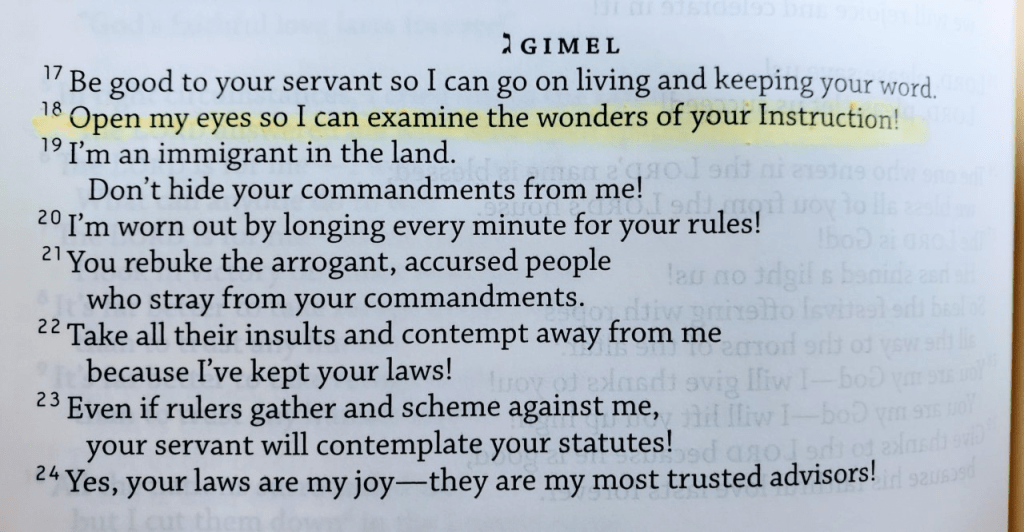
Psalm 119:17-32 – Examine the Wonders of God’s Instructions

Psalm 119:17-24, Common English Bible

ג Gimel

Be good to your servant while I live,
    that I may obey your word.
Open my eyes that I may see
    wonderful things in your law.
I am a stranger on earth;
    do not hide your commands from me.
My soul is consumed with longing
    for your laws at all times.
You rebuke the arrogant, who are accursed,
    those who stray from your commands.
Remove from me their scorn and contempt,
    for I keep your statutes.
Though rulers sit together and slander me,
    your servant will meditate on your decrees.
Your statutes are my delight;
    they are my counselors.

ד Daleth

I am laid low in the dust;
    preserve my life according to your word.
I gave an account of my ways and you answered me;
    teach me your decrees.
Cause me to understand the way of your precepts,
    that I may meditate on your wonderful deeds.
My soul is weary with sorrow;
    strengthen me according to your word.
Keep me from deceitful ways;
    be gracious to me and teach me your law.
I have chosen the way of faithfulness;
    I have set my heart on your laws.
I hold fast to your statutes, Lord;
    do not let me be put to shame.
I run in the path of your commands,
    for you have broadened my understanding. (New International Version)

The biblical psalms are one of my favorite places in the whole of Holy Scripture. I especially like Psalm 119 because it reminds me that I am not only saved from something, but I am also saved to something.

Genuine and real deliverance comes so that we can be free to love and serve God with our whole being. And Psalm 119 is there to help us know how to do just that.

Psalm 119 stretches for 176 verses as an acrostic to the Hebrew alphabet. Each Hebrew letter has its own 8 verse stanza, with each of those verses beginning with that letter. Unfortunately, of course, we lose this insight through translation.

One of the reasons the psalm was organized this way is because it was meant to be learned and memorized. In fact, the entire psalter was meant for public consumption – to be engrafted into the soul and hidden in the heart.

The wonders of Psalm 119 are, overall, a paeon of reverence and praise of God’s law. That’s because the Lord’s commands and instructions are an extension of the divine character. Laws of mercy and holiness are given to the people because God is merciful and holy.

Grace and law are not antithetical. They go together like a hand in a glove and rely upon each other. The hand of grace is what fills the glove of the law, and together, they extend divine help and direction to people in this fallen world of ours.

The heartfelt prayer of the psalmist is that the Lord would open his eyes so that he could see the wonders contained within God’s divine instructions for humanity.

“Open my eyes so I can truly see
the marvelous things in your law.”

Psalm 119:18, NET

This is a prayer for us, as well. Those who desire to please the Lord and walk in the way of God are continually seeking awareness of the divine all around them, insight into others, and understanding of self.

It is one thing to read the Bible, but it’s another thing altogether to understand it. The psalmist is asking for God to intervene on his behalf and remove anything and everything that would inhibit his ability to understand and discern God’s words and actions.

Insight, understanding, and application to life comes from dwelling in the Word. It is a process. A daily crumb will neither do to satiate our physical hunger nor our spiritual appetite.

Going days, even weeks, without ingesting God’s instructions will only lead to spiritual emaciation. It harms us and helps no one. Instead, we need to feed on Holy Scripture and savor every bite. Like the cow, we need to slowly chew and ruminate on Scripture so that it can be fully digested and become part of us.

I have memorized large chunks of the Bible over the years. The main reason my memory can call up so much Scripture is that I have read it, and continue to read it, over and over again. Even though I’ve read the Old Testament about one-hundred times and the New Testament in the neighborhood of three-hundred times, I still gain insight and understanding, seeing new and wondrous things.

I truly believe the Bible is an inexhaustible source of sage instruction and a continual fountain of wisdom. I’ll spend an eternity in heaven examining God’s Word and will never reach the height, depth, length, and breadth of it’s incredible, massive, and glorious precepts.

I am a strong advocate of straightforward readings of Scripture, over and over again. Although I encourage looking at devotionals, commentaries, and reflections (like this blog!) to help and encourage us, nothing can replace our constant and continual reading of the Bible.

The biblical Book of Psalms is the Church’s prayerbook. All 150 of them are meant to be used for every sort of life circumstance. Whether discouraged or anxious, joyful or confident, the psalms encompass the full range of the human condition – and Psalm 119 lets us know how central God’s instructions are to the life of God’s people.

So, read today’s psalm… several times. Let Scripture do it’s marvelous and wondrous work within you.

Blessed Lord, you caused all Holy Scriptures to be written for our learning. Help us so to wisely hear, read, mark, learn, and inwardly digest them so that by our patient reading of your holy Word, we may embrace and ever hold fast the blessed hope of everlasting life, which you have given us in our Savior Jesus Christ.

Luke 11:24-28 – Human Nature Abhors a Vacuum

Photo by Rene Asmussen on Pexels.com

“When an evil spirit leaves a person, it goes into the desert, searching for rest. But when it finds none, it says, ‘I will return to the person I came from.’ So, it returns and finds that its former home is all swept and in order. Then the spirit finds seven other spirits more evil than itself, and they all enter the person and live there. And so that person is worse off than before.”

As he was speaking, a woman in the crowd called out, “God bless your mother—the womb from which you came, and the breasts that nursed you!”

Jesus replied, “But even more blessed are all who hear the word of God and put it into practice.” (New Living Translation)

You have likely heard the old adage, “Nature abhors a vacuum.” This idiom is used to express the idea that empty or unfilled spaces are unnatural as they go against the laws of nature and physics. Jesus expressed a similar statement, not about physical nature but human nature.

People experience emptiness whenever something, or someone, has been expelled from our lives, creating a vacuum. In today’s Gospel lesson, the expulsion is that of an evil spirit. The bad spirit is kicked to the curb, so it goes looking somewhere else to settle, with no success. Then, the spirit decides to go back, check, and see if the person is occupied, or not.

Everything in nice, neat order. Cleaned up, looking good. But empty. For the spirit, this is ideal. So much space in such an organized environment that it becomes the ideal spot for a party of peers to turn the order back into chaos.

Yet, if there had been something to fill the void, the spirits could never have come and occupied the space.

It’s a pointed lesson about truly hearing. There’s the kind of hearing that goes in one ear and out the other. There’s also a type of hearing which listens yet does nothing to act on what is being heard. That seems to be the kind of hearing Jesus was talking about.

To hear God’s Word is one thing. To make it stick by putting into practice, is another thing altogether. It’s akin to the difference between having an attractive and expensive goatskin leather Bible adorning a coffee table in the center of the house. Looks great. Problem is, it never gets a genuine hearing because the cover rarely gets cracked open.

Once, in my first church as their Pastor, a man had a bevy of family issues which seemed endless. At first, I didn’t understand it. He seemed like a really nice guy. Every Sunday he was there, without fail, and always brought his Bible.

Then, one Sunday, after everyone had left, I found a Bible sitting in the pew where the man always sat. I opened it, and sure enough, it was his, his name written inside the cover. It appeared to be a brand spanking new one, until I looked at the publication date and inscription from when it was given to him: 1949.

In returning the Bible to the man the next day, I discovered that he indeed never read it. In fact, I quickly found out that in the thousands of sermons he had heard over the decades, none of them seemed to ever stick. He heard but didn’t really hear. Instead, he spent most of his life trying not to be involved in much of anything as a means of protecting himself from hurt.

Hearing God’s Word without putting any of into practice isn’t ever going to end well.

Obey God’s message! Don’t fool yourselves by just listening to it. If you hear the message and don’t obey it, you are like people who stare at themselves in a mirror and forget what they look like as soon as they leave. But you must never stop looking at the perfect law that sets you free. God will bless you in everything you do, if you listen and obey, and don’t just hear and forget. (James 1:22-25, CEV)

The Word of God has not been truly received until it is put into practice.

The person who only hears is like a Mr. Potato Head that is only ears. He can’t stand because he has no feet.  He cannot do anything because he has no hands. Mr. Potato Head needs some feet so that he can follow Jesus wherever he goes.  And he needs hands so he can do God’s will.

Listening to the Word without obedience is just that – it is mere hearing. 

Profession of faith in Jesus means nothing without a practice of that faith.

Learning the Bible is useless without living it.

Acceptance of the Word is nothing more than a mental exercise without action to back it up. 

Christianity is a vital love relationship with Jesus, and, so, is not merely a matter of hearing and affirming orthodoxy; it also involves orthopraxy, that is, having right practice, the doing of truth.

Good hearing leads to a good response.

When my firstborn daughter was still in her mother’s womb, I constantly talked to her. I was in seminary at the time, and I would come home and read her fairy tales in Hebrew. I spoke to her when I got up in the morning and when I went to bed. I told her all about how God was going to bless her and do great things through her. I told her of Jesus and his love for her. I practiced my sermons and Sunday School lessons on her – all before she was born.

When the day finally came of her birth, the nurses took her, and she cried and cried. She cried so much and so hard that I finally said to them, “Let me hold her.” The minute I held her, I began speaking to her, and what happened next got the attention of everyone in the room: my little baby daughter immediately got quiet. It was like that the entire time she was in the hospital. The only time she was happy was when I was speaking to her.

We respond to God’s voice when we recognize it. If we are not in the habit of responding to God’s Holy Word, it is likely that we do not know the Divine voice. My baby daughter didn’t need a lesson on how to respond to me. She knew exactly who I was: her father. 

Do we know our heavenly Father? Can we distinguish God’s voice?

We need to be servants who hear and respond to the voice of God, and not soakers who just sit and hear without any response at all.

Human nature abhors a vacuum. Our own inner emptiness needs to be filled with practicing the words of life we hear. This is the true path of blessing.

Gracious Lord, you have caused Holy Scripture to be written for our learning: help us so to hear, read, mark, learn, and inwardly digest the Word so that we may do what it says and embrace the joyful hope of everlasting life, which you have given us in our Savior Jesus Christ. Amen.