Spiritual Blessings (Ephesians 1:7-14)

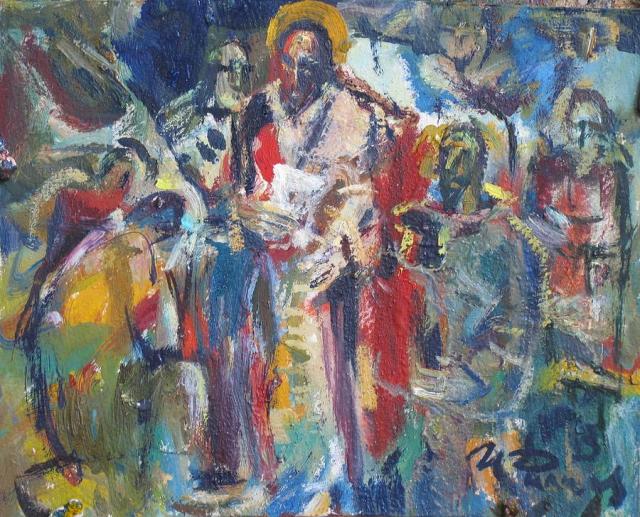
The Trinity, by Ukrainian artist Feodosiy Humeniuk, 1981

In him we have redemption through his blood, the forgiveness of our offenses, according to the riches of his grace that he lavished on us in all wisdom and insight.He did this when he revealed to us the mystery of his will, according to his good pleasure that he set forth in Christ, toward the administration of the fullness of the times, to head up all things in Christ—the things in heaven and the things on earth.

In Christ we too have been claimed as God’s own possession, since we were predestined according to the purpose of him who accomplishes all things according to the counsel of his will so that we, who were the first to set our hope on Christ, would be to the praise of his glory. And when you heard the word of truth (the gospel of your salvation)—when you believed in Christ—you were marked with the seal of the promised Holy Spirit, who is the down payment of our inheritance, until the redemption of God’s own possession, to the praise of his glory. (New English Translation)

The Apostle Paul wrote this letter to the Church at Ephesus. Believe it or not, the first chapter of Ephesians  comprises only two sentences in the Greek language for which he originally wrote. Ephesians 1:3-14 are one sentence, and Ephesians 1:15-23 is the other sentence. Thankfully, understandably, and mercifully, English translators have created multiple sentences for us so that we can better make sense of the text. 

It’s almost as if Paul was so excited to talk with the Ephesian believers about who they are in Jesus Christ and what they possess in him that he blurted out in writing with a flurry of enthusiasm and excited fervor without stopping to take a breath or a break.

Paul stacked word after significant word, on top of each other, in order to communicate the spiritual blessings that believers in Christ enjoy. Redemption, forgiveness, grace, wisdom, insight, predestination, faith, inheritance, and salvation are just some of the blessings given to those in union with Jesus Christ.

And, if that wasn’t enough, God has also graciously given us the Holy Spirit, the Paraclete, the one who comes alongside and helps us to live into the blessings we possess. Because God the Father predestined and elected us, God the Son redeemed us, and God the Spirit took possession of us, we are delivered from sin, death, and hell.

It’s as if we came to Christmas day expecting a package of underwear, and found instead a bunch of big boxes with some of the most lavish and expensive gifts we’ve ever seen!  This says much more about the giver than it says about us.

It was according to God’s good pleasure in Christ through the Spirit that believers in Jesus have such privileges.  Like the parent who sits back and watches the unpackaging of presents happen with great joy, so God delights and is pleased with the gifts given to us. The Lord absolutely delights in watching us unpack them and use them in this life.

These gifts, these blessings, are all lavishly provided because they are extensions of God, as if the Lord meticulously handmade each present with us in mind.

Throughout the entirety of Holy Scripture, all the stories and narratives, teachings and writings, are about God. The Lord of all creation is both the subject and object of each book of the Bible. Every good thing we have in this life is because of God’s gracious presence and power in this world.

Each positive experience we have is a direct result of God’s steadfast love toward people. All good gifts come from a good God who is delighted and pleased to give them.

Not a one of us purchased our own gifts and stuck them under the tree. God bought them all with the precious blood of Jesus and sent the Spirit to deliver them to us. 

Consider setting aside time today or tomorrow in a quiet place, and reflect on just one of the words in today’s New Testament lesson. Think about redemption or forgiveness, salvation, or grace, or any of the words which grab you.

Say the word repeatedly and meditatively, quietly and loudly, thoughtfully and with flavor. Consider what God did to bring you that gift. Contemplate the way(s) in which you have received the gift. 

Plan one way in which you might share your gift with another person. And make sure to give glory and praise to God for the grace lavishly given to you.

May your meditation lead to a deeper appreciation of what God has done for you; and may that revelation result in praise, honor, and glory to the One who accomplished so much on our behalf.

Gracious God, you have revealed and made known the way of deliverance from the power of darkness and brought me into your marvelous light. Help me to better understand all the ways you have acted on my behalf so that my life might reflect your grace and steadfast love to the world, through Jesus Christ, my Savior, in the enablement of the Holy Spirit. Amen.


Respect Wise Sayings (Proverbs 22:1-9)

Being respected is more important than having great riches.
    To be well thought of is better than silver or gold.

The rich and the poor are alike
    in that the Lord made them all.

The wise see danger ahead and avoid it,
    but fools keep going and get into trouble.

Respecting the Lord and not being proud
    will bring you wealth, honor, and life.

Evil people’s lives are like paths covered with thorns and traps.
    People who guard themselves don’t have such problems.

Train children to live the right way,
    and when they are old, they will not stray from it.

The rich rule over the poor,
    and borrowers are servants to lenders.

Those who plan evil will receive trouble.
    Their cruel anger will come to an end.

Generous people will be blessed,
    because they share their food with the poor. (New Century Version)

The Bible is a big book. In fact, it is more like a compilation of many books – 66 of them, to be precise, contained in the Old and New Testaments. Although the Bible has the grand theme of presenting a redemptive drama, it is not a flat one-dimensional piece of literature. 

Throughout the Bible’s contents, from Genesis to Revelation, it is chocked full of various literary genres. From poetry and narrative stories to apocalyptic accounts and exhortative epistles, Holy Scripture provides a many-sided look at the unfolding drama of God’s redemption toward humanity. 

Included in this big Bible is the book of Proverbs, a collection of wise sayings to help people navigate God’s big world. The chief reason it’s important to know that the Bible contains different types of literature is so that we can read it and interpret it well. 

A proverb is a short pithy statement of experiential truth. 

It’s not the same as commands or law. The individual Hebrew proverbs are designed to point out that, all things being equal, this is how the world works. For example, let’s consider one of the most misunderstood and misused verses in the Bible: Train up a child in the way he should go; even when he is old he will not depart from it. 

Many a parent has been made to feel unrelenting guilt over a wayward son or daughter, believing that somehow they have failed. The reason they have such feelings is that they treat the book of Proverbs as clear promises to claim. But biblical proverbs simply were not meant to be stretched in this manner.

Rather, the proverb is meant to communicate to us that if parents are diligent and faithful in raising kids, that in all likelihood, this training will never leave them; it will always stick with them in some way, shape, or form. 

Furthermore, it’s also true that many a parent has rejoiced over an adult child coming back to their faith after a sojourn in the muck of the world. Important to that return is the foundation laid years ago with faithful parenting that desired to pass on wise and good instruction.

Proverbs, therefore, are meant to encourage us, not with an ironclad promises, but with the hope that all the blood, sweat, and tears that parents, teachers, mentors, and others put into children, and into their diligent work, will someday likely bear much fruit of responsible lives that contribute and benefit the church and the world. 

So, be diligent, patient, and do not give up; keep persevering knowing that your labor in the Lord is not in vain.

And also consider the proverb that honoring, respecting, and fearing God will bring a person wealth, riches, and an abundant life. It might. Perhaps likely. But it’s neither a promise nor a command. And it’s definitely not a math equation; you cannot build an algorithm from it to get rich quick. No, the verse is a proverb.

In other words, if we are careful to pay attention to God, and seek to obey and trust the Lord for all things, then, it is quite likely that you will find yourself with plenty, and not be in want. Thus, we ought never to look at the world with black-and-white glasses that unthinkingly believes that all rich people are hard workers and godly, whereas all poor folk are lazy good-for-nothing’s.

What’s more, many a poor person is rich in faith and good works, whereas many of the rich, care little for God and spend their wealth on self-centered concerns. Understanding a proverb as a proverb helps us to avoid stereotyping people and giving them labels they don’t deserve.

Let’s keep going. I do believe, as the proverb says, that generous people will be blessed. But know this: genuine generosity always costs us something. It will take money, time, energy, and/or resources which become depleted when we give liberally. Some folk never acquire wealth because they are committed to sharing what they have with others. And, in my opinion, these are the persons who are truly blessed.

If we keep an eye toward acquiring wisdom, pursuing experiential knowledge, and trusting God, then we look to places in the Bible like the Proverbs, and seek to live life as it was intended to be lived.

Internalize the biblical proverbs and, all things being equal, you are quite likely to have a good and blessed life.

Blessed and almighty God, the Giver of life, it is from your hand that we have received all we have, and are, and will be. We understand that your divine call upon us is to be the stewards of your abundance, the caretakers of all you have entrusted to us. Help us always to use your gifts wisely; and teach us to share them generously. May our faithful stewardship bear witness to the love of Christ in our lives; we pray with grateful hearts, in the gracious name of Jesus. Amen.

Don’t Forget about Kindness and Truth (Proverbs 3:1-12)

My child, do not forget my teaching,
    but keep my commands in mind.
Then you will live a long time,
    and your life will be successful.

Don’t ever forget kindness and truth.
    Wear them like a necklace.
    Write them on your heart as if on a tablet.
Then you will be respected
    and will please both God and people.

Trust the Lord with all your heart,
    and don’t depend on your own understanding.
Remember the Lord in all you do,
    and he will give you success.

Don’t depend on your own wisdom.
    Respect the Lord and refuse to do wrong.
Then your body will be healthy,
    and your bones will be strong.

Honor the Lord with your wealth
    and the first fruits from all your crops.
Then your barns will be full,
    and your wine barrels will overflow with new wine.

My child, do not reject the Lord’s discipline,
    and don’t get angry when he corrects you.
The Lord corrects those he loves,
    just as parents correct the child they delight in. (New Century Version)

There is no wisdom apart from humility. And humility can only be accessed through being authentic and vulnerable. The proud person doesn’t look to God (or others) because they think they already know what is best and can figure out things without anyone’s help.

Wisdom is a skill that is attained through learning and application, over an extended period of time. The wise person has a solid body of knowledge, and is able to take that know-how and apply it to real life situations.

For the skill of wisdom to be realized, we must first take the posture of a child. We need to listen well, and humbly receive instruction. Without this initial mindset and heart attitude, wisdom will forever be elusive.

Then, when we learn and gain understanding, it’s imperative that we remember it. This is why the best learning engages all of our senses; it presses needed information deep inside us, so that what comes out of us is right, just, and good.

Concerning the Christian life, we can only obey commands which we know. So, it’s important to learn and retain the commands of God. This is one reason why I read my Bible every day; my mind and heart need the continual refreshment and recalling of Holy Scripture’s insight and instruction. I want to be so full of God’s good commands that if you cut me, I bleed Bible.

Kindness and truth are to be worn like a big gaudy necklace around our necks – so that we will always have in front of us what’s most important in living our lives.

The reason so many people are continually at odds with one another is that kindness and truth are neither acknowledged nor remembered. But you cannot have good relations without basic human kindness and a commitment to truth. Put another way, being gruff and mean, and fudging on reality, will not only get you nowhere, but it will also bring a profound lack of success in life.

That stubborn meanness and inattention to truth comes from spending way too much time alone in one’s head. Left alone for too long, every one of us will come up with all kinds of goofy thinking that we believe is the truth. But it’s really only craziness born of a tremendous lack of healthy interaction with others.

At some point, everyone must eventually trust the Lord – who is kindness and truth itself. Going it alone is not an option, that is, unless we want to be lonely, messed-up in the head, and miserable in both body and soul.

Let’s get real. Often, the reason why so many of us choose a path of arrogant pride, radical independence, and selfish loneliness is because we simply do not want to be hurt.

Someone, some group, or many persons have hurt us, and we’re determined to never be hurt and to hurt like that again. So, we shut others out – including God.

We may not go the route of becoming actual hermits, but we build invisible walls which no one can scale. This is why the loneliest people are actually around other people – they’ve shut them out emotionally, mentally, and spiritually, even though they are next to them physically.

Persons who take such a route to living eventually discover that, although they may have avoided the sort of pain they feared, a new kind of suffering is experienced. And it’s the kind of suffering that gnaws at your insides and slowly kills you.

Little does one know, but the fear, anger, and hatred morphs into a bitterness which becomes gangrene of the soul. The person dies a little bit at a time in an agonizing existence. We all must endure pain; it’s just a matter of what sort of pain we will accept: the bad kind or the good kind.

A good sort of hurt is the pain of healing, of making things right, of committing oneself to reconciliation and peace. It’s a soreness of being corrected by Holy Scripture and God’s directives, a suffering that will truly lead to life, not death.

So, what will it be? The book of Proverbs calls us to make a choice, not only between good and bad, but a choice of better and best, and of accepting the sort of pain that helps us grow; or rejecting that and enduring a debilitating hurt that damages deeply, maybe even permanently.

Let go of the pride and adopt humility. Become a student of wisdom. Take up the necklaces of kindness and truth. Honor God with a life full of experiential knowledge and devotion to the betterment of humanity. Learn to trust the Lord and others who are trustworthy. Know what it feels like to be merciful, pure, and peacemaking.

You may just find that the old tools of cynicism, sarcasm, skepticism, distrust, and unbelief become lost in the mental junk drawer of things rarely, if ever, used.

Lord Jesus Christ, you prayed for your friends that they would be one as you and your Father are one. We confess our resistance to your prayer. We have failed to maintain the unity of the Spirit. We have broken the bond of peace.

Grateful to God (1 Thessalonians 2:13-20)

Apostle Paul, by Ivan Filichev

And we also thank God continually because, when you received the word of God, which you heard from us, you accepted it not as a human word, but as it actually is, the word of God, which is indeed at work in you who believe. For you, brothers and sisters, became imitators of God’s churches in Judea, which are in Christ Jesus: You suffered from your own people the same things those churches suffered from the Jews who killed the Lord Jesus and the prophets and also drove us out. They displease God and are hostile to everyone in their effort to keep us from speaking to the Gentiles so that they may be saved. In this way they always heap up their sins to the limit. The wrath of God has come upon them at last.

But, brothers and sisters, when we were orphaned by being separated from you for a short time (in person, not in thought), out of our intense longing we made every effort to see you. For we wanted to come to you—certainly I, Paul, did, again and again—but Satan blocked our way.For what is our hope, our joy, or the crown in which we will glory in the presence of our Lord Jesus when he comes? Is it not you? Indeed, you are our glory and joy. (New International Version)

Reception and Acceptance of God’s Word

The Apostle Paul, in all of his letters to the churches, was attentive to affirming those things which are good amongst the believers; and not only the aspects of church life that needed change and/or repentance.

For the Thessalonians, Paul was profoundly grateful to God for the people’s receiving of the Word and their accepting it as from God. Perhaps there is no greater affirmation than this for the Christian.

In order to receive and accept God’s Word, people must know it. And people cannot know God’s Word unless they take the time and effort to read it and discover it for themselves.

Scripture reading is a foundational spiritual practice for Christians everywhere, and for all of Christ’s Church throughout the earth. Church worship liturgies, as well as individual Christians’ daily disciplines of faith, ought to be thoroughly saturated with Holy Scripture. Yet, many churches are believers, sadly, are not.

I am specifically calling out the conservative evangelical church on this. Although they claim to be Bible-centered, with an extended time for the sermon, there is a paucity of actual Scripture contained within those gathered times.

Too much of the preaching fails to truly explain Scripture, and there are virtually no Scripture readings or references outside the sermon and in the worship service. This is a travesty, and also a testament to the biblical ignorance of so many evangelicals.

What’s more, the evangelical impulse for a “personal quiet time with the Lord” is, in reality, practiced by precious few believers – and usually consists of little more than a daily crumb of the Bible.

I perhaps sound cranky and crotchety. Yet in a previous life, I was an evangelical Pastor for many years, and know the frustrations and challenges of attempting to bring biblical literacy to such churches and Christians. There’s a better way, but alas, that is a topic for another time and another post.

Imitators and Sufferers with God’s Churches

The true muster of a Christian and any Christian Church is the desire, speech, and action of actually following the words and ways of Jesus. It was the Lord Jesus himself who said:

“Remember what I told you: ‘A servant is not greater than his master.’ If they persecuted me, they will persecute you also.” (John 15:20, NIV)

“In this world you will have trouble. But take heart! I have overcome the world.”

Jesus (John 16:33, NIV)

Paul was thankful for the Thessalonians because of their solidarity with the other churches; and their willingness to suffer as Jesus did. What’s more, they did not try to reinvent the wheel, but affirmed the sound practices they saw in the original churches of Judea and imitated those good things.

This was not a matter of pragmatism, that is, just doing something that worked somewhere else and adopting it for yourself. Instead, Paul was talking about following the example of the first and earliest of churches. Those churches were made up of Jewish Christians who received a lot of persecution from their fellow Jews.

The Thessalonians, too, received grief and belligerence from the same sort of people, trying to bully them around and tell them what to do. But the believers held fast to the pattern of teaching and living they observed from both Paul and the churches who endured suffering in Judea.

It’s one thing to express belief. It’s quite another thing to suffer for those beliefs and experience persecution for them. God will handle the persecutors on Judgment Day, not us. It’s our job to remain faithful and persevere in the Christian life until that Day comes.

Glory and Joy in God’s Presence

For the Apostle Paul, glory and joy was not found in his great intellect and persuading many people, or his many accomplishments of planting churches and defending the faith. Paul’s highest joy was found in people coming to know Christ and living for Jesus.

His glory was in the hundreds of relationships established with people, and all the believers he mentored. In other words, Paul’s glory and joy was the real names and faces of people he encountered and gathered into the one Church, for whom Christ died and sacrificed himself.

It wasn’t even a thought in the Apostle’s big old head to gain glory for himself, or to pursue joy for it’s own sake. Rather, Paul discovered that real joy and glory comes in fulfilling the mission give to him by Christ:

To make disciples of all nations, baptizing them in the name of the Father, and of the Son, and of the Holy Spirit; teaching them to receive and accept God’s Word, to become imitators and sufferers with God, and to glory and joy in God’s presence.

Almighty God, Father of all mercies, we your unworthy servants give you humble thanks for all your goodness and loving-kindness to us and to all whom you have made.

We bless you for our creation, preservation, and all the blessings of this life; but above all for your immeasurable love in the redemption of the world by our Lord Jesus Christ; for the means of grace, and for the hope of glory.

And, we pray, give us such an awareness of your mercies, that with truly thankful hearts we may show forth your praise, not only with our lips, but in our lives, by giving up ourselves to your service, and by walking before you in holiness and righteousness all our days, through Jesus Christ our Lord, to whom, with you and the Holy Spirit, be honor and glory throughout all ages. Amen.