Trust and Obey (Deuteronomy 32:44-47)

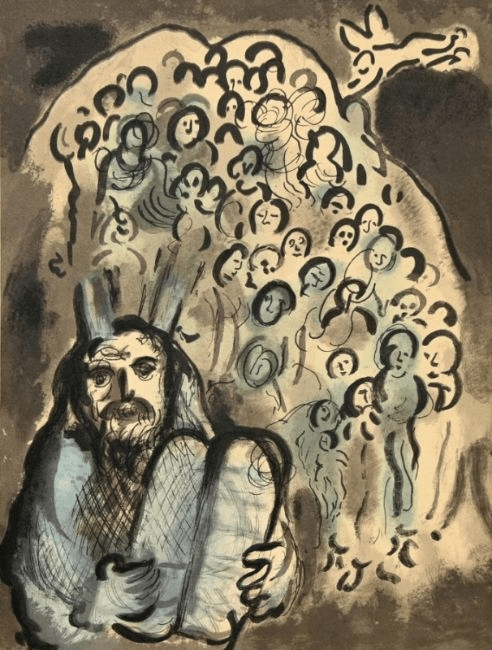
Moses and His People, by Marc Chagall, 1973

Moses and Joshua son of Nun recited this song, so that the people of Israel could hear it.

When Moses had finished giving God’s teachings to the people, he said, “Be sure to obey all these commands that I have given you today. Repeat them to your children, so that they may faithfully obey all of God’s teachings. These teachings are not empty words; they are your very life. Obey them and you will live long in that land across the Jordan that you are about to occupy.” (Good News Translation)

It seems that most people don’t like being told to do anything. There’s a lot of reasons for that. For me, it’s a trust issue. I have a very hard time obeying an authority that I don’t have much faith in.

That’s why I’m just fine submitting myself to God and obeying God’s commands and instructions – because I am firmly convinced that God knows what God is doing; and what’s more, that God has my best interests at mind and at heart.

The ancient Israelites were exhorted by Moses to obey all of God’s teachings because it would be the best way for them to live as a new nation in a new land. The Lord truly wanted what was best for the people, and so, God made sure to give them solid instructions on how to live and thrive together as a nation.

Deuteronomy is the fifth and final book of the Hebrew Torah, and of the Bible’s Pentateuch. The core of the book is a restatement of God’s Law received at Mount Sinai 40 years earlier for the generation about to enter the Promised Land.

The book of Deuteronomy emphasizes God’s love, justice, and transcendence; and stresses the covenant relationship between God and Israel. It looks forward to Israel’s life in the land being established. Foundational to their society, was maintaining God’s social and religious laws.

And those laws were in no way meant to be onerous or oppressive, but were a divine gift to the people. By obeying the Law, the divine/human relationship was secured and the people brought close to God. Foremost to the society was a humanitarianism and concern for the welfare of the poor and disadvantaged.

What’s more, Deuteronomy has a strong intellectual orientation. It urges all Israelites to study God’s laws. There is the expectation that everyone is to be smart and learn how to live wisely.

The participation of Joshua with Moses in teaching he laws was appropriate and important because Joshua was the one who would take over the leadership of Israel and bring them into the Promised Land. The leaders of the people were thoroughly committed to God’s Law – and it was through their wholehearted devotion that they could encourage others to follow them and do the same.

They were to take all of God’s words to heart. The mind, will, and emotions of individuals and families were to be captivated by the standard of God’s divine gift of the law to them. Only in this way would obedience truly become a reality. In other words, it takes complete faith and trust in order to obey.

The way to receive all the blessings of being in the land is through knowing God’s instructions and following them with wholehearted obedience. That means future generations need to be educated about the Law’s stipulations and about the necessity of obeying them with confidence.

Moses made it clear to the people that the divine laws are what life is to be oriented around. God and God’s Law cannot be separated because God’s Law is an expression of God’s very character. For the ancient Israelites, there was no other way.

Many generations later, King David received and learned these laws, understanding the relationship between the Lord and the Law:

The law of the Lord is perfect;
    it gives new strength.
The commands of the Lord are trustworthy,
    giving wisdom to those who lack it.
The laws of the Lord are right,
    and those who obey them are happy.
The commands of the Lord are just
    and give understanding to the mind. (Psalm 19:7-8, GNT)

When it comes to passing on the faith and spiritually forming others, we must have a holistic concern for both what and whom is being taught, as well as how to teach and why we do it. 

For Moses, he was open about expressing the great redemptive acts of God that brought deliverance and vindication to the people. He was convinced that there is no God but the Lord. And he wanted all Israel to know this and to never forget.

All of us, in every generation of believers, are to remember, recite, and rehearse the mighty acts of God, who secured salvation for us. We are responsible to learn, know, and keep the commands of the Lord in our hearts so that we can live into the freedom we possess as believers.

And the Lord has made it known that learning, knowing, remembering, and doing is no trifle thing; rather, this is our very life.

This is one reason why I have devoted myself to the reading, learning, teaching, and living of the Bible. It’s important stuff! And I can testify that living according to the understanding I have of God and Scripture is satisfying, as well as far superior to any other way I have ever tried to live before.

God’s Word must be personally received – no one else can do the work that I myself must do. God’s Word must be faithfully shared and communicated with our children. And God’s Word must be carefully obeyed and observed with head, heart, and hands. This is the responsibility of every believer.

Moses knew that the people could not possibly enjoy life if they deliberately chose to ignore the words given to them in love. I’m glad that, by grace, I know that, too.

Blessed Lord, who caused all Holy Scriptures to be written for our learning: Grant us so to hear them, read, mark, learn, and inwardly digest them, that we may embrace and ever hold fast the blessed hope of everlasting life, which you have given us in our Savior Jesus Christ. Amen.

To Believe, or Not (Mark 16:9-18)

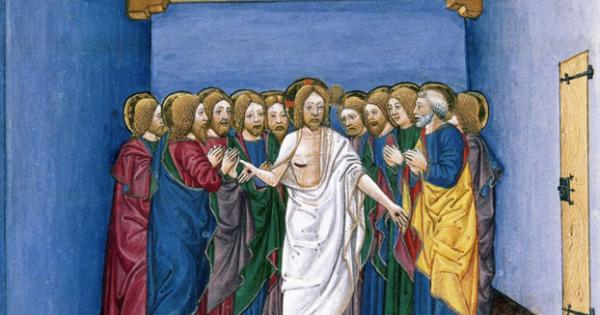
The risen Jesus appears to his disciples, by Unknown Italian artist, 1476

[Note: The earliest manuscripts and some other ancient witnesses do not have verses 9–20.]

When Jesus rose early on the first day of the week, he appeared first to Mary Magdalene, out of whom he had driven seven demons. She went and told those who had been with him and who were mourning and weeping. When they heard that Jesus was alive and that she had seen him, they did not believe it.

Afterward Jesus appeared in a different form to two of them while they were walking in the country. These returned and reported it to the rest; but they did not believe them either.

Later Jesus appeared to the Eleven as they were eating; he rebuked them for their lack of faith and their stubborn refusal to believe those who had seen him after he had risen.

He said to them, “Go into all the world and preach the gospel to all creation. Whoever believes and is baptized will be saved, but whoever does not believe will be condemned. And these signs will accompany those who believe: In my name they will drive out demons; they will speak in new tongues; they will pick up snakes with their hands; and when they drink deadly poison, it will not hurt them at all; they will place their hands on sick people, and they will get well.” (New International Version)

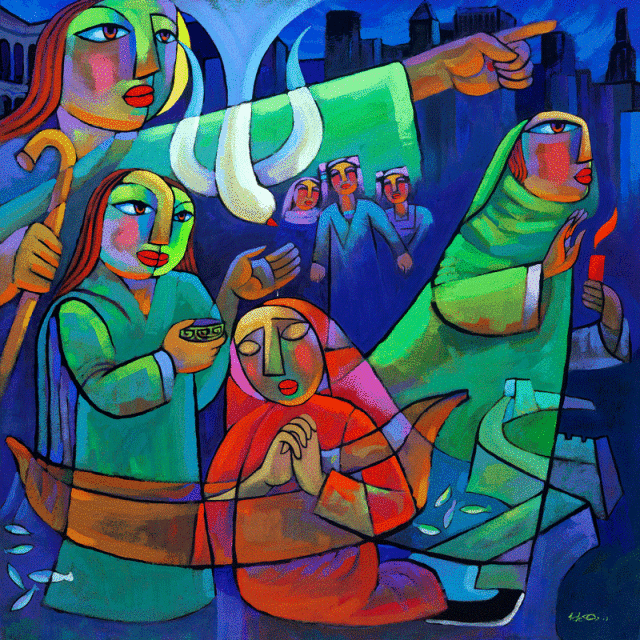
The Great Commission, by He Qi

So, how do you view the Bible? Some view it as a direct communication from God to human authors, as if the Lord actually wrote it all, akin to how Moses received the Ten Commandments. Others see the Bible as a thoroughly human invention of literature about God. And then there are those who are somewhere in-between the two views.

Textual criticism is a branch of study that examines a literary work, and aims to establish the original text. This is important and needed, especially since we have all sorts of ancient pieces of literature. We rely upon learned scholars who are fluent in the original languages, and in the examination of texts, so that we can have reliable translations of those texts.

Therefore, textual criticism of the Bible means thinking critically about manuscripts and variations in the biblical texts found in those manuscripts, in order to identify the original reading of the Bible. Keep in mind that, prior to the invention of the printing press, copies of everything had to be hand written. Scribes were trained scholars who meticulously copied manuscripts; and human error was always a part of the process.

The New Testament was copied by thousands of people in thousands of places in dozens of languages. Though that reality can make textual criticism rather complicated, this diversity is also a blessing; it speaks to the high probability that we have a very close and reliable authentic original Bible – namely because so many people were involved in copying scriptural texts.

Today’s lectionary reading is an entire chunk at the end of Mark’s Gospel that is very difficult to ascertain whether it was original to his writing, or not. If you are of the ilk that the Bible is a God-authored book, you will likely want to resolve this tension. And if you’re not, you just might be rolling your eyes at this point, as if this is all silly stuff that doesn’t matter.

I’m suggesting it is neither as silly nor as serious as some want to make it. It just is. And sometimes we must accept what is, without always having to explain it in objective Enlightenment terms; or relegate it to the realm of the ethereal and mystical.

Instead, we can deal with the text we have in front of us without any wringing of the hands, or ignoring it altogether. And what we have, it seems to me, is this: a text of Scripture that is consistent with the rest of Mark’s Gospel in showing us the nature of both belief and unbelief.

An ancient papyrus fragment of Mark’s Gospel

To believe, or not to believe? That is the question.

Throughout the Gospel of Mark, we are confronted with the choice of believing or disbelieving the acts of Jesus in his earthly ministry. And that issue of faith comes to a head with Christ’s resurrection.

The women exhibited belief. They made the pilgrimage to Christ’s tomb and discovered it empty. It is upon the testimony of women – even though a woman’s testimony was not considered reliable in that day – that believers know Christ is risen from death.

The men, however, are nowhere to be found. One reason for unbelief by people who ought to know better is that they go looking for all the wrong sort of evidence. While on this earth, Jesus refused to be like any sort of worldly ruler; he sought to use his authority by being a servant; and he tapped into the power of humility and love.

If we go limiting our epistemology (the study of how we receive knowledge) then we will likely not discover the truth about much of anything. The male disciples refused to believe the testimony of the female Mary Magdalene. The risen Christ finally showed himself and rebuked the stubborn men.

To see Jesus will take something else, something more, than our standard use of three dimensions and five senses and critical thinking skills. As important and needed as they are, it isn’t enough to truly see the risen Lord. We need to bring in some other epistemic impulses: the conscience and the gut; the spirit and the heart; intuition and experience; and the testimony of witnesses whom we would rather dismiss, than listen to.

Jesus ascends to heaven, but not everyone sees it – for obvious reasons. There are some who may search for evidence their entire lives, never to find it, because they want confirmation by means of their own mentally contrived and culturally conditioned constructs.

The Gospel is neither ant-intellectual nor only understood by the scholarly and learned; the good news of Jesus Christ is both simple and complex, easy to understand and hard to comprehend, compelling and revolting. And there is one thing for sure: the person and work of Jesus will always challenge us, change us, and move us.

The story is still being written, not just with pens and keyboards, with textual criticism and documentary evidence, but with mercy and love upon the tablet of the heart.

Lord, I want to believe. Help me in my unbelief! May I see and hear the risen Savior, through the enablement of the Spirit. Amen.

The Way of Love (Song of Songs 3:1-11)

Song of Songs III, by Marc Chagall, 1960

Night after night on my bed
I looked for the one I love.
I looked for him but did not find him.
I will get up now and roam around the city,
in the streets, and in the squares.
I will look for the one I love.
I looked for him but did not find him.
The watchmen making their rounds in the city found me.
I asked,
“Have you seen the one I love?”
I had just left them when I found the one I love.
I held on to him and would not let him go
until I had brought him into my mother’s house,
into the bedroom of the one who conceived me.

Young women of Jerusalem, swear to me
by the gazelles
or by the does in the field,
that you will not awaken love
or arouse love before its proper time.

Who is this young woman coming up from the wilderness
like clouds of smoke?
She is perfumed with myrrh and incense
made from the merchants’ scented powders.
Look! Solomon’s sedan chair!
Sixty soldiers from the army of Israel surround it.
All of them are skilled in using swords,
experienced in combat.
Each one has his sword at his side
and guards against the terrors of the night.
King Solomon had a carriage made for himself
from the wood of Lebanon.
He had its posts made out of silver,
its top out of gold,
its seat out of purple fabric.
Its inside—with inlaid scenes of love—
was made by the young women of Jerusalem.
Young women of Zion, come out and look at King Solomon!
Look at his crown,
the crown his mother placed on him on his wedding day,
his day of joyful delight. (God’s Word Translation)

Song of Songs III, by Marc Chagall, 1960

Eastertide is a celebration of new life through exploring the implications of living a resurrected life. A significant dimension to that life is a new awakening and awareness of love. Being raised to a new life of love means that we can dispense with old ways of looking at love that were unhealthy for us.

King Solomon’s Song of Songs has been viewed throughout the history of biblical interpretation in various ways. It’s been seen as a celebration of sexual love between a man and a woman. Others view the Song as a description of the mutual love between God and Israel or Christ and the Church.

With whatever approach we examine this unique book of Holy Scripture, I believe it’s helpful for us to avoid looking at it too literally, as if it were a sex manual for spiritually minded newlyweds.

For most of church history, the book has been viewed allegorically and metaphorically, not literally. So, it seems to me, this warrants the interpreter to walk mindfully and wisely through its wonderful prose, and not like some arrogant and supposed Romeo who believes they are God’s gift to scripture interpretation.

The Song of Songs, at its heart, is really an ode to Love itself. Love is the force that binds us together as humans, and comes from the One who is pure Love. As such, Love is perhaps the most potent strength in the universe. Thus, Love needs to be respected. Love must be handled with care, because its power can harm us if we are careless with it.

Longing for love is a universally understood feeling. The need for love is so great that the woman in today’s Old Testament lesson will put herself at considerable risk in order to seek and find her beloved in the middle of the night on the city streets.

“You have to keep breaking your heart until it opens.”

Rumi, 13th century Persian poet

Love, however, is not to be awakened before its proper time. Certainly, to love is to risk, for we choose to put ourselves out there for the sake of giving and receiving love. Yet, there are to be limits on that pursuit. Seeking love can put one in a hazardous situation. It’s best, therefore, to allow some patience with love, to not rouse love with blind desire.

Love will have its way; we need not force it before its true readiness.

The woman longs for her beloved. The pain of separation is almost too much for her to bear. Love hurts. There is, however, good pain and bad pain. The pain of waiting and wondering has a purpose which we need to submit to, and follow. It is an opportunity for careful reflection, mindful contemplation, and healthy introspection.

Without these spiritual disciplines, the problem of fear arises – not love – and begins to gnaw at us, that perhaps we are unloved. Thoughts and feelings of insecurity can creep in and dog us with incessant and obnoxious barking.

But we must trust in Love. Love cannot be domesticated, nor fully defined, and that is a good thing – because Love is much bigger than any of us. And it’s also good that we cannot precisely interpret nor explain all of the contents within the Song of Songs. The book is a good reminder that Holy Scripture stands above us, and not the other way around.

God is Love. And Love is God. True human love serves as a symbol of divine love. We not so much come to understand the ways of God and Love, as we discover it, describe it, and then determine to live it.

People never fully connect to God, at least this side of heaven, in much the same way as the desired rendezvous of the lovers in the Song never explicitly occurs. The God we seek is the God who corresponds to our needs and desires, our loves and our fears.

And yet, God is also wholly other than us; God is revealed to humanity by means of Scripture. God issues decrees and commands that may not seem as if they sync with our perceived needs. From this perspective, people must obey, regardless of any feeling.

God is, therefore, both approachable to us and completely apart from us, at the same time, all the time. God engages with us in intimate personal spiritual experiences; and God also reaches out through Scripture in human/divine encounters. Both ways are approaches of love, initiated by the One who loves us.

No matter what the question is, Love is always the answer. This is the way.

Creator God, by the mercies of your son, our Lord, Jesus, compel us to turn our hearts to the way of Love, so that we may follow Christ as your faithful people. Guide us, we pray, to Love. Amen.

How Can Young People Keep Their Lives Pure? (Psalm 119:9-16)

How can young people keep their lives pure?
    By obeying your commands.
With all my heart I try to serve you;
    keep me from disobeying your commandments.
I keep your law in my heart,
    so that I will not sin against you.
I praise you, O Lord;
    teach me your ways.
I will repeat aloud
    all the laws you have given.
I delight in following your commands
    more than in having great wealth.
I study your instructions;
    I examine your teachings.
I take pleasure in your laws;
    your commands I will not forget. (Good News Translation)

Every historical age, and every generation of people has its own struggles. Of course, the challenges vary widely depending on who you ask – young adults of different races, income levels, and geographic locations often have different concerns or prioritize the same concerns differently.

Young people today have particular challenges concerning money, school, violence, sex, climate change, social media, and many other issues. And they face them in different ways than I had to deal with them (back when I was considered young).

Yet, no matter the struggle, nor the concern, the ability to remain set apart for godly purposes is perhaps the main challenge for a spiritual young person. How can a young person keep their life pure?

The psalmist asked the question, and gave a straightforward answer: By obeying God’s commands.

Knowing the answer, however, is only part of attaining and maintaining purity of life. One must put in the hard work necessary to achieve it and hold onto it. And the psalmist helps out with that, as well.

An engagement with the following spiritual practices is how the young person can live into obedience to God and be pure. It’s necessary to frame them as “I will” statements, so that we continually understand that these spiritual practices are vital, and not optional, to a successful life of purity.

I Will Put Energy Into Prayer

It’s one thing to throw up a few prayers in the heat of the moment. But it’s an altogether different thing to devote oneself to prayer and intentionally put the time and energy into praying.

Devote yourselves to prayer, being watchful and thankful. (Colossians 4:2, NIV)

Let there be no excuses in developing a robust prayer life – with the content of those prayers including petitions to avoid falling into disobedience.

I Will Hold God’s Word In My Heart

This is the primary means of keeping sin at bay and maintaining purity and holiness. The Scriptures are meant to be read, ingested, meditated upon, ruminated on, contemplated, and lived. Bibles are not intended to adorn coffee tables; they are designed for their contents to be known.

We can only hold what we have. To keep God’s Word in the heart, it must be taken into that heart.

I have hidden your word in my heart, that I might not sin against you. (Psalm 119:11, NLT)

I Will Praise God

Praise to God arises organically whenever we truly take in the words of God. That’s because God’s Word is life. Praising the Lord is a consistent theme throughout Holy Scripture, as people experience the grace and goodness of God.

I will praise you, Lord!
    You always do right.
I will sing about you,
    the Lord Most High. (Psalm 7:17, CEV)

I’ve thrown myself headlong into your arms—
    I’m celebrating your rescue.
I’m singing at the top of my lungs,
    I’m so full of answered prayers. (Psalm 13:5-6, MSG)

I Will Repeat Aloud God’s Word

It’s a good thing to read the Bible and know the commands of God. It’s an even better thing to read, out loud, and read it more than once.

“…Ezra the priest brought the Law before the assembly, which was made up of men and women and all who were able to understand. He read it aloud from daybreak till noon… in the presence of the men, women and others who could understand. And all the people listened attentively to the Book of the Law.” (Nehemiah 8:2-3, NIV)

Ezra Reads the Law to the People, by Bernadette Lopez

This, in fact, is how we actually get God’s Word impressed on our minds and into our hearts. It’s important for Scripture to move from our short term memory into our long term memory. Then, we can draw from it, especially in those times when we need immediate wisdom or comfort or help.

Just as praise is organic, so God’s Word can spontaneously come out of us – that is, if we have prepared ourselves by filling up the soul to the full of Scripture. Then, helpful words and theology begin to overflow out of us, and benefits everyone.

I Will Delight in Obedience

Submission doesn’t come naturally to most people; it requires intentional development. We need a plan for getting the commands of God inside us. Then they can be familiar to us. And we can follow those commands with all the grace and ability the Lord grants us.

This is more than woodenly following some rules. Keeping to the letter of the Law only engages the mind. The heart needs to be involved, as well. We must also keep the spirit of the Law. And that can happen by learning to delight in obeying God.

Trust in the Lord and do good;
    dwell in the land and enjoy safe pasture.
Take delight in the Lord,
    and he will give you the desires of your heart…

The Lord makes firm the steps
    of the one who delights in him;
though he may stumble, he will not fall,
    for the Lord upholds him with his hand. (Psalm 37:3-4, 23-24, NIV)

I Will Study God’s Word

Learning to delight in God’s commands logically leads toward wanting to examine those commands more closely, to take a good hard look at the biblical teachings available to us.

We don’t necessarily need to become Bible scholars in order to study. We just need the desire and a way to take a closer examination at Scripture. A good way to begin is engaging in a practice known as Lectio Divina.

Lectio Divina is an ancient Latin term which means “spiritual reading.” It is to read Holy Scripture not just to know its contents, but to experience its power to restore, heal, transform, and draw close to God. 

This is a simple way to prayerfully read the Bible, meditate on its message, and listen for what God may be saying for us to do. The goal is to become more Christ-like.

Lectio Divina is based upon reading a selected text of Scripture three times. Each reading is followed by a period of silence after which we respond to God with what we are hearing as we listen.

First Reading

During the first reading, read the text aloud twice. Read slowly and carefully. The purpose of the first reading is to hear the text and listen for a word, phrase or idea that captures your attention. Focus your attention on it, repeating it within your mind several times.

Second Reading

During the second reading, read the text again. This time, focus your attention on how the selected word, phrase or idea speaks to your life. What does it mean for you today? How is Christ, the Word, speaking to you about your life through this word, phrase or idea? After reading, observe a period of silence, then express a brief prayer to God.

Third Reading

Read the text again. This time, focus on what God is calling you to do or to become. Experiencing God’s presence changes us. It calls us to something. During this final reading, focus on what God is calling you to do or to be. Again, observe a period of silence, then pray to God about what you believe you are being called to do or to be.

I Will Take Pleasure in God’s Word

It is probably a foregone conclusion, that when we commit our energy to prayer, hold the Word near and dear to our heart, praise God, speak aloud the words of God, delight in and study divine instruction, we will find ourselves enjoying every moment of it – and living a pure and holy life.

We will discover that God takes pleasure in us. This enjoyment of God over us is so compelling and gracious, that it’s almost as if we cannot help but reciprocate with praise, adoration, and devotion to holiness of life.

There is no arm-twisting in this realm of enjoyment. No need to gin-up motivation, nor to try and get obedience and purity out of others.

The sooner we all learn that the world truly spins on an axis of mercy, the quicker folks will realize a better way to live than endless rules and pronouncements.

For the Lord is always true to the basic divine character of pure steadfast love through what is right, just, and good. Amen.