A Reality Check (Hebrews 10:1-4)

The law is only a shadow of the good things that are coming—not the realities themselves. For this reason it can never, by the same sacrifices repeated endlessly year after year, make perfect those who draw near to worship. Otherwise, would they not have stopped being offered? For the worshipers would have been cleansed once for all and would no longer have felt guilty for their sins. But those sacrifices are an annual reminder of sins. It is impossible for the blood of bulls and goats to take away sins. (New International Version)

Sometimes, we silly people confuse the sign for the real deal. It’s important to distinguish between the two. We discern the difference all the time when it comes to more mundane affairs.

People generally know that looking at a movie poster is not watching the actual film; that wearing a string of cheap pearls is only mimicking the real and expensive ones; or that sitting in a doctor’s waiting room isn’t the same thing as being in the appointment.

However, when it comes to our religion, we seem to blur the lines between sign and substance. Praying a “sinners prayer” or making a profession of faith isn’t the same as growing, maturing, following, and living a committed Christianity.

Knowing some Christian lingo and/or going with the flow of cultural Christianity doesn’t necessarily mean that Christ’s words and ways are being followed.

And today’s New Testament lesson is a reminder, and not a guilt trip, that the law points to the actual substance of religious life – and is not life itself.

The laws surrounding the old system of animal sacrifice were never meant to be an end in itself. It pointed forward to the real deal and was, therefore, completely inadequate to bring deliverance from sin, death, and hell to anyone.

The very fact that sacrifices needed to be repeated year and after year demonstrated that they were ineffectual in saving a person. Rather, those sacrifices were designed to cause the worshiper to long for a sacrifice to end all sacrifices – to anticipate that the sin issue would be settled once and for all.

The only thing the sacrifices did was remind people they were sinners in need of a savior. Just as a slap on the hand is grossly inadequate for handling a murderer, so offering an animal was never going to do the trick in taking care of divine justice.

And besides, God has never been pleased with a bunch of sacrifices anyway. So, what is God really pleased with? The Lord is pleased with a heart devoted to obedience and fealty to Jesus Christ; God cares about inner attitudes and dispositions of the spirit which are inclined toward righteousness, holiness, mercy, humility, and justice for all.

Sacrifices, in and of themselves, have no power; they are like a toothless lion who couldn’t bite into you if he tried. The way to set things right is through the once for all mighty sacrifice of the Son – an offering to end all offerings.

God doesn’t want a checklist of daily sacrifices, any more than a spouse only wants supper on the table at night, or a paycheck every month. It’s nice but falls short of the full scope of marital interactions and relations. A marriage built on law won’t stand. It needs real flesh and blood relationship, complete with a devoted heart, sincere attitudes, and loving words and actions.

Since Christ has ably and permanently taken care of the sin issue, what sort of impact ought that to have on the Christian’s life? What kind of people are we to be?

To begin listing things to do is to go back to law and fail to grasp the gospel. And that’s where many churches and believers get tripped up and miss the grace of God altogether. Observing rules of cultural Christian activities or holding to some accepted Christian norms isn’t going to cut it.

Christ’s Sermon on the Mount by Jorge Cocco Santángelo

Jesus described the sort of people who go beyond ritual regulations and rules to embrace the true spirit and end of the law:

“You’re blessed when you’re at the end of your rope. With less of you there is more of God and his rule.

“You’re blessed when you feel you’ve lost what is most dear to you. Only then can you be embraced by the One most dear to you.

“You’re blessed when you’re content with just who you are—no more, no less. That’s the moment you find yourselves proud owners of everything that can’t be bought.

“You’re blessed when you’ve worked up a good appetite for God. He’s food and drink in the best meal you’ll ever eat.

“You’re blessed when you care. At the moment of being ‘care-full,’ you find yourselves cared for.

“You’re blessed when you get your inside world—your mind and heart—put right. Then you can see God in the outside world.

“You’re blessed when you can show people how to cooperate instead of competing or fight. That’s when you discover who you really are, and your place in God’s family.

“You’re blessed when your commitment to God provokes persecution. The persecution drives you even deeper into God’s kingdom. (Matthew 5:3-10, MSG)

That describes folk who have embraced faith as the fulfillment of law. It’s a summary of the law’s intended purpose and end.

So, let’s worship Christ; and not some caricature of him. Maybe carefully reading through the entire book of Hebrews in one sitting will help.

Blessed God, purify your people by your abiding presence. Enlighten the minds of your people with the light of your good news. Bring wandering souls to an awareness and knowledge of Jesus Christ; and those who are walking in the way of life, keep them steadfast to the end. Guard those who are strong and prosperous from forgetting you. Increase in us your many gifts of grace and make us all fruitful in good works for the sake of Christ in the power of the Holy Spirit. Amen.

The Tension of Advent (Hebrews 11:32-40)

What else can I say? There isn’t enough time to tell about Gideon, Barak, Samson, Jephthah, David, Samuel, and the prophets. Their faith helped them conquer kingdoms, and because they did right, God made promises to them. They closed the jaws of lions and put out raging fires and escaped from the swords of their enemies. Although they were weak, they were given the strength and power to chase foreign armies away.

Some women received their loved ones back from death. Many of these people were tortured, but they refused to be released. They were sure they would get a better reward when the dead are raised to life. Others were made fun of and beaten with whips, and some were chained in jail. Still others were stoned to death or sawed in two or killed with swords. Some had nothing but sheep skins or goat skins to wear. They were poor, mistreated, and tortured. The world did not deserve these good people, who had to wander in deserts and on mountains and had to live in caves and holes in the ground.

All of them pleased God because of their faith! But still they died without being given what had been promised. This was because God had something better in store for us. And he did not want them to reach the goal of their faith without us. (Contemporary English Version)

God has entered history through the incarnation of Jesus Christ. In this season of Advent, Christians everywhere enter a time of anticipation, waiting, and hoping. Advent is meant to stir our awareness of God’s actions – past, present, and future.

During this time of year, we need to feel the tension between what is and what is yet to come. Christ has come, in his first advent, to seek and save the lost. And yet, not all things have reached completion. Our deliverance from sin, death, and hell has been accomplished through the cross of Christ; yet this salvation isn’t here in it’s fullness. That will come when Jesus returns in his second advent to judge the living and the dead.

Which is why today’s New Testament lesson is perfect for the Advent season. It captures this awkward tension between already having something but not yet possessing it. It’s the tension of the Christian life. Celebration and hope are practiced together because we rejoice in what is, while confidently expecting what is not yet.

Throughout every era, people of faith have lived with the rubber band existence of feeling the extreme stretch without being broken by the pressure. Our spiritual ancestors didn’t break because of their hope. And the persons mentioned by the author of Hebrews inspire us to join them on this journey of perseverance until the promises of God are fully realized.

Gideon, Barak, Samson, and Jephthah all defeated large armies with just a few people because their robust faith melted circumstantial fear.

David, Samuel, and the prophets proclaimed truth, justice, and righteousness, knowing there would be adverse circumstances to speaking up and out.

People overcome dark times, establish what is just and right, gain what is promised, and do incredible things because they are looking beyond the present here-and-now of their difficulty to see something better. They know that their actions now will connect to better times ahead.

That’s what Shadrach, Meshach, and Abednego did in the face of overwhelming heat in a fiery furnace. It’s what Moses, Elijah, and David did by escaping the edge of the sword. They all refused to be thwarted in their mission and purpose for the world.

There were those who willingly endured torture and death rather than get sidetracked from their purpose. They were able to do it because they truly believed that their suffering and death was not the end of it. Better days were ahead and not even death could stop it.

This tends to make our own proclivities toward giving up when things are hard look really wimpy. Far too many folks have their focus in the wrong place – trying to change circumstances and other people – instead of focusing on simply being faithful to what God calls us to do.

We likely won’t have to undergo joint dislocations, torture racks, crushed bones, catapults, thumbscrews, branding irons, and a hundred other devious devices for trying to make a human’s spirit break.

Yet, we are presently enduring the subtly evil machinations of gaslighting, emotional manipulation, mental torture, spiritual abuse, and a hundred other sinister ways of attempting to break our will and commitment to what is right, just, and true.

The present awful consequences mean little whenever we’re able to connect what we’re doing to our coming heavenly reward. If the faithful people of the past could live and die in faith, no matter the circumstances, so can we.

Someday, everything will be made right by God. And when that day happens, we will experience it together as one people of God – all the believers of the past and us together. Right now, this present moment, the saints who have gone before us are patiently waiting for us….

Almighty God, give us grace to cast away the works of darkness, and put on the armor of light, now in the time of this mortal life in which your Son Jesus Christ came to visit us in great humility; that in the last day, when he shall come again in his glorious majesty to judge both the living and the dead, we may all rise together to eternal life, through him who lives and reigns with you and the Holy Spirit, one God, now and forever. Amen.

Real Forgiveness (Hebrews 9:23-28)

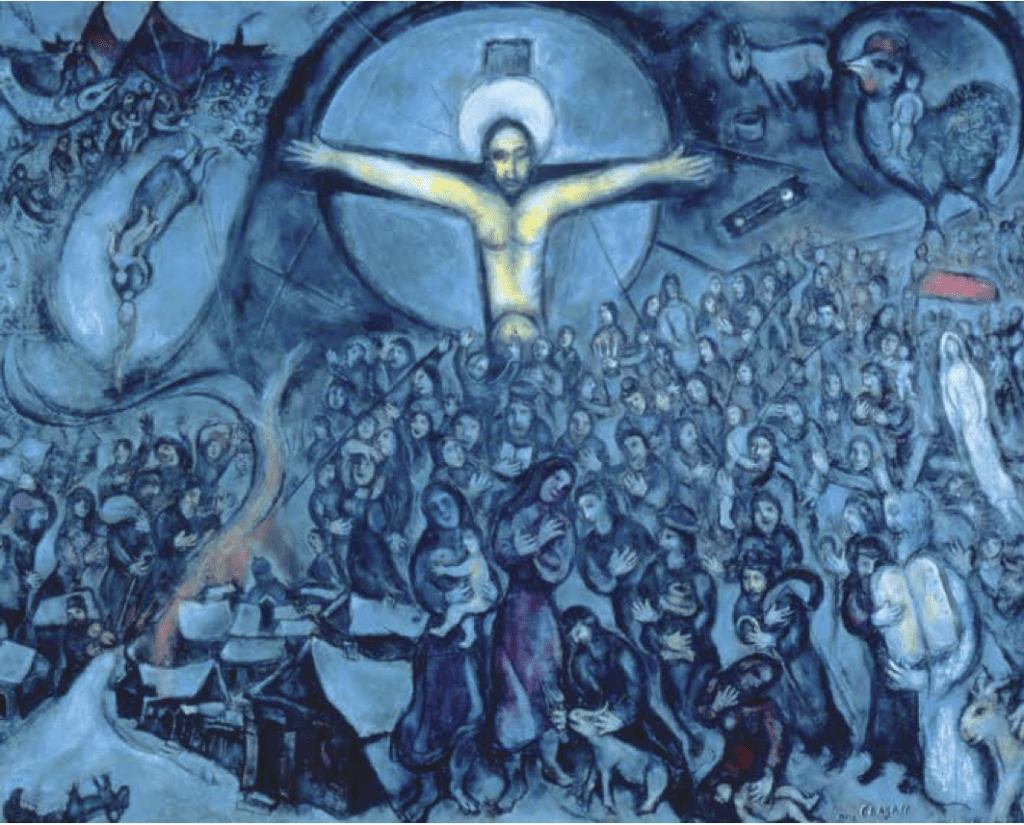
By Marc Chagall, 1941

It was necessary, then, for the copies of the heavenly things to be purified with these sacrifices, but the heavenly things themselves with better sacrifices than these. For Christ did not enter a sanctuary made with human hands that was only a copy of the true one; he entered heaven itself, now to appear for us in God’s presence. Nor did he enter heaven to offer himself again and again, the way the high priest enters the Most Holy Place every year with blood that is not his own. Otherwise Christ would have had to suffer many times since the creation of the world. 

But he has appeared once for all at the culmination of the ages to do away with sin by the sacrifice of himself. Just as people are destined to die once, and after that to face judgment, so Christ was sacrificed once to take away the sins of many; and he will appear a second time, not to bear sin, but to bring salvation to those who are waiting for him. (New International Version)

In truth, I could preach on the Cross every Sunday and never exhaust the immensely rich implications of Jesus Christ’s death for us. 

Perhaps, for many Christians, today’s New Testament lesson seems like a re-hashing of things we already know. Yet, it is important to keep plumbing the depths of Christ’s once-for-all sacrifice, because, through continual examination of Christ and the Cross:

  • We will know, both intellectually and experientially, that our forgiveness is real. 
  • We will be able, both spiritually and emotionally, to extend real forgiveness to others.

The original recipients of Hebrews were experiencing spiritual fatigue due to their difficult circumstances. The believers were so worn down from swimming upstream of their problems, that they considered throwing in the towel and giving up on Christianity (or at least the Church). 

The author of Hebrews truly believed that the way to combat this tiredness was through a robust understanding of Christ and the Cross. So, he sought to demonstrate that Jesus is superior to the old sacrificial system and has superseded it. 

There are three main distinctions between the old sacrificial system and the new way of Christ so that we will be encouraged to know that our forgiveness is real.

Reality vs. Simulation

The Old Testament sacrificial system, and its worship rituals in dealing with the sin issue, were only a copy and a shadow of the real sacrifice, which is Christ. The Temple sacrifices, in other words, were merely a facsimile of the real thing.

The difference between the old temple sacrifices and the sacrifice of Christ, is like the difference between riding a mechanical horse and an actual horse. Mechanical horses are merely a simulation of real riding.

Since Christ has come as the real sacrifice for sin, we need no longer be content with simulations and copies of the real deal. The Christian’s forgiveness is neither a simulation nor a copy because Christ is the real thing. 

By Marc Chagall, 1952

Jesus did not just mechanically mouth words of forgiveness to us; Christ secured real forgiveness through his death on a cross. This is no cheap imitation of forgiveness. Christ died an actual violent death.

The emphasis in Scripture on blood and sacrifice can be upsetting for many people. Yet, we need to understand that the brokenness of this world is so bad that it requires drastic action. Christ’s death reflects the horrible sin of humanity. Since Jesus has secured forgiveness for us at such a steep price, we are to receive it with great humility and joy, knowing that God loves us that much.

Permanent vs. Temporary

Jesus Christ dealt with the sin issue once and for all through his blood. He came to do away with sin, not just veneer over it. The old sacrificial system was like whitewashing a barn – it took care of the issue for a while, but it would need to be done over and over again.

We are familiar with temporary arrangements. For example, annual fees need to be paid and renewal stickers have to be put on a car’s license plate every year. Christ’s atonement, however, is no temporary arrangement. The forgiveness Jesus offers is permanent.

There is no need to keep offering sacrifices over and over because Christ is the sacrifice to end all sacrifices. The forgiveness we possess is not like paying an annual fee and getting a forgiveness sticker for the year. In Jesus Christ, we are forgiven! And this forgiveness was purchased with Christ’s own blood.

The cross that held Christ’s naked and marred body, exposed the violence and injustice of this world. The Cross revealed what kind of world we have and what kind of God we have: a world of gross unfairness, and a God of sacrificial love. Because Jesus was willing to do this on our behalf, we have a permanent forgiveness, settled once and for all, through his blood.

This old world needs real forgiveness that lasts forever – not a cheap sentimental forgiving that is merely a flash in the pan. 

Salvation vs. Judgment

A lot of religious energy can be spent trying to figure out how to make ourselves acceptable to God.

Part of the good news is that, in Christ, we do not need to fear the future. We have been made right with God through the death of Jesus. Through Christ’s sacrifice, the doors to heaven and earth get flung wide open. The way has been secured, the trail has been blazed, and the road has been made smooth to come to God.

Jesus, unlike any Levitical priest, has entered God’s presence, providing access to the living God. Christ did not need to offer sacrifice for his own sins but offered himself solely on our behalf. Jesus did more than offer the sacrifice; he himself became the sacrifice. It was a sacrifice to bring deliverance to humanity, not judgment.

Either to justify or to judge is God’s business, not ours. Our concern is to believe in the once-for-all sacrifice of Jesus that brings a permanent forgiveness; and, to share that life-giving message with others so that they, too, can experience deliverance from sin, death, and hell.

We can have such a hard time forgiving others because we struggle with experiencing our own forgiveness. The path to extending grace to others is in deepening our knowledge, understanding, and awareness of God’s grace in Christ.

Conclusion

The author of Hebrews meant for the Christian life to be an exciting and abundant adventure of following Jesus, the pioneer of our salvation.

And yet, many Christians do not know anything about this kind of life. They only see the Christian life as a duty and a chore, a kind of cross to bear. We must recognize that it is the Savior, Jesus Christ, the object of our faith, who has delivered us so that we can live a new life of freedom, enjoying our forgiveness and inviting others on the journey.

For he has rescued us from the kingdom of darkness and transferred us into the Kingdom of his dear Son, who purchased our freedom and forgave our sins.

Colossians 1:13-14, NLT

Jesus didn’t die on a cruel cross, then rise from death so that we could live ho-hum Christian lives.

Christ has granted us forgiveness so that we will enjoy the Christian life, appreciate the Word of God; relish in laboring together for the Gospel; and look forward with anticipation to how the Spirit will transform lives through Christ’s forgiveness. 

Real forgiveness opens our minds, hearts, and energies to live for Jesus, the pioneer of our salvation.

Lord Jesus Christ, you stretched out your arms of love on the hard wood of the cross that everyone might come within the reach of your saving embrace. Clothe us in your Spirit that we, reaching forth our hands in love, may bring those who do not know you to the knowledge and love of you; for the honor of your Name. Amen.

Hebrews 13:7-21 – Keep On Doing Good

Remember your leaders, who spoke the word of God to you. Consider the outcome of their way of life and imitate their faith. Jesus Christ is the same yesterday and today and forever.

Do not be carried away by all kinds of strange teachings. It is good for our hearts to be strengthened by grace, not by eating ceremonial foods, which is of no benefit to those who do so. We have an altar from which those who minister at the tabernacle have no right to eat.

The high priest carries the blood of animals into the Most Holy Place as a sin offering, but the bodies are burned outside the camp. And so, Jesus also suffered outside the city gate to make the people holy through his own blood. Let us, then, go to him outside the camp, bearing the disgrace he bore. For here we do not have an enduring city, but we are looking for the city that is to come.

Through Jesus, therefore, let us continually offer to God a sacrifice of praise—the fruit of lips that openly profess his name. And do not forget to do good and to share with others, for with such sacrifices God is pleased.

Have confidence in your leaders and submit to their authority, because they keep watch over you as those who must give an account. Do this so that their work will be a joy, not a burden, for that would be of no benefit to you.

Pray for us. We are sure that we have a clear conscience and desire to live honorably in every way.I particularly urge you to pray so that I may be restored to you soon.

Now may the God of peace, who through the blood of the eternal covenant brought back from the dead our Lord Jesus, that great Shepherd of the sheep, equip you with everything good for doing his will, and may he work in us what is pleasing to him, through Jesus Christ, to whom be glory for ever and ever. Amen. (New International Version)

I once rode a horse named “Old Glue.” The tired old horse got his name because he stuck to the ground like glue. I can testify firsthand that it took a furious amount of kicking to get that the old guy to move at all. 

I think about Old Glue every time I look at the final chapter of Hebrews. It feels like the author is firing off exhortation after exhortation trying to kick some life into a group of people who have lost their enthusiasm for Jesus:

  • Don’t forget about your spiritual leaders who faithfully keep watch over you and model how to live the Christian life
  • Don’t be fooled by a bunch of unfamiliar and strange gobbledygook teachings
  • Share in the disgrace of Christ by sharing in his sufferings
  • Keep offering praise to God in the name of Jesus
  • Don’t forget to help others through benevolence and generosity
  • Live a sacrificial life
  • Pray for your spiritual fathers and mothers
  • Be generous
  • Do good!

All these exhortations come kicking one after the other in a short amount of space. The reason why we ought to pay attention to them is that we were bought at the price of Christ’s blood. God has redeemed us with the ultimate price.

Let’s not allow ourselves to get fatigued doing good. At the right time we will harvest a good crop if we don’t give up or quit.

Galatians 6:9, MSG

We need to work at becoming holy and to serving with genuine Christian love as if this was the last day of our lives. 

We are to run like wild stallions for Jesus, instead of being stuck to the ground like Old Glue. 

Don’t be hateful to people, just because they are hateful to you. Rather, be good to each other and to everyone else. (1 Thessalonians 5:15, CEV)

There is no advantage to only moving when there is something in it for “me.” There is no benefit in griping and complaining. Yet there is eternal advantage in trotting along for the Savior. There’s life in following the trail outside the camp and meeting Jesus at the place of humility, disgrace, and suffering. 

After all, if it is God’s will, it’s better to suffer for doing good than for doing wrong. (1 Peter 3:17, GW)

There is no advantage to being stubborn and having to constantly be prodded into moving. However, there is joy awaiting the believer who learns to move with the unforced rhythms of grace.

Don’t be like Old Glue.

Keeping going. Keep doing good.

May Jesus help you do what pleases God. To Jesus Christ be glory forever and ever! Amen.