Listen (Jeremiah 42:18-22)

This is what the Lord Almighty, the God of Israel, says: ‘As my anger and wrath have been poured out on those who lived in Jerusalem, so will my wrath be poured out on you when you go to Egypt. You will be a curse and an object of horror, a curse and an object of reproach; you will never see this place again.’

“Remnant of Judah, the Lord has told you, ‘Do not go to Egypt.’ Be sure of this: I warn you today that you made a fatal mistake when you sent me to the Lord your God and said, ‘Pray to the Lord our God for us; tell us everything he says and we will do it.’ I have told you today, but you still have not obeyed the Lord your God in all he sent me to tell you. So now, be sure of this: You will die by the sword, famine and plague in the place where you want to go to settle.” (New International Version)

We all find ourselves in trouble at one time or another. The real issue is whether we’re in trouble for no fault of our own, or if we’re in dire straits because of our own stubbornness and stupidity.

God tends to take a lot of flack from us humans, whenever we are in the middle of trouble. Yet, much of the time, it’s our own dang fault for not listening to God in the first place.

Whenever other people are hard-hearted and unjust, we’re ready for some divine judgment to happen. But when it’s me, all I want is some mercy and grace, some understanding and acknowledgment of my predicament. We have got to realize that what’s good for the goose is good for the gander.

Talk can be cheap. The ancient people of Judah verbally affirmed their dedication to doing what God would tell them to do. And then, like some sort of spiritual dementia, they seemed to forget everything they said, and turned around to disobey all they heard from God.

It all came down to an issue of trust. The people looked to Egypt for their deliverance from the Babylonian army, instead of turning their faces toward God and doing exactly what the Lord wanted.

So, the Lord, an ever-present power much like the force of gravity, let the people know that if they’re going to ignore that force, they’ll end up falling and breaking their bodies.

People make mistakes. They do stupid things. And they sin against God and others. It happens. But how we respond to it all is highly important. If we don’t learn from our missteps, and choose to keep living without adjusting our lives to God’s abiding presence in the world, we can expect trouble.

A prudent person foresees danger and takes precautions.
    The simpleton goes blindly on and suffers the consequences. (Proverbs 27:12, NLT)

The ancient people of Judah had already suffered one Babylonian invasion. Now they were faced with yet another. The people wanted to flee. But their looking to Egypt was not a wise avoidance; it was an attempt to stick their heads in the sand, to put their fingers in their ears and shut tight their eyes. Instead, they needed to stay put and face the music.

The prophet Jeremiah reminded the people that, in this situation, there was a dual danger: It’s bad to go to Egypt, so don’t do it; and it’s really bad to disobey God, so listen and do what the Lord says.

Ignorance puts everyone in jeopardy. To follow through with plans that are diametrically opposed to what God has specifically said not to do, puts the entire community in the grip of a death sentence. After all, the Lord already knows what’s up and what’s going to happen if we foolishly amble into a hornet’s nest of trouble on top of trouble.

Whenever people are cursed, it’s typically because they refuse to listen; they don’t heed the warnings and end up doing something out of their anxiety, instead of acting with wisdom.

Unnecessary suffering comes from disobedience. Disobedience is a result of ignorance. And ignorance comes from purposefully not listening to sage advice, divine commands, and the wisdom of the ages.

It all comes down to giving focused attention so that we might hear and heed the voice of God. This is why the spiritual practices of solitude, silence, stillness, and contemplative and centering prayers are so very important. It puts us in a position to listen with open ears and receptive hearts.

The following are four guidelines of centering prayer, offered by one of the masters of this form, Father Thomas Keating, Intimacy with God: An Introduction to Centering Prayer:

  1. Choose a sacred word as the symbol of your intention to consent to God’s presence and action within.
  2. Sitting comfortably and with eyes closed, settle briefly, and silently introduce the sacred word as the symbol of your consent to God’s presence and action within.
  3. When engaged with your thoughts, body sensations, feelings, images, and reflections, return ever-so-gently to the sacred word.
  4. At the end of the prayer period, remain in silence with eyes closed for a couple of minutes.

The best way to avoid unnecessary trouble, heed biblical warnings, and listen to the divine is by aspiring and dedicating oneself to a genuine spiritual life.

St. John of the Cross, a spiritual giant of a prayerful and listening life, wrote in the sixteenth century, “God spoke one word from all eternity and he spoke it in silence, and it is in silence that we hear it.”

The reason God is so often silent, is that silence is God’s first language; all other verbal languages are but poor translations. Centering ourselves in prayer is a needed preparation for the contemplation that enables us to hear and listen well to the language of God.

Perhaps if the people in Jeremiah’s day did so, they would not have found themselves in such a dire predicament.

Almighty and everlasting God, make me ready, when your voice is truly heard, so that I may respond with glad obedience glad and steady devotion, silent and still to follow every word. Speak, Lord, for I am listening. Amen.


Listen and See (Isaiah 42:14-21)

For a long time, I, the Lord,
    have held my temper;
now I will cry out and groan
    like a woman giving birth.
I will destroy the mountains
    and what grows on them;
I will dry up rivers and ponds.

I will lead the blind on roads
    they have never known;
I will guide them on paths
    they have never traveled.
Their road is dark and rough,
    but I will give light
to keep them from stumbling.
    This is my solemn promise.

Everyone who worships idols
as though they were gods
    will be terribly ashamed.

You people are deaf and blind,
but the Lord commands you
    to listen and to see.
No one is as blind or deaf
as his messenger,
    his chosen servant,
who sees and hears so much,
    but pays no attention.

The Lord always does right,
and so he wanted his Law
    to be greatly praised. (Contemporary English Version)

The Christian season of Lent serves to remind us that we must cultivate awareness by opening our eyes and unstopping our ears. Spiritual blindness and deafness are the result of failing to pay attention, ignoring the moral vision of God, and not listening to God’s voice.

It’s not unusual for people to complain about God being silent and ignoring them. But do we ever consider how the Lord feels about us living our lives as functional atheists? There may be expressions of belief, yet God doesn’t factor into the daily life of many. And the Lord is not okay with this.

At least we have assurances throughout Holy Scripture that the Lord is attentive to us, even when silent or seemingly not there. However, when it comes to us, our silence and lack of being present to the Lord is outright spiritual blindness and deafness on our part.

Today’s Old Testament lesson almost seems as if Yahweh is like the person trying to get your attention in a crowded place – jumping up and down, waving his arms, yelling our name – doing whatever it takes for us to see and hear, listen and look up. Yet, alas, we don’t.

Maybe we need to remember what God’s divine eyes and ears have already seen and heard. The Lord heard the awful groanings of the Israelites in Egypt under their harsh slavery. And God took notice of them and saw what was happening. (Exodus 2:24-25)

Perhaps we must recall all the times the Lord heard the cries of the people and sent a deliverer (Judges 2:16-19); and looked from heaven, saw those in bondage, and freed them. (Psalm 102:18-20)

If we put our fingers in our ears, and cover our eyes for too long, our hearts will become hard, and we shall be unable to turn from unhealthy ways of living. We’ll become so obtuse and clueless that we cannot repent and be healed.

Then I heard the voice of the Lord saying, “Whom shall I send? And who will go for us?” And I said, “Here am I. Send me!” He said, “Go and tell this people:

“‘Be ever hearing, but never understanding;
    be ever seeing, but never perceiving.’
Make the heart of this people calloused;
    make their ears dull
    and close their eyes.
Otherwise they might see with their eyes,
    hear with their ears,
    understand with their hearts,
and turn and be healed.” (Isaiah 6:8-10, NIV)

This might seem rather hard. And yet, none of us can truly know comfort and consolation apart from facing the hard truth in front of us and the hard heart inside us. Everyone wants happiness without pain. However, we cannot have a rainbow without a storm, and a resurrection without a cross.

We can have a different experience of God. It’s not too late. The message of Lent is that we can prepare ourselves for the Lord’s deliverance – and it is likely to come in the form of great sorrow and great joy of which we could not have anticipated.

The wisdom I proclaim is God’s secret wisdom, which is hidden from human beings, but which he had already chosen for our glory even before the world was made. None of the rulers of this world knew this wisdom. If they had known it, they would not have crucified the Lord of glory. However, as the scripture says,

“What no one ever saw or heard,
    what no one ever thought could happen,
    is the very thing God prepared for those who love him.” (1 Corinthians 2:7-9, GNT)

We humans struggle with the hard things of life. Yet, what we don’t always see or hear is how those adversities are shaping and forming us as a people.

For how would we ever know the Lord as our:

  • Deliverer unless we were in bondage?
  • Comforter unless we were in trouble?
  • Helper unless we were weak?
  • Healer unless we were broken?
  • Provider unless we were poor?
  • Protector unless we were in danger?
  • Warrior unless we were under attack?
  • Rock unless we were being tossed about?

Every day is a fresh opportunity to experience the presence, power, provision, and protection of a God who sees and hears us. Believers are to honor and respect the Lord by listening to God’s voice and obeying God’s words.

So, let us use this season to offer prayers of repentance and faith:

O God, whose glory it is always to have mercy: Be gracious to all who have gone astray from your ways,
and bring them again with penitent hearts and steadfast faith to embrace and hold fast the unchangeable truth of your Word, Jesus Christ your Son; who with you and the Holy Spirit lives and reigns, one God, forever and ever. Amen.

Listen to the Prophets (Jeremiah 25:1-14)

St. Nicholas Church fresco of the prophets Isaiah, Jeremiah, Ezekiel, and Daniel by Leopold Bruckner, Prešov, Slovakia

This is the Message given to Jeremiah for all the people of Judah. It came in the fourth year of Jehoiakim son of Josiah king of Judah. It was the first year of Nebuchadnezzar king of Babylon.

Jeremiah the prophet delivered the Message to all the people of Judah and citizens of Jerusalem:

From the thirteenth year of Josiah son of Amon king of Judah right up to the present day—twenty-three years it’s been!—God’s Word has come to me, and from early each morning to late every night I’ve passed it on to you. And you haven’t listened to a word of it!

Not only that but God also sent a steady stream of prophets to you who were just as persistent as me, and you never listened. They told you, “Turn back—right now, each one of you!—from your evil way of life and bad behavior and live in the land God gave you and your ancestors, the land he intended to give you forever. Don’t follow the god-fads of the day, taking up and worshiping these no-gods. Don’t make me angry with your god-businesses, making and selling gods—a dangerous business!

“You refused to listen to any of this, and now I am really angry. These god-making businesses of yours are your doom.”

The verdict of God-of-the-Angel-Armies on all this: “Because you have refused to listen to what I’ve said, I’m stepping in. I’m sending for the armies out of the north headed by Nebuchadnezzar king of Babylon, my servant in this, and I’m setting them on this land and people and even the surrounding countries. I’m devoting the whole works to total destruction—a horror to top all the horrors in history. And I’ll banish every sound of joy—singing, laughter, marriage festivities, genial workmen, candlelit suppers. The whole landscape will be one vast wasteland. These countries will be in subjection to the king of Babylon for seventy years.

“Once the seventy years is up, I’ll punish the king of Babylon and the whole nation of Babylon for their sin. Then they’ll be the wasteland. Everything that I said I’d do to that country, I’ll do—everything that’s written in this book, everything Jeremiah preached against all the godless nations. Many nations and great kings will make slaves of the Babylonians, paying them back for everything they’ve done to others. They won’t get by with anything.” God’s Decree. (The Message)

An ancient rabbi once said that we have two ears and one mouth so that we will listen twice as much as we talk. 

Listening with curious and focused attention is a forgotten skill and a lost art in Western society. 

Slick marketing, political punditry, and over-the-top speech all scream into the culture because there is such a dearth of listening. It seems many people are more concerned to make their opinions known than do any kind of deep listening to another.

No one seems to want to put in the work of discovering another’s true thoughts, feelings, and needs. Instead, we’d rather rant, play armchair quarterback, and make uninformed comments on things we don’t understand.

It’s really downright sad and tragic that we fail to listen to each other. And it is especially terrible when we do not listen to God. 

The Old Testament prophets exist because of a failure to listen. At the time of Jeremiah, not only did the people not hear; they refused to listen. They put their fingers in their ears and babbled “la-la-la-la-la.” So, it was only fitting that the Lord sent the people to Babylon.

This was not merely the inability to listen because they were overworked, too tired, or “hangry.” The problem was much deeper than that. For years, God kept up a steady stream of words, telling the people exactly what was expected. But they didn’t listen, on purpose. Like a parent speaking to an angsty teenager, it all went in one ear and out the other with nothing getting done.

God passionately desired the people to amend their evil ways. But they didn’t want to hear it. 

So, after years, even centuries of unfaithfulness, unrighteousness, and injustice, God’s patience came to its limit. Tragedy happened. The Babylonian Exile became a terrible and harsh reality.

If there is no deep listening to God and God’s Word to us, there will be deep repercussions. 

Listen, my friends: None of us can do the will of God if we don’t know what God wants. It takes listening. And listening takes focused attention. And focused attention requires a posture of humility. And humility requires being emptied of all pride and hubris. 

Apart from genuine listening with the intent to understand and alter actions accordingly, there will be no peace, no love, no grace. The space of inattention quickly fills with lazy ears, emotional heaviness, spiritual sickness, xenophobic suspicion, anxious fear, dark thoughts, angry rants, and a retreat into selfish caring for oneself. 

The beginning of wisdom and human flourishing starts with listening well. Paying attention through deep listening brings humility of heart, purification of pride, and love of God and neighbor.

Truly hearing the words of God leads to self-awareness, cries for God’s mercy, a knowledge of humanity, the study of Holy Scripture, and a familiarity with the Church’s long tradition of sound teaching.

Therefore, silence is vital for everyone. Prayer needs to be more about sitting still in solitude and silence in order to listen and much less about talking at God.

But if we insist on making more noise than a couple of skeletons dancing on a tin roof, we will eventually be those skeletons – without any substance and only good for the grave.

So, read the prophets. Listen to them. Pay attention to their message. And heed their warnings and exhortations. Your ears will be glad you did.

Holy Father and God of all, your speech goes out into all the earth. Your Word is there for us to hear if we will only but listen. 

Lord Jesus, let your words and your teachings penetrate so deeply into my soul that your loving ways come out of me in all I say and do.

Blessed Holy Spirit, help me to so listen to your inner voice that encouragement and forgiveness pours forth from the wellspring of a heart which is baptized in God’s Word. Amen.

Luke 9:28-43 – Transfiguration Sunday: Listen to Jesus

Transfiguration by Laura James

Jesus took Peter, John and James with him and went up onto a mountain to pray. As he was praying, the appearance of his face changed, and his clothes became as bright as a flash of lightning. Two men, Moses and Elijah, appeared in glorious splendor, talking with Jesus. They spoke about his departure, which he was about to bring to fulfillment at Jerusalem. Peter and his companions were very sleepy, but when they became fully awake, they saw his glory and the two men standing with him. As the men were leaving Jesus, Peter said to him, “Master, it is good for us to be here. Let us put up three shelters—one for you, one for Moses and one for Elijah.” (He did not know what he was saying.)

While he was speaking, a cloud appeared and covered them, and they were afraid as they entered the cloud. A voice came from the cloud, saying, “This is my Son, whom I have chosen; listen to him.” When the voice had spoken, they found that Jesus was alone. The disciples kept this to themselves and did not tell anyone at that time what they had seen.

The next day, when they came down from the mountain, a large crowd met him. A man in the crowd called out, “Teacher, I beg you to look at my son, for he is my only child. A spirit seizes him, and he suddenly screams; it throws him into convulsions so that he foams at the mouth. It scarcely ever leaves him and is destroying him. I begged your disciples to drive it out, but they could not.”

“You unbelieving and perverse generation,” Jesus replied, “how long shall I stay with you and put up with you? Bring your son here.”

Even while the boy was coming, the demon threw him to the ground in a convulsion. But Jesus rebuked the impure spirit, healed the boy and gave him back to his father. And they were all amazed at the greatness of God. (New International Version)

When Jesus is around, extraordinary things happen. And yet, sometimes we just don’t perceive it. The three disciples of Jesus – Peter, James, and John – experienced something incredible, yet they were not really aware of what it meant, at the time. The Transfiguration of Jesus on the mountain was unimaginable and awesome. The disciples, however, were confused, sleepy, and walked away silent about the whole affair. 

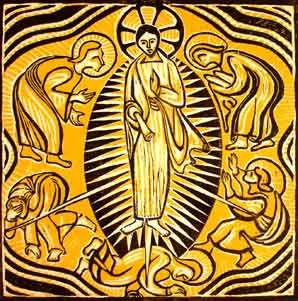
Woodcut of the Transfiguration by Sister Mary Grace Thul

Coming down from the mountain, the other disciples were found scratching their heads about a boy in need of healing. Jesus seemed rather perturbed about the all-around lack of faith. After curing the boy, everyone was amazed, as if they did not expect such a thing to occur.

We are not always told in the Gospels why Christ’s disciples often did not understand or perceive the significance of the miraculous, supernatural, or extraordinary events that took place right in front of them. Maybe their minds were somewhere else.

It could be that Peter had ADD (Attention Deficit Disorder) and was having trouble focusing.

Perhaps James trying to do some sort of ancient multi-tasking. 

Maybe John had some road rage on his way to the meeting on the mountain and was having a hard time thinking straight.

It could be that the three disciples were caught up in the anxiety of wondering where their next shekel was coming from.

Perhaps they were just up too late the night before binge watching the fishermen on the lake. But whatever was going on with the disciples, they were distracted.

So, we actually have God the Father step into the scene at the Transfiguration of Jesus on the mountain and speak. God isn’t typically in the business of exhorting people to listen unless they are not paying attention. The heavenly Father is clear, succinct, and to the point:

“This is my Son, whom I have chosen; listen to him.”

We are to listen to Jesus because he is God’s Son. Everything centers round him. 

Jesus is the full bodily and human representation of God on earth. Jesus is Savior, Lord and Master, Teacher and Healer.

Jesus is the complete fulfillment of all the Old Testament promises, and the one who will come again to judge the living and the dead.

Jesus is the mid-point of history, the hinge upon which all the universe swings. Jesus is the one whom we must listen to when he speaks and acts.

Therefore, our identity is to be fully bent, molded, and shaped in Jesus Christ. This spiritual formation of our lives happens as we intentionally seek to be with Jesus, listen to him, and do what he says. 

Transfiguration by Macha Chmakoff 

Jesus took Peter, James, and John up the mountain to experience his Transfiguration in a prayer meeting. Extraordinary things happen in prayer meetings. The early church gathered often in prayer meetings, following the example of their Lord Jesus. As the church listened to God and responded (in a rhythm of revelation and response) they saw Peter miraculously delivered from jail; ordinary people delivered from empty lives and demonic influence; and guidance in how to proceed as followers of Christ. 

Prayer is as much or more about listening to God as it is talking to him. It is in listening to God that we are filled with God’s Spirit and empowered to come down from the mountain and engage in God’s mission.

Jesus wanted the disciples to learn and discern something on the mountain. Jesus was changed in front of them. Moses and Elijah showed up and talked with him about his “departure,” that is, his “exodus.”

Moses was the one who listened to God and led the people in a mass exodus from slavery in Egypt to the freedom of the Promised Land.

Elijah was a prophet who listened to God and led the people out of centuries of idol worship and dead religion into the freedom of spiritual and national revival in Israel. 

And Jesus came to lead people in an exodus out of sin, death, and hell so that they can experience a new life of freedom, hope, peace, and joy.

Changed lives are God’s goal for us.  And a changed life will occur when we listen to God’s Son, Jesus, learn from him, and lean into faith in him – all of which takes humility.

Eventually, Jesus and his disciples came down from the mountain. Prayer meetings are great, but there is a time to descend the mountain and engage in God’s mission.

We are to participate with God in seeing changed lives through the work of Jesus.

We must bear witness to the redemptive saving events of Jesus to a world which desperately needs him – his healing work of both body and spirit.

The glory of God is presently here among us. We need to perceive it and be aware of it.  But to do so, we must listen well. 

Erik Weihenmayer is blind, yet on May 25, 2001, he reached the peak of Mount Everest. Suffering from a degenerative eye disease, he lost his sight when he was thirteen years old. But that did not stop him from mountain climbing. On a mountain where 90% of climbers never make it to the top—and 165 have died trying since 1953—Erik succeeded in large measure because he listened well. 

He listened to the little bell tied to the back of the climber in front of him, so he would know what direction to go. He listened to the voice of teammates who would shout back to him, “Death-fall two feet to your right!” so he would know what direction not to go. He listened to the sound of his pick jabbing the ice, so he would know whether the ice was safe to cross. 

When we journey through this life, listening well makes all the difference. So, how might we listen well to Jesus?  Here are some basic principles of active listening:

  1. Stop talking.  It was Mark Twain who said: “If we were supposed to talk more than we listen, we would have two tongues and one ear.” Proverbs 12:15 says, “The way of a fool seems right to him (therefore he has no need to listen) but a wise person listens to advice.”
  2. Prepare yourself to listen to God.  One of the ways I do this is by sitting in a quiet spot, free of distraction, and repeat several times to God, “Speak Lord, for your servant is listening” (1 Samuel 3:10). Then, I am quiet… and listen….  If this practice is way off your radar then I would recommend, at first, being quiet for only a few minutes. Then, after a few weeks, be quiet in longer stretches so that you can go 20-30 minutes or even an hour. We might even consider a silent retreat in which the sole purpose is to listen to what God is saying to us.
  3. Slowly and carefully read God’s Word. Scripture is meant to be digested in small bites and thoroughly savored. Slow down and be quiet enough to hear God speak through the Word. A contemplative and meditative readings of Holy Scripture will always yield spiritual health and vitality.
  4. Pray back to God what you hear him saying to you. This is active listening – a genuine dialogue between us and God. “Come, now, let us reason together,” the Lord has said (Isaiah 1:18). God wants a conversation with us.

God speaks, if we have ears to hear, through so much more than an audible voice.

The Lord’s Supper is a tangible proclamation of the person and work of Jesus Christ. It speaks to us, and, so, we must listen well. The Table proclaims Christ’s identity as God’s Son, the one who came to live a holy life, teaches us the way to live, and how Jesus died a cruel death so that we might be born again and experience new life. 

We Are All One in Jesus Christ by Soichi Watanabe, 2009

The Table proclaims our mission, that as often as we share in communion, we proclaim the Lord’s death until he comes again. That is, we witness to the reality of Christ’s redemption in our own lives. We share our own changed lives with others. We pray for them so that they will experience new life, as well. 

The Table proclaims our spiritual formation in Christ. At the Table, we are lifted and joined with Christ through the Holy Spirit. It is a mysterious joining that defies description, just as the disciples had a mysterious encounter that they could not fully explain. Yet they experienced it, nonetheless.

May we listen well, without distraction, to God’s Son. May we know God’s purpose for our life. And may we encounter Jesus at the Table, and in all of life, so that we experience new life. 

O God, teach us to listen to those nearest to us, our family, our friends, our co-workers. Caring God, teach us to listen to those far from us – the whisper of the hopeless, the plea of the forgotten, and the cry of the anguished. Holy Spirit of God, teach us to listen for your voice — in busyness and in boredom, in certainty and doubt, in noise and in silence. Gracious God, teach us to listen well to the message of your Table. May you change and transform us to be like Jesus. Teach us, Lord, to listen. Amen.