How to Cope with Trials of Faith (James 1:2-11)

Consider it pure joy, my brothers and sisters, whenever you face trials of many kinds, because you know that the testing of your faith produces perseverance. Let perseverance finish its work so that you may be mature and complete, not lacking anything. If any of you lacks wisdom, you should ask God, who gives generously to all without finding fault, and it will be given to you. 

But when you ask, you must believe and not doubt, because the one who doubts is like a wave of the sea, blown and tossed by the wind. That person should not expect to receive anything from the Lord. Such a person is double-minded and unstable in all they do.

Believers in humble circumstances ought to take pride in their high position. But the rich should take pride in their humiliation—since they will pass away like a wild flower. For the sun rises with scorching heat and withers the plant; its blossom falls, and its beauty is destroyed. In the same way, the rich will fade away even while they go about their business. (New International Version)

Where do you turn when unwanted circumstances leave you wondering how to cope?

The Apostle James, no stranger to adversity and stressful situations, likened our position in hard situations as faith being on the witness stand, put to the test. Faith is being examined and cross-examined. And it must stand the test. 

Our attitude toward such trials, in all their varied forms, determines whether we will become upset, hard-hearted, and calloused, or, come through having our faith confirmed with newfound peace and joy.

Christians are to view their adverse situations as an opportunity for their faith in Christ to develop and grow.

Rejoice in the midst of trials

Telling someone to consider their tough situation as pure joy is a really hard pill to swallow. 

James, however, was looking to fortify the believers’ faith. Whenever we get a cut or a laceration, the first thing needed is to apply peroxide to the wound so there will be no infection from the injury. It might seem insensitive because peroxide applied to an open wound, frankly, hurts like hell. Yet it must happen. It’s a necessary part of healing. 

The Apostle cared enough about the people to tell them what they needed to hear, up front. Without a positive, godly, and wise perspective on their difficulties, their faith would fail. Infection would set in and destroy the fledgling church.

Suffering is a significant part of the Christian life. God never promised that life would be or should be all cupcakes and unicorns. 

In fact, Christ promised just the opposite – that everyone who wants to live for Jesus in this present broken world will have a hard time of it. It’s not a matter if you will face the testing of your faith, but of whenever you face trials.

The good news is that adversity can become our teacher. We can learn patient endurance, which is necessary to the development of our faith. Spiritual growth only matures through the testing of faith through adversity.

These troubles come to prove that your faith is pure. This purity of faith is worth more than gold, which can be proved to be pure by fire but will ruin. But the purity of your faith will bring you praise and glory and honor when Jesus Christ is shown to you.

1 Peter 1:7, NCV

Faith is not a neutral or static thing. Faith is active and dynamic. It’s always either developing or degenerating.  Without spiritual peroxide, faith degenerates and becomes rancid. Eventually, gangrene sets in, and an amputation will happen. To avoid this, we need to learn how to experience joy in the middle of hard things.

Faith is challenging, and often hard. Yet, even within the pain, faith is incredibly invigorating and joyful.

Do not avoid trials

We need perseverance. Only through endurance is spiritual maturity realized. Let your hard situation do its necessary work. Immature people avoid hard things and instead put their energy into keeping up appearances.

Conversely, the mature person perseveres through the test and trial of faith. They understand that there must be pressure for spiritual maturity to occur.

God is looking to do something beautiful in our lives. So, if we constantly run away and do not deal with our hard situations, there will never be a pearl. It takes about ten years for a pearl to form in an oyster in the ocean.  Observing an oyster every day, you never notice any movement is happening. But it’s there.

In the Christian life, the consistent daily choices over a long period of time (perseverance) form the eventual beauty.

Pray for wisdom in the trials

Ask God for wisdom to see the adverse circumstance from a different angle – of its positive good, and for what God is accomplishing in and through it. The truth is, God is developing within people a strong vibrant faith, if we allow it.

Within a hardship, it does little good to ask, “Why is this happening to me?” It is much better to ask, “Why is this trial here for me? What can I learn from it?”

With no meaningful prayers, there is no meaningful wisdom for our circumstances.

Believe God is good no matter the trial

God is not mean, but generous. The Lord gives with no questions asked, and without giving us a hard time about our situation. Yet, there is a condition….

We must believe – that God is good, answers prayer, and gives wisdom. We may doubt a lot of things. Yet we are always to be secure in the knowledge that God has our best interests at heart. This is why there can be joy and perseverance, even when everything around us is going to hell.

Christians in humble circumstances actually have a high position because their poverty enables them to be open to God; and the pressures of poverty lead them to rely on God’s enablement and provision.

Whenever you find yourself with few material possessions; work hard but struggle to keep food on the table; and find it difficult to pay the bills – then, you are stripped of the illusion of independence and are left vulnerable before God. Trust isn’t optional, but absolutely necessary for survival.

Will we pour our lives into things, or into people?

Will we look for ingenuity and technical solutions in order to make our budgets budge, or will we come to God?

Will we define success as worldly wealth, or will we define success as acting justly, loving mercy, and walking humbly with our God?

Do not trust in wealth during a trial

In the midst of hard times, those who love the Lord Jesus are realize their true position and draw strength from it. Yet, for those who do not trust God alone but trust in their wealth and resources, things will not end well.

“Watch out! Guard yourself against all kinds of greed. After all, one’s life isn’t determined by one’s possessions, even when someone is very wealthy.” Then he told them a parable: “A certain rich man’s land produced a bountiful crop. He said to himself, What will I do? I have no place to store my harvest! Then he thought, Here’s what I’ll do. I’ll tear down my barns and build bigger ones. That’s where I’ll store all my grain and goods. I’ll say to myself, You have stored up plenty of goods, enough for several years. Take it easy! Eat, drink, and enjoy yourself. But God said to him, ‘Fool, tonight you will die. Now who will get the things you have prepared for yourself?’ This is the way it will be for those who hoard things for themselves and aren’t rich toward God.” (Luke 12:15-21, CEB)          

Such persons fade away even while they go about their business. Those who trust in things are the real underprivileged people. They may grow up and look beautiful. And yet, the next day, they’re gone – annihilated by a hot wind. 

Like a cornfield in a massive hailstorm, or a flower in a severely hot sirocco wind, the rich cannot stand in the judgment, that is, if they are trusting in their wealth to provide power, control, attention, and status.

The upwardly mobile path of worldly success and financial security, never stopping to lay up treasure in heaven, will have a rude awakening with a major career change in hell.

Conclusion

Where are you on the spectrum of faith? 

Do you need to turn from trust in stuff, and trust in Christ? 

Confess to God a love of things over love of Christ.

Declare to God that you want to change.

Believe in forgiveness through the cross of Christ.

Tell a trusted person about your decision.

Grant, O God, that we may never lose our way through stubborn self-will, and never abandon the struggle but endure to the end. Help us never to choose the cheap way of avoiding or circumventing our trials but embrace the Via Dolorosa. May we never forget that sweat is the price of all things, and that without the cross, there cannot be the crown. Amen.

Psalm 58 – Curse the Wicked

Do you rulers indeed speak justly?
    Do you judge people with equity?
No, in your heart you devise injustice,
    and your hands mete out violence on the earth.

Even from birth the wicked go astray;
    from the womb they are wayward, spreading lies.
Their venom is like the venom of a snake,
    like that of a cobra that has stopped its ears,
that will not heed the tune of the charmer,
    however skillful the enchanter may be.

Break the teeth in their mouths, O God;
    Lord, tear out the fangs of those lions!
Let them vanish like water that flows away;
    when they draw the bow, let their arrows fall short.
May they be like a slug that melts away as it moves along,
    like a stillborn child that never sees the sun.

Before your pots can feel the heat of the thorns—
    whether they be green or dry—the wicked will be swept away.
The righteous will be glad when they are avenged,
    when they dip their feet in the blood of the wicked.
Then people will say,
    “Surely the righteous still are rewarded;
    surely there is a God who judges the earth.” (New International Version)

The term “imprecatory” means to call down a curse on a person or group of people. There are eighteen imprecatory psalms within the Old Testament psalter, all of which make a clear petition for God to turn the evil back on the people who inflict it (or try to) on others. Maybe this surprises you that there is such language in the Bible.

There is nothing sanitized about imprecatory psalms. They are as raw and real as it gets, expressing deep anger. Whatever you might think about how a proper pious person ought to pray, imprecatory curses are likely not your first thought. But here they are, contained in Holy Scripture for our use.

One reason for the imprecatory psalms is that it is not any person’s place for revenge or retaliation. Instead, for people who are genuinely caught in the crosshairs of evil, for those who have awful trouble dogging them, prayer is their most effective recourse.

Sometimes you just have to tell it like it is. There is a time to do your best in putting up a good face so that you can deal with people who keep gossiping, slandering, and trying to get their way. Yet, there is also a time to call such behavior “evil” and cry out to God for help.

There are many folks who consider imprecatory psalms a problem because of their detailed expressions of cursing. Yet, such psalms refuse to put a positive spin on malevolent motives, wicked words, and destructive actions.

Desperate people utter desperate prayers. Their unflinching sense of injustice will not allow them to sugarcoat the villainous plans of corrupt people.

Evil is never toppled with tepid prayers from wimpy worshipers. Rather, nefarious agendas are thwarted in the teeth of specific, focused, and intense prayers directed with spiritual precision to the very core of diabolical forces.

We need not be shy about being real with God, even with praying imprecatory prayers. There really are people in this world, maybe even in your own life, that have malicious intent against you or others. Our job is not personal revenge, but to entrust ourselves to the God who fights for the poor, the oppressed, and the needy against the arrogant and the powerful. Let your prayers reflect your life.

With no cursing of evil, our emotional pain and spiritual anger come out sideways in an unkind sort of “snarky-ness” toward each other. What I am proposing is that our terrible hurt and our rage needs to be acknowledged and voiced.

Our bitterness must have an outlet, not directed toward one another, but toward the evil itself – and even toward God because God is big enough to handle our rage, whereas other humans are not.

Victimization needs a voice, and a bit of raging and cursing is the means to do it. Giving voice to our deep anger is cathartic and therapeutic. Our speech needs to be congruent with the intensity of our pain because where there are no valued words of assault for victims, the risk of hurting each other becomes much higher.

Despair with no voice and no one to hear will eventually transition to harming others.

Spiritual problems require spiritual implements to solve. And the imprecatory psalms are a major tool for pushing back the dark forces of this world. They are a significant means of spiritual assertiveness against heinous acts, acerbic words, systemic evil, depraved people, and horrible circumstances.

God’s wrath is an expression of God’s love because God is not okay with evil taking root in the lives and institutions of humanity.

Prayer is our privilege of coming to the God who upholds justice and righteousness. For if God is for us, who can be against us?

Hebrews 12:3-17 – Don’t Let Bitterness Take Over

Think about Jesus, who endured opposition from sinners, so that you don’t become tired and give up.

You struggle against sin, but your struggles haven’t killed you. You have forgotten the encouraging words that God speaks to you as his children:

“My child, pay attention when the Lord disciplines you.
Don’t give up when he corrects you.
The Lord disciplines everyone he loves.
He severely disciplines everyone he accepts as his child.”

Endure your discipline. God corrects you as a father corrects his children. All children are disciplined by their fathers. If you aren’t disciplined like the other children, you aren’t part of the family. On earth we have fathers who disciplined us, and we respect them. Shouldn’t we place ourselves under the authority of God, the father of spirits, so that we will live? For a short time, our fathers disciplined us as they thought best.

Yet, God disciplines us for our own good so that we can become holy like him. We don’t enjoy being disciplined. It always seems to cause more pain than joy. But later on, those who learn from that discipline have peace that comes from doing what is right.

Strengthen your tired arms and weak knees. Keep walking along straight paths so that your injured leg won’t get worse. Instead, let it heal.

Try to live peacefully with everyone, and try to live holy lives, because if you don’t, you will not see the Lord. Make sure that everyone has kindness  from God so that bitterness doesn’t take root and grow up to cause trouble that corrupts many of you. 

Make sure that no one commits sexual sin or is as concerned about earthly things as Esau was. He sold his rights as the firstborn son for a single meal. You know that afterwards, when he wanted to receive the blessing that the firstborn son was to receive, he was rejected. Even though he begged and cried for the blessing, he couldn’t do anything to change what had happened. (God’s Word Translation)

Bitterness begins with a seed of resentful anger…

it steadily grows within the soil of antagonism…

then, buds of hostility pop out…

and a devastating crop of corruption, injustice, chaos, and trouble feeds the community with death.

A bitter spirit doesn’t appear overnight.

Something happens, an event for which a person neither wanted nor expected.

And life becomes more difficult and sad.

A change or a loss occurred. It could be anything: a spouse walks out and asks for divorce; a job transfer or termination happens without any warning or discussion; estrangement occurs between friends; the house burns down; a bankruptcy looms in the near future; it’s hard to make ends meet; items are stolen; assault, abuse, and ridicule violate a person, family, or community.

These and a thousand other events happen in this old fallen world. It makes us angry, and rightly so. And yet, if that anger stews within us for too long, and grudges are nursed and coddled, it turns eventually into the bitterness which gives us gangrene of the soul. Then, like a nasty weed, the bitterness spreads and takes over the garden.

Don’t let bitterness take over your garden.

The ancient Hebrew Christians were in danger of losing their resolve and reneging on their commitment to Christ. Their circumstances had been so adverse, for so long, that they just did not have any more fight in them to keep going. 

The believers were losing their faith. They began holding onto grudges and letting go of their spiritual commitment; instead of holding fast to perseverance and discarding their resentments toward others, and even God.

Yes, life was a challenge. But, no, it wasn’t because God didn’t love them or was in some way just mean or capricious. The struggling believers were invited to see their adversity as education by correction in the school of hard knocks. It was a class in faith formation, and many of them were failing it.

God loves us enough to not always make everything a bowl of Cap’n Crunch or a plate full of bacon. The Lord is going to dish up some broccoli and brussels sprouts and expects us to eat it – even if we don’t like it or don’t want to. We aren’t going to have a healthy faith apart from it, and God is just being a good Father.

It isn’t what happens to us that matters; it’s how we interpret what happened to us that makes all the difference.

Hard unwanted circumstances will either make us bitter, or better. They will never leave us the same.

The path to perseverance, healthy interpretations, and keeping the seed of bitterness away is through keeping our minds on Jesus and being kind to one another. Antagonism cannot grow in the soil of grace and mercy.

Sometimes we might forget that Jesus didn’t have it so easy on this earth. He faced ridicule, insults, hardship, and was not born with a silver spoon in his mouth. Eventually, he was tortured and killed, having done nothing wrong and everything right. And there was absolutely no bitterness in his heart about any of it.

If that was the path for our Lord, then it is silly to think that, as Christ’s followers, we should avoid suffering and hardship. 

So, think about Jesus.

Consider him who endured suffering without resentment.

Don’t give up.

Keep your head and your heart in the game.

Feelings of resentful anger, giving up, and getting back at others only brings self-harm and makes life unnecessarily difficult for everyone. Whenever such feelings arise, it is our inner person’s warning that it is time to retreat with God and get a divine perspective on your situation.

Jesus, you are the Suffering Servant who has gone before us and secured deliverance from sin, death, and hell. In the scope of eternity, it is a small thing for me to live for you and face any kind of ridicule and hardship it might bring to me. I only ask to be in solidarity with you in all things. Amen.

Psalm 74 – A Devastating Loss

Our God, why have you
    completely rejected us?
Why are you so angry
    with the ones you care for?
Remember the people
    you rescued long ago,
the tribe you chose
    for your very own.

Think of Mount Zion,
    your home;
walk over to the temple
left in ruins forever
    by those who hate us.

Your enemies roared like lions
    in your holy temple,
and they have placed
    their banners there.
It looks like a forest
    chopped to pieces.
They used axes and hatchets
    to smash the carvings.
They burned down your temple
    and badly disgraced it.
They said to themselves,
    “We’ll crush them!”
Then they burned each one
of your meeting places
    all over the country.
There are no more miracles
    and no more prophets.
Who knows how long
    it will be like this?

Our God, how much longer
    will our enemies sneer?
Won’t they ever stop
    insulting you?
Why don’t you punish them?
    Why are you holding back?

Our God and King,
you have ruled
    since ancient times;
you have won victories
    everywhere on this earth.
By your power you made a path
    through the sea,
and you smashed the heads
    of sea monsters.
You crushed the heads
    of the monster Leviathan,
then fed him to wild creatures
    in the desert.
You opened the ground
for streams and springs
    and dried up mighty rivers.
You rule the day and the night,
and you put the moon
    and the sun in place.
You made summer and winter
    and gave them to the earth.

Remember your enemies, Lord!
They foolishly sneer
    and won’t respect you.
You treat us like pet doves,
    but they mistreat us.
Don’t keep forgetting us
and letting us be fed
    to those wild animals.
Remember the agreement
    you made with us.
Violent enemies are hiding
in every dark corner
    of the earth.
Don’t disappoint those in need
    or make them turn from you,
but help the poor and homeless
    to shout your praises.
Do something, God!
    Defend yourself.
Remember how those fools
    sneer at you all day long.
Don’t forget the loud shouts
    of your enemies. (Contemporary English Version)

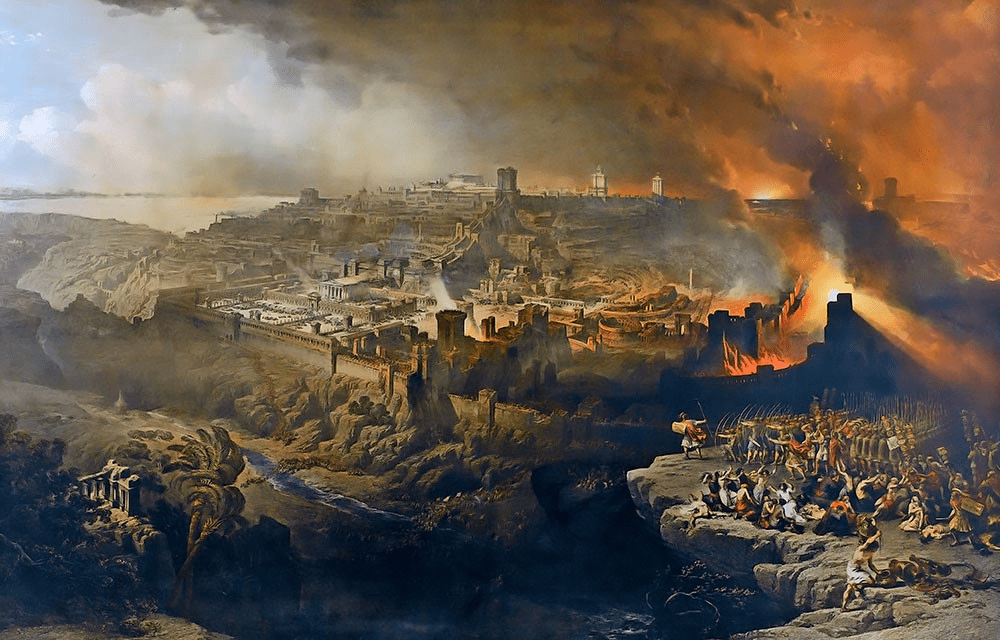
God’s temple was violated. The center and symbol of Jewish worship, culture, and life was gone.

Although we know that nothing lasts forever, that doesn’t mean we are always okay with it.

Asaph, the psalmist, was definitely not okay with the temple’s destruction. It was more than the loss of a building. For Asaph and his people, Jerusalem and the temple were the glue which held the world together.

They lost their center of being. And it was devastating to them.

Everyone and every society has their center, those values and practices which makes them a people. We all need a public center that defines who we are and what we are about. There must be a gravity that holds us to our place and doesn’t allow us to stray into oblivion and nothingness.

The central core of the people was eviscerated. So, today’s psalm is a lament for Jerusalem. It is a painful emotional and spiritual cry which goes well beyond bricks and mortar and the mere physical.

The ruin of the temple, Asaph complains, is the ruin of their God. Yes, it was the Babylonians who came and did the destroying and the de-centering. But it was God’s temple. God is the One responsible. It was God’s action. So, Asaph contends with God and comes at him with full challenge.

Asaph appealed to the Lord much like we do today. “Hey, God, remember how things were back there. It was good, right!? Now look at everything. It’s a mess.” The language is all meant to persuade God that things are so bad, that they are completely intolerable; thus, the Lord should do something about it.

God is bigger than the temple. So, therefore, God can and should restore the temple and make things right again, Asaph reasons. He sounds much like a person in the throes of grief, desperately trying to bargain with God to get things back to the way they were.

Point by point, the psalmist gives a sort of play-by-play to God about the awful situation and what happened. These guys who came and did their dirty work are ultimately your enemies, God, not just ours. So, take notice and act!

Remember the good old days, God, when you performed mighty acts of power against formidable foes, Asaph insisted. Against all odds, the Lord came through for the people… But now… there’s nothing. No divine action. The Babylonians came to Jerusalem, destroyed the city and temple, and got away with it.

Like a person experiencing extreme dizziness, Asaph and the people had a terrible spiritual vertigo which left them unable to get their balance and find their center.

Along with Asaph, in our horrible grief, we not only appeal to God, but we also insist, even tell God exactly what he must do, as if we were the Creator and Yahweh the creature. “Listen, Mr. Almighty God, you made a covenant with us and now you’re reneging on it with all this ridiculous silence and inaction.”

Yet, Asaph really knows better. He knows that, although the temple and the city are important as visible structures, the invisible God transcends all the tangible things we hold so tightly to.

We live in a day and age when all our religious structures are being dismantled, destroyed, done away with. Few persons now look to an institutional and visible building or system for their spirituality and worship.

And, although many believers may lament the changes and the disappearance of churches and religion, there still remains an invisible God to whom we can address – the very same God whom Asaph addressed all those millennia ago.

We are not, therefore, reduced to despair. In the end, it isn’t about buildings, ministries, programs, budgets, or church attendance – it’s about the source of life and hope in the absence of past knowable structures. It is a naked faith in the God who is there.

Lord Jesus Christ, by your patience in suffering you hallowed earthly pain and gave us the example of obedience to your Father’s will: Be near me in my time of weakness and pain; sustain me by your grace so that my strength and courage may not fail; heal me according to you will; and help me always to believe that what happens to me here is of little account if you hold me in eternal life, my Lord and my God. Ame