Hebrews 12:3-17 – Don’t Let Bitterness Take Over

Think about Jesus, who endured opposition from sinners, so that you don’t become tired and give up.

You struggle against sin, but your struggles haven’t killed you. You have forgotten the encouraging words that God speaks to you as his children:

“My child, pay attention when the Lord disciplines you.
Don’t give up when he corrects you.
The Lord disciplines everyone he loves.
He severely disciplines everyone he accepts as his child.”

Endure your discipline. God corrects you as a father corrects his children. All children are disciplined by their fathers. If you aren’t disciplined like the other children, you aren’t part of the family. On earth we have fathers who disciplined us, and we respect them. Shouldn’t we place ourselves under the authority of God, the father of spirits, so that we will live? For a short time, our fathers disciplined us as they thought best.

Yet, God disciplines us for our own good so that we can become holy like him. We don’t enjoy being disciplined. It always seems to cause more pain than joy. But later on, those who learn from that discipline have peace that comes from doing what is right.

Strengthen your tired arms and weak knees. Keep walking along straight paths so that your injured leg won’t get worse. Instead, let it heal.

Try to live peacefully with everyone, and try to live holy lives, because if you don’t, you will not see the Lord. Make sure that everyone has kindness  from God so that bitterness doesn’t take root and grow up to cause trouble that corrupts many of you. 

Make sure that no one commits sexual sin or is as concerned about earthly things as Esau was. He sold his rights as the firstborn son for a single meal. You know that afterwards, when he wanted to receive the blessing that the firstborn son was to receive, he was rejected. Even though he begged and cried for the blessing, he couldn’t do anything to change what had happened. (God’s Word Translation)

Bitterness begins with a seed of resentful anger…

it steadily grows within the soil of antagonism…

then, buds of hostility pop out…

and a devastating crop of corruption, injustice, chaos, and trouble feeds the community with death.

A bitter spirit doesn’t appear overnight.

Something happens, an event for which a person neither wanted nor expected.

And life becomes more difficult and sad.

A change or a loss occurred. It could be anything: a spouse walks out and asks for divorce; a job transfer or termination happens without any warning or discussion; estrangement occurs between friends; the house burns down; a bankruptcy looms in the near future; it’s hard to make ends meet; items are stolen; assault, abuse, and ridicule violate a person, family, or community.

These and a thousand other events happen in this old fallen world. It makes us angry, and rightly so. And yet, if that anger stews within us for too long, and grudges are nursed and coddled, it turns eventually into the bitterness which gives us gangrene of the soul. Then, like a nasty weed, the bitterness spreads and takes over the garden.

Don’t let bitterness take over your garden.

The ancient Hebrew Christians were in danger of losing their resolve and reneging on their commitment to Christ. Their circumstances had been so adverse, for so long, that they just did not have any more fight in them to keep going. 

The believers were losing their faith. They began holding onto grudges and letting go of their spiritual commitment; instead of holding fast to perseverance and discarding their resentments toward others, and even God.

Yes, life was a challenge. But, no, it wasn’t because God didn’t love them or was in some way just mean or capricious. The struggling believers were invited to see their adversity as education by correction in the school of hard knocks. It was a class in faith formation, and many of them were failing it.

God loves us enough to not always make everything a bowl of Cap’n Crunch or a plate full of bacon. The Lord is going to dish up some broccoli and brussels sprouts and expects us to eat it – even if we don’t like it or don’t want to. We aren’t going to have a healthy faith apart from it, and God is just being a good Father.

It isn’t what happens to us that matters; it’s how we interpret what happened to us that makes all the difference.

Hard unwanted circumstances will either make us bitter, or better. They will never leave us the same.

The path to perseverance, healthy interpretations, and keeping the seed of bitterness away is through keeping our minds on Jesus and being kind to one another. Antagonism cannot grow in the soil of grace and mercy.

Sometimes we might forget that Jesus didn’t have it so easy on this earth. He faced ridicule, insults, hardship, and was not born with a silver spoon in his mouth. Eventually, he was tortured and killed, having done nothing wrong and everything right. And there was absolutely no bitterness in his heart about any of it.

If that was the path for our Lord, then it is silly to think that, as Christ’s followers, we should avoid suffering and hardship. 

So, think about Jesus.

Consider him who endured suffering without resentment.

Don’t give up.

Keep your head and your heart in the game.

Feelings of resentful anger, giving up, and getting back at others only brings self-harm and makes life unnecessarily difficult for everyone. Whenever such feelings arise, it is our inner person’s warning that it is time to retreat with God and get a divine perspective on your situation.

Jesus, you are the Suffering Servant who has gone before us and secured deliverance from sin, death, and hell. In the scope of eternity, it is a small thing for me to live for you and face any kind of ridicule and hardship it might bring to me. I only ask to be in solidarity with you in all things. Amen.

Psalm 74 – A Devastating Loss

Our God, why have you
    completely rejected us?
Why are you so angry
    with the ones you care for?
Remember the people
    you rescued long ago,
the tribe you chose
    for your very own.

Think of Mount Zion,
    your home;
walk over to the temple
left in ruins forever
    by those who hate us.

Your enemies roared like lions
    in your holy temple,
and they have placed
    their banners there.
It looks like a forest
    chopped to pieces.
They used axes and hatchets
    to smash the carvings.
They burned down your temple
    and badly disgraced it.
They said to themselves,
    “We’ll crush them!”
Then they burned each one
of your meeting places
    all over the country.
There are no more miracles
    and no more prophets.
Who knows how long
    it will be like this?

Our God, how much longer
    will our enemies sneer?
Won’t they ever stop
    insulting you?
Why don’t you punish them?
    Why are you holding back?

Our God and King,
you have ruled
    since ancient times;
you have won victories
    everywhere on this earth.
By your power you made a path
    through the sea,
and you smashed the heads
    of sea monsters.
You crushed the heads
    of the monster Leviathan,
then fed him to wild creatures
    in the desert.
You opened the ground
for streams and springs
    and dried up mighty rivers.
You rule the day and the night,
and you put the moon
    and the sun in place.
You made summer and winter
    and gave them to the earth.

Remember your enemies, Lord!
They foolishly sneer
    and won’t respect you.
You treat us like pet doves,
    but they mistreat us.
Don’t keep forgetting us
and letting us be fed
    to those wild animals.
Remember the agreement
    you made with us.
Violent enemies are hiding
in every dark corner
    of the earth.
Don’t disappoint those in need
    or make them turn from you,
but help the poor and homeless
    to shout your praises.
Do something, God!
    Defend yourself.
Remember how those fools
    sneer at you all day long.
Don’t forget the loud shouts
    of your enemies. (Contemporary English Version)

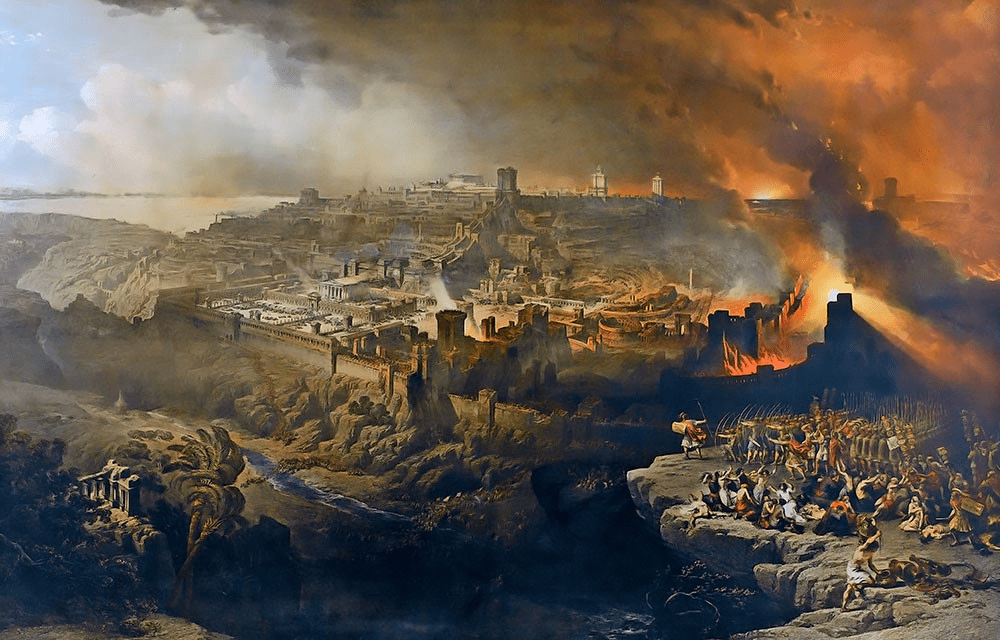
God’s temple was violated. The center and symbol of Jewish worship, culture, and life was gone.

Although we know that nothing lasts forever, that doesn’t mean we are always okay with it.

Asaph, the psalmist, was definitely not okay with the temple’s destruction. It was more than the loss of a building. For Asaph and his people, Jerusalem and the temple were the glue which held the world together.

They lost their center of being. And it was devastating to them.

Everyone and every society has their center, those values and practices which makes them a people. We all need a public center that defines who we are and what we are about. There must be a gravity that holds us to our place and doesn’t allow us to stray into oblivion and nothingness.

The central core of the people was eviscerated. So, today’s psalm is a lament for Jerusalem. It is a painful emotional and spiritual cry which goes well beyond bricks and mortar and the mere physical.

The ruin of the temple, Asaph complains, is the ruin of their God. Yes, it was the Babylonians who came and did the destroying and the de-centering. But it was God’s temple. God is the One responsible. It was God’s action. So, Asaph contends with God and comes at him with full challenge.

Asaph appealed to the Lord much like we do today. “Hey, God, remember how things were back there. It was good, right!? Now look at everything. It’s a mess.” The language is all meant to persuade God that things are so bad, that they are completely intolerable; thus, the Lord should do something about it.

God is bigger than the temple. So, therefore, God can and should restore the temple and make things right again, Asaph reasons. He sounds much like a person in the throes of grief, desperately trying to bargain with God to get things back to the way they were.

Point by point, the psalmist gives a sort of play-by-play to God about the awful situation and what happened. These guys who came and did their dirty work are ultimately your enemies, God, not just ours. So, take notice and act!

Remember the good old days, God, when you performed mighty acts of power against formidable foes, Asaph insisted. Against all odds, the Lord came through for the people… But now… there’s nothing. No divine action. The Babylonians came to Jerusalem, destroyed the city and temple, and got away with it.

Like a person experiencing extreme dizziness, Asaph and the people had a terrible spiritual vertigo which left them unable to get their balance and find their center.

Along with Asaph, in our horrible grief, we not only appeal to God, but we also insist, even tell God exactly what he must do, as if we were the Creator and Yahweh the creature. “Listen, Mr. Almighty God, you made a covenant with us and now you’re reneging on it with all this ridiculous silence and inaction.”

Yet, Asaph really knows better. He knows that, although the temple and the city are important as visible structures, the invisible God transcends all the tangible things we hold so tightly to.

We live in a day and age when all our religious structures are being dismantled, destroyed, done away with. Few persons now look to an institutional and visible building or system for their spirituality and worship.

And, although many believers may lament the changes and the disappearance of churches and religion, there still remains an invisible God to whom we can address – the very same God whom Asaph addressed all those millennia ago.

We are not, therefore, reduced to despair. In the end, it isn’t about buildings, ministries, programs, budgets, or church attendance – it’s about the source of life and hope in the absence of past knowable structures. It is a naked faith in the God who is there.

Lord Jesus Christ, by your patience in suffering you hallowed earthly pain and gave us the example of obedience to your Father’s will: Be near me in my time of weakness and pain; sustain me by your grace so that my strength and courage may not fail; heal me according to you will; and help me always to believe that what happens to me here is of little account if you hold me in eternal life, my Lord and my God. Ame

Hebrews 10:32-39 – Don’t Throw Away Your Confidence

Remember those earlier days after you had received the light, when you endured in a great conflict full of suffering. Sometimes you were publicly exposed to insult and persecution; at other times you stood side by side with those who were so treated. You suffered along with those in prison and joyfully accepted the confiscation of your property, because you knew that you yourselves had better and lasting possessions. So, do not throw away your confidence; it will be richly rewarded.

You need to persevere so that when you have done the will of God, you will receive what he has promised. For,

“In just a little while,
    he who is coming will come
    and will not delay.”

And,

“But my righteous one will live by faith.
    And I take no pleasure
    in the one who shrinks back.”

But we do not belong to those who shrink back and are destroyed, but to those who have faith and are saved. (New International Version)

Confidence is necessary for the Christian life. It’s not optional. One can only persevere through trouble with some confident hope.

It’s one thing to bear up under a hard circumstance for a few days or weeks. It’s altogether another thing for that same hardship to continue for months, even years.

Living with such adversity everyday makes one tired… really tired. Feelings of hopelessness slowly creep within. And, after a while, the person or group of people just want the madness to end. So, they simply give up, being lost in their troubles, feeling alone and bereft of options.

Without the confident expectation of better days ahead, while in the throes of difficulty, a failure of faith can too easily happen.

To realize better days, it’s important to remember the earlier days. I’m not talking about living in the past and wishing it were the 1950s again with Beaver Cleaver across the street. This is not about believing that the past was the good old days, and that the present is bad.

Instead, we can recall and remember the ways we endured and persevered with joy in past experiences.

The original Christian recipients of the message of Hebrews needed to recall the various ways they stood firm and tall in their faith, despite the adversity.

In earlier times, they were insulted and persecuted. Yet, they showed solidarity with others in similar situations. The believers were attentive to prisoners and sought to meet their needs. And they responded to the confiscation of their property with joy because they knew there was so much more than this present life and it’s possessions.

But the persecution and the insults continued… day after day… with no apparent end….

The Christians began to lose their grip on faith. They needed to reconnect with their purpose, with why they were Christians to begin with.

Originally, the reason they had such incredible attitudes while enduring hard things is because they were pursuing heavenly treasure. Their earthly possessions were merely temporary things, not of eternal value. They understood that people have eternal value, not stuff, so the believers willingly focused their efforts in helping others.

However, over time, the band of believers lost their focus. All they could see was the pain and the difficulty. They became disconnected with their purpose. And so, they were in danger of losing their faith and becoming utterly hopeless.

What to do? Give up? Renege on faith? Adopt a “whatever will be, will be,” sort of philosophy?

No. Instead,

Remember what God has done for you.

Affirm what is right, just, and true.

Embrace faith and patience.

That’s what the prophet Habakkuk did. And his resilience helped to bring proper perspective to present troubles.

“Nothing that is worth doing can be achieved in a lifetime; therefore, we must be saved by hope.”

Reinhold Niebuhr (1892-1971)

Habakkuk was distressed over the corruption of his fellow Israelites. Things were askew and not right. So, he complained to God about it. 

God responded by informing Habakkuk that judgment was coming to Israel through the Babylonians. This was neither what Habakkuk expected nor wanted. The prophet grumbled even more because the Babylonians were more corrupt than the Israelites. 

The prophet was having a hard time, and it seemed God was only making things worse, not better.

Habakkuk struggled to come to terms with what God was doing, and not doing. Finally, he concluded the matter by reconnecting with his faith: 

Even though the fig trees have no blossoms,
    and there are no grapes on the vines;
even though the olive crop fails,
    and the fields lie empty and barren;
even though the flocks die in the fields,
    and the cattle barns are empty,
yet I will rejoice in the Lord!
    I will be joyful in the God of my salvation!
The Sovereign Lord is my strength!
    He makes me as surefooted as a deer,
    able to tread upon the heights. (Habakkuk 3:17-19, NLT)

Perhaps the most significant faith experience we can have, is to come to the point of complete trust in God so that our happiness is not dependent upon good circumstances. 

The truth we all must eventually come around to is that joy and security is independent of what’s going on around us. 

Even though we face difficulty, and even evil, confidence can still exist and thrive within us. We can still rejoice because we don’t need everything to go our way in order to be happy.

Faith, patience, and joy are neither cheap, nor easy. For them to remain rooted within us, we must affirm our commitment to Christ daily. And that requires remembering.

What’s more, there is a reward ahead if we persevere to the end.

We can remain patient, express faith, kindle hope, and remember necessary things whenever we stop doing unimportant things which do not add value to our ultimate goals.

So, be mindful of the things which are most important to you; and move through life at a pace of hope, not anxiety. Don’t throw away your spiritual confidence, just because things are continually hard.

God, give us grace to accept with serenity
the things that cannot be changed,
Courage to change the things
which should be changed,
and the Wisdom to distinguish
the one from the other.

Living one day at a time,
Enjoying one moment at a time,
Accepting hardship as a pathway to peace,
Taking, as Jesus did,
This sinful world as it is,
Not as I would have it,
Trusting that You will make all things right,
If I surrender to Your will,
So that I may be reasonably happy in this life,
And supremely happy with You forever in the next.

Amen. – The Serenity Prayer by Reinhold Niebuhr

Psalm 11 – Fight, Flight, Freeze, or Faith?

I have taken refuge in the Lord.
How can you say to me:
“Flee to your mountain like a bird?
Wicked people bend their bows.
They set their arrows against the strings
to shoot in the dark at people whose motives are decent.
When the foundations of life
are undermined,
what can a righteous person do?”

The Lord is in his holy temple.
The Lord’s throne is in heaven.
His eyes see.
They examine Adam’s descendants.
The Lord tests righteous people,
but he hates wicked people and the ones who love violence.
He rains down fire and burning sulfur upon wicked people.
He makes them drink from a cup filled with scorching wind.
The Lord is righteous.
He loves a righteous way of life.
Decent people will see his face. (God’s Word Translation)

We all know what it feels like to take the brunt of someone’s poison verbal darts. And it’s scary. What do you do? In a state of fear, shock, or panic, we will likely either fight, flight, freeze, or faith.

If you have ever received a nasty email based on half-truths and accusations; stood dumbfounded as someone hurled misinformation and criticism at you; and/or experienced the victimization that comes from slanderous and gossiping tongues, then the psalmist knows exactly how you feel. 

Cobbling together a hasty email response, full of anger and vitriol, only sucks us into the person’s evil ways. Metaphorically punching someone in the face for their slap to your face is how the demonic realm handles offenses. Fighting back with an equal or greater force is diametrically opposed to the way of Jesus in loving our enemies and praying for those who persecute us.

Then, there is the response of taking flight from the nastiness. Indeed, it sometimes seems as if good people are always getting swallowed whole by unjust words and behaviors directed squarely at them. And it doesn’t help when the downers among us stroll along and give us their unhelpful fatalism about how there is nothing we can do and how nothing will ever change.

For others, they are just plain dumbfounded that another person can be so mean or controlling, so they freeze, unable to speak or do anything. They end up suffering in silence, without their victimization having a voice.

To be the target of evil speech or malevolent actions is, at the least, unsettling, and, at worst, can bring years of struggle, depression, and inability to serve. Yet, there is someone who sees it all, and that someone will address the wrong. We have an option beyond fighting back in anger or fleeing altogether in fear. We can trust God.

The Lord sits aloft, overseeing all, and knows everything humanity does and says. God always does right and wants justice done. Everyone who shares a divine sense of what is right and just will see God’s face. God will act because the Lord abhors and despises those who are cruel and enjoy violence.

It’s not a good idea to get on God’s bad side. The way to flare God’s anger is by possessing an acerbic tongue; relishing in verbal violence; and, having no remorse about any of it. Because God loves people, God hates evil. The righteous are to take solace in the truth that God really does see the harm done and is in a position to do something about it. Like the psalmist, we seek the Lord. The Lord fights our battles.

Whenever we are harassed and the ungodly give us a hard time, the psalmist isn’t offering some nice religious platitudes such as, “Just let go and let God,” “Everything works for the good of those who love God,” or “It’s okay, you’ll be in heaven someday.”

In another context, maybe those statements are helpful. But being in the teeth of the wicked, all is not okay. As much as some folks try to sanitize an evil situation with rainbows and butterflies, the evil is real, and it’s there. The truth is that everything is not okay. The earth is filled with violence, malevolence, oppression, injustice, and systemic evil. The psalmist knows this, all too well.

Humble yourselves under God’s power so that he may raise you up in the last day. Throw all your anxiety onto him because he cares about you. (1 Peter 5:6-7, CEB)

Today’s psalm is reminding and reassuring us that the Lord is aware of what’s going on and will most certainly do something about it. God will act to punish the wicked and deliver the Lord’s people. There may not be peace this present moment, yet it will not always be this way. We shall behold the face of the Lord.

The Lord is a righteous judge. Justice is the foundation of God’s throne. God sees the entire spectrum of humanity and can make a right assessment of people’s thoughts, intents, words, and actions. We, however, cannot. Therefore, it is most necessary for us to put our trust in a Divine Being who cares about right and wrong and has the power to act with justice.

Whenever we are hemmed-in through the schemes of diabolical persons and are powerless, there is always the choice to trust in the Lord. The outcome of every life on earth rests in the hands of God. And it will be a just and right rendering.

Trust in the Lord and do good. Seek peace and pursue it. We might struggle mightily on both the inside and outside – our hard circumstance might not change immediately – yet God is the One who will vindicate the just person when the time is right.

You are not alone. The Lord is with you always.

God of justice, look at the state of your servant and act on my behalf. Do not let evil prevail. Thwart the ungodly so that they can no longer do any harm. Amen.